@rcobooth@PTBwrites@ehaspel There's a quote from Elizabeth Warren right after that's both more recent and more on-the-nose if you prefer. I tried to interview Khanna and AOC for the record--if you get the chance to talk to them, feel free to pose this critique
@rcobooth So you think it's very small but relevant? I'm trying to engage, so it's frustrating to get called glib. I don't think it's true that men's attitudes have stagnated. As I wrote in the piece, they are continuing to change rapidly
@rcobooth I obviously dispute that I'm strawmanning and glib, but yes I really don't think men's attitudes/behavior wrt unpaid work are big factors in the fertility decline. The paper you cited says <1% from worst-country to best. Do you think it's multiples higher? If so, why? Genuinely
@rcobooth "Dismissing men's behaviors and attitudes as irrelevant" and 'arguing that going from the worst country in Europe to the best would move fertility <1%' just seem not that different. So it seemed better to converse with the papers that argue larger effects
@PTBwrites I'm not sure I follow how the weed/porn/gambling/wages fit in. Fewer and fewer men (of all classes) want or practice this "traditional" type and the marriage rate and TFRs keep declining, so the explanation is w/p/g/w, but what's that have to do with "tradition"?
@rcobooth Wow, I didn't even notice that "higher" should be "lower" there. Sorry about that. They make that typo three times; my eyes just glossed over it. I more meant that the effect size is tiny! "almost 1%" from moving from the lowest-gap country to the highest-gap country!
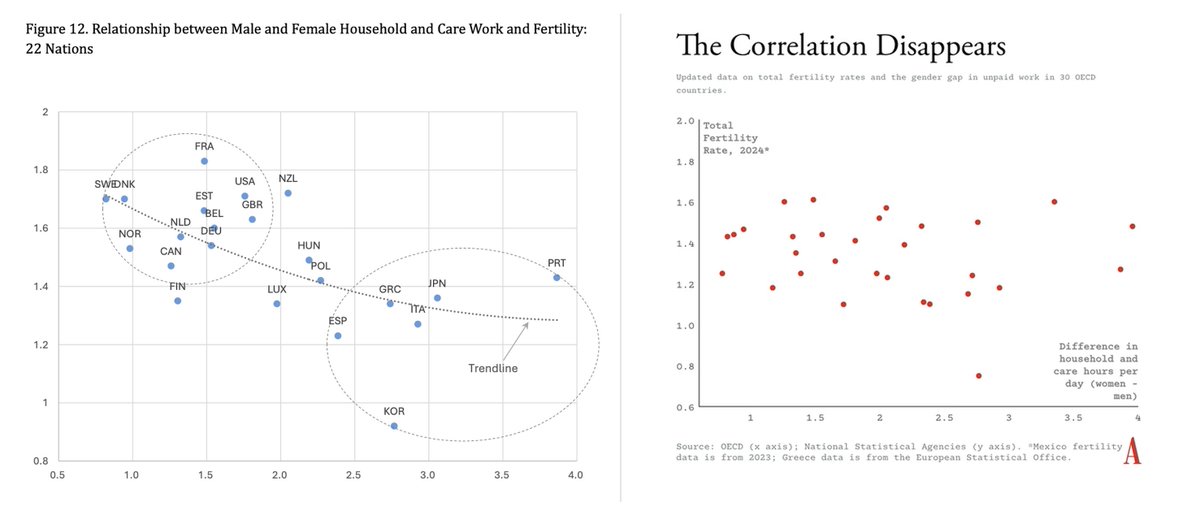
What about the influential 2008 paper hers is based on? The same thing! Update the data, and the whole chart shifts right and down, until the relationship is completely flat. Across the world, men's contributions to the home are rising as fertility plummets.
For about three decades, scholars have argued that if men did more childcare and housework, the fertility rate would rise. The first part is happening, but the second is not.
https://t.co/JS3cQLChUW
Nobel-winning economist Claudia Goldin has a new paper asserting this theory. But if you add in the rest of the OECD to her most important chart and update the data, the correlation vanishes.