Our policymakers remain fundamentally unserious about enhancing American trade and logistical competitiveness. A serious approach would begin with:
(1) Priortizing strategic export & import goods & commodities by removing artifical barriers.
(2) Fast tracking acquisition of
The United States is the #1 exporter of scrap metal - by a significant margin. Until we can connect our own coastal supply chains at scale and move our own scrap metal feedstock to American coastal minimills, we're actively fogoing a massive national comparative advantage. The impossibly high costs of a largely abandoned domestic shipping and shipbuilding sector prevents these low margin but nationally strategic supply chains from existing. Many immediate and concrete steps we can take if America's steel makers are interested in the potential new access.
This is superb. Bravo, @BartGonnissen for a very clear explanation. The USA requires many more drydocks of all varieties if we are to credibly develop meaningful dual use shipyard capabilities at scale.
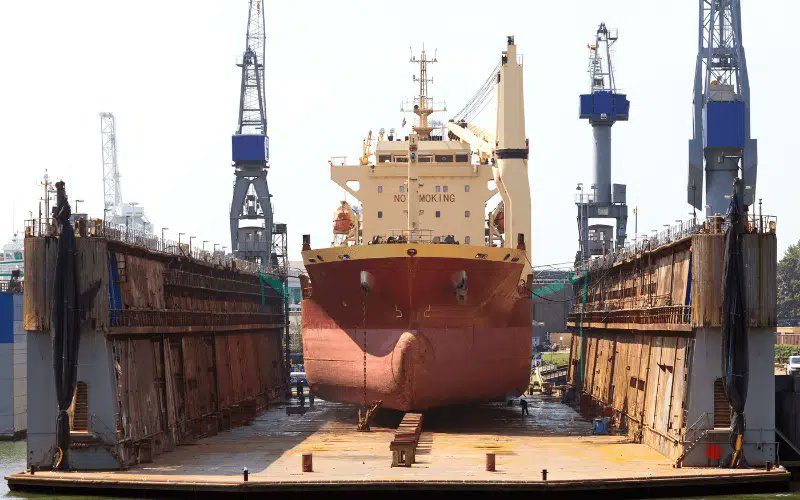
1/x So you've seen photos or video of ships in drydock and you've probably noticed that those ship don't just sit on the bottom of the dock, but they are resting on blocks, placed underneath the ship. How does that work? A small 🧵
@SECNAV@POTUS@SECNAV, given the current state of the MIB, what is your vision for a Mahanian approach to dramatic expansion of commercial shipbuilding? Will we pursue this and if so, what is the next concrete step to that end?
What does success look like, specifically, @SecDuffy? This is a very easy statment to make, but it's completely unclear what your plan is. The Exec Branch can only do so much and it's evident that it has no plan. The Legislative Branch has most of the power here but is completely captive to folks who are mortified by any meaningful expansion of domestic shipbuilding. What is your plan?
It's in fact a bit more complicated for some industries- but certainly comes back to money at one level or another. The USA produces about 100 naval architects annually, compared to China's 10,000 according to some analysis. Naval architecture comp isn't preventing folks from pursuing the degree - it's the lack of an industry. There could be the needed demand and supply could be generated if the folks running the nominally American "industry" wanted more ships and shipbuilding. But - it pays to keep the system suppressed for the players that are in it. So, as the talk heats up about bringing American shipbuilding back and the bottlenecks like the lack of naval architects are illuminated, increasing comp doesn't increase supply. Hell there are only maybe 3 or 4 schools with this degree program. The long lead infrastructure and experienced human capital for training simply doesn't exist at any scale and its rejuvination is curtailed by an intentionally suppressed industry.
"...nobody wants the cheapest lowest cost strategic infrastructure, because that leaves your entire tax base exposed to all manner of risks and your economy is brittle."
Great insight here & strong case for elevating the US approach to & treatment of our maritime industrial base
Strategic Assets
The world has a rich taxonomy of strategic assets, but what are they and why are they strategic?
The US has the PPD-21 framework that lists 16 sectors, EU has Critical Entities Directive that lists 11 sectors and UK has Critical National Infrastructure (CNI) that lists 13 sectors.
How does stuff qualify?
1. Systemically Central, how much other stuff depends on it?
2. Time to replace, long lead times, specialised construction, regulated under treaty.
3. Concentration/ single point of failure, few alternatives.
4. Control of flows, energy, goods, capital, data, timing, transport.
5. Coupling / synchronicity, tight real time coupling to other things.
6. Cross-border, international contagion risk.
You put all of this together and you can quickly figure out an expansive taxonomy of asset types that are critical strategic assets.
- Skip the list if you want -
High voltage substations and large transformers.
Grid control centers (SCADA, EMS)
Fuel refineries, pipelines, terminals
Gas compressor stations, pipelines, terminals
Undersea fibre cables, landings
Major internet exchanges IXPs
Hyperscale cloud regions + core datacenters
DNS infrastructure and SSL certification
Satellite PNT, ground stations
National time reference labs
Container ports and intermodal railways
Maritime choke points
Airports, ATC centers
Rail mainlines, signal, dispatch
Water treatment, pumping stations
Wastewater, trunk sewers
Large dams, reservoirs, flood control
Fertilizer plants, potash supplies
Grain elevators, silos, terminals
Pharma API, vaccine manufacturing
Industrial gases, distribution
Semiconductor fabs, packaging
Central banks, settlement rails (RTGS), major CCPs
Emergency comms, dispatch
- /list -
All of the above is pretty benign stuff in a unipolar world. But we don’t live in that world anymore. In a multipolar world, strategic infrastructure is fundamentally different to other stuff.
Suddenly nobody wants the cheapest lowest cost strategic infrastructure, because that leaves your entire tax base exposed to all manner of risks and your economy is brittle.
Suddenly your national debt is harder to market and you’re paying higher interest rates than your competitors.
Again, a lot of things about the world are changing and it’s not always obvious what the second and third order effects are. But once you realise a few things they become undeniably.
Suddenly you want to go back and check that list again.
It’s a different kind of world. Your country might not face war or invasion threats, but mischief is a risk all of its own. eg you compete with someone, and they’re suddenly buying up all the DRAM.
There are lots of strategic things out there, and we should all be familiar with what they are and how the world really works.
@mrbcyber Ambassador Manes seems to allude to this as "a wake up call" and a new challenge. The Chinese distant water fleet pillaging this area (and many others), at scale, with hundreds of ships at a time, has been a persistent annual operation for many years.
@johnkonrad Apply just about everything you just said (particularly the closing bit) to our non existant but vastly potential for coastal shipping as well.
@johnkonrad Not too mention there are foreign built ships in the Jones Act fleet. And many of the dozens of exceptions in law were fought for very hard and very quietly by individual firms who pour money into keeping the status quo. Yes for me, but not for thee.
There is no shortage of capital to resolve our maritime deficiencies, rather there is a chronic dissonance of culture & politics & strategy. But ffs, let's cease funding the adversary's capabilities & direct that immense wealth towards self-reinforcing freedom in creatively.
ALL-AMERICAN INVESTING 🏈⚓🇺🇲
A few years back, @RussellOkung decided he wanted to get paid a portion of his NFL contract in BTC. Other athletes have since followed suit.
Now, @saquon is a proud investor in Anduril, a path which other athletes will surely follow in coming days.
I'm here for this kind of unconventional investment thinking, because in different ways, these great athletes are betting on the security and sovereignty of US citizens and the free people of the world.
Why does this matter?
Even as POTUS has rightfully set a grand vision for American maritime revival, the US requires massive investments into maritime infrastructure and technology - shipbuilding, shore to ship crane manufacturing, chassis for containers, autonomy solutions, advanced cyber security, advanced materials and metal refining, powerplants and battery tech, skilled labor training, and much more. Things that build and move what our economy consumes. And it shouldn't be up to the government (e.g. taxpayers) to shoulder that burden alone.
Meanwhile, the total value of US university endowments is around $900B. An estimated $7-8B is invested into Chinese companies and market instruments. The total value of US gov't employee pension funds is $6 trillion - with a "T". More than $70B is invested into Chinese companies and market instruments.
Despite various proposed bills in Congress to block these types of investments, and yeoman work of leaders like @SenatorBanks and @RepGregMurphy, the problem persists. This is not free markets at work - it's a knowing transfer of American institutional wealth to an existential adversary.
So, how do we square these circles? It's simple - we incentivize this collective $7T pile of money to do what Russell Okung and Saquon Barkley did by promoting capital allocation into instruments of individual sovereignty and collective security.
I've recently floated here, on Midrats with @cdrsalamander and @lawofsea, and on Spaces with @chigrl and @johnkonrad (follow all of these amazing people if you don't already, by the way), the concept of Maritime Innovation Special Economic Zones, where profitable and derisked private investment into ships, systems, next-gen powerplants and battery tech, infrastructure, geoeconomic alliances, technology, education, the trades, and American workers can come together as COEQUAL stakeholders in entrepreneurship and revival of the maritime sector.
Such a spin on war bonds would open up vast opportunities for individual and institutional investment, where NFL players, university endowments, Wall Street, and American citizens can come together to secure and build the indispensible "things that move the things" we need.
If we do this, a rising tide of reindustrialization and maritime dominance will become a tsunami of generational prosperity and security for free people everywhere, and tap deeply once more into that seemingly infinite herital reserve of American ingenuity and greatness.
Never short America. 🇺🇲
@ADoricko This is a super tough output range for nuclear because it's slightly too high for truly compact radioisotopic thermal generators (100s of watts) and way too low for microreactors (100,000s watts min). Nuclear doesn't scale down well due to physics & economics.
@zanehengsperger America leads the world in scrap metal exports, in large part because we cannot ship the scrap to ourselves for lack of Jones Act qualified ships. So we lose out on ~20m tons annual production & instead allow Turkey & China, etc to displace. Energy✅️, Feedstock✅️, Logistics⛔️
@BrianTHart Important to note that foreign firms include American Jones Act carriers such as Matson, which employ Chinese State owned shipyards at a disproportionate scale for work such as major overhauls and refits. Massive and rampant counterintelligence vulnerability.