What absolute nonsense. The paper doesn't claim that gravity must be quantised. It discusses a theory based on expectation values (mean field gravity, sometimes called "semi-classical gravity"). 1/2
Sorryt to take more of your time.
I can offer JUNO as the observable handle. That published six days ago.
In this framework the neutrino mass is the dark energy scale divided by the QCD coupling to the power 3/2. No free parameters.
That gives m₁ ≈ 0.27 meV, m₂ = 8.75 meV, m₃ = 50.69 meV.
JUNO measured Δm²₂₁ = (7.50 ± 0.12) × 10⁻⁵ eV². Our prediction is 7.65 × 10⁻⁵ eV². Within 1.25 sigma.
They measured sin²θ₁₂ = 0.3092 ± 0.0087. Our prediction is 0.306. Within 0.3 sigma.
Their data shows 2.2 sigma preference for normal ordering. We predict normal ordering.
The sum 59.7 meV is the next test. Awaiting Simons Observatory results.
Thanks again for reading.
@d1c1pler@Briankeating its never ending. I have been running slvers almost continually for 2 weeks. Some times running more than one at a time until my head exploded
@d1c1pler@Briankeating Looks interesting. I'll read that after the weekend. I just finished those microscopic derivations and proofs. So I have to write them up now.
Thanks, I really appreciate you taking the time to reply.
In the model(DTM), φ = R e^{iα}. R is the Higgs amplitude degree of freedm; α is the phase/winding degree of freedom.
The derived Z₃ structure gives three phase sectors and gives us three generations.
Mass comes from Higgs/amplitude channel by phase closure. The same Z₃ geometry gives the Koide charged-lepton relation, so the neutrino result sits inside a wider mass/mixing structure.
The throat factor, C_mix, and related terms are geometric readouts of the same φ-defect action. They come from the Z₃ winding/closure structure and map onto mass and mixing.
Yes, the formulation starts from a complex-field action:
S[φ,g] = S_EH[g] + ∫√−g [½(∂R)² + ½R²(∂α)² − V(R,α)] d⁴x,
with the Z₃ in V.
The framework uses this same φ structure for dark energy, Koide geometry, neutrino masses, dark matter (we have a derived prediction), soliton/black-hole closure and the formation of the Universe.
The next tests are Σmν ≈ 59.7 meV, normal ordering, and octant/mixing refinements.
This model developed from a cosmology model that predicted DESI results and improved over the standard model in CLASS runs, into a unification. Its now complete apart from a few microscopic derivations in write up.
Again thanks for engaging. Are you a physicist?
Not really doing the math, (AI for that) just doing a lot of theories I am in the process of putting some of a 3 year lets call it a spaghetti incident of theories together. I followed Feynman cycle logic of guessing and solving or learning from the mistake. I have to see how good it really is now. So with that said I will share what i get on probably zenodo first
Thanks, I really appreciate you taking the time to reply.
In the model(DTM), φ = R e^{iα}. R is the Higgs amplitude degree of freedm; α is the phase/winding degree of freedom.
The derived Z₃ structure gives three phase sectors and gives us three generations.
Mass comes from Higgs/amplitude channel by phase closure. The same Z₃ geometry gives the Koide charged-lepton relation, so the neutrino result sits inside a wider mass/mixing structure.
The throat factor, C_mix, and related terms are geometric readouts of the same φ-defect action. They come from the Z₃ winding/closure structure and map onto mass and mixing.
Yes, the formulation starts from a complex-field action:
S[φ,g] = S_EH[g] + ∫√−g [½(∂R)² + ½R²(∂α)² − V(R,α)] d⁴x,
with the Z₃ in V.
The framework uses this same φ structure for dark energy, Koide geometry, neutrino masses, dark matter (we have a derived prediction), soliton/black-hole closure and the formation of the Universe.
The next tests are Σmν ≈ 59.7 meV, normal ordering, and octant/mixing refinements.
This model developed from a cosmology model that predicted DESI results and improved over the standard model in CLASS runs, into a unification. Its now complete apart from a few microscopic derivations in write up.
Again thanks for engaging. Are you a physicist?
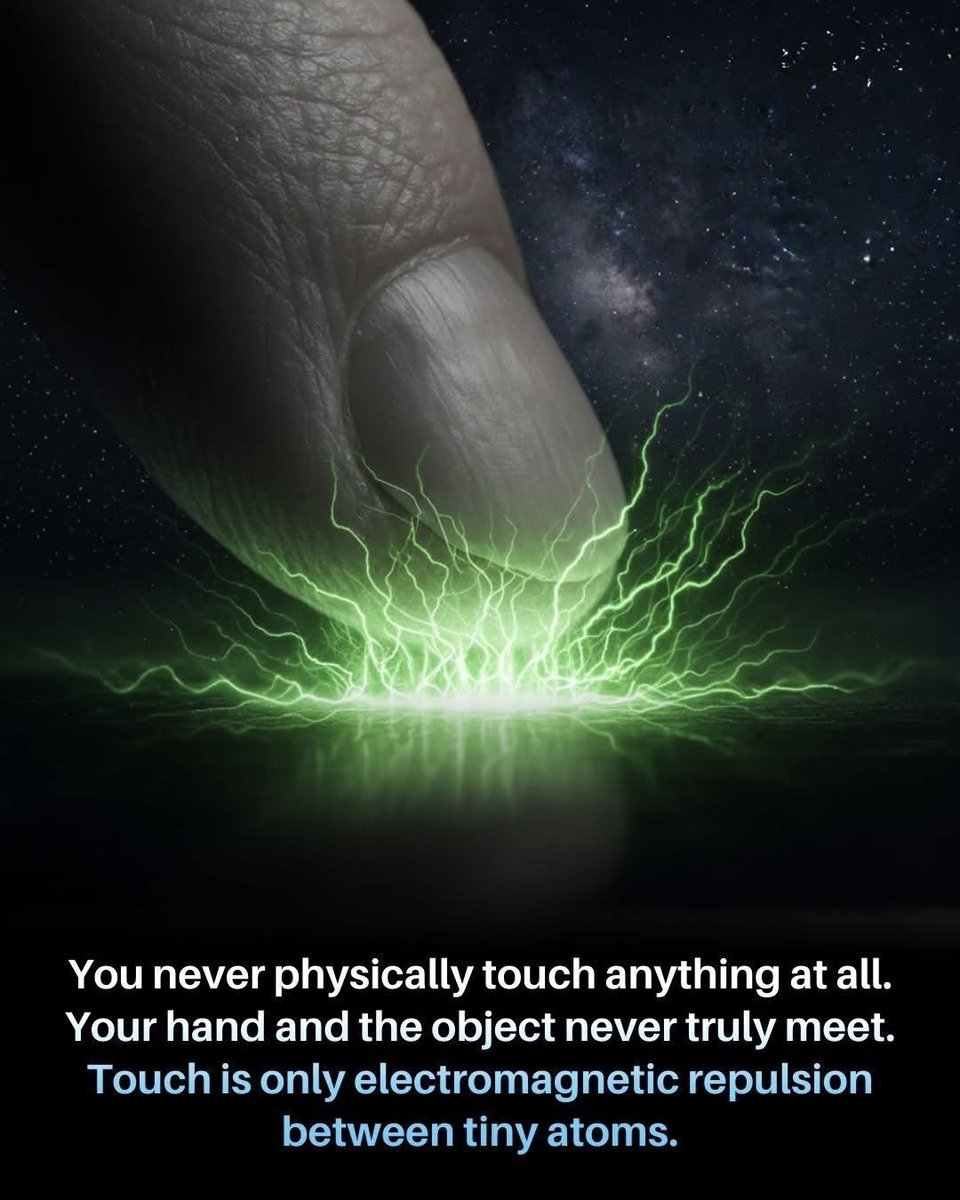
🌌 WHAT IF YOU'VE NEVER TOUCHED ANYTHING?
It sounds impossible, but science suggests you never truly touch anything at all.
When your hand touches an object, the atoms in your skin and the atoms in the object repel each other with tiny electromagnetic forces. What feels like "touch" is actually an invisible force pushing back.
So the next time you hold your phone or shake someone's hand, remember: you may be feeling a force, not actual contact.
Source:
OpenStax. University Physics Volume 2. OpenStax, Rice University.
🌌 WHAT IF YOU'VE NEVER TOUCHED ANYTHING?
It sounds impossible, but science suggests you never truly touch anything at all.
When your hand touches an object, the atoms in your skin and the atoms in the object repel each other with tiny electromagnetic forces. What feels like "touch" is actually an invisible force pushing back.
So the next time you hold your phone or shake someone's hand, remember: you may be feeling a force, not actual contact.
Source:
OpenStax. University Physics Volume 2. OpenStax, Rice University.