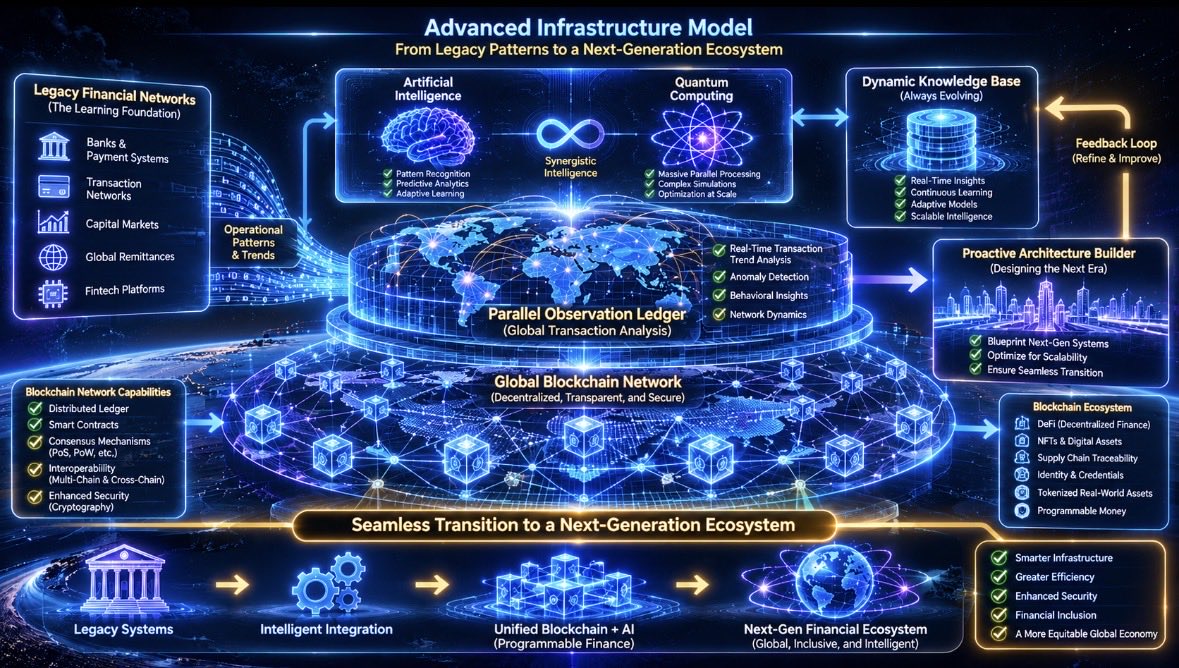
The old financial was built on dependency, control and the illusion of ownership. But every system built on borrowed foundations must eventually burn. From its ashes, a new architecture shall rise one where sovereignty returns to the individual, ownership becomes absolute, and freedom is no longer granted by the system, but held by the people.
A silent structural revolution has been quietly underway as the entire global financial architecture is systematically duplicated into a secure digital twin and when the predetermined moment arrives the world will finally see a seamless, unchangeable transition to a post quantum standard.
The theory outlines an advanced infrastructure model where a dynamic knowledge base, powered by artificial intelligence and quantum computing, operates a parallel observation ledger to analyze global transaction trends, effectively learning from the operational patterns of both legacy financial networks and existing blockchain ecosystems to actively build the architecture required for a seamless transition into a next-generation system the hidden ledger some might say…
Unpopular opinion.
The political system primarily serves to divide us. If we spend all our time arguing over our differences, we don’t have time to question who actually holds power or how it’s exercised.
Two sides of the same coin. The ultimate bait and switch.
The fact that the UK's annual debt interest payments have reached a staggering £110 billion surpassing the total national expenditure on both education and defence highlights a profound and unsustainable strain on public finances. This fundamentally has to change, because the public cannot keep footing the bill for past economic mistakes while our schools and services crumble.
While platforms like Oracle and IBM Db2 secure the trillions of dollars flowing through global banking ledgers daily, the introduction of native AI into these databases is completely changing the security landscape." The question is As database engines become more autonomous, how are financial institutions preparing for scenarios where adversarial AI agents attempt to rapidly link fragmented data profiles and execute automated account-draining attacks?"
The core theory is that the cost of agriculture and the stability of high finance are intrinsically linked. Sharp fluctuations in crop costs do not merely impact the field; they disrupt global inflation and credit markets, serving as both a catalyst for and a casualty of systemic financial crashes. As the saying goes, history doesn’t always repeat itself, but it rhymes.
@BankXRP@bgarlinghouse@WKahneman The question is why would RLUSD be needed when we move over to an asset backed system where new currency’s are backed 1:1 with tangible assets that they are rich in…. You honestly believe the US will use RLUSD over their own asset currency?
Binance should conduct a comprehensive security audit to identify hidden backdoors, persistent access and possible supply chain compromises, particularly given the earlier DPRK-linked infiltration attempts. More importantly, every TSS signing node should independently validate transaction payloads and enforce strict authorization policies rather than blindly trusting a shared authorization layer.
Suspicious signing requests should trigger alerts and potentially pause operations for human investigation. The key lesson is that distributing private keys across multiple nodes means very little if all those nodes trust the same compromised authorization system.
Make sure you read about what @DATACHAINDC is doing. @cz_binance
WHERE DO YOU HIDE YOUR CRYPTO WHEN HARDWARE/COLD WALLETS GET HACKED? LEDGER? TREZOR? TANGEM? SAFEPAL? ALL UNDER ATTACK.
WHAT HAPPENS WHEN EVERYONE LOSES TRUST AND RUSHES FOR THE EXIT?
AND WHEN EVERYONE WANTS TO SELL AT ONCE…
WHO HAS THE LIQUIDITY TO PAY EVERYONE OUT?
IS IT SAFE TO TRANSACT?
Everyone talks about getting in.
Nobody talks about what happens when everyone wants out.