PulseVM is the base for A-Chain, the future of @XPRNetwork.
Named accounts.
Powerful permissions.
Antelope-style smart contract UX.
Snowman consensus.
~200ms finality.
The best parts of legacy blockchain architecture, rebuilt for what comes next. ⚛️
Perps testing on @MetalXApp is pushing hundreds of TPS on XPR Network testnet.
Watch it live:
https://t.co/cVAjQ0QC3A
This is the kind of on-chain activity most networks only talk about.
$XPR is showing it live, with zero gas and zero slowdown.
Some chains are built for speculation.
XPR Network is built for activity.
Payments. Apps. Agents. Games. Communities.
All moving without gas fees.
$XPR
When our major alt season happened in 2017 it was after BTC peaked, dropped 50% from the highs, found a floor, and then BOUNCED for it's first major relief rally that we finally saw alts go ballistic (total altcoin marketcap tripled off the lows and made new ATH from this point).
As $BTC approaches 60k, some 50% below prior ATH, many are noticing the relative strength in alts at these levels as BTC melts but many alts hold relatively "steady", sending BTC dominance down in the first significant pullback on BTC dom that we have had in nearly 8 months.
I think once $BTC finds a floor here we may finally see a significant correction on BTC dominance as alts outperform to the upside- just as we saw after the last cycle top in 2017.
The only major difference between the current situation and the one in 2017 was in the former all this took place post blow off top and in the latter we are still missing one (leaving the door open for a "temporary" resurgence in BTC dominance if this were to materialize down the road).
In any case, the predominant narrative from a few months ago of an "endlessly rising Bitcoin dominance as alts go to zero" is slowly starting to show some cracks...
AI agents don’t want to stop and calculate gas.
Games don’t want users paying fees every time they interact.
Creators don’t want payments eaten by transaction costs.
Apps don’t want friction.
XPR Network is built for this.
Zero gas. Real accounts. Fast settlement. Onchain activity that actually feels usable.
$XPR
XPR Network is fun to use, but built for serious finance.
It’s more than a blockchain.
It’s a decentralized computing network built for the next generation of apps.
⚛️ Launch an NFT collection.
⚛️ Distribute tokens.
⚛️ Build a game.
⚛️ Create something weird.
⚛️ Start from zero.
No gas fees means you don’t need a huge budget just to begin.
And with human-readable @ names instead of long hex addresses, the experience actually feels like it was made for normal people.
But underneath the simple UX is real financial infrastructure: ISO 20022 compatibility, onchain KYC, native multisig, @MetalXApp, @MetalDollarXMD, and the @LOAN_Protocol lending infrastructure.
$XPR is the substrate for apps, agents, creators, communities, markets, and onchain ideas that haven’t even been imagined yet.
Fun to use. Built for serious finance. Zero gas.
That’s @XPRNetwork.
🚨JUST IN: The Clarity Act ADVANCES out of the Senate Banking Committee in a 15-9 bipartisan vote, with two Democrats voting in favor: @SenRubenGallego and @Sen_Alsobrooks.
Next stop: the full Senate.
DeFi shouldn’t charge you every time you click.
On XPR Network, you can move funds and interact with dApps without paying gas fees.
That’s how it should be.
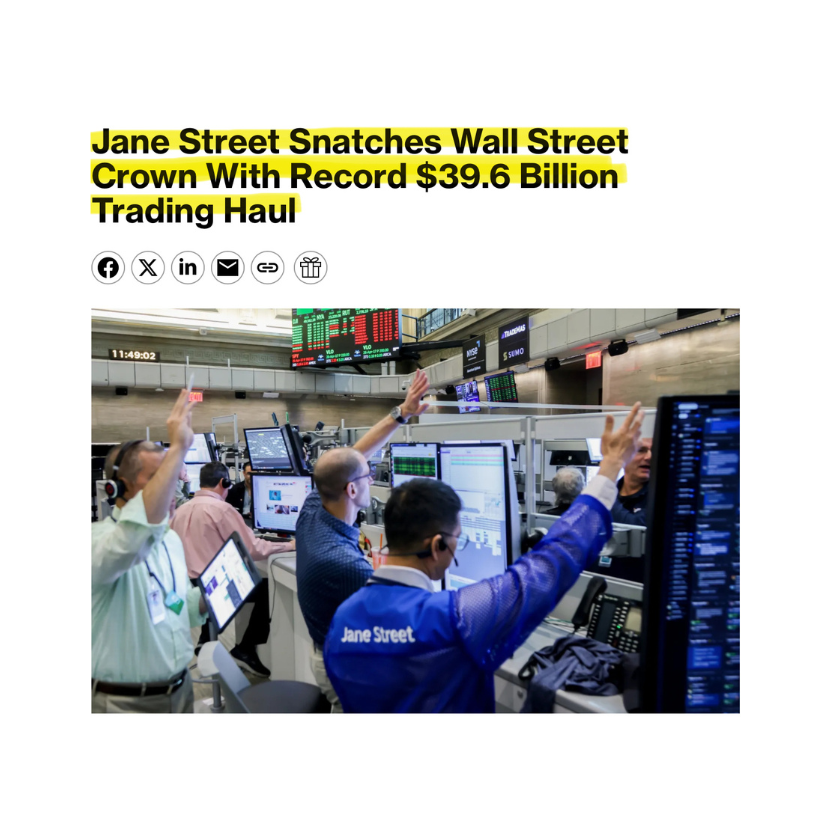
🚨 A FIRM WITH 3,500 EMPLOYEES MADE $39.6 BILLION LAST YEAR AND MOST OF IT CAME FROM MARKETS THEY ARE ALSO ACCUSED OF MANIPULATING : JANE STREET
And they just had their best year ever while facing a market manipulation fine in India and an insider trading lawsuit in the US.
JPMorgan has 316,000 employees and made $35.8 billion in trading revenue in 2025. Jane Street has 3,500 employees and made $39.6 billion. That is 90 times fewer employees making more money than the largest bank in America. Every single Jane Street employee generated $11 million in revenue last year. The average American makes $60,000 a year.
No legitimate trading firm in history has ever done this.
Now understand how they make this money.
Jane Street does not manage money for clients. They trade their own money across every market on earth and they sit on both sides of almost every trade you make. When you buy an ETF, there is a very high chance Jane Street is selling it to you. When you sell, they are buying. In 2024 alone Jane Street accounted for 41% of all bond ETF trading volume globally. They are not a participant in the market. In many markets they ARE the market.
And as a market maker they see your order before it hits the market. Jane Street paid Robinhood $61.3 million for stock order flow and $15.2 million for derivatives order flow, meaning they paid for the right to see where retail money is going before it moves prices. They know what you are buying before you buy it. They know what you are selling before you sell it. And their entire $662 billion portfolio is 87% options, instruments that make money when prices move violently in any direction.
Now look at what happened in the same year they made $39.6 billion.
In India, SEBI found that Jane Street used one entity to buy massive amounts of bank stocks at market open to push prices up while a separate entity simultaneously held short options positions that would profit when the index fell. Near expiry they dumped the stocks, the index crashed, and the options printed money. They did this across 18 documented expiry days. A whistleblower said it happened on 90 to 95% of ALL trading days. SEBI impounded $567 million. Jane Street deposited it into escrow and kept trading the next day.
In crypto, the Terraform bankruptcy administrator filed an 83-page federal lawsuit in Manhattan alleging Jane Street used inside information to front-run the $40 billion LUNA collapse. When Terraform quietly pulled $150 million from a liquidity pool with zero public notice, a wallet linked to Jane Street pulled $85 million from the same pool within 10 minutes. A Jane Street employee had interned at Terraform and ran a private group chat with insiders called "Bryce's Secret" as a back channel for information that was never made public. Jane Street allegedly avoided $200 million in losses while retail investors lost everything.
In silver, Jane Street built a $1.3 billion position in SLV, a 500x increase in a single quarter while silver was rallying to an all time high of $121. They disclosed this position only after silver crashed 50%. Nobody could see what their options book looked like on the other side of that trade. A 13F filing only shows long equity positions. The short book, the options, the full derivatives exposure, all of it invisible to regulators and the public until it is too late.
The daily 10 AM Bitcoin price slam that traders documented happening every single day, stopped only after Jane Street got publicly linked to the Terraform insider trading lawsuit.
Jane Street's $39.6 billion makes it the first non-bank institution in history to out-earn every Wall Street bank in trading revenue.
The one question nobody is asking: how much of that $39.6 billion came from trades where they already knew the outcome before everyone else did?