Charlie Munger spent 50 years studying why intelligent people make catastrophically stupid decisions.
It is the most useful thing I have ever watched:
1. Incentives are more powerful than anyone thinks. Munger says he has been in the top 5% of his age cohort his entire life in understanding the power of incentives and he has still underestimated it every single year. Federal Express could not get their night shift to work efficiently until someone realized they were paying by the hour. They switched to paying by the shift. The problem disappeared immediately.
2. People rationalise terrible behavior when their incentives point that way, and they do not even know they are doing it. A doctor in Nebraska was removing perfectly healthy gallbladders for years. When Munger asked an old colleague whether the doctor knew he was harming patients, the answer was no. he genuinely believed the gallbladder was the source of all medical evil and that removing it was an act of love. That is incentive-caused bias at its most extreme.
3. Psychological denial is real, and it is not just for weak people. A family friend's son flew off a carrier in the North Atlantic and never came back. His mother, a completely sane woman, simply never believed he was dead. Reality was too painful, so she distorted it until it was bearable. Munger says we all do this to some extent, and it causes terrible problems.
4. Consistency and commitment tendency are one of the most powerful forces in the human mind. Once you have stated a position publicly, you are psychologically locked into it. Max Planck said the really important new physics was never accepted by the old guard. A new guard came along that was less brain blocked by its previous conclusions. If this happened to the deans of physics, Munger says, imagine what it does to ordinary people.
5. The Chinese brainwashing system used on prisoners of war worked better than torture. They did not start with big demands. They maneuvered people into making tiny little commitments and declarations and slowly built from there. The same mechanism operates in every cult, every sales system, and every ideology that gets deeply embedded in people's heads.
6. Pavlovian association shapes buying behavior at a level most people never consciously process. Munger estimates three quarters of all advertising works on pure Pavlov. Coca-Cola does not want to be associated with funerals. They want to be associated with the Olympics, wonderful music, heroics. The association itself changes how people feel about the product at a subconscious level. Raising the price of a product can actually increase its market share because price and quality are associated in the human mind, and people use price as a signal of value.
7. Persian messenger syndrome is alive and running every major organization. The Persians killed the messenger who brought bad news. Bill Paley in his last 20 years, did not hear one thing he did not want to hear. everyone around him knew bringing bad news was dangerous. The result was that one of the most powerful men in media made terrible decisions for two decades because reality never reached him.
8. Social proof causes otherwise intelligent people to follow each other off cliffs. When one oil company bought a fertilizer company in the 1970s, practically every other major oil company rushed out and did the same. There was no rational reason for oil companies to own fertilizer companies. But if Exxon was doing it, it was good enough for Mobil. Every single acquisition was a disaster.
9. The efficient market theory persisted in academia for decades despite Berkshire Hathaway existing as a living contradiction. One economist kept adding sigmas to explain away the anomaly. two sigma, then three, then four, eventually six sigma. Munger's observation: It is better to add a sigma than change a theory just because the evidence comes in differently. That economist later went into money management himself and sank like a stone.
10. Contrast bias warps perception constantly and invisibly. Put your hand in hot water, then room temperature water. It feels cold. Put your hand in cold water, then room temperature water. It feels hot. same bucket. The human sensory apparatus has no absolute scale, only a contrast scale. Real estate agents exploit this deliberately. They show you two overpriced, awful houses first, then take you to a merely overpriced house, and it feels like a bargain.
11. The frog in slowly heating water is the business version of contrast bias. If something bad comes to you in small pieces, you are likely to miss it entirely. Munger says he has known many high-powered brilliant businessmen who were destroyed this way. not because they were stupid but because each incremental change was too small to trigger alarm. The contrast was never large enough to notice.
12. Authority bias is so powerful it can make trained professionals watch a plane crash. In flight simulator experiments, when the pilot, the authority figure, does something that any trained co-pilot knows will crash the plane, 25% of the time, the co-pilot sits there and lets it crash anyway. They have been trained to know better. The authority relationship overrides the training.
13. Deprivation super reaction syndrome explains why people go insane over small losses. Munger's neighbor had a 180 degree view of the harbor. the neighbor put in a pine tree about 3 feet high that turned it into a 179 and three-quarter degree view. They had a blood feud that went on for years. The New Coke disaster is the corporate version. Coca-Cola told customers they were changing a flavor and triggered a deprival super reaction so powerful that Pepsi was weeks away from releasing old Coke in a Pepsi bottle. smart engineers. brilliant lawyers. armies of psychologists. All missed it.
14. Envy and jealousy are far more powerful than greed and almost entirely absent from psychology textbooks. Munger says Warren Buffett has said half a dozen times that it is not greed that drives the world but envy. In a thousand-page psychology textbook, the index entry for envy and jealousy is blank. One of the most powerful forces in human behavior and academia essentially ignores it.
15. Gambling addiction is not explained by variable reinforcement alone. Skinner thought he had fully explained gambling by showing that variable reward schedules pound in behavior more powerfully than fixed ones. But the people who design modern slot machines know things Skinner did not. Lotteries where you pick your own number get far more play than lotteries where the number is assigned to you. People who commit to a number believe it has more validity because they chose it. Near misses on slot machines trigger deprival super reaction syndrome. It is four or five psychological tendencies working together, not one.
16. The most dangerous situations are when multiple psychological tendencies combine toward the same end at once. Munger calls this the lollapalooza effect. Tupperware parties use four or five tendencies simultaneously. Moonie conversion methods combine multiple tendencies and work extraordinarily well. alcoholics anonymous achieves a 50% no drinking rate when everything else fails because it also combines multiple tendencies toward a constructive end. The Milgram experiment is not just about obedience. it involves authority bias, consistency and commitment tendency, and contrast effects all working together. That combination turns human brains into mush.
17. Boards of directors are structurally designed to fail as corrective mechanisms. The top executive is the authority figure. He is doing something questionable. You look around, and nobody else is objecting, which is social proof that it is fine. He flies you around in the corporate jet and raises your director fees every year, which triggers reciprocation tendency. Munger's rule: boards only act when the behavior gets so bad it starts making them look foolish or threatens legal liability. That is the only forcing function that reliably works.
18. John Goodfriend of Salomon Brothers destroyed his career and reputation because he did not fire a trusted employee who had lied to the government. Every psychological tendency pointed toward keeping the man. He was a close colleague. His wife was known. He was part of a group that had made over a billion dollars for the firm. He said he had never done it before and would never do it again. Goodfriend looked into his eyes and believed him. The man did it again. The lesson: everyone who gets caught embezzling says they have never done it before and will never do it again. That is what they all say.
19. Darwin avoided confirmation bias by deliberately seeking out disconfirming evidence. Munger says Darwin was not especially smart by ordinary standards of human acuity. Yet he is buried in Westminster Abbey. Munger studied how Darwin worked and realized he had psychological tricks worth learning. Darwin always paid extra attention to evidence that contradicted his theories. Munger started doing the same and credits it as one of the most important intellectual habits of his life.
20. Why is the most important word in communication? Carl Braun designed oil refineries with spectacular skill, and you got fired in his company if you wrote a communication without explaining why. not just who, what, where, and when, but why. Braun knew that in a complex system where things can blow up, a communication system that always explains the reason behind an instruction works dramatically better than one that does not. Forstein, the general counsel of Salomon, told Goodfriend on multiple occasions that he had to report the employee's misconduct. He explained it was the right thing to do. He never explained what would happen to Goodfriend personally if he did not. he failed to use the most powerful tool of persuasion. Goodfriend ignored him. When Goodfriend went down, Forstein went with him.
I immensely enjoyed watching the Oklahoma City Thunder win the NBA Championship last year.
But, I learned more by watching them lose this year.
For the last two years the Oklahoma City Thunder have been the best team in the NBA. That ended on Saturday night when they lost to San Antonio in Game 7 of the Western Conference Finals.
I’ve decided the reason we need sports is because they teach us about success and failure. Every week we intentionally pit teams against each other in a zero sum game. One side will win and one will lose.
We do this because we want to be a part of success. But we also want to learn how to fail from those we admire. We want to experience failure as a part of a community that is disappointed together.
Even the most successful teams have to go through periods of failure and disappointment.
The same is true of us as individuals.
I do a lot of public speaking and I have come to loathe the part where I am introduced. I get it, the point is to communicate credibility so that people will actually listen to me when I speak.
But when I hear my bio it isn't the full story. It is just the highlights. It is a way of telling my story that sounds like an unbroken string of success.
The people who know me best know the deeper truth. For every success I’ve experienced, I can tell several stories about the setbacks that preceded it.
Simple Modern has been more successful than I could have dreamed. But the startup I helped build in the years before founding Simple Modern was a failure that lost millions of dollars.
Those kinds of stories don’t show up in newspaper articles. They should because they are essential.
Success is like a cake and you cannot bake without the ingredients of failure, difficulty and hardship. Without these challenges, It is impossible to develop the skill and perseverance needed to achieve anything worthwhile.
The Thunder failed to reach their goal this year, but as I have listened to their reactions following game 7 I have heard individuals who are:
Owning the failure
Avoiding excuses
Taking personal responsibility
Choosing to trust their teammates
Looking for ways to grow and improve
In my estimation, someone is a “winner” based on their mindset and not the scoreboard. Winners eventually win on the scoreboard because they have a mindset that makes it inevitable.
I’ve been fortunate to have a front-row seat, both literally and figuratively, to the Thunder’s ascension. I’ve learned that the foundation of their success was built when they weren't winning basketball games. Because the foundation is their mindset and culture. Over the last two years they’ve experienced more success than a fan like me could reasonably hope for.
But since their season ended, I realized something surprising. I appreciate the team in defeat even more than I have in victory.
They have shown me, and many other people in this community, how winners approach failure.
@biancoresearch@DA_Stockman This reads to me like the president is getting close to capitulation, and simply wants to get ahead of the media narrative.
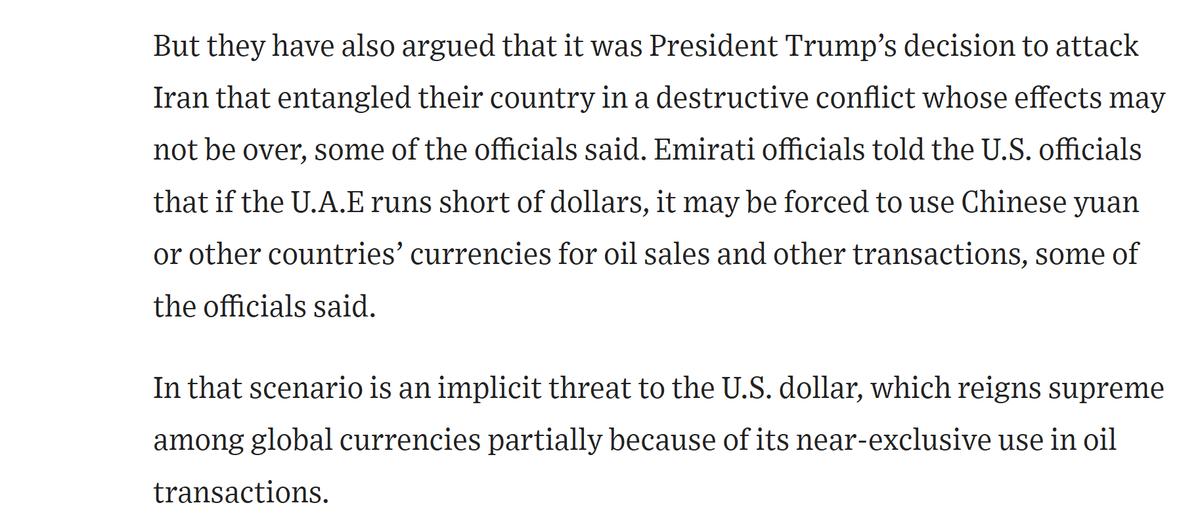
UAE to Trump Administration: "You started this war; if we run short of USDs as a result of it, either you will give us USD swap lines, or we will be forced to start transacting oil and gas in CNY and other currencies."
-WSJ, just now
Via @ces921
This 13-min lecture on "Antifragility" by Nassim Taleb will teach you more about surviving market chaos than 2 years of risk management at BlackRock
Save this video & watch it
This video will teach you more than any course, then read the article
MILTON FRIEDMAN ONCE HELD UP A PENCIL AND EXPLAINED THE ENTIRE FREE MARKET IN 2 MINUTES
"There's not a single person in the world who could make this pencil."
The wood came from Washington. The graphite from South America. The rubber from Malaya. The brass ferrule, the paint, the glue: he had no idea where they came from.
"Literally thousands of people cooperated to make this pencil. People who don't speak the same language, who practice different religions, who might hate one another if they ever met."
"There was no commissar sending out orders from some central office. It was the magic of the price system."
"When you buy this pencil, you are trading a few minutes of your time for a few seconds of the time of all those thousands of people."
One of the greatest explanations of capitalism ever recorded.
This is crazy! Sure, I sympathize with the concerns over the prospects for future revenue justifying this massive spend. This is the story of capex booms and busts around new technology throughout history. But to suggest that AI is not revolutionary, not world changing, is absurd, particularly coming from the likes of Griffin. I’m seeing it real time, firsthand, in my business.
How to interpret the rise in bond yields across the G10? Here's a guess: the market has priced in moderate oil disruption that marginally raises upside inflation risks and lowers probability of central bank easing this year. If at some point markets perceive a much worse disruption or something else (private credit?) compounding the shock, yields would likely move down on expectations of easing. A potential catalyst: larger drawdown in equities.
Perhaps a better explanation
When you buy a commodity future, it expires. To hold your position, you sell the expiring contract and buy the next one. That's rolling.
In backwardation, the next contract is cheaper. You pocket the difference every roll. That's positive roll yield, and it's why funds go long.
In contango, the next contract costs more. Every roll bleeds money. Funds go short or stay away.
Backwardation pays you to be long. Contango charges you for it.
I generally agree with @greg_ip on oil shock in isolation, but I am uncomfortable with the layering on top of other cost shocks:
- sharp increase in tariffs
- sharp decrease in immigration
- sharp increase in policy uncertainty
... when hiring is already at a standstill.
Putin has agreed to accept US security guarantees for Ukraine, Zelensky’s office chief Budanov said.
Budanov added that the Russian army is not preparing to advance on Kyiv at this time. He also expressed confidence in the prospects of peace talks, noting that the issue of demilitarized zones has already been resolved.