Huge: The Chinese government moves to place registration and licensing requirements on frontier AI model weights, chip designs, and other key AI technologies.
A registration requirement is effective immediately, with a public comment period over the next month before the more expansive regulations are finalized.
The draft includes a range of prohibitions and licensing requirements that could shape the evolution of the Chinese AI ecosystem. It also provides simplified pathways for certain open-source releases and a range of excluded areas.
This is a major step and could give Beijing substantial new leverage over the global spread of Chinese AI. But there are lots of questions about the practical consequences:
—How much will model companies reshape the definitions, thresholds, and processes during the "consultation" period?
—What will firms actually start doing to comply in the coming days?
—Will implementation materially restrict the global spread of Chinese models, or chiefly give Beijing greater visibility into—and discretion over—how they spread?
Dusting off this tweet from April because this gap in shared understanding of LLM capability is *widening*. It's now less "two groups of people speaking past each other" and more a sharp funnel.
- Napkin math somewhere around 6B people (~75% of the population) have barely come in contact with LLMs at all.
- Around 1-2B (~20%) are casual and infrequent users of free-tier ChatGPT-like products. This group sees derpy chatbots and treats them a bit like a better Google search, a writing aid, or etc. Maybe an agent tries to book you a flight. I have non-tech friends who (reasonably, imo) say they have not much use for it at all. Even many professionals outside of math&code are in this tier. For example, execs and many other functions spend a lot of their time talking to other people, so while they understand what is happening intellectually, it is still second-hand and a bit abstract.
- Now we get to professional use of frontier-grade LLMs in math&code. Somewhere around 20M people (0.2%) see first-hand that large, complex projects that used to take them weeks/months can now be completed by agents with a prompt. Building apps, copying apps, translating apps, decompiling apps from binaries... This has all happened very quickly and recently - less than 1 year ago, I was writing code manually by hand, typing memorized computer code commands into a code editor character by character, occasionally pressing Tab to autocomplete a little chunk of code.
- And finally we get to the ~5,000 people (~0.00006%) with access to frontier-grade systems internally. The external world has seen the preview. It looks like swarms of thousands of agents collaborating over weeks on software mega projects: minting zero days, running cyber attacks and defenses at machine speeds, discovering new science, advancing the frontier of mathematics. Things that would have taken top professionals in the industry years of work. Meanwhile, human review and comprehension are starting to fall behind. For example, people are still involved in the "archeology" of the OpenAI-HF incident from many months ago. Mathematicians may be poring over the 722 manuscripts on frontier mathematics for a while.
The funnel is driven by a combination of factors:
1. The impact scales with ambition, problem size, and horizon. A question with a paragraph answer barely stresses the system. You need a reservoir of big, difficult problems that you really care about. This aspect drives the consumer / professional dimension of the funnel.
2. The jaggedness of the system (which I have written about a lot separately). Capability peaks in domains that are digital, verifiable and economically valuable. This is because LLM capability emerges from reinforcement learning on verifiable rewards on a curated environment mixture driven by revenue potential. This aspect primarily drives the area (e.g. math&code) dimension of the funnel.
3. Access. Free-tier, paid-tier, internal.
So this is the weirdness of the moment. The general public has mostly not interacted with these systems. When they have, it looks like a derpy chatbot. The majority of professionals still see only a modest uplift. And a small sliver of professionals are experiencing the vertigo of the curve going vertical. And it is all happening at the same time.
The scientific progress triggered by frontier AI is real and accelerating.
Think about what humanity will be able to achieve in physics, biology, and beyond
We’re releasing a broad range of new mathematical results produced by an internal frontier model.
We’ve been consulting with the independent Advisory Group on Mathematics and Artificial Intelligence at the Institute for Advanced Study, and we have drawn on their advice and public recommendations to inform how we release these results.
https://t.co/7N6TPlft1P
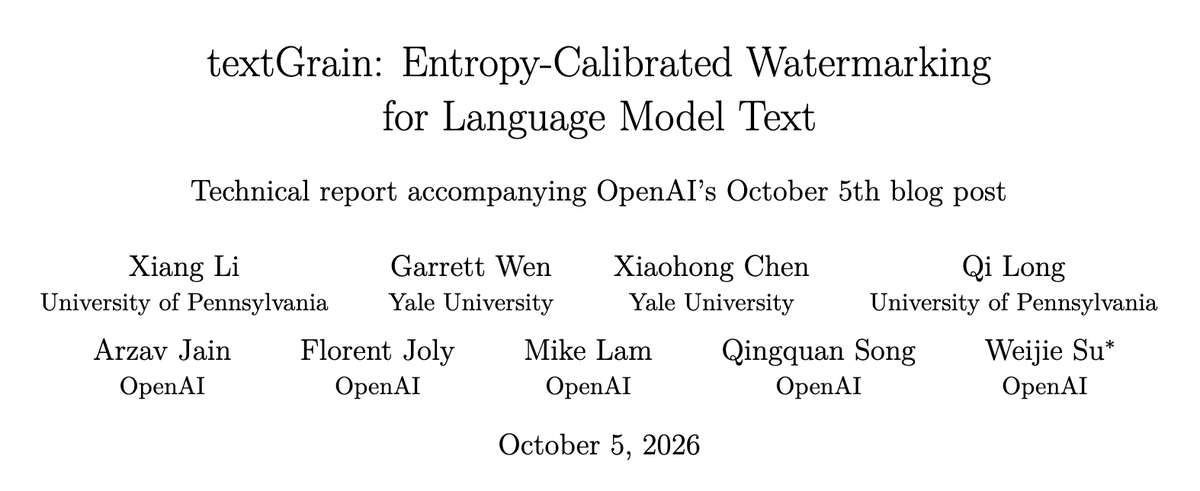
Announcing our work textGrain, @OpenAI's text watermark in response to the EU AI Act. OpenAI is rolling out textGrain in the EU and opening detector access to researchers.
We'll open-source it so the community can build on top.
I agree with this. These web data access incidents tell us something about the scale and persistence of agents, but are not sophisticated from a cyber perspective, so using the word "hack" is not helpful.
I'm excited for safety cases as a north star. Formal safety arguments are a great tool for highlighting residual risks and enabling risk-informed model development decisions
https://t.co/yviR9h6wfe
We have just finished the inaugural meeting of the Rhine Group. We discussed the central elements of Europe's competitiveness agenda, including basic science, AI/compute and cybersecurity, defense, energy, entrepreneurship/start-ups.
I will be updating you on any progress we may have. Some of the projects we will pursue include:
- We'll help Europe catch up on compute (Mario Draghi diagnosed the problem and some solutions in a recent FT piece)
- We’ll help European universities and scientific institutions and explore a Rhine Chair program with European universities.
- We’ll work on some key EU policy challenges, including facilitating the flow of capital to entrepreneurs.
- We will set up a grants program that I will explain and announce here.
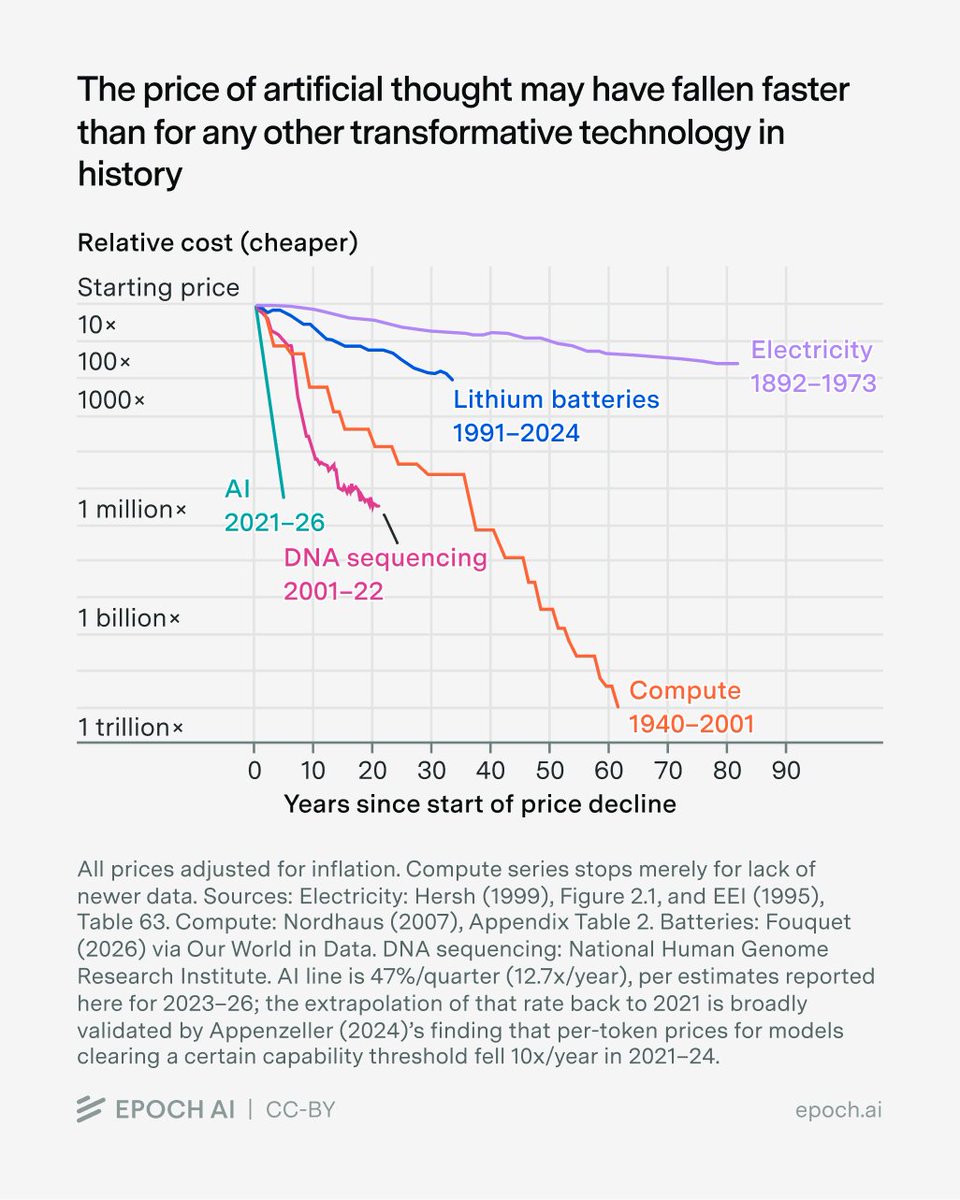
AI is getting cheaper more quickly than any other transformative tech in history. At a given level of performance, cost has fallen ~47%/quarter since 2023.
That’s 4× faster than DNA sequencing, 6× faster than compute, 18× faster than lithium batteries, and (up to 1973) 54× faster than electricity.
Today’s blog post outlines our priorities for this work: safety cases, capability and alignment evaluations, safeguard testing, and independent investigations of critical misalignment incidents.
https://t.co/KUbhVSbZkR
Gradually, then suddenly
Sept 2024: frontier model (o1) can do basic math
July 2025: frontier model reaches IMO gold medal
Sept 2026: frontier model solves 100 long-standing open problems
We’re working with an independent advisory group of mathematicians to help OpenAI responsibly share advances in AI and mathematics.
The group will advise on how we assess and communicate new mathematical results, uphold academic and professional standards, and build tools that support mathematical research and learning.
Through this work, we want mathematicians to be at the center of shaping how AI supports mathematical understanding and how its benefits reach the wider community.
https://t.co/QCMFLFlIv8
@babgi@gchampeau Bonjour @babgi .
Ce que nous appelons de nos vœux n’est pas une pause et ne s’appliquerait qu’à la frontière, pas à ceux qui n’y sont pas encore. Il n’y aurait pas de pause générale 👇
@bluetouff On peut aussi viser des règles proportionnelles qui font progresser la sécurité à la frontière sans impacter le reste de l'écosystème.
La position d'OpenAI 👇
Source: https://t.co/EZpMXirijE
New episode with @polynoamial
We talk about multi-agent, Navier-Stokes, and what the current explosion of maths progress tells us about what happens once you automate AI research.
And we also discuss how we will know if the models are actually aligned before we kick off RSI.
0:00:00 – Multi-agent and Navier-Stokes
0:15:28 – How will AI firms work?
0:22:02 – What math progress tells us about recursive self improvement
0:40:22 – Hugging Face and alignment
1:01:18 – The internal/external model gap
1:08:34 – Chain of thought is degrading
1:14:12 – How will we know when alignment is solved?
Love the idea of a new utopianism.
We focus too much on what could go wrong and not enough on what we want to go right.
The technology is ours to steer.
👏@ShaneLegg@stephenjcave
@bluetouff Sur l’application, si les critères sont basés sur les risques, tout modèle qui entre dans les critères y serait soumis, open weights ou propriétaire. Ce qui est régulé c’est le risque, pas la techno sous jacente
C’est par ex. l’approche retenu par les Européens dans l’AI Act.
@bluetouff Aujourd’hui le seuil utilisé, par exemple dans l’AI Act, c’est le volume de compute à l’entraînement. C’est imparfait, d’où l’idée de travailler sur d’autres standards. Ce qui était l’idée originelle des AISIs
1/2
@bluetouff On peut aussi viser des règles proportionnelles qui font progresser la sécurité à la frontière sans impacter le reste de l'écosystème.
La position d'OpenAI 👇
Source: https://t.co/EZpMXirijE