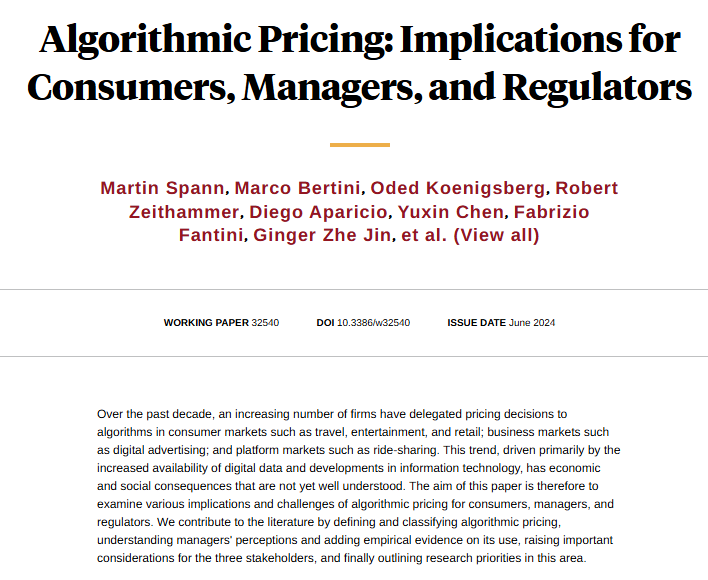
Implications and challenges of algorithmic pricing for consumers, managers, and regulators, from Spann, Bertini, Koenigsberg, Zeithammer, Aparicio, Chen, Fantini, Zhe Jin, Morwitz, Popkowski Leszczyc, Ana Vitorino, Yalcin Williams, and Yoo https://t.co/ETw9fpmX8e
Newly Accepted Articles 6/23 (3 of 5)
"Frontiers: The Interplay of User-Generated Content, Content Industry Revenues, and Safe Harbor Provisions: Quasi-Experimental Evidence from YouTube" by
Wlömert, Nils; Papies, Dominik; Clement, Michel; Spann, Martin
@DPapies@MartinSpann
Our study shows that understanding location-specific demands is key. Retailers can leverage this knowledge, alongside mobile tech, for optimized in-app targeting and better assortment decisions, leading to an enhanced customer experience and increased sales.
5/5
Also, we find that the number of products within the same category that are searched together (search breadth) increases as store distance and density increase. Durable products influence these patterns.
4/5
Key findings? Store distance and density significantly influence search behavior. Detailed searches for product-specific attributes (search depth) increase as store distance decreases and store density increases.
3/5
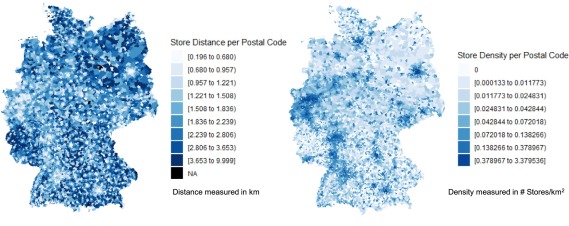
We introduce two new metrics: 'Present Store Distance' and 'Present Store Density.' These measures help us understand how a shopper's location relative to stores affects their search behavior.
2/5
Our @daurer@MartinSpann@PManchanda_ latest mobile search paper was accepted for publication at Decision Support Systems. We explore how smartphones change how we search and shop offline based on our location. https://t.co/7q3nooBSxo
🧵1/5
Car sharing can be paid through a flat-rate or a pay-per-use model. Dowling et al. show that consumers exhibit a pay-per-use bias, since they underestimate their usage, prefer flexibility, and are affected by weather.
#SharingEconomy#Pricing#PayPerUse
https://t.co/mPYJVpYSXQ
Congratulations to @lhmuc and @MartinSpann, whose paper "An Experimental Analysis of the Effectiveness of Multi-Screen Advertising" won the Journal of Interactive Marketing 2020 Best Paper Award! https://t.co/q2xEHnaeue
Car sharing can be paid through a flat-rate or a pay-per-use model. Dowling et al. show that consumers exhibit a pay-per-use bias, since they underestimate their usage, prefer flexibility, and are affected by weather.
#SharingEconomy#Pricing#PayPerUse
https://t.co/mPYJVpYSXQ
How do consumers search for offline products on mobile? Using data on 67 mln searches, my paper w/ @dommolitor@daurer@MartinSpann develops & links 2 location-specific measures - present store distance & present store density - to search depth & breadth. https://t.co/Io7NH4a2HK
Car sharing can be paid through a flat-rate or a pay-per-use model. Dowling et al. show that consumers exhibit a pay-per-use bias. Consumers underestimate their usage, prefer flexibility, and are affected by weather.
#SharingEconomy#Pricing#PayPerUse
https://t.co/mPYJVpHhzg
In my paper (forthcoming in @IJRMktg) w/ @kath_dowling & @MartinSpann, we find that 21-32% of car sharing services customers prefer to pay per ride over a monthly subscription, ultimately costing them more. See why here https://t.co/ExDY6WkPno @MichiganRoss@LMU_Muenchen
Kakatkar and @MartinSpann propose a new approach that lets #retailers triangulate the challenge of (a) deriving insights from highly unstructured #shopper data in the #store, (b) guarding #consumer#privacy by using non-personalized data, and (c) achieving commercial objectives.
How does a #paywall work and which configuration options do content providers have? A catchword article by Robert Rußell, @lucasstich, Thomas Hess, @MartinSpann, and me in @bise_journal provides recent insights. Have a look, it's #openaccess! https://t.co/wY47NkC3VG