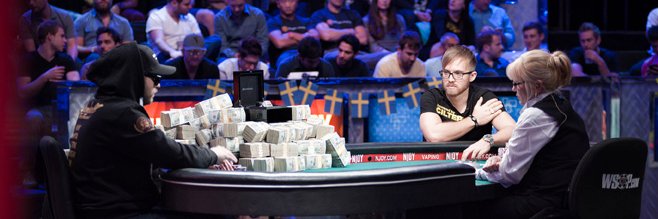
@SamGreenwoodRIO@WSOP@Ali_Nejad Agree and I wish Ali and Nick could cover every event. But I also think their synergy is hard to replicate because the gap between casual and high-level poker discussion is much bigger than in most sports. They’re just incredibly good at bridging that gap
Feels like there’s always gonna be this disconnect between what pros want and what operators are optimizing for.
@WSOP what if there were two stream options?
Keep the main stream's commentary action focused and aimed at the masses.
Then offer a second stream w two elite pros who are capable of providing a deeper analysis and discussion. No play-by-play needed.
Better viewing experience overall and allows you to optimize for two completely different audiences instead of trying to satisfy both with one product.
The duo that is commentating the the $25k heads up @wsop needs to be replaced, unwatchable. Standard hands being played and they are cluelessly commenting on “misplays” like they have any clue how to play poker in the first place.
I actually think this has the potential to be wildly successful. Seems like @KmartPoker has combined his experience from Traitors, streaming/content creation and poker into a new concept. Excited to tune in.
Lol yeah, every review system is flawed in the sense that most people only leave reviews after either an exceptional or bad personal experience. As long as the emotional reviewers rate everyone consistently badly, it should mostly even out.
As far as I understand, this is mainly an internal system for WSOP to identify who needs more training and who their strongest dealers are. You’d hope they don’t take the results at face value and still do their own DD as well.
I suggested this 3 years ago and people absolutely hated the idea.
There can obviously be downsides, but overall I think this is a positive for both players and dealers.
If you’re rating a dealer based on the cards you get dealt, you might as well rate your Uber driver based on the number of red lights they hit.
Our Dealer Rating System is coming to Vegas!
Using the new Dealer Rating System on WSOP Live…
• Players can rate the dealer at their table
• Ratings are shared internally with tournament staff
• Dealers with the highest ratings will earn rewards throughout the series
@jeffplatt and the rest of Team WSOP are excited to recognize and reward great dealers at the WSOP. Shuffle up and deal!
This week, @PaulSeaton is joined by none other than the 2014 WSOP Main Event winner @Martin_Jacobson, the man who learned the meaning of hard studying long before poker solvers became a thing 👇
https://t.co/y3ubx2mGdy
@TiltFish Biggest adjustment has been embracing emotions instead of suppressing them. Enjoying the wins, learning from the losses, and trying to stay more present rather than always looking ahead.
Love this from @jasonbsu
One problem I’m battling is that the same traits that drive success are the ones that create the stress... hard to separate the two without changing how you operate entirely.
It’s a bit like the scepticism around meditation, you’re hesitant to change because you’re afraid you might lose your edge.
The pattern I keep seeing:
1) Poker pro goes on social media
2) Poker pro spills his guts
3) Talks about the mental toll and anguish he has suffered in order to get to the position he is in, how he is unable to fully enjoy his success, how he is constantly questioning whether he should keep going, but that also his entire life and identity are wrapped up in poker
4) Everyone is supportive
My best guess is that what happens next is they feel better—because there’s a real cathartic release that comes from sharing the experience you are having with others, of letting other people see you and hear you exactly as you are.
And it feels nice to know people care.
This probably feels nice for a week or two.
Life feels better, more hopeful going forward.
But then everything starts to slowly slip back into feeling all those things you talked about, because you didn’t actually change anything or address the things that caused you to get into that place, which is:
1) Your motivation system is broken
The things you complain about and are making you miserable (feeling like your back is against the wall, feeling like you have to show people how good you are, feeling like you are an impostor unless you keep going hard every day) are the things that fuel your success—and you don’t know how to live or succeed without them.
2) You avoid your emotions
You avoid them by thinking about them, talking about them, writing about them, and also the classic avoidance of them with tv, booze, drugs, dating apps, etc
You do everything except the one thing that would make you feel better, which is to accept them.
That’s it.
These two leaks will break anyone.
Two things that, when you fix them, would make all of these long and painful social media posts go away for good—because when you’ve got a sound motivational system locked in and you are able to accept your emotions as they come in both poker and life, life all of a sudden feels how you always wanted.
There’s ease.
Comfort.
When things don’t go your way, it doesn’t feel like the walls are caving in.
Instead, you can feel the pain.
But at the same time sense you are okay and at peace, not having all those anxious thoughts about what if this or that happens.
Instead, just able to move forward.
And when things go great?
No more obsessing about what others are saying or thinking, or whether you deserve any of this, or whether you’re going to be able to keep it going, or saying dumb stuff like “can’t be results-oriented, just gotta stay focused on the process.”
Instead, you can let it feel good.
Enjoy the wins.
Feel more excited to move forward and do more of what you love at a high level.
Success and money has never, and will never, cover up these two massive leaks in the way one goes about doing their business—if anything, it will just make it so that you spend way too much of your time wishing you had never gone down the path of having so much success and money, because it feels so damn bad.
===
This was an excerpt from my daily email newsletter last week.
If you like it and want more, come join us.
It's 100% free.
And takes less than 20 seconds to join.
Link is in my bio.
I think it depends heavily on sample and field size.
Variance in large-field MTTs is massive, and live it’s almost impossible to get a meaningful sample, even over many years, which makes it hard to judge players based on results alone.
As a pro, you can usually tell pretty quickly who’s actually winning in the field though.
Surprised by the number of people who find it inconcievable that someone with $50m in tournament earnings over a long career doesn't have millions in the bank.
It’s easy to confuse earnings with profit, make assumptions without full information or underestimate how much $ someone at that level is actually putting in. In today’s highroller scene, you can easily run eight figures in annual buy-ins with thin margins and huge variance.
Also, being a great poker player doesn’t automatically make you a great investor or money manager.
The main difference between poker and mainstream sports is that there just isn't enough incentive. People get excited about golf because the elite are so far above the recs, whereas in poker the gap isn't really that big. It's a bit ironic that the thing that makes poker great (anyone can compete vs the best) is also what makes it lose a lot of the exclusivity that exists in sports.
@jeremyausmus Started doing this post workouts after learning how important it is to shut off your fight-or-flight response. Makes a lot of sense to do it after poker sessions too.
@taylorcaby Agree with most of this.
Most investments aren’t zero-sum like poker, but people tend to overestimate their edge, which skews how they allocate capital.
If you asked 1,000 players why they play a certain tournament, almost all would say they believe they have an edge.
The trap most players fall into is re-investing in the same asset class where they’ve had success.
After I won the main, I spent years putting money into backing players and startups because it felt more interesting than index funds. When you play poker for a living, you get used to high variance and big upside, so it’s hard to get excited about slow returns and low volatility.
But once you have some capital, the game changes. Consistent compounding beats high-risk, high-reward investments.
I’ve never been big on backing other players—I’ve really only done it once. I’d much rather go long on the S&P 500 than sweat someone else’s variance while I’m already navigating my own. There is a massive amount of mental ease that comes with an investment you don't have to manage or think about daily.