Congrats to @elonmusk and @SpaceX on the largest IPO in history. Tens of thousands worked to tackle some of the hardest engineering problems imaginable, revolutionizing an industry in service of their nation and humanity, are now fully realizing the American Dream🇺🇸
May this moment spark many more companies like it across the domains of the future, unlocking new capabilities and prosperity for those who dare to dream.
China kicked off a busy month with three missions for a single internet constellation in the span of nearly four days.
Round up via Martin Smith (@MartiniumSpace).
https://t.co/qByZLb9UlF
Connecting the Stars
Connecting mountains and seas, so journeys are no longer distant.
Connecting sky and earth, so information breaks every boundary.
Connecting industries, so innovation keeps growing.
Connecting the future, so dreams will eventually arrive.
With the success of the ZQ-2E Y6 launch mission, Spacesail’s SPACESAIL DTC 01 and @ChinaMobile_X CMCC-02 have been precisely deployed into their designated orbits.
As the creator of China's commercial space transportation systems, LandSpace delivers satellites to space — while also connecting communication networks, satellite internet, and the evolving needs of commercial space. Together, they provide continuous support for an integrated space-ground network.
As more satellites rise into orbit, it’s not just signal coverage that expands — it’s our capacity to connect the world.
From connecting each other, to connecting everything.
From connecting the Earth, to connecting the future.
Humanity’s gaze of exploration will always reach beyond the horizon.
Connecting the stars. ✨
Details on The Exploration Company's Storm:
- Liquid Oxygen/Liquid Bio-methane
- 1,765kN / 180tf thrust (about 72% Raptor 3)
- Full-flow staged combustion cycle
- Reusable
"[...] Storm represents a concrete step toward a new generation of European rocket propulsion."
The Exploration Company had already been working on this engine for some time, but I guess today is the "official" unveiling or something.
So far they've worked on turbomachinery, main combustion chamber hardware, regeneratively cooled nozzle extensions, as well as oxidizer-rich and fuel-rich preburners.
P.S. the original name, Typhoon, was so much better than "Storm" 😭
📷 The Exploration Company
Captured by Anduril's network of 400 telescopes deployed around the globe:
The second stage of the Falcon Heavy launch of ViaSat 3-F3 performing a routine thrust event. This produced a spiraled-shaped plume effect, a nominal part of operations for a successful launch of Viasat's latest satellite.
Starting with some energy, and my inability to write brief updates, I am just extremely proud of the NASA crew, our industry, and our international partners. We are getting into a rhythm here at NASA. Earlier this year, setbacks put the Artemis II rocket back in the VAB for repairs, and we determined it was necessary to add another mission, Artemis III in 2027. Since then, we have unveiled the Ignition plans to build a Moon Base and nuclear-powered spaceships, launched a highly successful mission around the Moon, brought the crew home safely, and now watched the torch pass to Artemis III. There will be no shortage of major milestones to celebrate in the months ahead as we build the Moon Base and launch the Nancy Grace Roman telescope. I am beyond proud of the team and all the momentum and excitement around the space program.
I do want to take this moment to address two of the questions I have been seeing since the crew announcement.
Why are there no women assigned to Artemis III?
I have seen reactions ranging from disappointment to outrage. I have personally been to space twice with 50% female crews. My closest advisors and some of the smartest engineers I know are women. In our latest NASA leadership organization, nearly 50% of the Center Directors and Mission Directorate leadership are women. The last astronaut candidate class selected under this Administration was majority female because they were the best of the best, including one astronaut I previously went to space with.
In a world with so much controversy, I hope this can be a moment where we celebrate the astronauts selected, respect the integrity of the process, and recognize the extraordinary depth of talent across the entire corps. The crew selection does not involve any political appointees. The Astronaut Office assigns the crew that gives the mission the best chance of meeting its objectives, taking into account many factors, including the background and expertise of the astronauts, such as test pilot experience, development work on specific programs, and availability. For example, those raising this concern may not be aware of the pipeline of crews already preparing to launch to the Space Station, or those who have been undergoing lunar-specific training that would be a better fit for a future surface mission.
The Artemis III astronauts are experienced, qualified, and deserve to be celebrated for the mission they have been assigned, just as the crews that follow will be celebrated when their time comes. We have an extraordinary astronaut corps, and every mission and every crew is part of a larger campaign to get America back to the Moon and to build the future we all dreamed about as children.
What are the objectives for Artemis III if both landers will not be fully ready?
Coming off a highly successful lunar mission like Artemis II, it is not surprising that the bar is set high for Artemis III. I think it is important to understand how difficult and dangerous it is to land astronauts on the Moon. We have not done it in a very long time, and we want to draw from a past playbook for success. That means getting into a cadence of launching, learning, and rolling improvements into the next mission.
First and foremost, it is imperative for SLS to be flying with some frequency for operational currency and, honestly, safety. Earlier this year, it was very clear across NASA leadership that an additional mission was necessary in 2027. It is also imperative to gain interoperability data from rendezvous and docking with landers in Earth orbit. We do not need those landers that are still in development to be fully capable and certified for landing on the Moon on Artemis III, but we do need to test certain systems and controllability. Not to mention, we are moving quickly into a future where we do not require a single rocket to bring everything necessary for a mission to space, and as such, gaining experience with multi-launch campaigns and on-orbit assembly is directionally correct.
The Blue Origin test lander for Artemis III will incorporate many of the most important systems and subsystems that have not previously been operated by the provider, including ECLSS in a crew cabin, and other avionics. With SpaceX, they have demonstrated many of those capabilities continuously on Crew Dragon, but other controllability tests are important based on the negative-X axis acceleration that will be necessary when Starship undertakes the TLI burn to the Moon with a docked Orion.
After Artemis III, we will learn a lot and roll in further improvements, be that hardware, software, or procedural updates, as both providers undertake end-to-end uncrewed demonstrations to the surface in 2028, in advance of Artemis IV, where NASA astronauts will finally complete the grand return to the Moon.
As I said in my remarks yesterday, when Gene Cernan left the lunar surface on Apollo 17, he said, “We leave as we came, and, God willing, we shall return, with peace and hope for all mankind.” We are returning, and we are doing so with the fire carried forward from Apollo, the lessons learned from Artemis II, the crew of Artemis III, and all those who will follow. NASA will send the very best crews for the right missions. If the composition of our astronaut corps and our latest class of candidates says anything, it is that we have exactly the talent required to get the job done.
Godspeed Artemis III, and all those who will follow.
Thanks to some creative unfolding with design and test heritage from our FLEX rover, our stowed CLV-1 measures approximately 2 x 2.3 x 2.2 meters on its journey to the Moon and unfolds after deploying onto the lunar surface.
Limbs are deployed into the driving configuration using actuators linked to the suspension assemblies. These also allow the chassis to be raised and lowered to the ground to make it easier for Artemis crews to get in and out.
Fully unfolded, the rover sits approximately 4 x 2.3 x 2.6 meters.
During a spacewalk early in his career, @astro_luca's helmet began to fill with water. As the water started to rise Luca couldn't breathe, communicate or even see, relying on his safety tether to return to the airlock - and safety. He handled the life-threatening crisis with so much calm and clarity that his heart rate stayed stable at a resting rate and colleagues at mission control couldn't even tell he was stressed.
This is a story that is passed around the hallways at ESA as legend. It's a story that tells you more about an astronaut than any CV ever could.
Luca is precise, composed and determined. He is exactly the right person for this role. A test pilot by training, with two missions to space, a commander of the International Space Station – he has seen spaceflight from every angle that matters.
Yesterday I felt so much pride for Luca, as I caught a glimpse of his two daughters from the audience while they watched their father named part of the #ArtemisIII crew, in what must be one of the most emotive moments of his career.
Caro Luca, siamo tutti orgogliosi di te. Buon volo!
https://t.co/f2yCvYe6eM
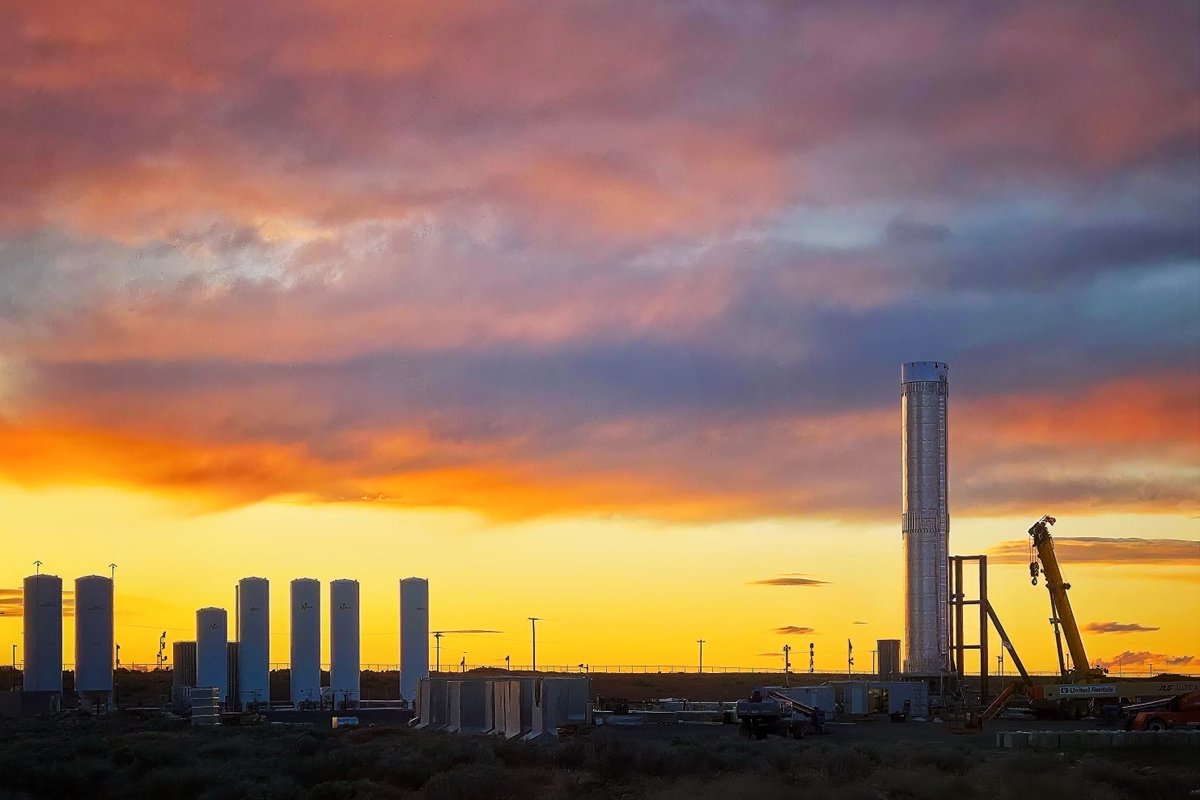
The sun has set on our Stage 1 structure's time in Moses Lake, but it will soon rise over our launch site in Cape Canaveral.
No one said the road to launch was easy, but it sure is a pretty ride. 🚀🌅
Read our blog to learn more about the proto-qualification campaign: https://t.co/TFKfrM2n2B
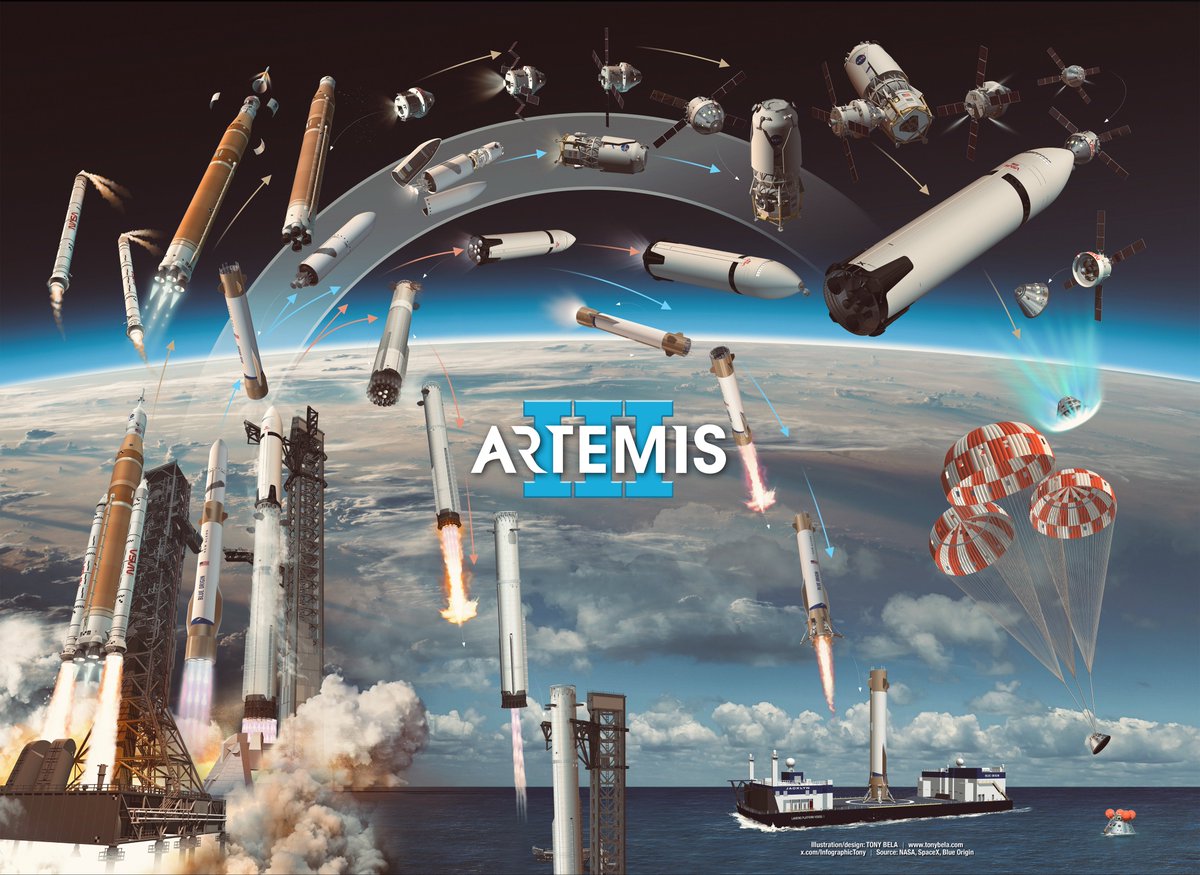
Introducing Artemis III.
Four astronauts. Three launches. Two dockings. One splashdown.
In 2027, the Artemis III mission will practice docking the Orion spacecraft with two lunar landers in low Earth orbit — the capability we need to return humanity to the Moon’s surface.
ZhuQue-2E Y6 Launch Mission Recap
“Long as the journey is, we will reach our destination if we stay the course; difficult as the task is, we will get the job done if we keep working at it.”
— Xunzi, Exhortation to Self-Cultivation
A Venus-Jupiter conjunction tomorrow night kicks off a mini planetary parade – with Mercury joining the scene through June 15.
Look west just after sunset to see the planets cozied up!
Coming soon: one of history’s most complex missions
Tune in on Tuesday, June 9, at 11am ET, to meet the astronauts flying aboard Artemis III, the mission that will test docking capabilities with commercial landers in low Earth orbit — an important step to crewed lunar landings.
UPDATE 4.0: Artemis III (unofficial) infographic. This work-in-progress infographic illustrates humanity's next big step in returning to the lunar surface.






![dpoddolphinpro's tweet photo. Details on The Exploration Company's Storm:
- Liquid Oxygen/Liquid Bio-methane
- 1,765kN / 180tf thrust (about 72% Raptor 3)
- Full-flow staged combustion cycle
- Reusable
"[...] Storm represents a concrete step toward a new generation of European rocket propulsion."
The Exploration Company had already been working on this engine for some time, but I guess today is the "official" unveiling or something.
So far they've worked on turbomachinery, main combustion chamber hardware, regeneratively cooled nozzle extensions, as well as oxidizer-rich and fuel-rich preburners.
P.S. the original name, Typhoon, was so much better than "Storm" 😭
📷 The Exploration Company](https://pbs.twimg.com/media/HKexKYEWUAA4kZf.jpg)