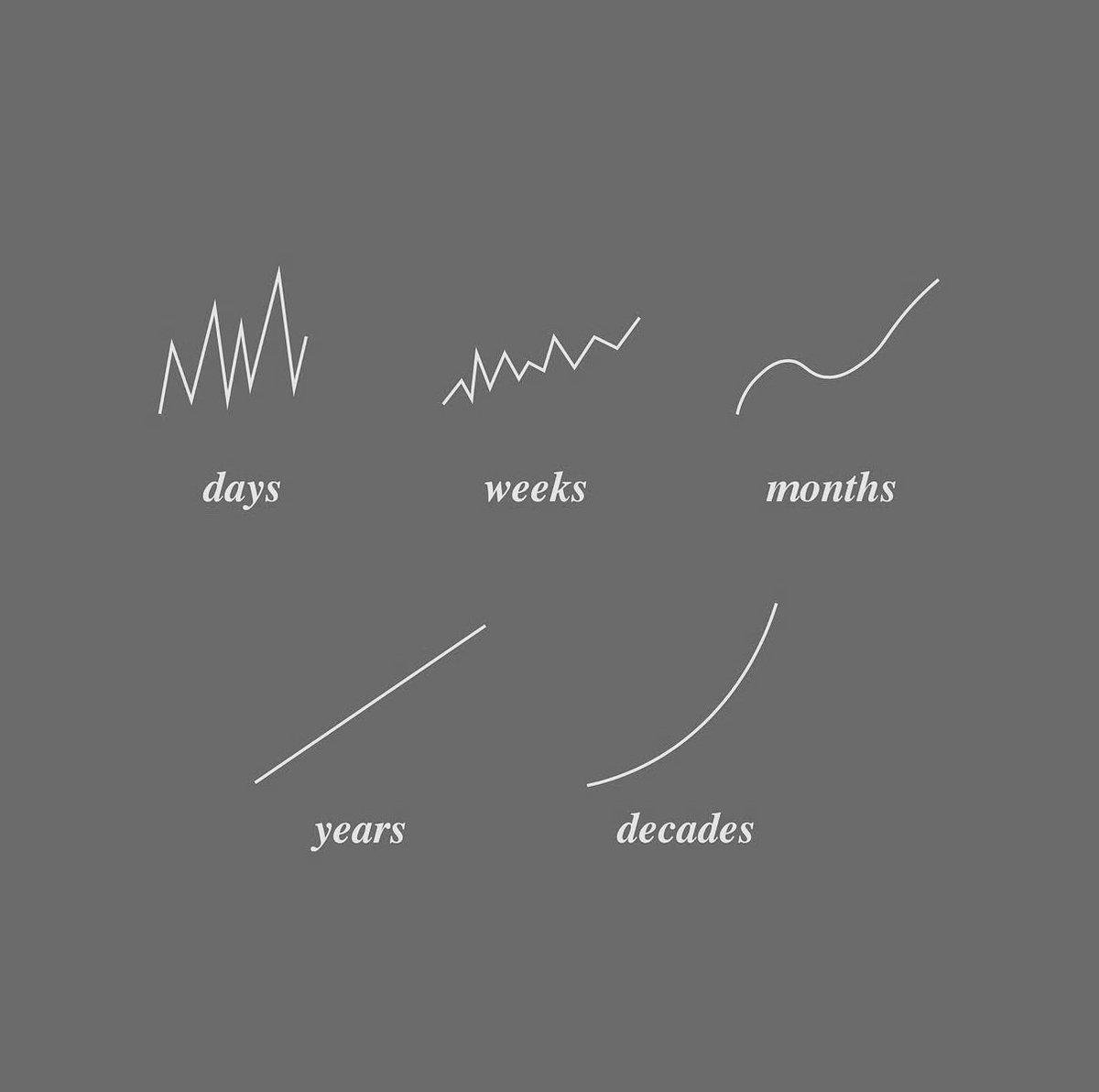
I think the most interesting shift sparked by AI is who it rewards.
For the longest time, it seemed like the world rewarded those who followed a clear, logical path.
People who:
1. Anticipated valuable skills
2. Acquired those valuable skills
3. Leveraged those valuable skills
I don’t think that works anymore. Because you can’t really anticipate valuable skills like you could in the past.
This “new world” will reward those who are just willing to be beginners over and over again. Value now seems to accrue to those who can pair insatiable curiosity with bias for action.
The valuable skills of the future aren’t really fixed skills. They’re much more akin to mindsets.
One of the easiest ways to get ahead is to create before you consume. If you struggle with this, set a rule for yourself: before you engage in a single scroll, you must produce something: words, code, music, videos, ideas, anything. At first, your brain will resist doing it, because the dopamine from your handheld shiny rectangle will be far easier and require less effort. But if you can overcome this initial resistance, you will quickly rewire your reward system to crave the feeling that comes from successfully contributing something to the world, rather than consuming someone else’s contribution.
Look at the world around you – do the most powerful people seem happier to you? They are not because they do not understand the causes of happiness. From a recent interview with @el_pais – read the whole thing: https://t.co/3wupMnEWml
Why reading is an antidote to loneliness:
Loneliness isn’t the absence of people, it’s the absence of curiosity. As an avid reader, I come into contact with this realization all the time.
The very act of reading is a vote for solitude, as it’s one of the rare mediums where you have to be fully present to interact with the material. It’s just you, the book, and wherever you’ve chosen to read it. Having friends and people around is not a feature of the experience.
Yet amidst this absence of people, you don’t feel lonely. If anything, you feel like you’re in the company of someone you care for, deeply engaged in whatever they have to say. That’s because the act of reading is also a vote for curiosity, where you allow the musings of another to come in contact with your worldview. You’re welcoming the author into your intellectual home, providing them with the opportunity to share everything they know.
That’s why I believe that reading is one of the antidotes to loneliness. You don’t need the physical presence of a person to feel the warmth of their ideas, as your curiosity for those ideas is usually enough. And as long as you can retain this curiosity for the thoughts of another, the fog of loneliness won’t have the ability to touch the shores of your mind.
I’m not saying going for a walk will solve all your problems, I’m just saying there’s almost no problem that’s going to be made worse by going for a walk.
The mystic sees the parts and feels the whole.
The artist feels the parts and creates the whole.
The engineer assembles the parts and crafts the whole.
The scientist measures the parts and explains the whole.
All search for the hidden likeness within things.
This poem is called ‘seek’.
In whispers soft, in restless stride,
A human heart, it cannot hide
The yearning deep, the endless quest,
To seek, to find, to put to test.