Australia’s leading educator-led trading institute. Certified, compliant, and trusted internationally. Empowering mastery through evidence based education.
Inaugural Day 1 complete.
What a day and cool mix of interesting folks checking in on what crypto is up to. The MtM team had a few stage visits with more scheduled for tomorrow. @ASX__Trader will be up on stage Sunday, along with Craig Tapping. Two of our best sharing some insights. Check it out and come and say hello.
@nzcryptocon
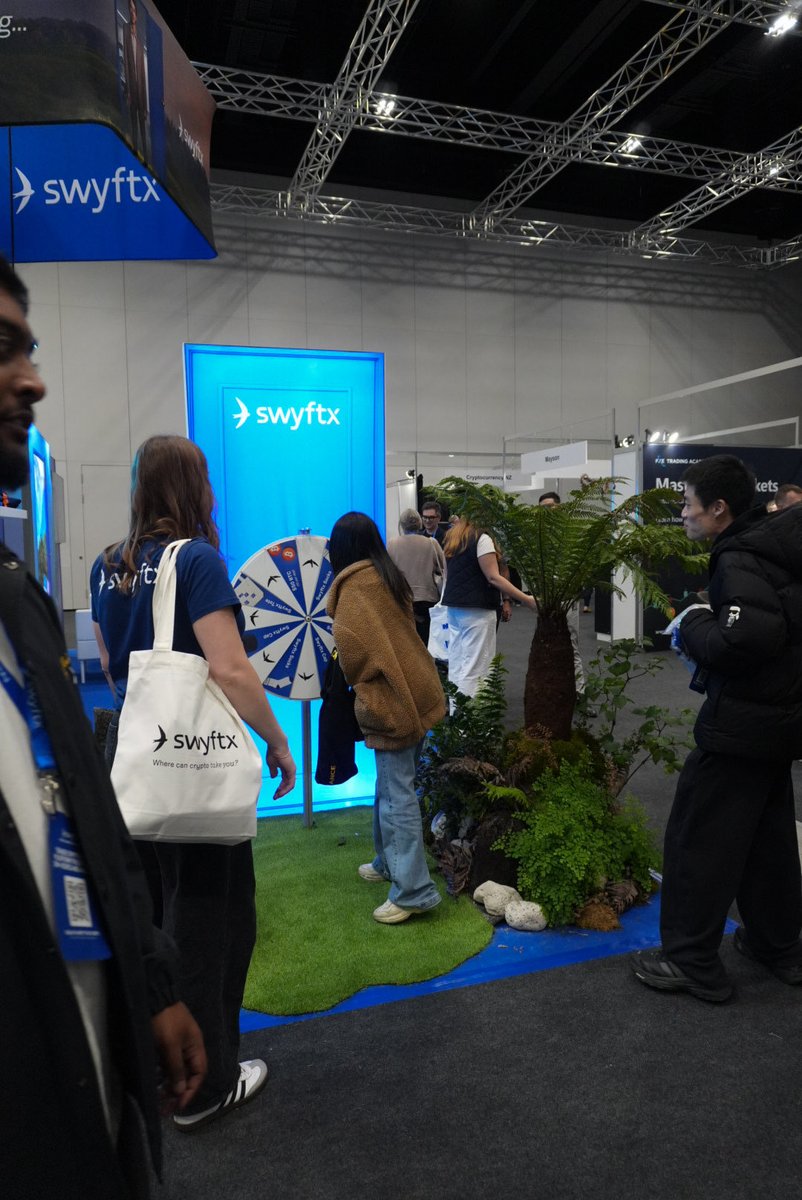
Day 1 of @nzcryptocon is done! 💥
It was incredible start to the weekend to get to meet so many of our Kiwi customers and have such engaging conversations around crypto in New Zealand both on and off the stage.
A drop in from the @BluesRugbyTeam also made the day just a little bluer too 💙
Bring on day 2! And if you didn’t get time to stop by the Swyftx booth today, come say hi tomorrow and spin the wheel to score some Swyftx merch or crypto prizes
Taken from Daily telegraph yesterday. Charts led the news.
Australia’s economy is officially slowing down, as cost-of-living pressures, surging oil prices and slowing government spending combine for a lacklustre result.
KPMG chief economist Brendan Rynne said the national economy had slowed to a crawl and there was no growth in sight.
Investment Fund VanEck’s head of investment and capital markets Russel Chesler warned slowing growth could lead to stagflation.
“Australia could now well be entering a stagflation regime of low growth and high inflation,” Mr Chesler said.
“GDP is falling while unemployment is rising and inflation is surging.”
Stagflation is the worst possible outcome for an economy as it combines high costs, rising unemployment and little to no growth.
In a press conference following Wednesday’s GDP release treasurer Jim Chalmers was quizzed on Australia’s slowing productivity.
Productivity – which is a measure of the nation’s GDP divided by hours worked- fell by 0.6 per cent over the March quarter.
This effectively means Australians are working more hours and are getting less.
Stop Trying to Make Money 🧠🤔
The crew in @MasteringMkts Gold Academy and the FUN101 course hear me say this a lot, and it's crucial to long-term success - stop trying to make money 🤓
Stay with me here 👍
A beginner mindset sees a losing position and says:
❌ "I'll wait until I get back to break even."
An investor/trader mindset says:
✅ "Does this still fit my thesis?" - and then takes action.
I recently closed a position at a loss.
Not because I think the company is bad.
Not because I think it's overvalued.
In fact, I still think it's heavily undervalued.
The problem was simple:
The timeline blew out.
The pathway changed.
The end goal no longer matched what I originally invested for.
My thesis broke 🤷♂️
Could I have sat there for another year? 100%.
Could it still work out? Absolutely, and I expect it will.
But it broke my rules.
And rules only work if you follow them when it's uncomfortable 🫡
That's the mindset difference 🧠
Beginners focus on being right and the fear of a loss.
Experienced investors and traders focus on process.
When you focus on being right or are scared to take a loss, losses hurt.
When you focus on process, losses become part of the game.
That's why I say: stop trying to make money.
Focus on executing your strategy well and the money becomes a by-product 💪💲
And the reality?
Within three days I had already made the loss back and then some.
Not because I'm a wizard 🧙♂️😆
Because capital was freed up and redeployed into opportunities that actually matched my strategy ✅
The loss didn't matter.
Protecting the process did.
Your portfolio doesn't care where a dollar comes from.
It only cares that you consistently place capital into the highest-probability opportunities available to you 💪🫡
#InvestmentStrategy #investor #stocktrading
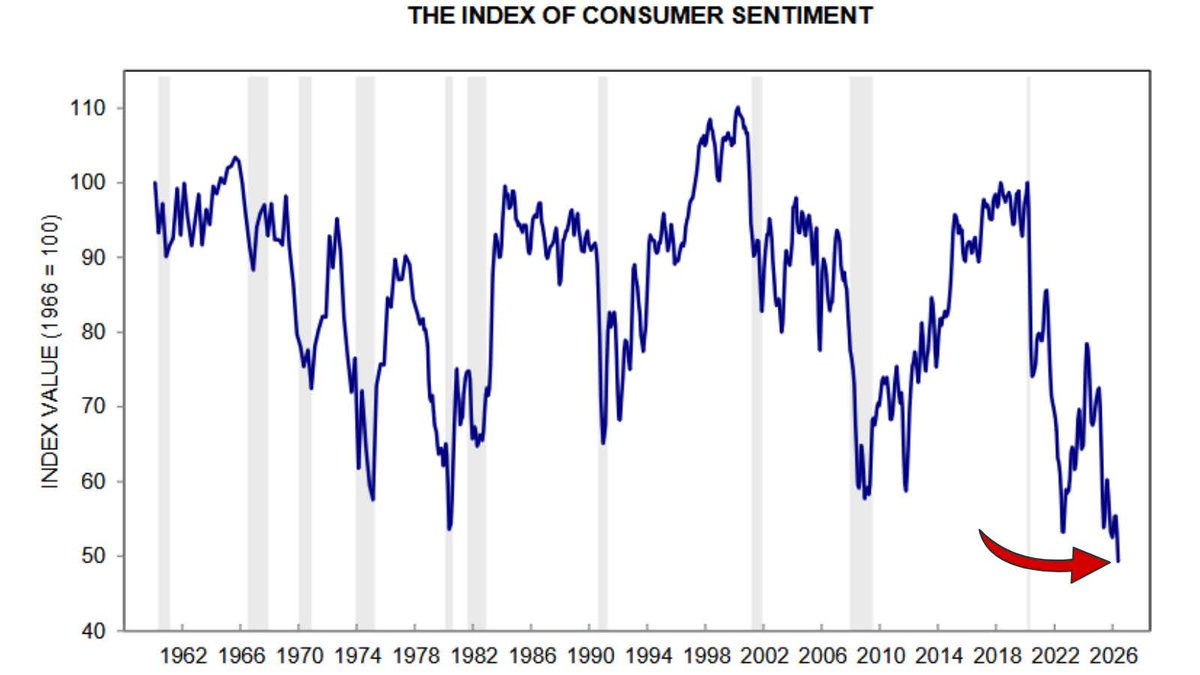
Consumer sentiment has hit its lowest in history .
One thing that really stands out on this chart…
Look how many recession periods there used to be.
Back in the 60s, 70s, 80s and even early 90s, recessions happened regularly. The economy would boom, reset, recover… then repeat the cycle.
But since the GFC?
We’ve basically only had one brief recession during COVID, and even that was heavily cushioned by massive stimulus, money printing and emergency intervention.
Now look at consumer sentiment. Historically, whenever sentiment drops this low something has usually already broken underneath the surface.
That’s what makes this chart so interesting to me.
Consumers already feel recessionary… even though markets are still elevated and many economists continue debating whether a recession is even coming.
There’s a real disconnect between Wall Street and Main Street right now. The average person feels it every day:
• Higher food prices
• Higher insurance costs
• Higher rent and mortgage repayments
• Rising energy bills
• Working harder just to maintain the same lifestyle
People are exhausted. And here’s the part that’s actually quite scary… Recessions are healthy. Nobody likes hearing that, but historically recessions are part of how economies reset excesses. Weak businesses fail. Debt gets cleared out. Speculation cools down. Asset bubbles deflate. The system resets and starts rebuilding again. The problem is… we’ve delayed that process for so long now.
Every slowdown since 2008 has been met with:
• Lower rates
• More stimulus
• More liquidity
• More debt
• More intervention
That helps short term pain. But over time it also creates bigger imbalances underneath the surface:
• Record debt levels
• Inflated asset prices
• Housing affordability problems
• Speculative behaviour everywhere
• Massive dependence on cheap money
It’s a bit like a forest. Small fires are healthy because they clear out the dead wood. But if you suppress every small fire for decades, eventually you create the conditions for one enormous uncontrollable fire.
Maybe this time really is different.
Or maybe we’ve simply delayed the economic cycle so long that when the reset finally comes, it becomes one of the largest economic adjustments most people alive have ever experienced.
Not been much to write about in crypto since calling the top on Bitcoin back in October last year.
Wasn’t the most popular person in the room saying in front of the CEO of MicroStrategy that Bitcoin was about to fall below 60k… which just so happened to be below their buying price. 😅
Safe to say it got pretty quiet after that.
But even through a bearish crypto market where 99% of coins have been going down, there’s still been a few standouts.
And this is the power of combining institutional-grade research from one of our key partners, UpTrade, with our technical analysis.
Instead of following the crowd, you start finding the few projects that are actually bucking the trend.
We did a free webinar at the beginning of the year with the boys at @UpTradeOfficial showing exactly that, and one that stood out immediately was HYPE.
Since then, HYPE is now up over 240% against Bitcoin in 2026 and is one of the very few altcoins currently making new highs.
If you want to check out the research team at UpTrade, have a look here:
https://t.co/uYS9gSytuT
We are also proud to be the official education partner of CryptoCon.
If you'd like to learn how we identify these standout opportunities and meet some of the biggest names in the industry, come along to @nzcryptocon on June 6-7.
You can find tickets and event information here:
https://t.co/61vH141fF3
There’s another one we mentioned that day that is also outperforming in 2026 and just broke out setting up in a similar way right now too.
I’ll drop it in the comments.
Oil, the gold bull case and where to watch🛢️🥇🐃
Oil is driving the short-term volatility, but central bank accumulation is still underpinning the long-term gold bull case👀
That’s the key point the market is trying to work through right now.
Gold has looked heavy recently after profit taking and the sharp oil move higher.
Why?
Because higher oil prices:
➡️ increase inflation fears
➡️ push real yields higher
➡️ strengthen the USD
➡️ reduce Fed cut expectations
All temporary headwinds for gold.
But underneath the surface…
- Asian buying - particularly China - continues supporting dips.
That’s important.
Because while Western markets have been taking profit and rotating risk around…
- central banks and Asian buyers still appear structurally interested in accumulating gold reserves.
And this is the key nuance:
I don’t think the gold thesis is broken at all.
In fact, structurally it still looks incredibly strong:
• rising debt loads
• geopolitical fragmentation
• reserve diversification
• weakening confidence in fiat systems
But in the short term?
Oil and energy markets are complicating the path higher.
There’s also likely some sovereign liquidity management occurring in the background as elevated energy prices pressure economies and currencies.
So right now we have:
👉 short-term macro pressure
vs
👉 long-term structural support
—
Bottom line:
Gold currently feels less like a broken bull market…
…and more like a market being temporarily pulled between:
• energy-driven inflation fears
• and ongoing central bank accumulation 🟡
Our capital light small gold producers/near term producers could be a great spot to be watching as things play out 🤠
@MasteringMkts #gold #oil
Graincorp - GNC:ASX and how to play the Agri commodity reality 👀
Being exposed to a market that’s flooded with supply is rarely a good thing as an investor/trader, but that is literally the reality of the grain market right now 🌽🚜
Right now the grain market is still dealing with:
❌ global oversupply
❌ low grain prices
❌ compressed margins
And GNC were caught right in the middle of it - I flagged in @MasteringMkts Academy a month or so back that GNC did let us know abut the challenges back in February 😶🌫️
Unfortunately their latest half year result was poor and many were caught out 😬
With GNC it’s fair to ask “But aren’t wheat and grains meant to be pumping because of supply issues and geopolitical tension?”
GNC’s result is actually a really good example of the disconnect that happens between an agricultural commodity market and the actual companies involved 💪
So despite the bullish long-term narrative…the CURRENT reality is still soft 😬
And while the commodity price itself may spike/run on fear and froth, the actual market itself usually takes time to actually be impacted by the issues the spot price market is freaking out about.
This is where understanding commodity cycles matters.
Usually the sequence goes:
1️⃣ supply issues begin forming
2️⃣ inventories slowly tighten
3️⃣ spot commodities react
4️⃣ then producers/processors improve later
There’s often a lag.
And sometimes we get what’s happened in this current case with the war where number 3 moves to number 1 in anticipation, but that anticipation takes time to play out in to on-the-ground market reality 👍
Either way, business like GNC usually benefit last in the chain.
—
So if you’re bullish Agri over the next 6–12 months because of:
• geopolitics
• fertiliser costs
• weather risks
• supply chain disruptions
…then the cleaner trade may actually be:
➡️ commodity exposure itself - wheat/corn etc
➡️ ETFs
THEN later:
➡️ businesses leveraged to improving grain margins like GNC.
Bottom line:
The long-term Agri setup is still very interesting.
But GNC’s result was a reminder that:
…the current grain market is still oversupplied and margin pressured right now 📊
The play is there, just not through GNC at the moment 🫡💪
$GNC #asx
A big market crash will likely come at some point over the next couple years. History says it always does.
And when it happens, what you buy during that period will probably determine the difference between being comfortable… and becoming truly wealthy over the next 5-10 years.
That’s why Gold Coast Live 2026 is focused on preparation, positioning, and identifying where the real opportunities could be heading into the next major cycle.
This won’t be a surface-level event or recycled social media content. We’ll be taking a full top-down approach to the markets, starting with the macro picture and working all the way down to specific opportunities and chart analysis.
Tung, who recently FAT FIRED, will be bringing his macro hat, breaking down the major themes shaping global markets right now and where he believes investors should be paying attention moving forward.
Craig T will then dive even deeper into macro, sentiment, intermarket analysis and market timing, helping connect the dots between global conditions and portfolio positioning.
Craig D will focus on the education side around dividend investing, including how to identify quality dividend-paying companies and avoid getting trapped chasing unsustainable yields.
Jamie and Craig D will then combine fundamentals and technicals together using a true bottom-up approach, showing attendees some of the key opportunities they’re personally looking at right now and why those areas stand out to them heading into the next 5-10 years.
And then with me we’ll get our hands dirty.
As a group, we’ll go through naked charts live and vote on what actually looks attractive in today’s market environment. Real chart work. Real discussion. Real application.
No hype. No theory-only presentations. Just practical education from people actively involved in the markets every single day.
Gold Coast Live
20 June 2026
Mantra on View, Gold Coast
VIP already sold out.
200 tickets already gone. Limited general admission remaining.
https://t.co/k0nG7bKHvc
A follow-up on my previous post and a mea culpa on one thing. My post was based on the original superannuation tax proposal. That version had no indexation: a threshold designed to remain frozen in nominal terms while inflation ate it away.
The government also originally proposed taxing unrealised capital gains. Paper money you hadn't received. Absurd but true.
The new law indexes the $3M threshold. While yes, an improvement, this is a classic bait-and-switch tactic. Something I have written about here; https://t.co/8945XPpJSU
“Hang around with five… and you’ll become the sixth.”
We all know we are a product of our environment.
That’s why Mother’s Day means so much. Behind so many successful people is an incredible mother who sacrificed, guided, supported, and created the environment for her children to grow, believe in themselves, and get a head start in life.
My mum turned 70 this year and is currently travelling around Canada. The standards she set and the environment she created shaped the men my brothers and I are today.
I’m also blessed to have another incredible mother in my life, my wife, who shows that same love, care, and commitment every single day to our children. She sets high standards, leads by example, and is there for them in every way possible.
I’m very proud and grateful for the family we have, because it all starts with the environment mothers create. It’s the hardest job in the world, and us sons never stop appreciating everything they do.
Happy Mother’s Day to all the amazing mums ❤️
Been getting a lot of DMs lately.
Some of you saying a massive thanks for the heads up on rates. Some of you feeling the squeeze. We’ve had three rate hikes already in 2026. Naturally, people are starting to ask questions.
What’s going on?
Where is this heading?
Now the RBA is pointing to the war. And look, it sounds like a clean explanation. Easy to understand. Gives people something to blame. But here’s the reality.
I was talking about this back in early December. That was months before there was even talk of a war. And if you go back even further, I mapped this out in late 2021.
My minimum target was 6 to 8% interet rates.
My base case was 8 to 10%.
We’re already sitting in that 6 to 8% range now. And there’s still a lot of data pointing higher. So this didn’t just suddenly happen. The war didn’t create this. It just gave them something to point to. This was building for a long time. Government spending was aggressive. Inflation was already there under the surface. And the macro cycle we’re in was always pointing toward tightening. The war just sped things up a little bit. That’s it.
This is where most people get caught. They see one headline and think that’s the whole story. But nothing in markets happens in isolation. Everything flows into something else.
Rates go up.
That puts pressure on households.
Pressure on households slows spending.
That flows through to businesses.
Then jobs. Then asset prices. Then everything else.
It’s all connected.
If you actually want to understand this properly, go back to my posts from the first two weeks of December. I spent that whole period breaking it down in real time. What I was seeing. Why I believed the biggest rate moves since 2022 were coming in 2026.
It’s all there.
Go read it.
Take the time to understand it.
So next time, you’re not reacting late.
You’re ready.
I’ve heard they’re weighing up either grandfathering the 50% CGT discount or giving people a 2 year window to sell before any changes kick in.
Which option do you think makes more sense, and how do you see it impacting the market?
A 25 year old just turned $225 million into $5.5 billion in 12 months.
Here’s exactly what he bought.
Leopold Aschenbrenner got fired from OpenAI in April 2024.
He spent the next few months writing a 165-page thesis predicting AGI by 2027.
Then he launched a fund and put his money where his thesis was.
He bought zero Nvidia. Zero Microsoft. Zero Google. Zero Amazon.
He bought what AI actually runs on.
Bloom Energy (BE), power infrastructure for data centers. Up 1,422% in one year.
Lumentum (LITE), optical components that move data between chips. Up 1,331%.
Sandisk (SNDK), storage. Up 3,130%.
CoreWeave (CRWV), GPU cloud infrastructure. Up 166%.
Iris Energy (IREN), AI computing and data centers. Up 583%.
The thesis was simple: every AI company needs energy, bandwidth, storage, and compute.
Nobody was buying those. Everyone was buying the AI companies themselves.
He was right.
His fund now manages $6 billion. Backed by Patrick and John Collison of Stripe and former GitHub CEO Nat Friedman.
I’m adding this to my watchlist.
Every time he files a new 13F, we will break it down here.
Turn on notifications so you don’t miss the alert, this is VERY important.
Many people will wish they followed us sooner.
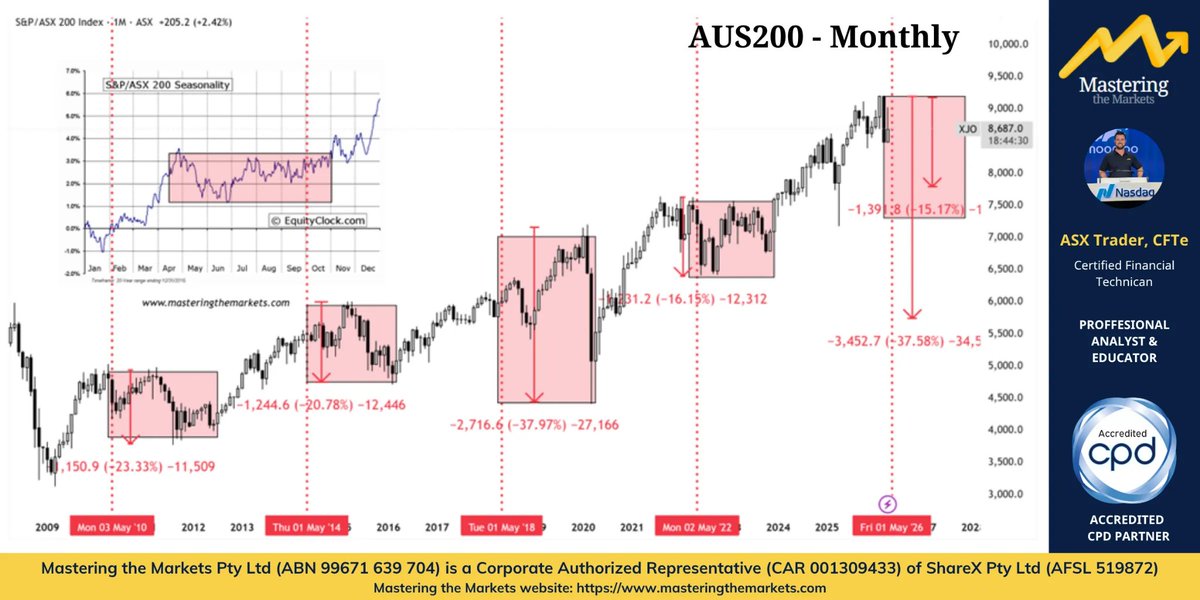
May and June seasonality is coming up, and historically these are two of the weaker months of the year for the XJO.
So people need to be aware that we are moving into that winter period for the market.
But when we zoom out even further and look specifically at midterm election years, so 2026, 2022, 2018, 2014, and 2010, the pattern becomes even more important.
Since the GFC, every midterm cycle has eventually resulted in lower prices, with drawdowns ranging from 16% to 37%.
Now, history does not always repeat, but when something has happened 100% of the time across this sample, you have to respect it.
What we often see is a small correction during this period, then a pump, then a much larger correction. That happened in three of the four examples. In the other one in 2022, we saw the large correction first, followed by a smaller correction.
So the key message here is awareness.
We are not trying to predict with certainty. We are trying to understand the rhythm of the market, respect the historical pattern, and be prepared if price starts behaving in a similar way again.
25-30% countertrend moves happen in every Bitcoin bear trend. Bitcoin near $80K is now approaching three critical on-chain levels: the True Mean Price. STH cost basis. Densest overhead supply in the distribution. Bitcoin is rallying into all three at once.
And anecdotally, when the STH cost basis crossed below the True Mean Price in previous bear markets (green arrows on the chart), Bitcoin entered the final leg lower. That cross has happened again. If the Feb low is the real bottom, price needs to reclaim and hold above the mid-$80ks to unwind that bearish onchain supply reality.
Chart H/T to @_Checkmatey_
Hydrogen just pushed another 14% overnight. That’s now up 44% from when I first started mapping it out a few weeks ago in New Zealand.
What’s interesting isn’t just the move… it’s the sentiment.
2 weeks ago, I wrote a mainstream article about why I thought it was bullish. Not a single person agreed.
https://t.co/eDw2U8WO38
That’s exactly the point.
No one is positioned in hydrogen.
Most people say it’s too expensive.
Most say it has no real use case.
Which tells you something important… retail isn’t there.
I’ve seen this before on my calls.
Silver in the 20s — no one wanted it.
Oil in the 50s — no one believed in it.
Lithium April last year - old technology
Hydrogen now — same story.
I wrote about sentiment on last week's article here: https://t.co/3cmhKmzi6S
The pattern is consistent:
When everyone agrees, the opportunity is usually gone.
When everyone disagrees, that’s where things start to get interesting.
Love what others hate.
Hate what everyone loves.
Australian households are facing renewed pressure as banks move ahead of the RBA again, with nearly 90% lifting mortgage rates before the May 5 decision.
Fixed rates are rising again, and in some cases, lenders have already pushed through multiple increases between RBA meetings.
Earlier this year, I noted that 2026 would deliver the most aggressive rate hike since 2022. This is exactly why I secured a 3-year fixed rate at 5%.
At a recent live event in New Zealand, I had an insightful conversation with a property expert who has transacted over 1,000 properties. He shared a simple observation:
“When the Gold Coast overtakes Melbourne in price, you’re usually near the top of the cycle.”
Looking at the current data:
Gold Coast median house price ~ $1.35M
Melbourne median house price ~ $970K
The Gold Coast has already moved ahead.
At the same time:
Melbourne has remained relatively flat
Lifestyle markets like the Gold Coast have led price growth.
This type of divergence is often seen late in a cycle:
Capital rotates away from major cities
Lifestyle and speculative markets outperform
Sentiment remains resilient despite tightening conditions.
Of course, no single signal defines a market top. However, when multiple indicators begin to align, it’s worth paying attention.
And yet, as always, many will still argue that this time is different.
Spare a thought for recent buyers who entered the market on the firsthome buyers 2% and 5%. The shift in conditions is being felt quickly.
Source: https://t.co/GFnWmzxG9d.
Everyone says “just DCA into the S&P 500 and you’ll be fine.”
That works… until it doesn’t.
Investing in US equities right now feels a lot like gold in the late 1970s. Back then, people piled in near the top thinking it would keep going forever. What followed wasn’t a crash and instant recovery… it was decades of going nowhere in real terms.
That’s the part most people don’t understand. Valuation matters. Right now, the S&P 500 is trading at historically expensive levels. When you zoom out over 100+ years, buying at these levels has usually led to weak or disappointing returns over the next decade or more. And you can actually see this play out clearly. When valuations push to around two standard deviations above the norm, that’s the red zone. Historically, those periods have led to very poor returns, sometimes even “dead money” for a decade or longer.
On the flip side, when the market drops to around one standard deviation below the average, that’s where the real opportunities show up. Those are the green zones. Think post-GFC. Think early 1980s before the massive bull run into the dot-com era. That’s where the best long-term returns have come from.
And then you layer in the technicals… On a yearly timeframe, RSI has only pushed into overbought territory a handful of times in history.
Great Depression era.
1970s energy crisis.
Dot-com bubble.
And now.
That kind of confluence matters.
It tells you this isn’t just “a bit expensive”… it’s historically stretched. And this is exactly where Buffett’s mindset comes in.
He’s sitting on a massive cash pile, not because he’s scared, but because he’s a value investor. Everything he does revolves around one thing:
Margin of safety.
He’s not interested in buying when everything is stretched. He waits for moments where the downside is limited and the upside is asymmetric.
You can apply that same thinking to the index. This doesn’t mean “don’t invest.” It means: Don’t blindly buy what’s expensive. Don’t chase crowded trades. Wait for your margin of safety. Look for what’s being ignored. There are always opportunities in the market… just not always in the places everyone is looking.
The real edge isn’t being in the market. It’s knowing where to be. And if you haven’t seen it, Tung (Macro Investor) and I teamed up, macro + technicals, to show how you can still invest passively in this environment. Because even if I wouldn’t touch US equities right now…
https://t.co/fo5EOjiiHG
There’s always something undervalued. You just need to know where to look. Skate to where the puck is going not where it's been.