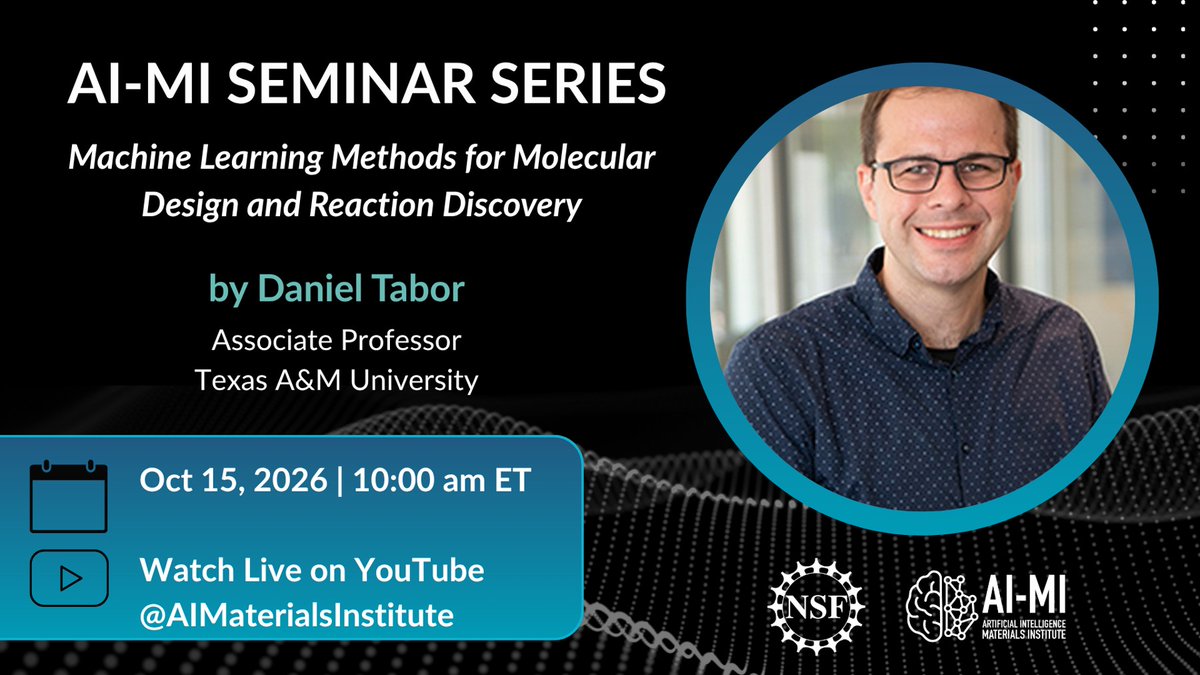
Next in the AI-MI Seminar Series: Daniel Tabor (Texas A&M University) on "Machine Learning Methods for Molecular Design and Reaction Discovery." Thu Oct 15, 10 am ET, streaming live on YouTube. Details: https://t.co/yW0jMgk7TF
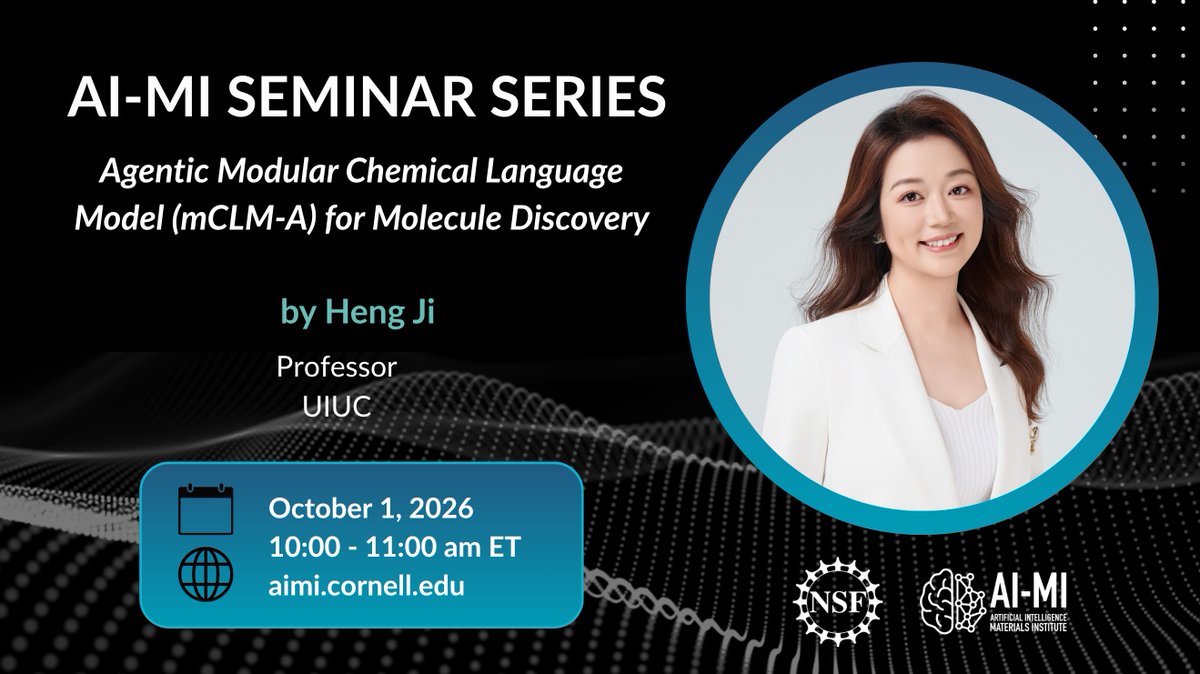
Next in the AI-MI Seminar Series: Heng Ji (UIUC) on "Agentic Modular Chemical Language Model (mCLM-A) for Molecule Discovery." Thursday, October 1, 10 am ET. https://t.co/bA2fZL27UN
It's National Postdoc Appreciation Week. Thank you to the postdocs across AI-MI whose work drives AI-driven materials discovery every day 🙌
Join AI-MI as a Postdoctoral Fellow: https://t.co/ODfXtpFuUJ
Registration is now open! Cornell University is hosting the 2026 CAMPUS Symposium on Oct 22, 2026 — a full-day showcase of advanced materials research, collaboration pathways, facility tours, and emerging technologies. Register: https://t.co/idvGgCXqrt #2026CAMPUSSymposium
AI-MI senior personnel Yoav Artzi (Cornell Tech) is General Chair of COLM 2026, the Conference on Language Modeling, meeting October 6–9 at the Hilton Union Square in San Francisco. https://t.co/jWBwJwc43g
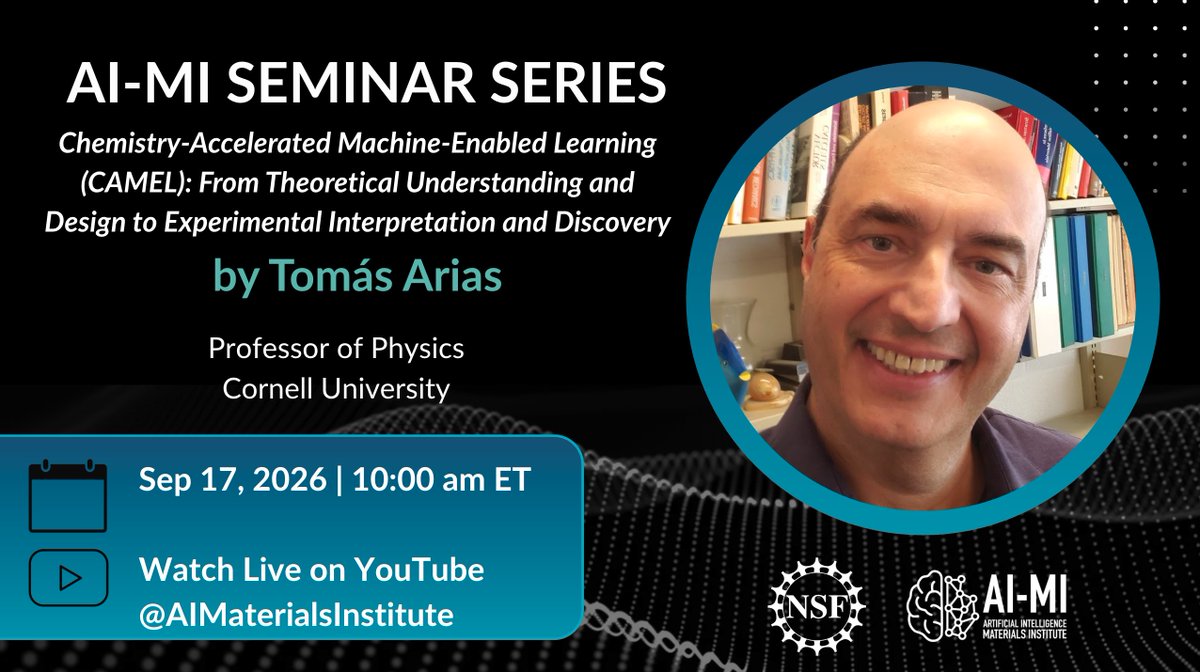
Next in the AI-MI Seminar Series: Tomás Arias (Cornell) on "Chemistry-Accelerated Machine-Enabled Learning (CAMEL)." Thursday, September 17, 10 am ET. https://t.co/mpIk8Zse0C
AI-MI–supported work cuts diffusion-model sampling cost 10× with no retraining. "Optimize Your Sampling" tunes the timestep schedule directly with Bayesian optimization — a 5-step schedule keeps 89–94% of 50-step quality. Belardi & Weinberger (Cornell). https://t.co/LhDkbkdFWn
An AI method predicted PtPb₃Bi would superconduct. A new AI-MI–supported study in Chemistry of Materials confirms it — and finds superconductivity across the whole MPb₄₋ₓBiₓ family (M = Au, Pd, Rh), at 4.9, 4.2 and 3.4 K. Katmer & Schoop (Princeton). https://t.co/R5u5qInKDj
Congratulations to Kilian Weinberger, Yoav Artzi, Jennifer J. Sun and their co-authors: "Co-Evolving Structured Knowledge and Reasoning in Language Models" is accepted at COLM 2026. https://t.co/9f8kdQr95T
Terminal-Bench-Science first release v0.1 is out! It's been a fun challenge in my @SnorkelAI internship to shape TB Science with @vincentsunnchen and @StevenDillmann! Very excited to drive this forward with Cornell AI for Science folks at our NSF institute @MaterialsAI!
I'm bullish that TB Science will define the next generation of coding agents---a "Claude Code for Science"---we'll likely see frontier labs using TB Science as a compass to drive scientific discovery.
Benchmark is hard for frontier LLMs at release. But looking beyond the task difficulty leaderboard, TB Science is good at the basics of benchmark building:
- Task breadth and realism. Real computational workflows across physical, life, and mathetical sciences. The hardest part in working on TB Science this summer has been to get STEM scientists to work on this. There are very few scientists with the high domain expertise---with LEAN, FORTRAN, pymatgen, opencv etc. code---to build good tasks. Highly skilled grad students, postdocs, and faculty at the best universities worldwide. I spent a lot of 'office hours' helping scientists onboard and scour through agent evaluations. It's been a steep learning curve on speaking a vocab that both programmers and STEM experts understand.
- Task sandboxing. Last year at Cornell we adopted @harborframework to reproducibly evaluate agents---it's amazing how well it scales. Would love to see it adopted across agent eval + training research infra.
- Task instructions, oracle solutions, deterministic verifiers. Bad benchmark tasks underspecify instructions "write me a PDE solver" and overspecify verifiers to only allow the human-written solution. @StevenDillmann and I have done a lot of back and forth on defining the fine line. Something I've learned is that, for science tasks, it's really up to the scientist to specify what they think is reasonable. We should defer to their judgement as they'll end up using a good "Claude Code for Science"🙏
Coding agents have become insanely good at coding as a "skill" but can they understand scientific knowledge as "memory"? This year will be pretty exciting for scientific progress w/ AI!
Next in the AI-MI Seminar Series: Nima LeClerc (Principal Physicist, Digital Twins for Quantum Hardware, Diraq) on "Digital Twins, AI-aided control and the Path to Scalable Quantum Hardware." Thu Sept 3, 10:00 am ET — live on YouTube. https://t.co/QFFauhABpa
AI-MI Director Eun-Ah Kim (Cornell) spoke at KITP’s "AI for Quantum Matter" — "AI for quantum simulation towards hybrid learning" (Aug 20). She is also a scientific advisor to the program, which runs at UC Santa Barbara through Oct 8. Video: https://t.co/tClVwFjAbS
AI-MI researchers kick off the AI-driven Scientific Discovery session at KDD 2026 in Jeju this Thursday. Guangyao Chen and Fengqi You will present "From Noisy STEM to Crystal Structure: Evidence-Structure CoDiffusion under Composition Constraints".
https://t.co/zt9JBb039p
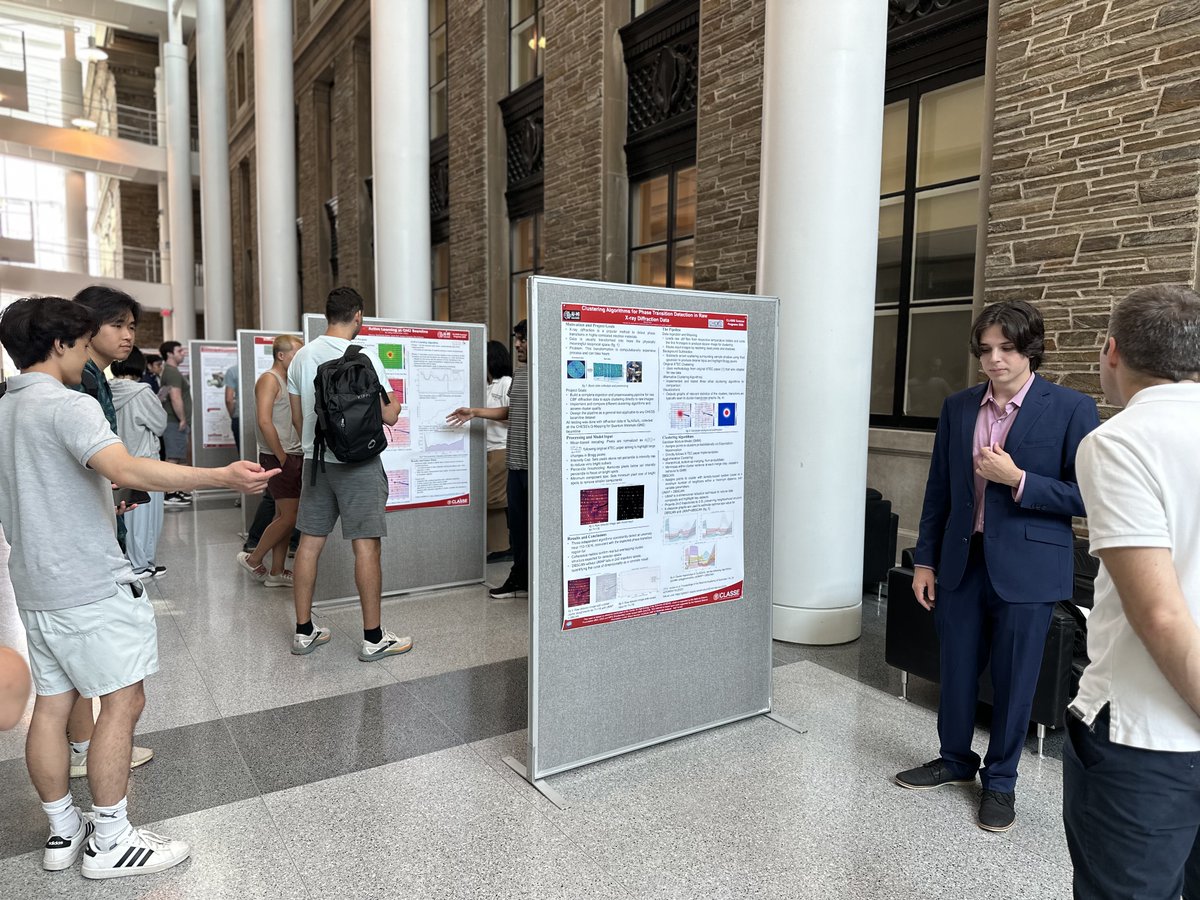
That's a wrap on AI-MI SURP 2026. Fourteen undergraduates spent summer at Cornell on AI for materials — from ML analysis of X-ray scattering at CHESS to grey-box Bayesian optimization on a self-driving lab — and presented their final projects this Friday.
https://t.co/ooOmFeEGpi
AI-MI–supported study turns moiré flat-band engineering into design rules: a monolayer's band-edge momentum and orbital character predict which lattice (honeycomb, kagome, square) and topology emerge across 600+ bilayers. Co-author: Andrei Bernevig.
https://t.co/b0sbCGLPzz
Welcome to AI-MI! @jacobrgardner from @Penn joins the Institute as Senior Personnel. His work on probabilistic machine learning and Bayesian optimization — deciding what to measure next, not just what to predict — is core to AI-guided materials discovery. https://t.co/uPgDRjI1pO
AI-MI at #M2S2026: Director @eunahkim gave an invited talk on interpretable, structure-aware AI that predicted superconductivity in PtPb₃Bi before the experiment confirmed it. Kin Fai Mak was an invited speaker on 2D materials. https://t.co/RLZs3xyWyY
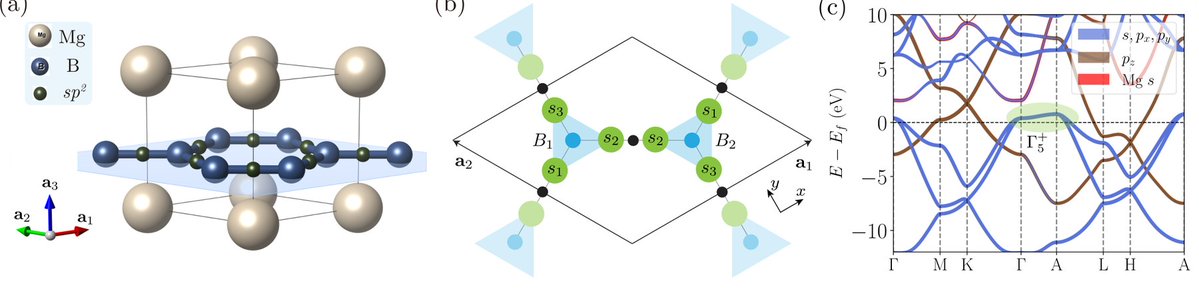
New AI-MI–supported work rebuilds the theory of MgB₂, the record-Tc conventional superconductor (~39 K): its boron network is best described as a bond-centered kagome lattice, and quantum geometry helps set Tc. Co-authors: Morosan @rice, Schoop @SchoopLab & Bernevig @Princeton