Your central hub for daily #mathematical inspiration. Explore elegant theorems, mind-bending puzzles, and the beautiful logic that shapes our universe. #Math
Mastering Definite Integration just got easier. 📊
Whether you are prepping for major exams or just surviving advanced Calculus, these 12 fundamental properties are the ultimate cheat sheet you need to simplify those complex integrands.
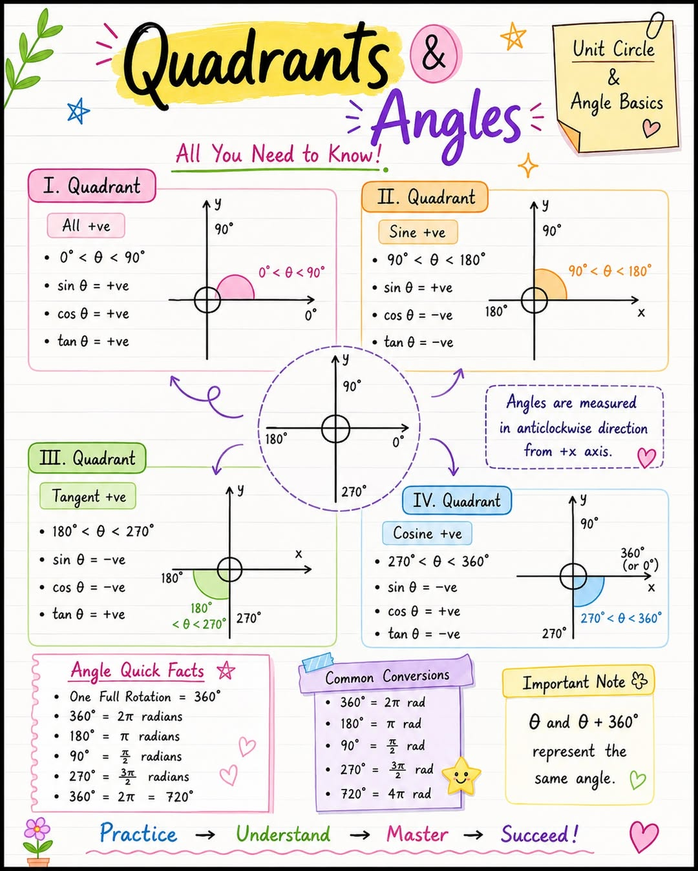
📐 Master Quadrants & Angles in Minutes! 🎯
Struggling to remember which trigonometric function is positive in each quadrant? This colorful cheat sheet makes it easy!
Inside this guide:
✅ All 4 Quadrants explained
✅ Signs of Sin, Cos & Tan
✅ Angle ranges (0°–360°)
✅ Degree ↔ Radian conversions
✅ Unit Circle basics & quick revision notes
Perfect for JEE, NEET, MHT-CET, CBSE, HSC, SSC, and all competitive exams.
📌 Save this post for your next revision.
📤 Share it with your study partner.
Translating rotation into waves.
The unit circle is the engine of trigonometry. As the angle rotates, the Sine, Cosine, and Tangent curves emerge perfectly in sync.
Mastering Calculus starts with speaking its language! 🗣️🔢
Ever look at a derivative or integral and feel like it’s written in an alien code? Breaking down the notations is the first step to unlocking advanced math. From the limit definition of a derivative to the exact anatomy of an integral, every single symbol has a specific job to do. 📈📉
Understanding what you are reading makes solving it so much easier. Save this cheat sheet to keep these foundational concepts fresh in your mind! 📌
Drop a 💯 in the comments if you want to see more formula breakdowns!
The Faces of e — One number, many beautiful forms.
From natural growth and infinite series to logarithms and calculus, see how the magical constant e connects it all together.
Save this post for your math revision and share it with a fellow math lover! 📐✨