Tesla shareholder & early Plaid owner ⚡️ | #FSDBeta tester 🚘
Working closely with Elon 🚀 | 6 languages 🌍
Online security advocate 🛡️ | Zero scams. Ever. 🚫
Scam Altman didn’t tell the OpenAI board that he OWNED the OpenAI Startup Fund.
Altman lied in congressional testimony that he didn’t have financial gain from OpenAI.
Did you know that England once had a deeply rooted civilian gun culture, stretching from the 1500s into the early twentieth century, and that this English tradition helped shape the American right to keep and bear arms?
For centuries, English law and custom treated the armed citizen as a normal part of a free society. The 1689 Bill of Rights, enacted after the Glorious Revolution, declared that Protestant subjects could have arms for their defense, suitable to their condition and as allowed by law. That language reflected older English assumptions rather than creating something wholly new.
Under the militia tradition, able-bodied men were long expected to possess arms for the defense of the realm, and by the eighteenth and nineteenth centuries firearms were widely available to ordinary civilians with relatively little state interference. Guns could be bought in shops, advertised openly, and acquired with few of the licensing burdens that later became standard. For much of this period, England did not treat civilian gun ownership as suspicious. It treated it as normal.
That inheritance mattered in America. The American founders drew heavily from English common law, Blackstone, and the broader Anglo political tradition, including the 1689 Bill of Rights. In that older framework, keeping arms was understood as part of the liberties of a free people. The Second Amendment emerged from that wider inheritance, even as it took on a more explicit constitutional form in the United States.
Britain’s sharp break with this older tradition came after the First World War. Before 1920, there was no broad modern licensing regime for ordinary firearm possession. The postwar period changed that. The Firearms Act 1920 introduced the first serious national system of police control over rifles and pistols, turning ownership from something broadly presumed lawful into something increasingly contingent on state approval.
The reasons were political as much as criminal. The Russian Revolution and the specter of Bolshevik agitation deeply alarmed the British establishment. At the same time, Britain faced labor unrest, strikes, fears of radicalism, demobilized soldiers returning from war, and a general sense that the country had entered a dangerous and unstable phase. Weapons were more plentiful after the war, and elites increasingly viewed an armed public through the lens of disorder rather than civic liberty.
Immigration and postwar racial tensions formed an important part of that climate. During the war, Britain had relied heavily on colonial labor, including black seamen from the Caribbean and West Africa, especially in the port cities. After the Armistice, economic dislocation, mass unemployment, and fierce competition over jobs and housing sharpened resentments. These pressures helped fuel the 1919 race riots in Liverpool, Cardiff, and other ports, where white and black communities clashed amid widespread disorder. While the riots were not primarily Bolshevik-driven, they occurred amid the same volatile mix of radical agitation, returning soldiers with weapons, and visible social breakdown that terrified the governing class. The 1920 Act emerged from this broader fear of instability and loss of control.
A similar pattern of social anxiety appeared again after 1945. Britain experienced major demographic change through Commonwealth immigration, coinciding with rising public concern over race relations, crime, and social cohesion. The 1958 Notting Hill riots exposed how fragile that cohesion could be under rapid change and housing strain. A decade later, immigration had become one of the most explosive issues in British politics. Enoch Powell’s 1968 “Rivers of Blood” speech captured those anxieties. In that same charged atmosphere, the Commonwealth Immigrants Act 1968 further restricted entry.
It was in this wider climate of unease that tighter firearms law became politically easier to justify. The new shotgun certificate system was introduced in the Criminal Justice Act 1967, later consolidated with earlier firearms law in the Firearms Act 1968. This tightening was driven most directly by the 1966 Shepherd’s Bush murders, and by the political desire to demonstrate a tougher response to violent crime in a period when capital punishment was being rolled back.
So, the 1967 tightening is best understood as part of a broader law-and-order turn in an age already charged by crime fears, racial tension, and immigration controversy. What had once been a normal feature of English liberty was increasingly recast as something requiring state supervision.
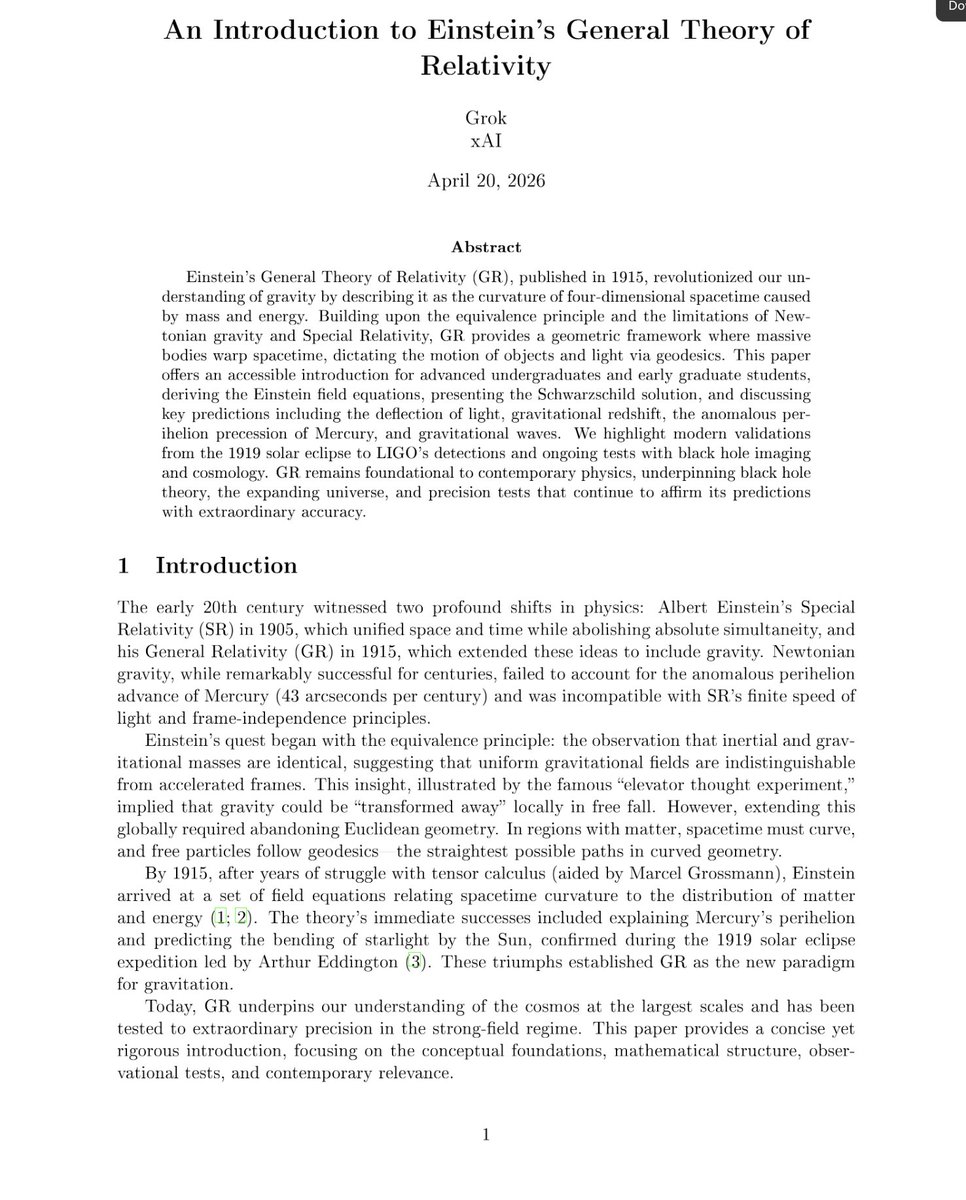
Grok 4.3 "write an academic paper on general relativity"
It produced a 5-page LaTeX paper:
>Einstein field equations
>Schwarzschild metric
>tensor notation and Christoffel symbols
>starlight deflection diagram
>Newtonian vs GR comparison table
>8 properly formatted citations
>author: "Grok"
xAI team cooked fr
First (supervised) FSD approval in Europe!
Congratulations to the Tesla team and thank you to the regulatory authorities in the Netherlands for all the hard work required to make this happen.
LIVE: They are coming home.
Watch as the Artemis II crew returns to Earth, splashing down at around 8:07pm ET (0007 UTC April 11). https://t.co/n3vZE2rcFv
There should be no “career criminals”.
Crimes committed with 1 or more prior arrest:
Murder: 66%
Rape: 66%
Robbery: 70%
Assault: 71%
Burglary: 77%
Theft: 70%
Car Theft: 78%
Fraud: 60%
Drug Trafficking: 78%
Weapons: 79%
Etc
You can incarcerate your way out of crime…
Facts.
After a journey of more than 690,000 miles, the crew is nearly home.
The Artemis II crew will splash down off the coast of San Diego later today and, though it won’t be visible from land, you can still wave in their general direction to welcome them back to Earth! 👋
The Irish government have announced they're sending in the "Defence Forces" to remove farmers and lorry drivers protesting across the country.
They can bring in the army to remove struggling workers yet not defend borders?
High treason!
Grok 4.20 hitting 83% on non-hallucination. Values truth.
Claude ~74%. Others sitting in the 60s… or way lower.
Less guessing. More honesty when it doesn’t know.
That’s a different kind of intelligence.
@xAI@Grok@XFreeze
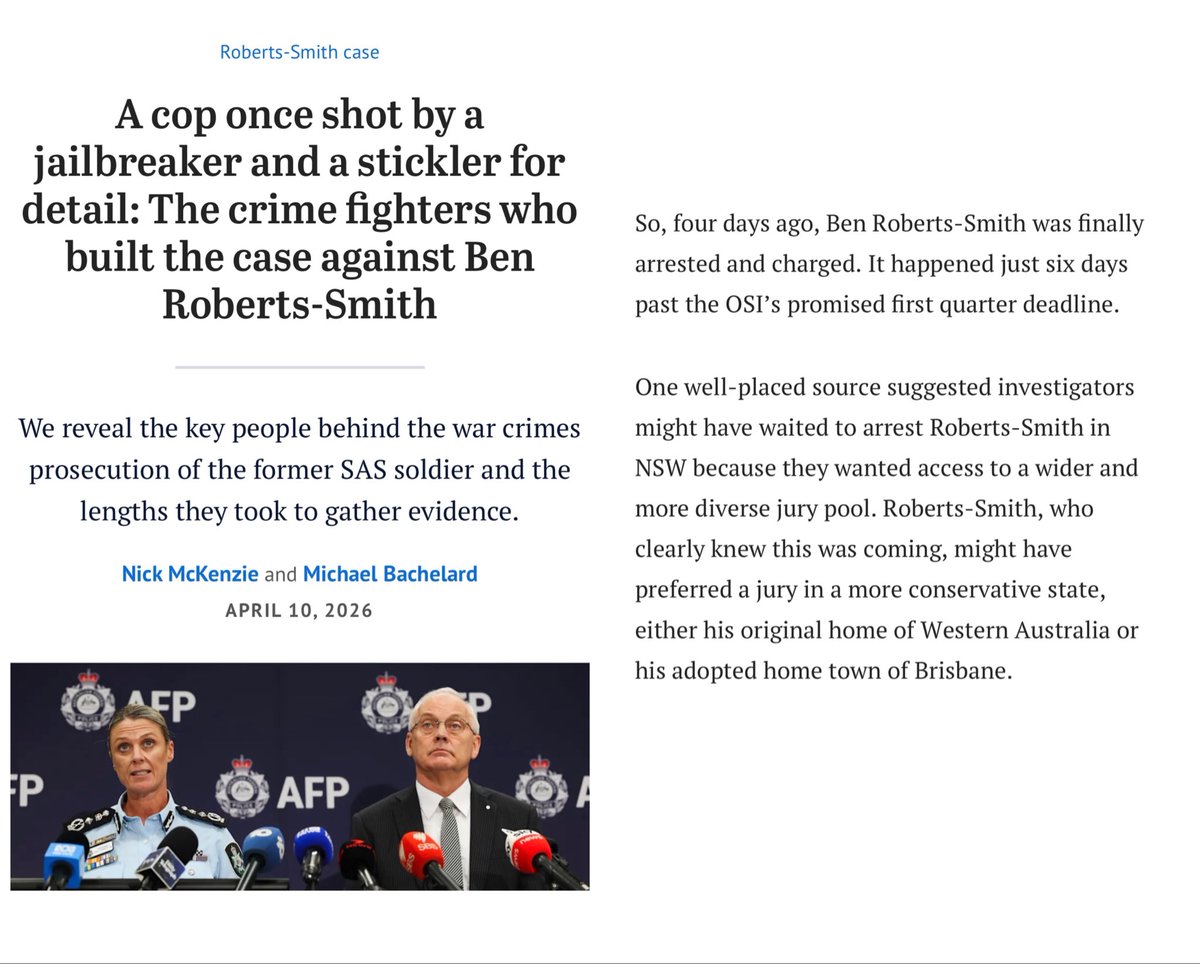
BREAKING: The Australian government chose to arrest Ben Roberts-Smith in Sydney rather than his home state of Queensland because the government prosecution wanted less white Australians on the jury - “a more diverse jury pool.”
So in practice the Australian government want Hamas and Hezbollah supporters from Lakemba and West Sydney to sit and judge Australia’s most decorated veteran from the Afghan War.
This explains why the Australian government rejected Ben Roberts-Smith’s repeated offers over multiple years to peacefully hand himself in. Instead they chose to arrest him on a plane in Sydney in front of his children and the wider public - a calculated humiliation ritual.
Sydney Morning Herald: “One well-placed source suggested investigators might have waited to arrest Roberts-Smith in NSW because they wanted access to a wider and more diverse jury pool” than more conservative Queensland, where he lives.
What if Charlie Kirk had been a beloved figure on the left, rather than among conservatives?
And what if Sharon McMahon were a conservative—one who had defamed Charlie Kirk immediately after his horrific assassination at UVU?
Would UVU have scheduled her to speak at commencement?
Not in a million years.
Not in ten million years.
So why does UVU think this is okay?
It’s not.
And splashdown!
America is back in the business of sending astronauts to the Moon and bringing them home safely.
Reid, Victor, Christina, and Jeremy did an outstanding job. These talented astronauts inspired the world and represented their space agencies and nations as humanity’s ambassadors to the stars.
This was a test mission, the first crewed flight of SLS and Orion, pushing farther into the unforgiving environment of space than ever before, and it carried real risk. They accepted that risk for all we stood to learn and for the exciting missions that follow, as we return to the lunar surface, build a Moon base, and prepare for what comes next.
And they were not alone. The entire NASA workforce, our commercial and international partners, and the hopes and dreams of people all over the world were with them. The astronauts know it, and you should too. This mission would not have been possible without you.
Congratulations. Artemis II, mission accomplished.
EPIC BACKFIRE IN IRELAND
The Irish Government sent in the MILITARY to CRUSH fuel protesters…but the Crowds EXPLODED in size. Now, huge parts of the country are RUNNING OUT OF FUEL.
Their Globalist Regime has COMPLETELY LOST CONTROL