@Kalasinga_ I have dealt with one of this matters. Wherein a certain SC was quick to aid their case to only pull out when things became hot. They tried to pass 1.2 B as legit business. The fraud here is not new to this town.
Justice Bahati Mwamuye added a rare touch of Kenyan musical reference to his landmark constitutional ruling on the Rastafari community’s bid to use cannabis as a religious sacrament, opening the judgment with lyrics from the controversial song Bangi by Just Imagine Africa (J.I.A.), the Kenyan alternative music band led by the late singer and guitarist Michael Mugo.
The excerpt provided a cultural backdrop to the court’s examination of bhang’s spiritual significance within the Rastafari faith and the legal questions surrounding its use.
The unconventional opening, which brought a Kenyan music reference into a constitutional judgment, has attracted reactions online, with many appreciating his use of a familiar artistic work while addressing issues of religious freedom, public health and the country’s cannabis laws.
Woe unto you if the court states as follows; "For rulings and judgements, please check the CTS or we shall upload rulings and judgements by the end of today" mark you it has not been read.
An employee has been ordered to pay his former employer Ksh. 1,452,112.12, while the employer has been ordered to pay him Ksh. 241,668 for unfair termination.
The employee sued claiming that he was unfairly dismissed for poor performance. His employer argued that he had negligently handled clients' printing machines, causing costly damage, unnecessary repairs and the expense of flying in engineers from India.
The court agreed the employer had valid concerns about his performance but found that it failed to follow the mandatory disciplinary process before terminating his employment, making the dismissal procedurally unfair.
However, the employer also filed a counterclaim seeking to recover the losses allegedly caused by the employee's negligence. Since the employee failed to challenge that evidence during the trial, the court allowed the counterclaim and awarded the employer over Ksh. 1.45 million.
This is a reminder that winning an unfair termination claim does not shield an employee from liability for proven negligence.
🚨🚨 BREAKING: YOUR EMPLOYER'S CASHFLOW PROBLEMS DO NOT SUSPEND YOUR RIGHT TO A SALARY.
The Employment and Labour Relations Court at Kisumu has delivered an important decision clarifying a question that affects thousands of Kenyan workers: what happens when an employer simply stops paying salaries because business is struggling? In Pride King Services Ltd v Innocent Onyango [2026], a security guard resigned after going four consecutive months without receiving his salary. The employer admitted that it had experienced financial difficulties, explained that employees had been informed of the situation, and argued that the Respondent should have waited for the company to stabilize because the outstanding salaries would eventually be paid. The Court rejected that reasoning. In one of the most striking passages of the judgment, Justice Nzioki wa Makau reasoned that it is not the responsibility of a worker to figure out how the employer will pay his wages. The Court held that by failing to pay wages for months, the employer had created the very circumstances that led to the termination of employment and therefore upheld the finding that the employee had been constructively dismissed.
The Court's reasoning is significant. A salary is not a discretionary benefit that an employer may postpone until business improves; it is the primary consideration for an employee's labor and one of the employer's most fundamental contractual obligations. While the employer pleaded financial hardship, the Court found that such hardship could not be shifted onto an employee who continued reporting to work without pay. At the same time, the Court carefully distinguished liability from quantum. Although it upheld the findings on unlawful termination, salary arrears, notice pay, service pay and compensation, it reduced the awards for underpayments, house allowance and accrued leave because those claims were subject to the statutory limitation period under the Employment Act.
The jurisprudential importance of this decision lies in its reaffirmation that the risk of running a business belongs to the employer, not the employee. Courts will not readily accept financial difficulties as a legal justification for withholding wages while expecting employees to continue working. Equally, employees who seek relief must be alive to the limitation periods governing employment claims, as even a successful claim may be substantially reduced if brought outside the periods prescribed by law. The judgment therefore strengthens two important principles of Kenyan employment law: wages remain a fundamental contractual obligation despite economic hardship, and statutory employment rights must be enforced within the timelines established by Parliament.
Kindly repost widely 🙏
When people did mandamano against finance bill, it was mainly pushed by the younger generation. Now they are coming to raid the pockets of the big with taxing dividends. It has come full circle, let see how they will fight this.
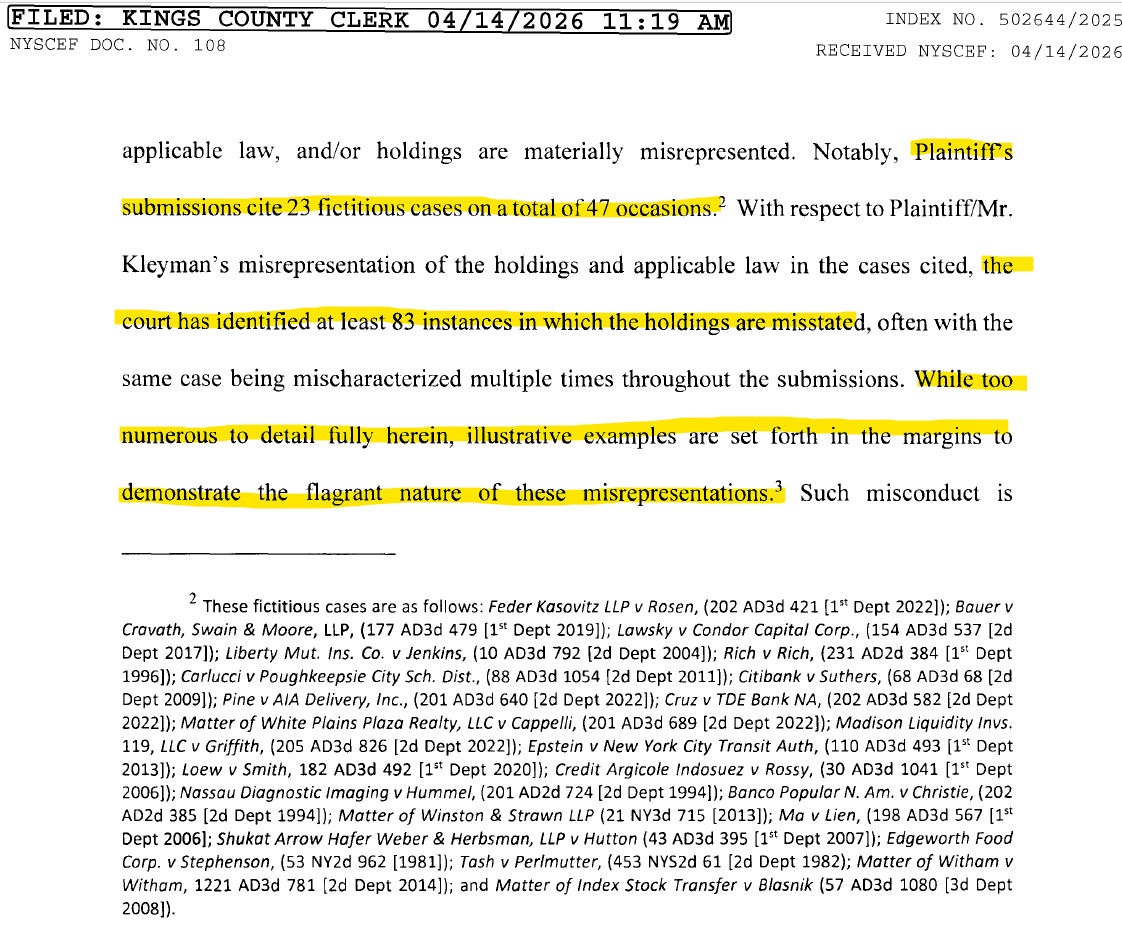
A law firm sues a client for $1.24M in unpaid legal fees.
But in that litigation, the lawyer cites 23 fake cases, on 47 occasions, across 19 filings, including in a motion for sanctions against the client (!).
The court also notes "at least 83 instances" where the lawyer misstated case holdings, with examples "too numerous to detail fully herein."
The client defendant who allegedly owed the money says he never even signed a retainer agreement, was never invoiced, and he filed an ethics complaint against the lawyer.
The court points out that the lawyer sought $50,000 in fees "for work product that appears to have been generated through the use of artificial intelligence, without adequate verification of the accuracy of the cited authorities."
The court grants the client's cross-motion for sanctions against the lawyer. Sanctions hearing and order to follow.
Nyoro is right. The poor theatrics on these fuel prices are so mediocre that the only justifiable reason to make roadside declaration is to get clout. It is very sad that politics of today is done in such a joking manner.
Whenever I review conveyancing or commercial contracts for clients in transactions where the other party is a high-net-worth entity, the first place I go is the dispute resolution clause. Any reference to a scam called arbitration goes straight out.
In Kenya, Arbitration is often dressed up as an efficient alternative to litigation, but in practice it frequently serves the interests of the arbitrator who will charge ridiculous fees and the party with the deeper pockets to bribe the arbitrator.
By the time the arbitration circus is over, you often end up in court anyway, yet this is a process that was supposed to avoid litigation in the first place. At that point, the dispute has already lost nearly a decade to a mechanism that promised efficiency.
This is Good & Long overdue!!!
The Central Bank of Kenya (CBK) has approved Safaricom's request to mask customers' full names and phone numbers in Lipa na M-Pesa transactions. This change applies only to Till and Paybill payments.
Moving forward, when money is sent via Lipa na M-Pesa (Till or Paybill), the recipient (merchant) will see only the sender's first name and a partially masked phone number (e.g., 07XX XXX XXX). This prevents the misuse of personal data for unsolicited marketing or other unauthorized purposes.
The measure is designed to protect users from unauthorized data sharing with third parties and ensures compliance with Kenya's data protection laws….
CJ’s has been ordered to pay Ksh 75,000 for sending unsolicited promotional text messages to a customer. The ODPC ruled in favor of Steve Onwonga Omwenga, who complained that the popular Nairobi eatery kept bombarding him with marketing SMS without his consent.
Businesses that ignore data protection laws are officially on notice that consent is not optional and “just marketing” can turn into a Ksh 75,000 mistake.