SWP 1011 by Aakriti Mathur, Aniruddha Rajan and Matthew Naylor (all BoE), looks at the effectiveness of Basel III capital regulation in supporting bank lending during Covid-19
https://t.co/SLIeshtNyI
🚨Final call for applying to our PhD Internship programme! 🚨
Applications close tomorrow, 5 February (2359 UK time, 0059 CET, 1859 EST). Best of luck to all PhD students!
Applications for our summer 2024 PhD Internship programme are now open! Great opportunity for PhD students to come to the BoE, work with our research team + get experience of working in a central bank. More details at: https://t.co/EMpUZQGnHd
LATEST RESEARCH
New paper presented at the EBA conference on banking supervision a few days ago by John Krainer and Pascal Paul @pascalpaul.
Banks that experienced larger market value losses on their securities during the monetary tightening cycle in 2022 extended relatively less credit to firms.
Authors find a stronger effect for (i) available-for-sale securities, (ii) unhedged securities, (iii) low-capitalized banks, and (iv) banks that have to include unrealized gains and losses on their available-for-sale securities in their regulatory capital.
https://t.co/pvEMo5lpTq
🚨🚨🚨 The UK Monetary Policy Event-Study Database is now live!! 🤩
HF monetary policy surprises from a variety of asset prices (& factors!) since BOE independence in 1997, continuously updated & free to use 🙌
https://t.co/6bjOPJPC69
With @robin_braun & Tuli Saha
🧵👇
Reminder: Our 2024 PhD programme is now open. Apply now to be part of our diverse + talented research team! Applications close at midnight on 13 November
📣Calling all PhD students, PhD supervisors + mid-career researchers!📣
We're hosting a webinar on 8 Nov about research at the BoE. Your chance to find out about our new research agenda PhD internships, PhD hiring + mid-career recruitment. [Please RT]
📢 We are hiring📢
A great chance to be part of our diverse + talented research team at a really interesting time. If you have a PhD / will have one by end 2024 please apply! Deadline is 13 Nov
https://t.co/EMpUZQFPRF
More details + application form at: https://t.co/mvJVADaROA
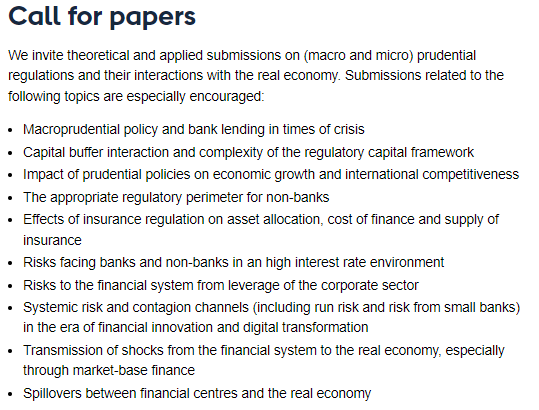
📢Call for Papers📢
Our 3rd annual Bank of England Agenda for Research (BEAR) conference takes place on 26-27 February on the theme of "The Prudential Framework". Keynotes from Bo Becker (@beckerbobo) + @JulianeBegenau. Submission deadline is 17 November.
https://t.co/qHTuckvVUr
ICYMI: BU post on indicator of risk perceptions. "In 2023 Q1, the UK measure fell to its lowest level since the outbreak of the Covid pandemic, indicating higher risk perceptions and potentially foreshadowing weaker economic activity"
https://t.co/KU3ZlEINtz
'The to-do list is not finished until you are. Learn to live in peace with that fact’, @TimHarford offers up some hard truths to those of us struggling to manage our time
https://t.co/LbE27X55b0
Short overview in @washingtonpost oped👇. Since then we've added many more bells and whistles based on the outpouring of comments received. We hope this work will inform policy to better address this all-too-common issue. [2/2]
https://t.co/1n5BDvRJ5K
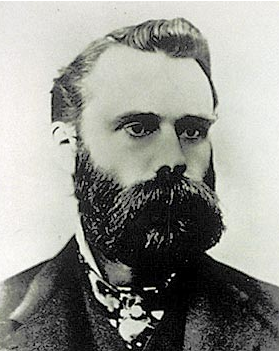
This is the 6th post in a series on 'important economists', based on the judgment of the @ExanteData team. Today, we look to a little-known pioneer in financial economics. Louis Bachelier (1870-1946) was a French mathematician and pioneer in the field of mathematical finance.
He is best known for his groundbreaking work on the theory of speculative markets and stochastic processes, which laid the foundation for modern mathematical finance and option pricing.
Bachelier's most notable contribution was his 1900 Ph.D. thesis titled "Théorie de la Spéculation," which introduced the concept of a random walk and applied it to the valuation of financial derivatives. In his thesis, Bachelier proposed that stock prices evolve randomly over time, following a Brownian motion or Wiener process. This idea anticipated later developments in probability theory and stochastic calculus.
Although Bachelier's work received little recognition during his lifetime, it gained attention in the 1950s and 1960s when other mathematicians and economists rediscovered his ideas and built upon them. Giants in statistics and mathematics such as Andreï Kolmogorov and Benoît Mandelbrot cited his work and recalled his important contributions. His work had a profound impact on the development of the Black-Scholes-Merton model, which is the foundation for modern option pricing and risk management.
Louis Bachelier's contributions to mathematical finance and stochastic processes have made him a significant figure in the history of finance and economics. His work continues to influence researchers, practitioners, and students in the field of quantitative finance.
We will cover many more 'important' economists in coming weeks on this feed...
This is the Queen's Stepwell in Gujarat, India, built nearly 1,000 years ago.
It is beautiful, but it isn't unique — India is filled with hundreds of stepwells just like it.
Here is the story of the world's most extraordinary underground architecture...
Deposit betas for all!
We’ve posted historical deposit betas for all U.S. banks from 1984 to 2022:
https://t.co/R6LFbthSMe
With @idrechs, @schnabl_econ, and Dominik Supera
1/9
🧵SWP 1019 by Gabor Pintér combines several sources of transaction level data to sketch out a narrative of September 2022 gilt market crisis and documents a number of key stylised facts about how it played out…
https://t.co/vVmCSaqZFW