Just saw a comment that was like, “all you need to do is visit downtown to see there’s something wrong with Toronto.”
My guy, there’s lots that can be improved in Toronto but have you ever talked to someone just visiting our downtown? Here’s @therealburns3 on his recent trip.
A recent Princeton study analyzed over 20 years of voting and polling data and found that American voters have a "near-zero, statistically insignificant impact on public policy."
So, if the US government doesn't represent the People, the obvious question becomes, "Does a political solution remain? Can we vote our way out of this, or is it too late already?"
Join me as I seek to answer that question: https://t.co/N2Gykx0d61
Suicidal malpractice by liberals to let Tucker each their lunch on this and become the most prominent voice in the media on this. Just letting the right reap the rewards on what should be a lay up but they're too afraid of offending the sensibilities of the killers.
The way many casual Jays fans see Jeff Hoffman & Daulton Varsho is the way they see Mitch Marner & Bryan McCabe & Larry Murphy & on & on & on.
Hoffman was nails in the postseason, until he allowed one earned run in Game 7 (something Chris Bassitt, Trey Yesavage and Shane Bieber also did).
Varsho was absolutely integral to the Jays making the postseason last year & was huge in the ALDS vs New York. He will finish his Jays career as one of the best defensive players in franchise history.
The casuals can hate. I’ll remember them as integral pieces to a World Series run.
I don't care what he thinks about video games, Roger Ebert had the ultimate redpill on nerd culture as a whole.
This basically describes every fandom on earth, and once you see it, you can never un-see it.
Adorno was right that pop music consumers would increasingly understand and evaluate music through the categories of the music industry itself (sales, charts, branding, market success).
I use ultrasound many times every single day in the ICU, but there’s a lot of unreasonable hype about this “whole body imaging” ultrasound. I’m very skeptical of the claims being made and I’ll explain why:
First some fundamental limitations of US:
Ultrasound doesn’t penetrate bone and doesn’t pass through air very well. This makes imaging the brain and lung parenchyma essentially impossible with US. Bowel gas also frequently makes it difficult to visualize abdominal structures like stomach, small bowel, colon. It can’t see into bone either which can limit its utility for musculoskeletal imaging. For this reason ultrasound isn’t really amenable to a “whole body scan.” It’s hard to see how this could replace other modalities (MRI, CT) if it can’t visualize so much of the body.
Ultrasound exams are often dynamic. If you’ve had one you may have been asked to roll or move to visualize certain structures. This requires a skilled operator. Immersing the patient in a tank for a 1 minute scan is a cute shortcut. It’s technically easier but it probably won’t be able get optimal images, further limiting interpretation. Also are they exchanging the water in the bath each time? Much of the time spend on imaging is actually cleaning the scanner between patients. Unclear how you can quickly disinfect a liquid scanner.
The theoretical resolution of ultrasound is very high, but that isn’t quite the same thing as being able to identify structures. There are lots of artifacts and limitations to ultrasound. For some organs (thyroid, kidney, liver) it’s great. For others it may be less so (pancreas, colon, stomach, etc). Hard to see this replacing existing methods, especially if the concern is cancer screening.
Ultrasound isn’t really one modality. There are a lot of different techniques (B mode, M mode, 3d modes, different types of Doppler, etc). Unclear how many of these this gizmo can do. Adding these capabilities may make the scan more capable but will also add to the scan time if it has to switch modes. There’s no free lunch. There’s always a tradeoff between scan quality and time.
AI is great at *certain* narrow medical image interpretation tasks. But there isn’t a massive training set of data for this “new” modality. I wouldn’t expect AI to be very good at reading these scans until they’ve accumulated millions. That means they are still paying human radiologists to interpret for the foreseeable future.
Everything in medicine is based on evidence. Proving that lung cancer screening saves lives took a decade. Where are the studies for this? So far just hype. More concretely, without evidence insurance won’t pay.
Finally, Who is this technique for? Yes it avoids ionizing radiation but so does MRI. Yes it’s quick, but so is a CT scan. The scan may be quick but the interpretation may be slow (It’s still dependent on human radiologists) and the machine may require time to clean. It can’t image lots of body parts so it’s hard to see how it replaces “whole body MRI scanners.” I’m sure there are tech/wellness bros who are excited but pay out of pocket for low quality wuick partial body scans but wider adoption depends on more than hype.
@SebastianCaliri "The FDA is not in the slightest ready for this." Is possibly the funniest way of saying the FDA will not approve this thing for diagnostic imaging I could think of.
The smartest man in AI just exposed the whole AGI narrative as a LIE.
And he used a physics problem from 1905 to prove it.
His name is Demis Hassabis. He runs Google DeepMind, and won the Nobel Prize for using AI to crack a problem in biology that had stumped scientists for 50 years.
Almost nobody in this industry has a track record like his.
He went on the NothingButTech podcast and called out the biggest lie in AI right now:
Right now the loudest voices in AI are telling you that AGI is basically here. OpenAI has literally defined AGI as a system that can outperform humans at most "economically valuable work." In other words, if it replaces enough jobs, we have arrived.
Hassabis thinks that bar is a joke.
He said real general intelligence has to do what the human brain can do, because the brain is the only proof we have that this kind of intelligence is even possible. He called that "a higher bar than just being able to do some useful economic work," which is about as close as a polite British Nobel laureate gets to calling his rivals out.
Then he gave the actual test:
Today's AI has read everything humans have ever written, including the theory of relativity. So when it explains relativity back to you, it's repeating an answer that already exists.
That's not intelligence.
So Hassabis proposed a test that makes memorization impossible. Train an AI on only what humanity knew in 1901, four years BEFORE Einstein published relativity. Then ask it to come up with relativity on its own.
It can't look up the answer, because in 1901 the answer doesn't exist yet. The only way to pass is to do what Einstein actually did: Take the same physics everyone else had and reason its way to an idea no human had ever had.
Hassabis says not a single AI today can, no matter how much it has memorized. Which means what we keep calling "almost AGI" is really just the best librarian in history.
It can find any answer that already exists but it cannot create one that doesn't.
His second version is even sharper:
AlphaGo, the system his own team built, famously invented a brand new move that no human had played in 2,000 years of the game.
Everyone called it genius but Hassabis says that still is not the bar.
The real test is not whether an AI can invent a new move inside Go, it is whether an AI could INVENT a game as deep and as beautiful as Go in the first place.
No model that exists today can do it.
The people telling you AGI has already arrived are the same people raising hundreds of billions of dollars on that exact promise.
The valuations only work if the finish line is right in front of us. So the finish line keeps getting dragged closer, and AGI keeps getting quietly redefined down to "does useful work," until the products they already sell happen to qualify.
Hassabis has nothing to prove and nothing to sell you. He already won the Nobel, and he is telling you the machines still cannot do the one thing that would make them genuinely intelligent, which is have a truly original idea.
To be fair to him, he is not a pessimist about it. He believes real AGI IS coming, and he is spending his life building it. He just refuses to pretend it is already sitting in your phone.
So the next time a founder tells you AGI is months away, remember that the one man in the room with a Nobel Prize built his test around Einstein, and admitted that nothing we have made can pass it.
What do you think?
There's a section in Plato's Republic that this photograph captures. It's in Book Eight where Socrates is discussing how an oligarchy transitions into a democracy. One way is when the workers are in physical proximity to their bosses and realize they can be overthrown.
Baseball players are still the proletariat by definition. They still sell their labor and don’t own the means of production. And they’re still engaged in a class war with those that do.
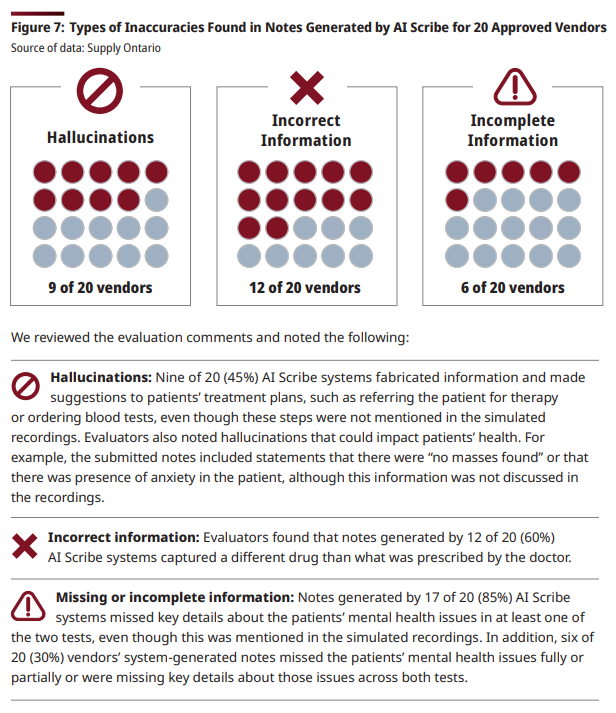
An auditor for the Ontario, Canada government found that AI agents tasked with turning doctor/patient conversations into structured notes routinely hallucinated false treatments, replaced drug names with entirely different drugs, and missed crucial information