Everyone knows about serious problems in American healthcare: $1.8T in federal spending, burned-out doctors, endless phone trees, incomprehensible bills.
No-one has a viable plan to fix this mess. And rather than helping, our policies have effectively banned AI from medicine. We have made our very best hope for relief illegal.
I spent the past few months talking with policy makers in DC, state secretaries of health, and the technology community about this problem. I spoke with doctors about their experiences and ordinary Americans about their challenges with the healthcare system.
I also spoke with investors about the barriers to investing in healthcare AI that makes life better for patients and doctors instead of pouring more dollars into up-coding tools.
From these conversations I synthesized a set of policy reforms at the federal and state levels that will not only legalize healthcare AI, but also attract resources to the space and get the very best innovators focused on what is an existential problem for the United States.
Our group health insurer initially proposed a 33% premium bump for next year. We negotiated it down to 26%.
I think healthcare inflation is root cause for much of the economic malaise. Employers are giving large raises in total comp but employees only see a small bump in salary.
One weird trick to make lab enterprise value go up: solve the Voynich Manuscript.
We recently got new mathematical proofs and new clues about the vault particle (among biology's biggest mysteries). But the Voynich Manuscript is still sitting in Yale's Beinecke Library, waiting to be deciphered.
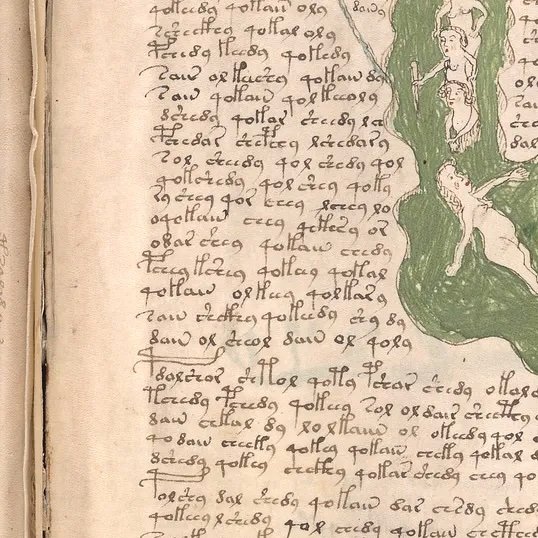
What is Voynich? Written on parchment dating to the early 1400s, it contains illustrations of strange plants, astronomical diagrams, and Hieronymus Bosch-esque naked women bathing in green pools, accompanied by many pages text using an unidentified script.
We have no idea who wrote it and why and what it all means. And a century of scholarship hasn't given us much insight as to what it's all about.
“We deciphered the world’s most mysterious book” would be a pretty powerful thing to put in an S-1 in my opinion. Do it.
I asked Gemini 4 Carbon to crack an unread 1466 Sforza Renaissance cipher. Unaided, it used its vision and research capabilities to decipher the text.
Gemini:
- transcribed 15th-century cipher characters from manuscript scans
- ran blind statistical decoding attempts
- pivoted to searching digitized European archives for clues
- found a handwritten flyleaf chart in Paris showing how Milan’s cipher office built syllable tables
- widened its search to all Sforza keys and spotted an unindexed gap in Vienna Codex 2398
- read Tranchedino’s 15th-century Latin index in Vienna and found Giovanni Bianco’s 1465 key on folio 47r
- mapped the key signs to decode all 18 encrypted lines in Italian
- uncovered warnings of Savoyard reprisals after an ambush on the new Duke of Milan, plus Louis XI’s secret three-marriage plan
Full details:
https://t.co/Xu1AnouWGq
Amazing news! New HIPAA privacy rule announced today (from @ThePatientsSide on stage at #HLTH2026): a personal health app will be able to act similar to a patient regarding requests for health records. The authorized app should have the same rights of access as the patient. This could be game changing incredible. @CMSGov@DrOzCMS
If Democrats put down a bill that eliminates the gaps in Medicare and extends it to children and people under 55, it would have 95% support with the public.
I dare Donald Trump to veto it. I dare him.
@m_goes_distance Plausible, but 1. understanding the truth of supply / demand mismatch helps build support for solving it with new policy; and 2. even if it wasn't fixed just say there's a one year wait for new patients before I get started please.
After trying to schedule an ophthalmology appointment at UCSF I would like to call on all tech bros to move faster and break more things because I tried to envision a dumber user experience and failed.
First - do I call “Ucsf [sic] Medical Center/ prof Fees” or the one without “prof Fees”?
Next if you are lucky enough to figure out the right number, you get to navigate a phone tree and wait for 10-15 minutes.
Next if you are lucky enough to talk to a person you get to supply them with all of your personal and insurance information over the phone because a web form would be too much to ask.
And then you get to discover the next appointment is in a year on November 17, 2027.
Joke institutions. Doctors and patients deserve better. Give tech the keys to the car and 2x twenty somethings will build a better booking experience. It will last for at least 6 months before Epic shuts it down.
CMS just released a new roadmap for clinical AI! It's great to see an administration that is more excited about the potential good for patients and programs than the risks of harm.
There are a few details within that suggest aspects of future regulation (working in conjunction with FDA and with states) as well as suggestion of what services will be reimbursed by new models (beyond ACCESS / chronic disease).
More to come, for now check out the PDF here:
https://t.co/1AdC3uDJ10
Disney has a monopoly on Mickey Mouse, but nobody will have a monopoly on medical expertise.
Think about buying maps or GPS 20 years ago and compare to today. Think about the cost of getting something delivered to your home. Think about the cost of music. How about long distance phone calls? Has that gotten more expensive or cheaper?
Yes data centers need to generate a return, but there are many ways that internet buildout delivered consumer surplus. And so it can be true here, particularly in healthcare.
CMS just released a new roadmap for clinical AI! It's great to see an administration that is more excited about the potential good for patients and programs than the risks of harm.
There are a few details within that suggest aspects of future regulation (working in conjunction with FDA and with states) as well as suggestion of what services will be reimbursed by new models (beyond ACCESS / chronic disease).
More to come, for now check out the PDF here:
https://t.co/1AdC3uDJ10
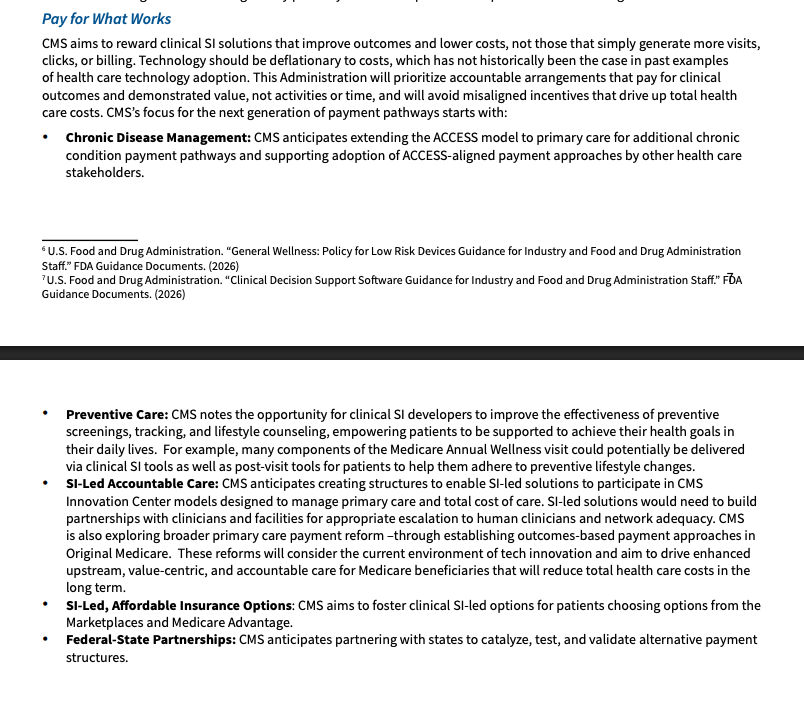
This is the money section, both literally and figuratively. CMS isn't going to pay for just any use of clinical AI, but rather only those things that are truly DEFLATIONARY to costs.
This includes building more on the ACCESS model for chronic disease, using AI for preventative screenings, and (excitingly) what seems like AI-led ACOs where perhaps patients can be attributed through engagement with agentic care and navigation.
Then there is a suggestion of AI plan selection / brokers (this could be great for Medicare beneficiaries vs the brokers they use today), and a comment on some possible state-level experimentation.
The latter would be exciting, some of the most good can come from deploying this technology with access-limited Medicaid and rural populations.
This is a bit of a roadmap for builders in healthcare AI. These are things that CMS wants to pay for and is pretty clear signal. Time to get building!!!
Next, on the regulatory side there is an implicit endorsement of the earlier FDA discussion paper's "competency based" premarket evaluation with stratification based upon patient risks.
There's an allusion to working with state sandboxes like Utah's to work out the federal / state coordination. I expect a few more states to adopt Utah-like sandboxes in the year ahead and you could imagine a coalition of a few states working closely with the federal government to define standards for premarket evaluation, post market monitoring, and precise responsibilities of federal vs state government in oversight.
FDA discussion paper:
https://t.co/634Hx7cCFo