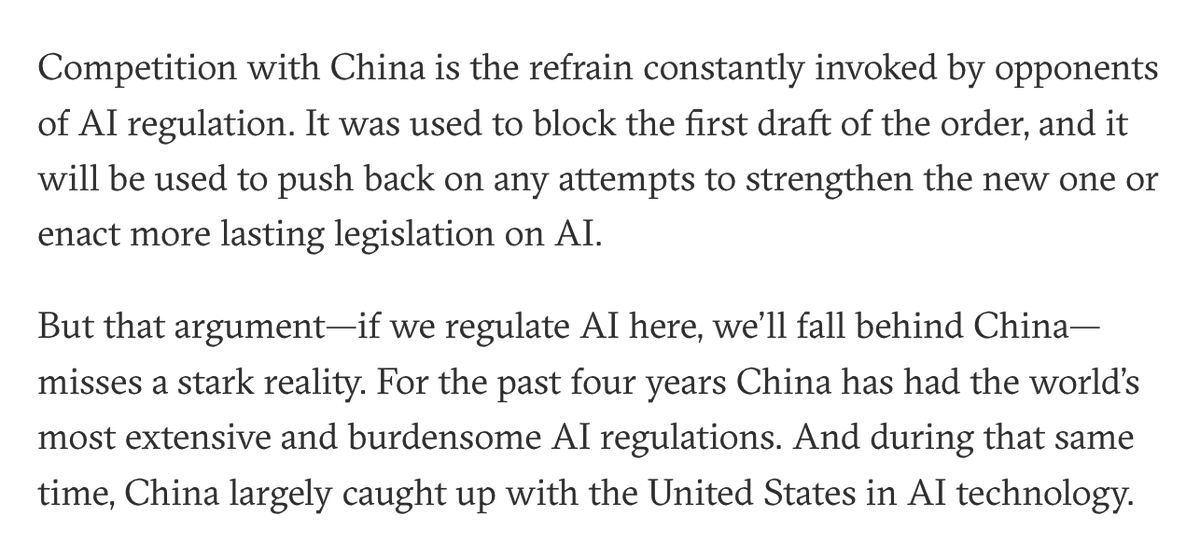
New piece from me in the wake of new White House EO on AI. It looks at a seeming paradox:
- For the past 4 years, 🇨🇳 has had the world's most extensive and burdensome AI regulations.
- During that same period, Chinese AI companies largely caught up w/ their 🇺🇸 peers.
Link below
Giving up its “zero tolerance” approach to controlling gen AI models was the precise change China made to its gen AI regulation that unlocked the industry.
Draft reg said models “shall not” create unacceptable content, final said “take effective measures” to reduce the content.
Unironically: This is exactly the sort of anti-progress policy position I expect from the CCP, not the land of the free.
I’ve been running around telling people I think the U.S. political system is better-positioned than China’s to adapt to AI’s disruptive effects.
If the Trump administration is adamant in holding a “zero-tolerance” policy for AI deployment, it will seriously imperil U.S. leadership in AI services.
As I wrote for @AEI last year: In the age of “glass-cannon” technology, the ability to adapt quickly is more important than the ability to predict perfectly.
We’re a resilient, democratic society capable of weathering massive technological change. Let’s act like it.
This is a CAISI staff appreciation tweet.
A remarkable set of ML experts at CAISI, including my PhD classmates, have stuck it out through all the uncertainty of the last few years, foregoing extremely lucrative industry offers to ensure the USG can now react well to frontier AI.
Thank you for your service.
LATEST play-by-play on the White House-Anthropic export controls saga:
- It will likely take longer than a few days to reach a resolution that eases export controls, a senior WH official tells me but they left the door open to the possibility that it can be done quickly. “That’s up to Anthropic.”
- Since Friday, Trump has asked Howard Lutnick to be more involved with Anthropic
- On Saturday, Lutnick, Sean Cairncross, Anthropic’s Tom Brown + Sarah Heck had multiple high level hour+ long calls
- Over the weekend, Anthropic assembled a technical team including Logan Graham from “Frontier Red Team,” Dave Orr who is head of safeguards, and lead security researcher Nicholas Carlini to engage the admin
- Today (Monday), the Anthropic trio gave in-person presentation to administration officials from ONCD and Commerce’s CAISI. Chris Fall, head of CAISI, was one of the participants.
- Bessent has been less involved over the weekend and Treasury did not participate in the in-person meetings Monday
- Lutnick and Bessent both flew to G7 on Air Force One with Trump
W/ @cheyennehaslett
https://t.co/8B4gFAeM6v
People should take up Rep. Trahan and Rep. Obernolte on their call for input on GAAIA.
Rest assured companies/trade associations will, but will safety-oriented folks?
https://t.co/dxJx4lNCkh
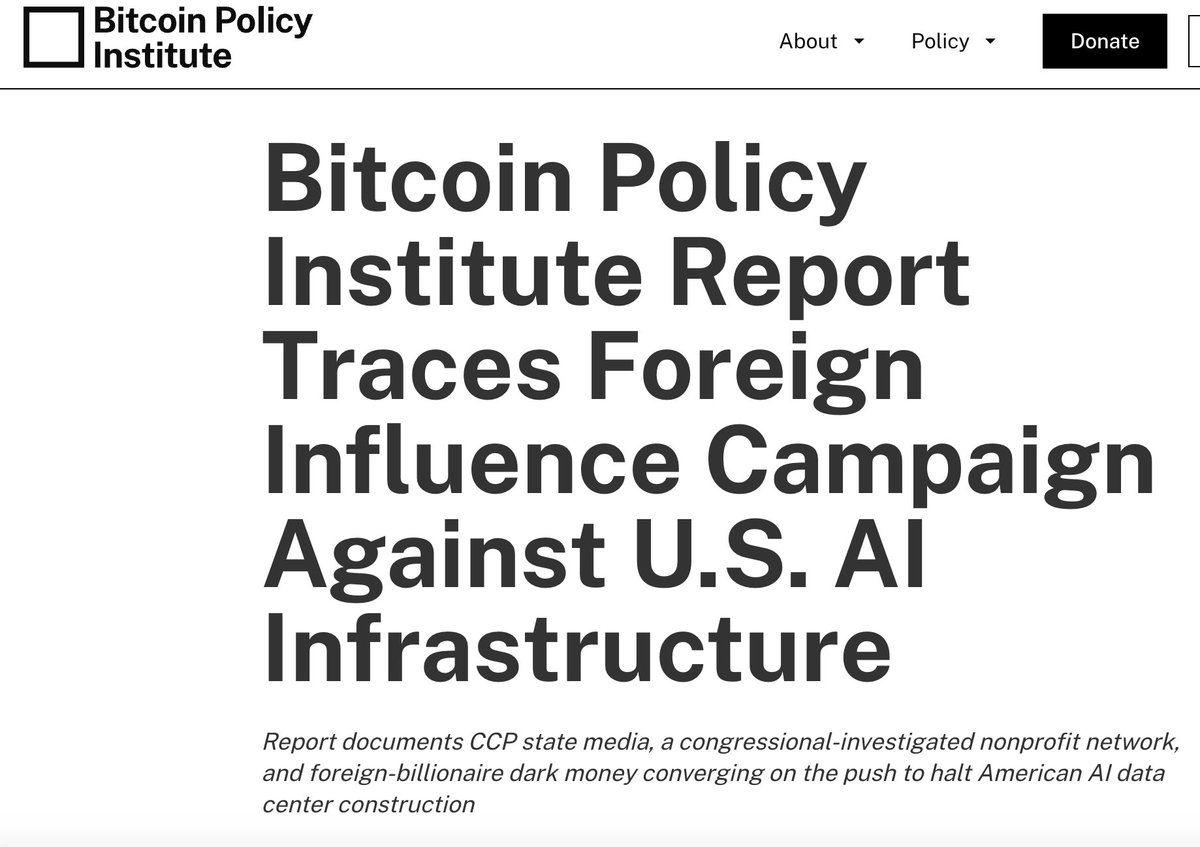
Bethany doing the maddening work of debunking intentionally dishonest reports that try to discredit activism by Americans as Chinese influence ops.
When politicians convince themselves the only way Americans could disagree w/ them is if they're subject to foreign conspiracies...
I increasingly find that my primary role in the "China influence" space these days is to debunk a lot of very, very poor quality "China influence" research reports that have been coming out.
I don't think it would be an overreach to call this slate of reports "China influence slop." But such a term is too kind, because it fails to indicate that these reports are primarily motivated by the desire to delegitimize grassroots American organizating by attempting to associate them with "hostile foreign forces" — a tactic widely used by the CCP to delegitimize grassroots Chinese civil society whenever it finds such movements inconvenient.
Let me start with a couple recent ones:
— The reports from Bitcoin Policy Institute and Power the Future which have led House reps to call for an investigation into anti-data center organizing
— And this latest one about how China is supposedly bankrolling climate activism at the University of California system and thereby acting to "shape California’s climate and energy policies."
I can demonstrate, very easily, that these reports are
1) exceedingly poor quality as China influence reports go
and
2) primarily and overwhelmingly motivated not by a desire to uncover China's influence (and thus to preserve the integrity of US civil society), but rather to delegitimize what are very obviously organic US movements (and thus to compromise the integrity of US civil society)
Reports like these represent an anti-democratic abuse of the concept of China influence research, which denies agency to real Americans.
These reports, given both their methods and their political goal, are also a form of disinformation and propaganda, very similar to how China paints Hong Kong pro-democracy protesters as stooges of America.
And finally, these reports make a mockery of actual, high-quality China influence research.
This must stop now — and journalists reporting on this style of report should do so with the highest degree of journalistic professionalism and scrutiny.
U.S. and China AI development will continue to fluctuate between 3 and 15 months. It's interesting that China is becoming open, and the U.S. is becoming closed. Great conversation with @alansmurray at the WSJ Leadership Institute CEO Summit.
https://t.co/gc1jZNvxSh
CAISI has reportedly been directed to stop publishing public model assessments as the new AI EO gets implemented.
Natsec engagement on AI is essential. But pulling CAISI's evals from public view doesn't make the field more secure. It just means fewer eyes on the science when we need more.
Openness and natsec don't have to be in tension here. We should be doing both.
Xi Jinping’s right-hand man, Cai Qi, is now president of the Central Party School, among his other roles.
Xi Jinping and Hu Jintao both served as head of the school before becoming top leader, as did prior generation leaders like Hu Yaobang, but in more recent years it’s been a landing spot for a favored senior retired official (e.g., Chen Xi held onto the post even after he stepped back from running the Organization Department).
This will set off a flurry of speculation about Cai’s future, following recent reports describing him as “China’s second most powerful man.”
But it’s not a clear signal of much other than that Cai continues to be someone Xi relies on and supports.
https://t.co/tvMkt99qel
The striking photo here is by H.S. Liu, an AP photographer who was in Beijing at the time of the Chinese military’s massacre of unarmed protesters in June 1989. For those who know Beijing, this was taken by the Second Ring Road and Jianguomenwai Diplomatic Compound.
AI safety skews heavily male. Wanting to do a small part in amplifying some of the women doing important work in the field, starting with technical safety, alignment, and evaluations.
@hlntnr -- Interim Executive Director at Georgetown's CSET, former OpenAI board member. Bridges technical and policy better than almost anyone!
@BethMayBarnes -- Founder & CEO of METR, the frontier model evaluations nonprofit. Former OpenAI alignment researcher.
@ajeya_cotra -- at METR on threat modeling and loss-of-control risk. Known for the biological anchors framework on AI timelines.
@vkrakovna -- Research scientist at Google DeepMind Alignment team. Co-founder of Future of Life Institute. Currently working on deceptive alignment and scheming evaluations.
@ancadianadragan -- VP of AI Safety, Alignment & Collaboration at Google DeepMind.
Who else should be on this list?
1/ I just read @MattSheehan88’s new piece in Carnegie and it's a great takedown of the one argument that kills every attempt to regulate AI: "do that and we hand the lead to China." The record says otherwise. 🧵https://t.co/i0u2sB96SF
New piece from me in the wake of new White House EO on AI. It looks at a seeming paradox:
- For the past 4 years, 🇨🇳 has had the world's most extensive and burdensome AI regulations.
- During that same period, Chinese AI companies largely caught up w/ their 🇺🇸 peers.
Link below
The OpenAI national security policy team is hiring for my old job!
As the AI stakes get stratospheric, the technical nuances of policy become extremely important. This can be an incredibly positively impactful role for the right person. If you might be excellent at this, I’d love to answer your Qs.
@miclchen Yep, broadly agree. There's significantly more testing going on than what's written into the regs/standards, but overall its narrowly scoped and methodologically weak.
That's why I think the US-China gov dialogue should (at least partly) focus on T&E methodology.