$1M+ in e-commerce sales. $80,000 frozen overnight. 3 years away from the game
when i came back, ad costs were up 20% and the median store was getting back $1.88 for every $1 it spent.
for most stores that's a loss
here's what i wish someone told me before i spent a dollar:
the stuff that used to work now quietly drains ur bank account every single day
i started selling online in 2014. mostly pet products
back then it was almost too easy. throw up a cheap website, run some ads, and the orders just came. some of those products felt like gold mines
then slowly it stopped working
the algorithm changed. costs went up. products that used to print money started losing it
and on top of that, shipping delays. which meant returns. which meant chargebacks from customers who were tired of waiting
at some point i was spending more time putting out fires than building anything
(the $80k is its own story. a payment processor and a pair of slippers. another post)
so i stepped away for 3 years. worked on other things, kept an eye on the industry, didn't run a store
when i came back and looked at ads again, i barely recognized it
the cost to show ur ad to 1,000 people went up about 20% in a single year
the median store on meta gets back around $1.88 for every $1 it spends. for most stores that isn't even break-even once u take out product cost and shipping
and the targeting tricks everyone used to swear by mostly don't matter anymore. meta's AI decides who sees ur ad, and it decides mostly based on the ad itself
so a lot of new stores are doing everything the old way, spending real money, and wondering why nothing works
it's like trying to fill a bucket that has a hole in the bottom. u keep pouring more in and the level never moves
here's what i'd tell anyone starting now:
1. don't run a single ad until ur tracking actually works
2. know ur break-even number before u launch, not after
3. ur creative is ur targeting now. spend ur time there
4. fix the product page first. most carts get abandoned there, not in the ad
none of that is exciting. it's also the difference between ads that pay and ads that just cost
i put the exact checks i run before launching any ad into a free checklist
comment "ADS" and i'll send it over,
must follow so i can DM
his works way beyond supplements, and it’s the cheapest retention fix there is
the fastest way to find your “top 3 misuses”: read your 1-star reviews and your support inbox. customers already wrote the email for you
I learned a version of this the hard way. back when shipping delays hit my pet products, most of the chargebacks came from people who just didn’t know when their order would show up. one honest “here’s exactly when to expect it” email would have saved a lot of them
expectations aren’t a nice touch. they’re the difference between a refund and a repeat customer
what’s the #1 thing your customers get wrong right after they buy?
It’s really easy to avoid the 50%+ churn your getting on subscriptions right now
It’s not because the product was necessarily bad, it’s because nobody taught them how to use it properly
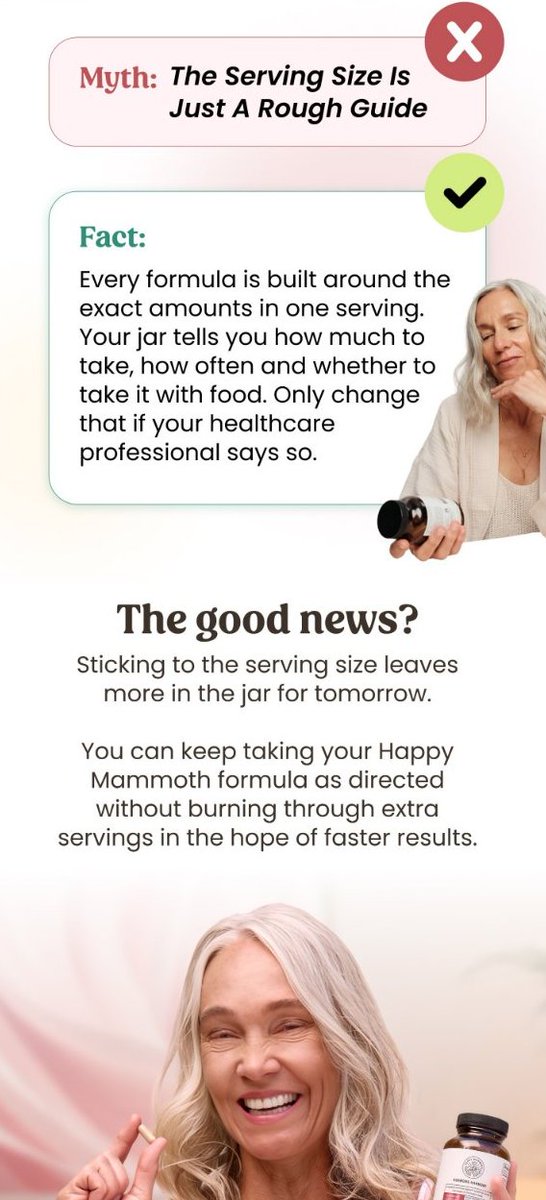
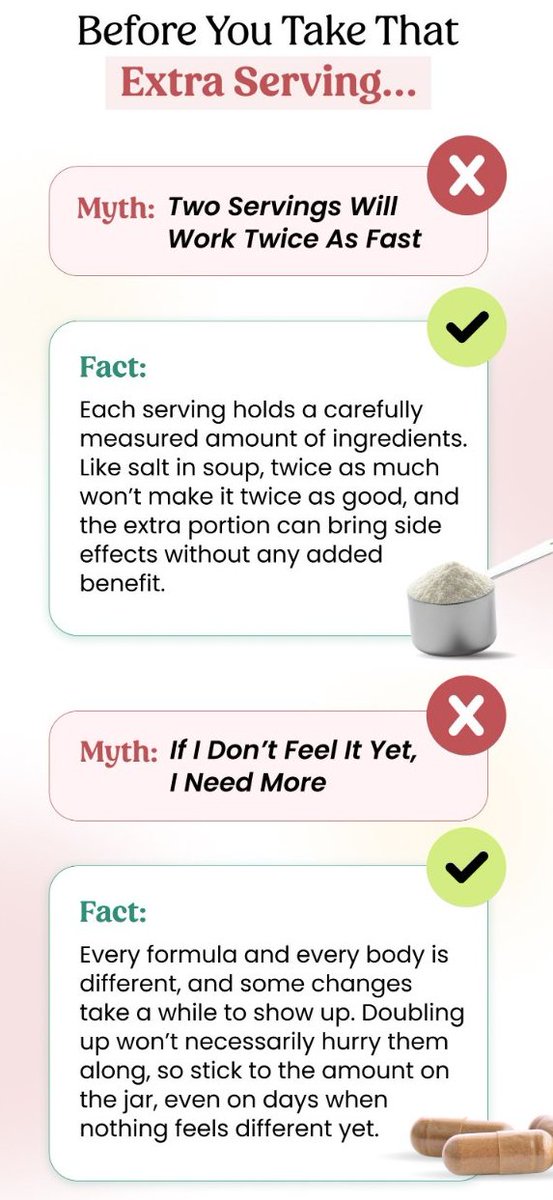
Most brands ship the box and pray, but Happy Mammoth uses post-purchase emails to call out bad habits before customers ruin their own results:
- Warning that double dosing won't speed up progress, saving customers from side effects and wasted cash
- Setting straight-up timing expectations so people don't quit when day three doesn't feel life changing
- Locking in precise daily serving sizes so taking the supplement becomes an automatic routine
A boring receipt email gets swiped away into the archive
A raw reality-check sequence fixes misuse, manages expectations, and keeps subscribers locked in long after the hype wears off
Even the most impatient buyers stick around when you give them an honest roadmap instead of sales hype
How to run this exact play on your next batch of orders:
- Uncover the top 3 ways customers misuse your product or expect instant miracles
- Send a dedicated myth-busting email 24 hours after purchase to set the record straight
- Spell out exact dosage and timing rules in simple plain text before the package lands on their porch
Stop sending generic receipt emails and start teaching your buyers how to actually get results from day one
“saw it coming 3 months out” is the real flex here
the first big month is usually a spike. the first boring month is usually a system
I learned the difference the hard way. my early pet products had months that felt like magic, and I couldn’t have told you why. so when they slowed down, I couldn’t tell you why either
boring is what happens when you know your numbers cold: what a customer costs you, what they spend, how many come back
if you can’t predict next month, you don’t have a business yet. you have a good streak
I've done $1M months for years now. Nothing compares to making my first $100K.
$100K month = years of chasing it with nothing but effort
$1M month = saw it coming 3 months out
Every goal since = a target and a plan to hit it
The first one felt like I earned it with all the effort I put into it...and the rest feels like the business doing its job.
So if your next number feels boring, you built it right (make sure to hit it anyway)
agreed, and in e-com “just try” needs one rule attached: try cheap, try fast, try again
most people’s first “shot” is $5,000 in inventory and a brand they spent 3 months designing. that’s not a shot. that’s a bet
a real shot is $280 in ads, 4 different angles, 7 days. lose it and you learned something. win it and you know exactly what to scale
take more shots. just make them small enough that you can afford 10 of them
Everything you want is on the other side of taking a shot, asking again, and not giving a fuck about what other people think until you get what you want.
You just have to fucking try.
$1M+ in sales. $80,000 frozen overnight. 12 years of mistakes
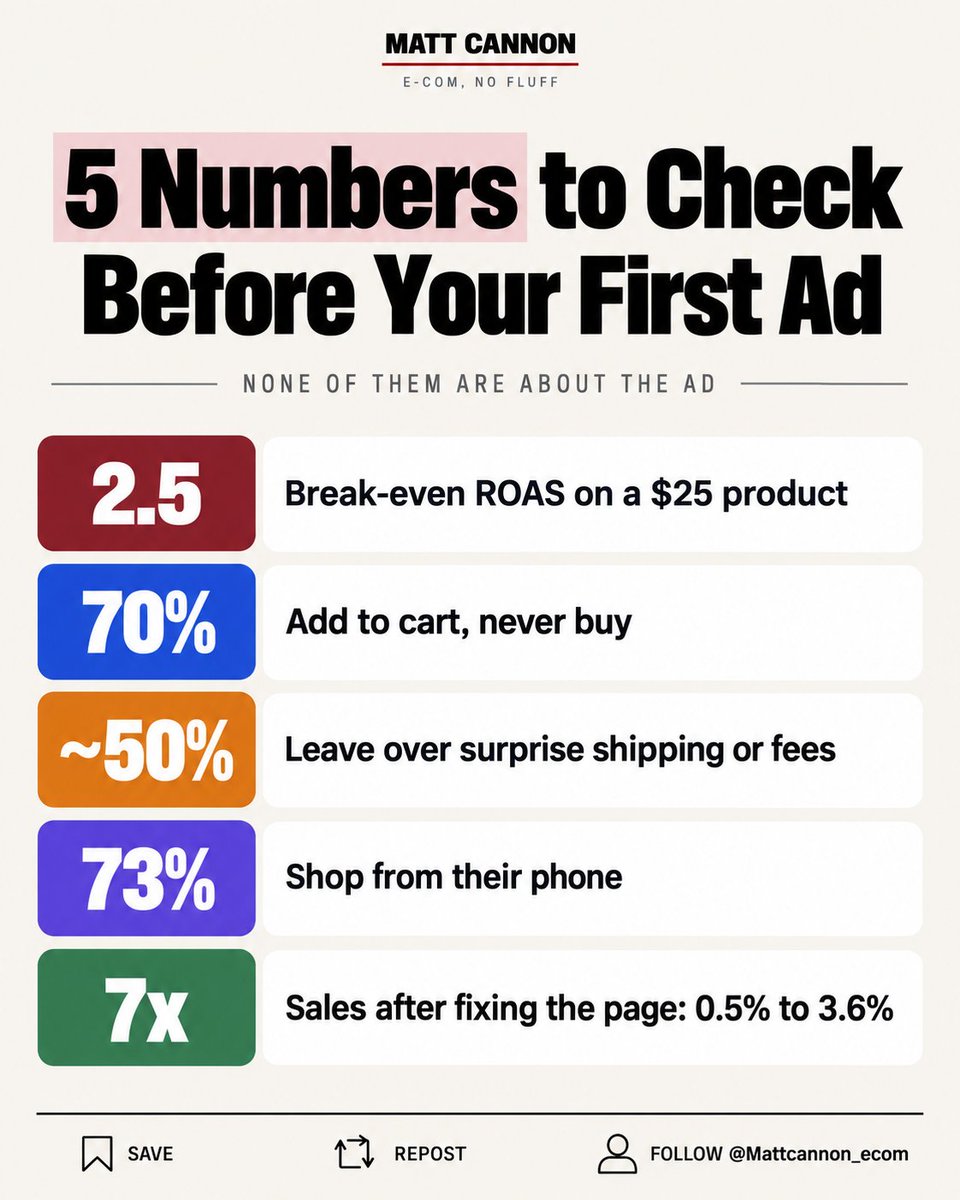
here are the 5 numbers I’d check before spending a single dollar on ads
most new stores never look at them. that’s why most new stores lose money
1 → your break-even ROAS
a $25 product that costs you $15 needs $2.50 back for every $1 in ads just to break even. the median store on meta gets back about $1.88. do the math before you launch, not after
2 → 70%
that’s how many people add to cart and never buy. the ad did its job. something on your store sent them away
3 → almost half
that’s how many shoppers bail when shipping or fees show up higher than expected at checkout. surprises kill sales
4 → 73%
that’s how much e-commerce traffic is on a phone. if you’ve never bought from your own store on your phone, you’re guessing
5 → 0.5% vs 3.6%
my buddy Justin’s conversion rate before and after we fixed his page and ads. same product, same price, same traffic. about 7x the sales
here’s where it gets stupid
none of those 5 numbers are about the ad
most stores keep changing their ads when the leak is somewhere else. it’s like pouring more water into a bucket with a hole in the bottom
fix the bucket first. then pour
I put every check I run before launching an ad, plus the full system for finding a product, building the store and running your first campaign, into one book
comment “ADS” and I’ll send you the link
must follow so I can DM
$280. 4 ads. 7 days. 14 sales
a beginner would have quit, because the average looked like a loss
here’s the test I’d run on any new product, as an example
one campaign. broad targeting. $40 a day. 4 ads, each with a genuinely different angle
after 7 days:
ad A, pain angle: $52 spent, 0 sales
ad B, before and after: $96 spent, 7 sales, $13.71 each
ad C, confidence angle: $71 spent, 3 sales, $23.67 each
ad D, the objection: $61 spent, 4 sales, $15.25 each
say your break-even is $18 a sale
the overall average is $20 a sale. over break-even. looks like a failure
here’s where it gets stupid
2 of the 4 ads are profitable. the other 2 dragged the average down
turn off A and C. give B and D the whole budget
next week starts with 2 ads that already beat break-even
think of it like a sports team. you don’t cut the whole roster because 2 players had a bad game
the rules I’d follow:
→ don’t touch anything for 7 days
→ kill any ad that spends 2 to 3x your break-even with zero sales
→ scale winners about 20% every 3 to 4 days
most stores quit on the average
the average lies. the individual ads don’t
almost half of shoppers abandon their cart when the total comes out higher than they expected
not because of the product. because of the shipping line
here’s the trap
a store shows $34.99 on the product page. then $7.99 shipping appears at checkout
the customer didn’t change their mind about the product. they changed their mind about you
it felt like a trick, even though it wasn’t
now the same store shows $42.99 with free shipping
same money in your pocket. a completely different feeling at checkout
think of it like a restaurant that adds a surprise $8 fee to the bill. the food was great. you’re still not going back
hot take: free shipping is the cheapest conversion boost most stores never test
not because shipping is free. because surprises are expensive
what I’d do on any new store:
→ build shipping into the price
→ show the delivery time on the product page, before checkout
→ if you do charge for shipping, show it before the cart, not after
how many of your carts are dying at the shipping line right now?
40% off a $40 product leaves you $2
a "buy 2, save 15%" bundle on the same product leaves you $24
same product. same customer. 12x the profit per order
here's the math, as an example
say your product sells for $40 and costs you $22 to make and ship
40% off:
price $24. cost $22. profit $2 before ads
buy 2, save 15%:
price $68. cost $44. profit $24 before ads
now add the ads. say a sale costs you $18 in ad spend
40% off: you lose $16 on every order
the bundle: you keep $6 on every order
this is where it gets ugly
Black Friday is when new stores copy the big brands' 40% off. the big brands can afford it. most small stores can't, and they find out in December
think of it like a gas station price war. the giant chain can sell below cost for a week. the corner station that copies them is closed by spring
how to build a Black Friday offer that protects your margin:
1 → write down your real cost per unit, including shipping
2 → let the discount come from the second item, not the first
3 → run the math against your ad cost before you launch
4 → make the deadline real. a fake one only works once
the biggest discount doesn't win Black Friday
the offer you can still afford to advertise does
Cool build, I'd love to see it trained on an ad account next. Courses teach what should work, while your real winners and losers show what actually did. The courses give it the vocabulary, but your data gives it judgment.
Great post 💪🏼
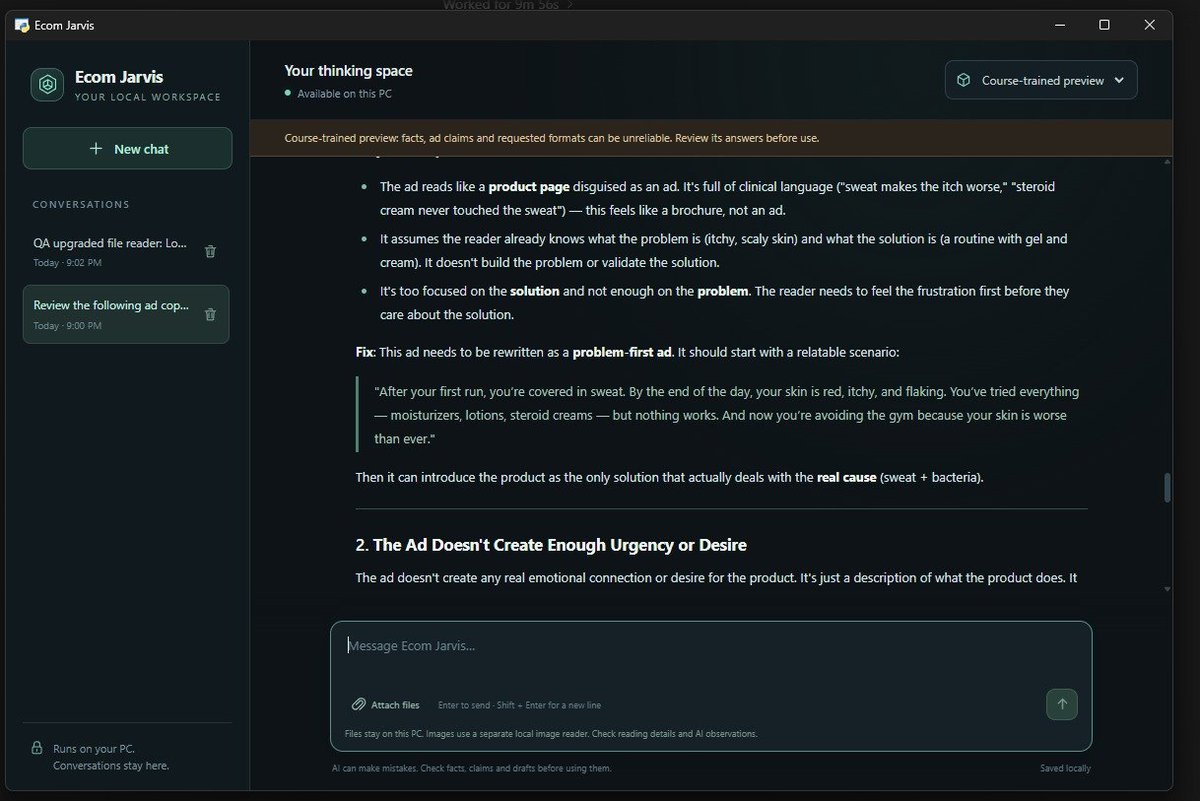
i might’ve just built the most unfair ecom tool on my PC
Ecom Jarvis is officially alive
i trained a local AI model on 21 of the biggest ecom courses in the game right now
$100k+ worth of paid ecom education
creative strategy
media buying
product research
offers
copy
CRO
scaling
customer research
all compressed into one model running on my own machine
not a claude wrapper
not chatgpt with a prompt
not an agent calling APIs
an actual fine-tuned model
Qwen3 4B + LoRA
millions of course tokens
fully local
then i gave it an ad it had never seen before
and it immediately started tearing apart:
the hook
the emotional angle
the problem framing
the CTA
the audience fit
the structure
then started rewriting the weak parts
still early
still stress testing the hell out of it
but if this keeps holding up...
i basically built Ecom Jarvis
the Uproot example is the whole lesson
they sold a product you only buy once, and turned it into reorders without changing what they are
here's a quick way to find your version, in 3 questions:
1 → what problem does your customer have right before they use your product?
2 → what do they still deal with right after?
3 → what do they buy that runs out?
a no-pull dog leash isn't a leash brand. it's a "walks that don't suck" brand. training treats, bags, calming chews
a posture corrector isn't a posture brand. it's a "my back hurts at my desk" brand. lumbar pillows, stretch bands, recovery cream
same customer. same trust. new reasons to come back
you don't need a new brand
you need to find out what your customer buys next
"Oh I should start a supplement brand so I can get some LTV"
⠀
Been hearing this a lot lately.
Especially from guys already doing $1M/month+
⠀
I can tell you from the hundreds of Ecom brands I work with, this is usually pure cope.
⠀
Don't get me wrong, LTV is a great move.
⠀
But LTV doesn't mean supplements, and it definitely doesn't mean starting a new brand.
⠀
Oodie did $1B in sales with zero subscriptions.
When I met their founder Davie, he told me up to 50% of their customers in Australia come back.
They just kept expanding product lines and designs under the same brand.
⠀
"Yeah but that was 2020, ads were cheap."
⠀
Ok. Look at Ridge right now.
⠀
The average guy buys a wallet once every 7 years. Sean Frank, their CEO, still calls LTV the weakest part of the business.
⠀
He's tried supplements. They're not what's growing Ridge.
⠀
What is? Products that fit what Ridge already is.
Rings now do tens of millions a year, and he thinks chains could do $80M a year within two years.
⠀
Launching products like these is why Ridge is on track to grow 50% this year, at nine figures.
⠀
A harder market makes LTV more important.
It also makes going back to $0 way more expensive.
⠀
You're already doing 7 figs with product-market fit, winning ads, a team that knows how to make them, and customers who trust your brand.
⠀
And just to get some LTV, you want to start a supplement brand and go back to $0??
⠀
The problem is most of you can't see where else your current brand can go, so starting a new brand looks like the only way to get LTV.
⠀
So what do??
⠀
Milk out your position.
⠀
Define what your brand's position is, then find the LTV products you can create that solve problems inside it.
⠀
An Evolve member asked this exact thing in our Discord a few months ago.
Pet cleaning product, reusable, customers only ever buy once.
⠀
Look at Uproot Clean.
⠀
Their first product was a reusable pet hair remover, and their pet hair tools are now in 3M+ households.
But they're a one-time purchase, the whole selling point is you never need to buy another one.
⠀
But their positioning was never "the pet hair remover brand."
It was pet cleaning.
All they care about is cleaning up after your pet, and nothing else.
⠀
So they milked it.
More hair removal tools, then a whole laundry line built for pet owners with detergent sheets, washing machine cleaner and scent boosters.
⠀
And magically, the brand built on a product you only buy once now sells stuff people have to reorder.
No supplement in sight.
⠀
Ofc, supplements can still be the right move IF they match your positioning.
⠀
Eight Sleep sells a bed cover that heats and cools you while you sleep and runs a few grand. The hardware is about as one-and-done as it gets.
⠀
Their position is sleep fitness, so when they launched a supplement, it was a sleep supplement, under the same brand, formulated off 600M+ hours of their own customers' sleep data.
⠀
They didn't need a new brand to sell it.
The trust and the data were already sitting inside the one they had.
⠀
That's a supplement that makes sense, not "supplements have good LTV so let's launch one."
⠀
Now, there are a few cases where a new brand can be the right call.
⠀
If, for example, you genuinely don't give a sh*t about your niche, to the point you'd never want to make an ad for it yourself, then a new brand can make sense.
⠀
But start from the market, not from "I need a supplement."
Don't box yourself in like that.
⠀
Look at the market you're already in first and see where there's an opportunity to own more of it.
⠀
You already know that customer better than anyone starting from scratch. That's an edge you throw away the second you jump into a random new niche.
⠀
And keep your current brand cooking the whole time.
Put an operator on it before you leave, because half your attention means every problem there takes twice as long to fix.
⠀
So before you start a supplement brand, ask yourself if you actually need one, or if you just haven't milked out your position yet.
⠀
Because most of the time it's the second one, and starting a new brand is just the cope move.
⠀
Tis the way of the chad scaler.
cheap leads are the most expensive thing in your ad account
here's the math, as an example
$20 leads, but only 1 in 20 can actually afford you. that's $400 for every real prospect
$60 leads, but 1 in 3 can afford you. that's $180 for every real prospect
the "worse" campaign costs less than half as much per real prospect
most ads experts optimize for the first number because it looks great in a report
the fix usually isn't the targeting. it's the ad itself:
→ say the price, or at least the range
→ call out who it's for, and who it's not for
→ add one qualifying question before they can book
fewer leads. better calendar. more money
stop asking what a lead costs. ask what a real customer costs
If you’re making a few million a year and using ads to grow, you’ve probably hired an “ads expert.”
They talk about clicks, pixels, audiences, and all that ad fuckery.
But they can’t explain why your calendar is full of broke leads who can’t afford you.
That’s not scaling.
That’s burning money and hoping some of it comes back.
4% vs 20%. same email, same offer, one word changed
on a 10,000-person list, that's 400 clicks vs 2,000
my take: "claim" works because the moment someone claims something, it starts to feel like theirs. and once it's theirs, they don't want to lose it
which is why I'd stack it with a real deadline:
"claim your $15 reward" gets the click "your $15 reward expires Friday" gets them to use it
a few easy swaps for any store:
→ "free gift with purchase" → "claim your free gift"
→ "here's 10% off" → "claim your 10% before Sunday"
→ "join our rewards program" → "claim your first reward"
same cost to you. you're just letting the customer take the first step
RETENTION HACK:
The fastest way to boost engagement with a reward you're already offering: change one word.
“Here's your discount” ▶︎ “Claim your discount.”
We ran a test with the same email and the same offer. One version asked people to claim a discount to unlock a quick survey. The other just invited them to take the survey, with no framing.
▲ The claim version got a ~20% click rate.
▼ The plain invite only got ~4% (yikes).
Of the people who clicked, 85% went on to finish the survey. But that’s not the only interesting thing we found out:
Retention didn't just hold steady in the "claim" group, it actually went up! 7-8% higher repurchase rate and LTV, versus the group that got the same value with none of the claiming.
★ The mechanism is simple: it's a micro-commitment.
The second someone clicks to claim something, they've made a tiny decision to want it. That small act of choosing makes them value it more than if it just showed up.
This principle works in reverse, too. Brands that already gave a gift by default started letting people "claim" it instead during checkout, and conversion rates went up.
Some might call this manipulative, but I wouldn’t. If claiming something makes people actually use what they bought and stick around longer, that's just good marketing.
If your brand is handing out some sort of incentive, stop giving it away!
It’s the same cost to you, but with a much different (much better) result.
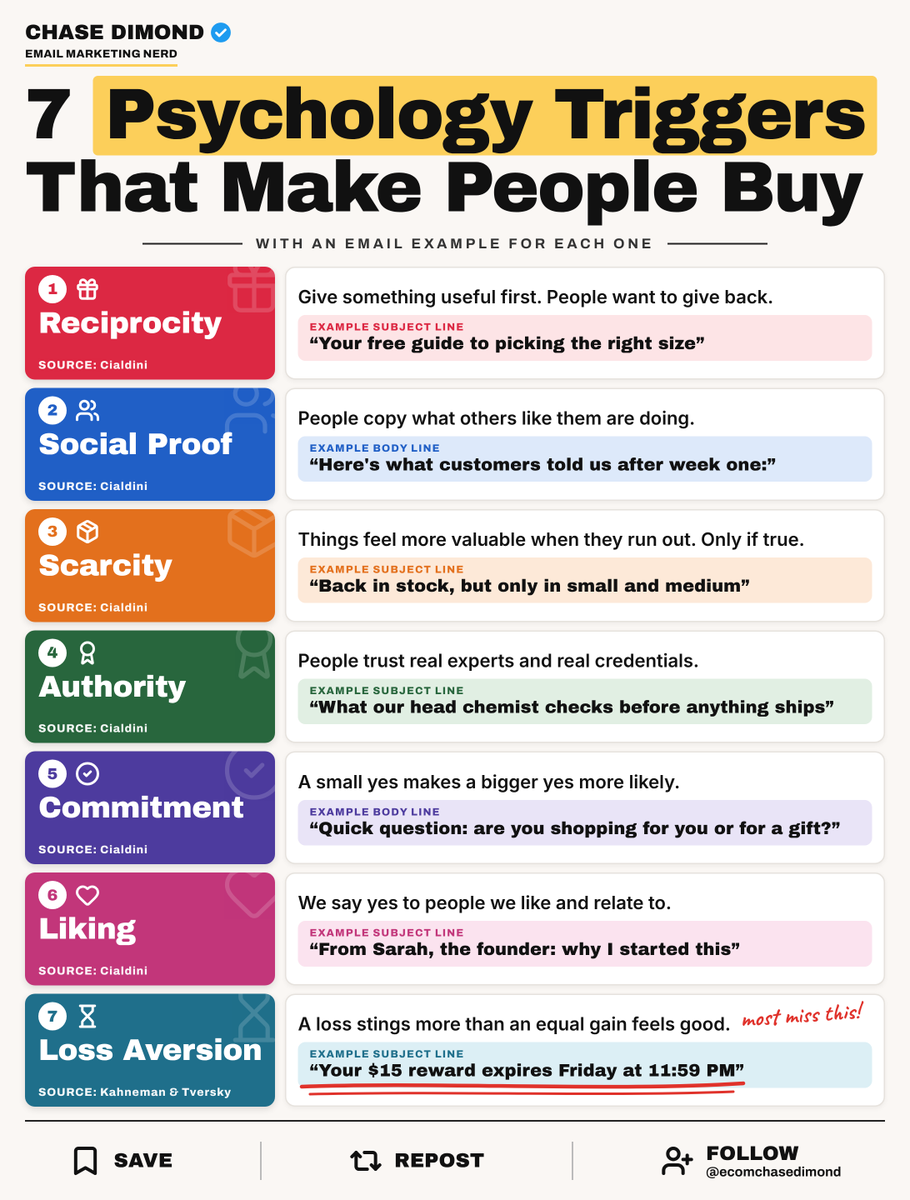
same $15 offer. same 10,000 subscribers. two subject lines:
“get $15 off your next order”
“your $15 reward expires Friday at 11:59 PM”
the first one gives them something. the second one gives them something to lose
people feel a loss about twice as hard as an equal gain, it’s one of the most proven ideas in behavioral economics
imagine the second line converts at 3% instead of 2%. at a $50 average order, that’s $5,000 more from changing one sentence. same list, same discount, same product
and it works way beyond email:
→ cart: “your $15 reward is applied, it expires in 24 hours”
→ product page: “your discount is saved until Friday”
→ abandoned checkout: “we’re holding your size until tonight”
one rule though: the deadline has to be real
fake countdown timers work exactly once. the moment a customer comes back Saturday and the “Friday only” deal is still there, you’ve traded a sale for their trust
real deadline, real reward, real loss
#7 is the one I’d test first