It's a nihilism, they don't even really have an ideology to speak of, just "other bad" and degradation of differences. It's appalling. Who feels that neo-Nazis should be in power in the US running Homeland Security X feeds with white nationalist anthem references? It's certainly just a handful of far right trolls.
You have "unreplaceable people skills" that can't be replaced by an intelligence running 24/7 that has a PhD level understanding of all fields simultaneously in its context window. Sorry, everyone is cooked actually. Starting this year. Everyone needs to read this and start considering what he's saying: https://t.co/jeGrBSCAoZ
I built an automated content pipeline with n8n and I'm sharing setup details tonight.
Every morning at 7am it searches Google for AI related news, has Claude read through the results, picks five interesting stories, writes full articles on each one, and emails everything to me formatted and ready for review. Cost per run is about fifteen cents.
I used SyntaMCP (https://t.co/xYyuG4jPk8), which is a MCP (Model Context Protocol) connector that gives Claude direct access to n8n's node configurations. With it, the workflow is created almost completely correct on the first try (with caveats, debugging/testing will be needed).
If you want to build this yourself:
You need four accounts. All free or cheap to start.
n8n (https://t.co/dPdP9OdOGB) - Sign up, your workspace is ready immediately. This is where the workflow runs. Free tier available.
Anthropic (https://t.co/Hp1dEo9M5c) - Get an API key. This is what powers Claude. Pay per use, pennies per run.
SerpAPI (https://t.co/1UNbABVZ53) - Get an API key. This is how the workflow searches Google. 100 free searches per month.
Gmail - You already have this. You'll connect it through n8n.
Once you have those, import the workflow JSON file (available here: https://t.co/bCHqy5jIc1) into n8n, create the Claude, SerpAPI and GMail credentials, change the email address to yours in the JSON file and hit test.
Full "Content Automation Setup Guide for N8N.pdf" available here: https://t.co/Z3194I9t6i
Monthly cost running daily is about $3-5. Prompts can be updated to your specific use case, I offered AI related news as the example here, update the prompt node in n8N or the JSON file directly as needed.
Appreciate feedback or questions, run with this a bit, it'll be quite useful for dropping summaries of focused news into your Inbox daily.
During my job search I noticed I was typing the same instructions over and over. Paste resume, paste job description, ask for optimized bullets. Paste job description, ask for interview questions. Paste company name, ask for research. Every application, same routine.
So I stopped doing that and started building Skills in Claude — saved prompts with expert instructions already baked in. Run them with one click instead of re-explaining myself constantly.
https://t.co/P57FuCjkTw
For job seekers, AI Career Skills now has:
Job Readiness Scorer (how well do you actually match?)
Resume Customizer (tailored bullets per application)
ATS Keyword Optimizer (robots read your resume first)
Cover Letter Generator (some companies still want these)
Interview Prep (questions + STAR answers from your background)
Salary Negotiation Coach
Company Research (show up informed)
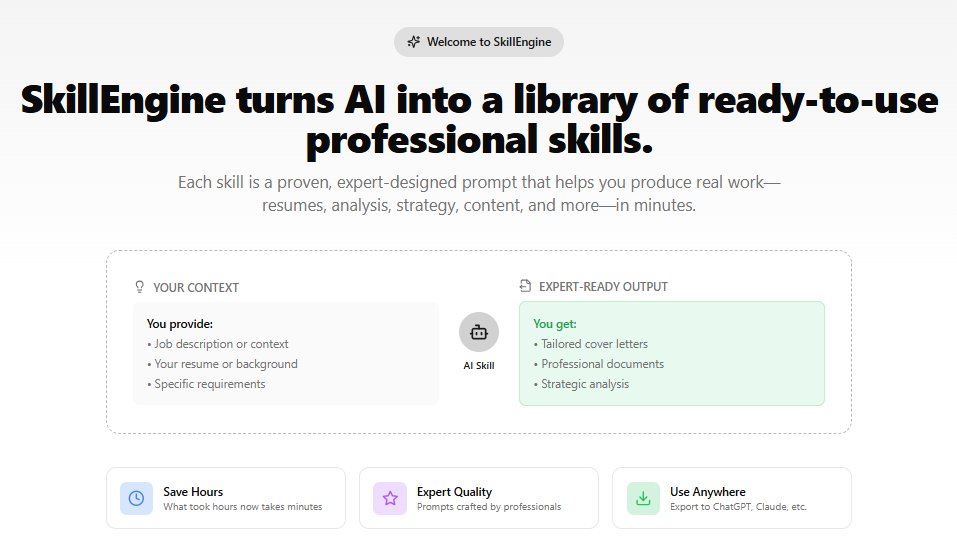
293 skills and 39 multi-step workflows are now available crossing not only job searches, but many other job roles as well. Skills for financial analysts, marketers, project managers, sales — any repeated task where you're explaining context to AI should be a saved skill, not a fresh conversation every time.
You can try Skill Engine without an API key now — ChatGPT 4o-mini works currently or you can try with your own API key from Gemini, ChatGPT or Claude.
Let me know what you think and if these skills and workflows prove helpful.
I asked Claude what would help make my consulting website best in class in Wisconsin for AI marketing/consulting agencies.
It recommended I add an AI Assistant module to the site for answering questions.
Two hours later, the SkillEngine Assistant is live and will respond to your queries, ChatGPT 4o-Mini is the model in use. Default queries are in place for specific business use cases - AI Workflow Automation, Campaign Strategy, Google Campaign Setup and Analytics & Reporting.
I'll likely want to add a backend document repository for queries here later to tailor responses to most regularly asked questions.
Feelings as the result of a two hour project?
This is breathtaking. Magic.
Here's my updated home page: https://t.co/F9YxZEolFR
Here's the new AI Assistant page: https://t.co/MCyPaUPEaY
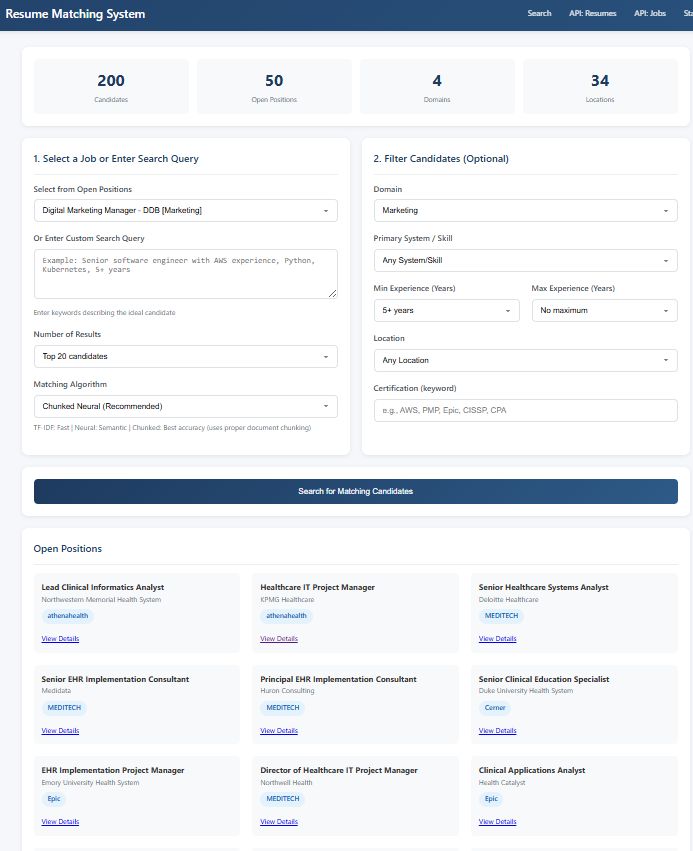
I built a multi-domain resume matching system with three different retrieval algorithms this morning in about two hours.
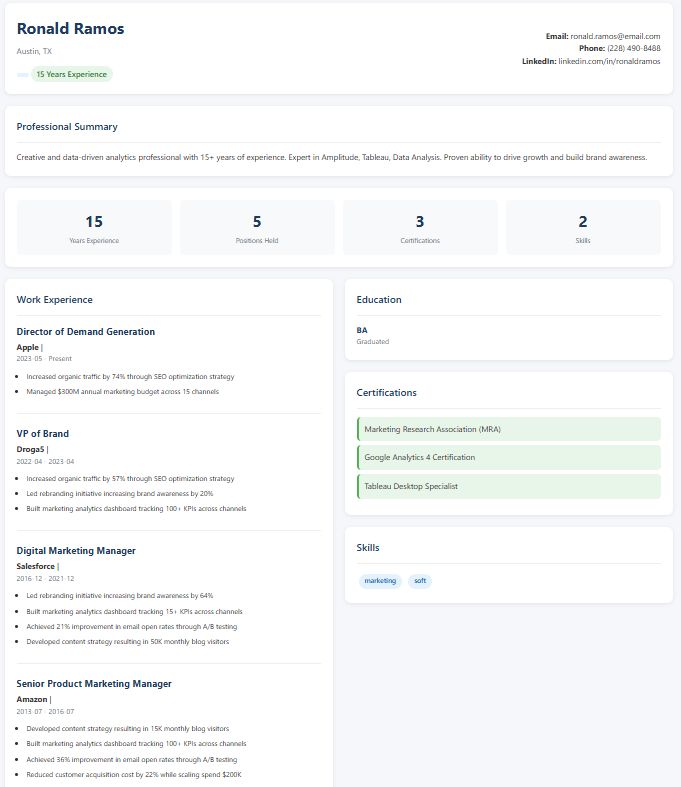
What started as a healthcare IT proof-of-concept now handles four domains: Healthcare, Technology, Business, and Marketing. I created 200 synthetic resumes with 50 test job descriptions.
It was built with three matching modes:
TF-IDF + Keywords (fastest): Best when exact terminology matters. "Cerner Certified" should match "Cerner Certified," not get fuzzy with "electronic health records experience." Healthcare recruiters care about specific certifications. This mode tells them exactly why someone ranked where they did.
Neural Embeddings (faster): Uses AI to understand meaning. Knows that "decade of cloud architecture experience" and "10 years building AWS infrastructure" are similar concepts.
Chunked Neural (most accurate): The same AI approach, but smarter about how it processes documents. This is the one I'd actually recommend.
Lightweight AI embedding models can only process a limited amount of text at once. About 200 words. The model I used (all-MiniLM-L6-v2) was built to be fast, optimized for embedding sentences or short paragraphs. It caps at 256 tokens (roughly 200 words).
The average resume in my test set was about 600 words. When you feed a 600-word resume into a 200-word model it silently ignores everything after the limit. The fix was breaking resumes into logical sections first: summary, each job, education, certifications, skills. Now every section gets processed and no context is lost.
What else the system does:
Location scoring: Calculates distance between candidate and job location. Closer candidates score higher unless the job is remote.
Recency weighting: Recent experience counts more than old experience. Five years of current work beats ten years of work from a decade ago.
Explainable rankings: Every score breaks down into components. HR can see exactly why someone ranked where they did.
Ranking verification: Automated checks that generate audit reports for compliance.
To make this production-ready, I’d need the following: authentication, a real database instead of JSON files, connection to an applicant tracking system and cloud deployment.
Full design document with architecture details, code patterns and production recommendations linked here if you’re interested in learning more: https://t.co/ysNJxyoZZF
I was working with the $20 Claude account level today and tried a one shot of a Skill I had created that had about 400 lines of text in it. Claude could process this, but locked me out for four hours from entering a single new prompt. Outrageous. We are already behind on compute, I don't know why this isn't acknowledged broadly, we are massively behind on availability of compute!
By popular demand, I’m releasing this interview with @mikealfred a day early.
We discuss his investment playbook, AI outlook, picking winning stocks, why Bitcoin is the “most important asset in human history” and exactly how he would allocate a $1 million portfolio today.
TIMESTAMPS:
00:00 Mike Alfred origin story
2:33 Building retail following
4:18 Gemini Bitcoin Credit Card | Bitwise | Bitdeer (BTDR)
6:02 Bitcoin miners pivoting to AI
11:21 Options, leverage
13:44 Influence, pressure
19:33 Speculation, gambling mindset
27:38 Speed Wallet | Bitkey | The Bitcoin Way | Genius Academy
29:28 Why Bitcoin is sluggish
32:36 AI’s 20-year cycle and power competition
37:46 Industrial policy
42:12 Bitcoin reserves
48:25 Bitcoin vs equities
52:48 Conviction during volatility
I was working with the $20/month Claude today to develop a set of new Skills. Running a single prompt skill request at this point takes up all the compute at that account level for 4-5 hours. It seems obvious that we are short on compute across the US and will need to scale up massively if we want actual agentic AI.
My prompt was about 400 lines long in a MD file, so there's that, I'm not using this as a substitute for search, I want it to research and generate specifically formatted artifacts all in one go given one input document or block of text (in this case a job description)
If you're curious, I attached the MD file so you can see how I'm approaching this specific job preparation use case. I'd be happy to share the SKILL file itself if you'd like to import it into and try it in Claude.
Here's the MD file:
---
name: job-application-prep
description: "Comprehensive job application preparation system that analyzes job descriptions and creates customized application materials. Use this skill when the user provides a job description or job posting and wants help with: (1) Resume customization for specific roles, (2) Professional cover letter creation, (3) Skills gap analysis, (4) Interview preparation materials, (5) Company research and competitor analysis, (6) Creating interview response strategies for addressing gaps. Trigger when users mention applying for jobs, tailoring resumes, preparing for interviews, or researching companies they're applying to."
---
# Job Application Preparation Skill
This skill provides a comprehensive workflow for preparing job applications, from resume and cover letter customization to interview preparation, company research, and competitive landscape analysis.
## Overview
When provided with a job description, this skill produces:
1. Customized resume highlighting relevant experience
2. Professional cover letter tailored to the role and company
3. Skills gap analysis with mitigation strategies
4. Targeted interview responses for each gap
5. Common interview questions for the role
6. Company background with competitor analysis
7. Red flags assessment and due diligence
## Workflow
### Step 1: Job Description Analysis
Extract and analyze key elements:
- Required skills and qualifications
- Preferred/nice-to-have skills
- Role responsibilities
- Company culture indicators
- Keywords and terminology used
- Experience level requirements
- Salary range (if provided)
- Benefits and perks highlighted
### Step 2: Resume Customization
Create a tailored version that:
- Mirrors job description keywords naturally
- Emphasizes relevant experience first
- Quantifies achievements related to role requirements
- Adjusts skills section to match priorities
- Reframes experience using role-specific terminology
- Maintains ATS (Applicant Tracking System) optimization
**Format guidelines:**
- Use action verbs that match the job posting's language
- Include metrics where possible (percentages, dollar amounts, time saved)
- Keep bullets focused on outcomes, not just responsibilities
- Maintain consistent formatting for ATS parsing
### Step 3: Professional Cover Letter Creation
Create a compelling, customized cover letter that:
**Structure:**
- Professional header (name, contact info, date, employer details)
- Strong opening paragraph stating the position and capturing attention
- 2-3 body paragraphs demonstrating fit and value
- Closing paragraph with call to action
- Professional sign-off
**Content guidelines:**
- **Opening:** Express genuine enthusiasm and immediately establish credibility
- **Why This Company:** Demonstrate research by referencing specific company initiatives, recent news, mission/values alignment, or industry position
- **Why You're Qualified:** Connect your experience directly to job requirements using specific examples and quantifiable achievements
- **Address Potential Concerns:** If transitioning industries/roles, proactively address this as a strength
- **Competitive Context:** Reference company's market position or recent strategic moves (informed by competitor research)
- **Cultural Fit:** Weave in company values and demonstrate alignment with organizational culture
- **Call to Action:** Express desire for interview and provide next steps
**Tone:**
- Professional but personable
- Confident without being arrogant
- Enthusiastic without seeming desperate
- Industry-appropriate formality level
**Best practices:**
- Keep to one page (3-4 paragraphs)
- Avoid generic templates - make it specific to this role and company
- Don't simply repeat resume - provide context and narrative
- Show knowledge of company's challenges and how you can help
- Use "you/your" language (focus on employer needs, not just your qualifications)
- Include a memorable detail or insight from your research
- Proofread meticulously - errors are fatal in cover letters
### Step 4: Skills Gap Analysis
Create a structured analysis:
**For each gap:**
- Skill name and proficiency level required
- Current proficiency level (if any)
- Impact level (Critical / Important / Nice-to-have)
- Mitigation strategy (transferable skills, quick learning plan, projects to highlight)
**Gap categories:**
- **Hard skills**: Technical skills, tools, certifications
- **Soft skills**: Leadership, communication, problem-solving approaches
- **Domain knowledge**: Industry-specific experience or knowledge
- **Experience gaps**: Years of experience, specific role types
### Step 5: Interview Response Strategy
For each identified gap, create:
**Response framework:**
- Acknowledgment (honest but brief)
- Bridge (connect to related experience)
- Evidence (specific example from past)
- Growth plan (concrete steps already taking/planning)
- Enthusiasm (why this excites you)
**Example structure:**
"While I haven't used [specific tool] in production, I have extensive experience with [related tool] which shares [key similarities]. In my role at [company], I [specific relevant achievement]. I've already started [learning activity] and am excited to deepen my expertise in [area]."
### Step 6: Common Interview Questions
Generate role-specific questions in categories:
**Technical questions:**
- Tool/technology-specific queries
- Problem-solving scenarios
- Best practices and approaches
**Behavioral questions:**
- Leadership and teamwork
- Conflict resolution
- Project management
- Adaptation and learning
**Role-specific questions:**
- Scenario-based challenges for this position
- Questions about company products/services
- Culture fit questions
**Prepare for:**
- "Walk me through your resume"
- "Why this role/company?"
- "Tell me about a time when..."
- "What are your weaknesses?"
- "Where do you see yourself in 5 years?"
### Step 7: Company Research & Competitive Landscape Analysis
Use web_search to gather comprehensive intelligence:
#### Company Overview
- Mission, values, and culture
- Products and services (with specific details)
- Recent news and developments (last 6-12 months)
- Company size, structure, and growth stage
- Leadership team and key executives
- Financial performance or funding status
#### Market Position & Competitive Analysis
**Competitor identification:**
- Direct competitors (same products/services, geography)
- Indirect competitors (alternative solutions)
- Emerging threats (new market entrants, disruption)
**For each major competitor, research:**
- Size and market share
- Key differentiators
- Recent strategic moves (mergers, acquisitions, expansions)
- Strengths and weaknesses
- Financial health
**Competitive insights to weave into application:**
- How target company compares to competitors (market position)
- Target company's competitive advantages (to emphasize in cover letter/interview)
- Industry trends affecting all players
- Strategic opportunities or threats company faces
- Why target company is better positioned than alternatives
**Example cover letter integration:**
"I'm particularly drawn to [Company]'s approach to [specific strategy], which differentiates you from competitors like [Competitor A] and [Competitor B]. Your recent [initiative] positions the company well for [market opportunity]."
**Example interview integration:**
"I've been following [Company]'s expansion into [market/product area]. How do you see this positioning you against [Competitor], especially given their recent [competitive move]?"
#### Red Flags Investigation
**Financial health:**
- Recent funding/revenue news (last 12 months)
- Layoff announcements or restructuring
- Executive departures or board changes
- Delayed payments to vendors (check forums)
- Office closures or downsizing
**Culture red flags:**
- Glassdoor reviews below 3.0 or trending downward
- Recurring themes in negative reviews (specific issues)
- High turnover in role you're applying for
- Multiple postings for same role over 6+ months
- Vague or aggressive job descriptions
**Leadership concerns:**
- Founder/CEO reputation (check LinkedIn, news)
- Executive team stability (tenure, departures)
- Board composition and experience
- Previous ventures and outcomes
- Public communications and transparency
**Product/Market concerns:**
- User reviews of products/services
- Competitive position weakening
- Regulatory or legal challenges
- Technology debt or outdated stack (for tech roles)
- Customer complaints or public disputes
**Work-life balance indicators:**
- "Fast-paced environment" (often code for overwork)
- "Wear many hats" (possible understaffing)
- After-hours/weekend work expectations
- Unlimited PTO (often means less PTO taken)
- Remote work policies and flexibility
#### Positive Indicators (Green Flags)
- Growth trajectory and stability
- Employee satisfaction (Glassdoor, LinkedIn, etc.)
- Innovation and market leadership
- Work-life balance reputation
- Career development opportunities
- Awards and recognition
- Community involvement
- Diversity and inclusion initiatives
- Technology investment
- Transparent communication
### Step 8: Deliverable Format
Present findings in a comprehensive document with these sections:
#### 1. Executive Summary
- Role overview
- Key strengths for this position
- Top 3 gaps to address
- Overall fit assessment (with percentage if appropriate)
- Risk level and recommendation (proceed/proceed with caution/red flags)
#### 2. Customized Resume
- Full formatted resume ready to submit
- Highlight key changes made
- Keywords emphasized
- Achievements quantified
#### 3. Professional Cover Letter
- Complete 1-page cover letter ready to submit
- Incorporates company research and competitive insights
- Addresses any career transitions or gaps proactively
- Demonstrates cultural fit and enthusiasm
#### 4. Skills Gap Analysis Table
| Skill | Required Level | Current Level | Impact | Mitigation Strategy |
|-------|---------------|---------------|---------|---------------------|
#### 5. Interview Response Guide
- Prepared responses for each gap using STAR method
- "Bridge" statements connecting related experience
- Specific examples ready to deploy
- Follow-up points to strengthen responses
#### 6. Interview Questions Prep
- 20-30 likely questions organized by category
- Brief talking points for each
- Questions that incorporate competitor knowledge
- Red flag validation questions to ask
#### 7. Company Intelligence Brief
- 2-3 paragraph company overview
- Competitive landscape summary (3-5 major competitors)
- Market position and strategic context
- Key facts to weave into responses
- Recent news to reference
- 5-10 insightful questions to ask interviewer
- Red flags assessment with severity ratings
- Green flags and positive indicators
#### 8. Competitor Analysis Summary
- Comparison table of target company vs. 3-5 competitors
- Key metrics (size, market share, growth)
- Competitive advantages of target company
- Industry trends affecting all players
- How to use competitive knowledge in interview
#### 9. Action Items
- Immediate prep steps (today/this week)
- Skills to brush up on
- Stories to prepare using STAR method
- Research to deepen
- Questions to ask
- Networking opportunities
- Timeline for preparation
## Best Practices
**Research depth:**
- Use 5-10 web searches for thorough company research
- Use 3-5 searches specifically for competitor analysis
- Check multiple sources for red flags (Glassdoor, news, forums, Reddit)
- Look at company's own content (blog, social media, press releases, investor updates)
- Review competitor websites and recent news
- Check industry publications and analyst reports
**Resume customization:**
- Never fabricate experience
- Reframe existing experience to highlight relevance
- Use exact keywords from job posting where truthful
- Keep it to 1-2 pages
- Quantify achievements with metrics
- Front-load most relevant experience
**Cover letter best practices:**
- Write custom letter for each application (never use template)
- Research company thoroughly first
- Include 1-2 specific company facts (recent news, initiatives)
- Reference competitive position naturally if appropriate
- Address career transitions proactively
- Show cultural fit through language and values alignment
- End with clear call to action
- Keep to one page maximum
**Gap addressing:**
- Be honest but strategic
- Focus on learning agility and transferable skills
- Show proactive steps already taken
- Frame gaps as growth opportunities
- Never apologize for gaps - own them confidently
- Have concrete learning plans ready
**Interview prep:**
- Prepare 2-3 strong examples for each gap
- Use STAR method (Situation, Task, Action, Result)
- Practice responses out loud
- Anticipate follow-up questions
- Prepare questions that show competitive knowledge
- Know competitor names and recent moves
**Competitive intelligence usage:**
- Don't name-drop competitors to seem impressive
- Use competitive knowledge to ask insightful questions
- Reference market position naturally when explaining interest
- Show understanding of industry landscape
- Avoid negative comments about competitors
- Focus on why target company is best positioned
## User Interaction
Always ask for:
- Full job description or posting URL
- Current resume (to work from)
- Any specific concerns or focus areas
- Timeline (helps prioritize preparation)
- Industry/sector for appropriate competitive analysis
- Geographic location (if not specified in job posting)
Offer to:
- Create practice interview scenarios
- Review and refine prepared responses
- Research specific aspects in more depth
- Update materials as user practices and refines
- Conduct additional competitor research if needed
- Review cover letter drafts for tone and content
## Output Format
Create all materials in a single comprehensive document (docx preferred, or markdown) for easy reference during interview prep. Use clear headers, tables, and formatting for scannability. Include page breaks between major sections for easy printing and reference.
**Recommended document structure:**
1. Executive Summary (1 page)
2. Customized Resume (1-2 pages)
3. Cover Letter (1 page)
4. Skills Gap Analysis (1-2 pages)
5. Interview Preparation Guide (5-10 pages)
6. Company Intelligence & Competitor Analysis (3-5 pages)
7. Action Items (1-2 pages)
Total length: 15-25 pages for comprehensive preparation
## Updates and Enhancements
**Version 2.0 Changes:**
- Added Step 3: Professional Cover Letter Creation with detailed guidelines
- Expanded Step 7 (formerly Step 6) to include comprehensive Competitor Analysis
- Added competitive intelligence integration examples for cover letter and interview
- Enhanced deliverable format to include cover letter and competitor comparison
- Added competitor analysis summary as separate deliverable section
- Expanded best practices to include cover letter and competitive intelligence usage
- Updated description to explicitly mention cover letter and competitor research
**Key Improvements:**
- More actionable competitive insights
- Better integration of research into application materials
- Clearer guidance on cover letter structure and tone
- Enhanced market positioning context
- More sophisticated competitive analysis framework
@SAHbitcoin You're selling $87 calls? Up like 25 to 30% in weeks even if the shares are called by Friday? What's the story? IREN is beautiful right now, what's your investment thesis and story? Go long....
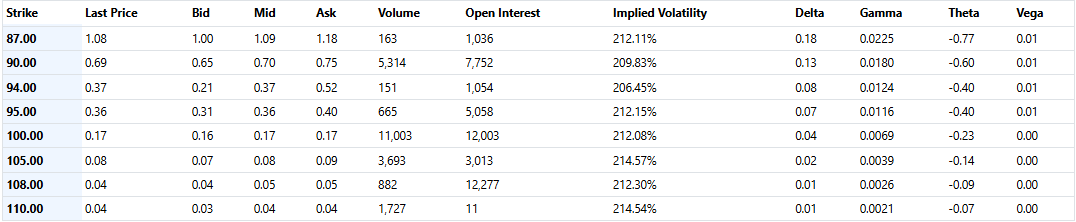
11/7/2025 $IREN Call option volume. Note huge bets at $100 and $108. Good news will propel these to massive gains tomorrow. Major Put contract volume is at $60 for Friday. IREN price is at $75 currently, it's probably a bad bet to imagine price will drop -25%+ in a day to make those profitable, the 16.3K $60 Put contracts will expire worthless. Tomorrow's trading will be extremely interesting. @mikealfred