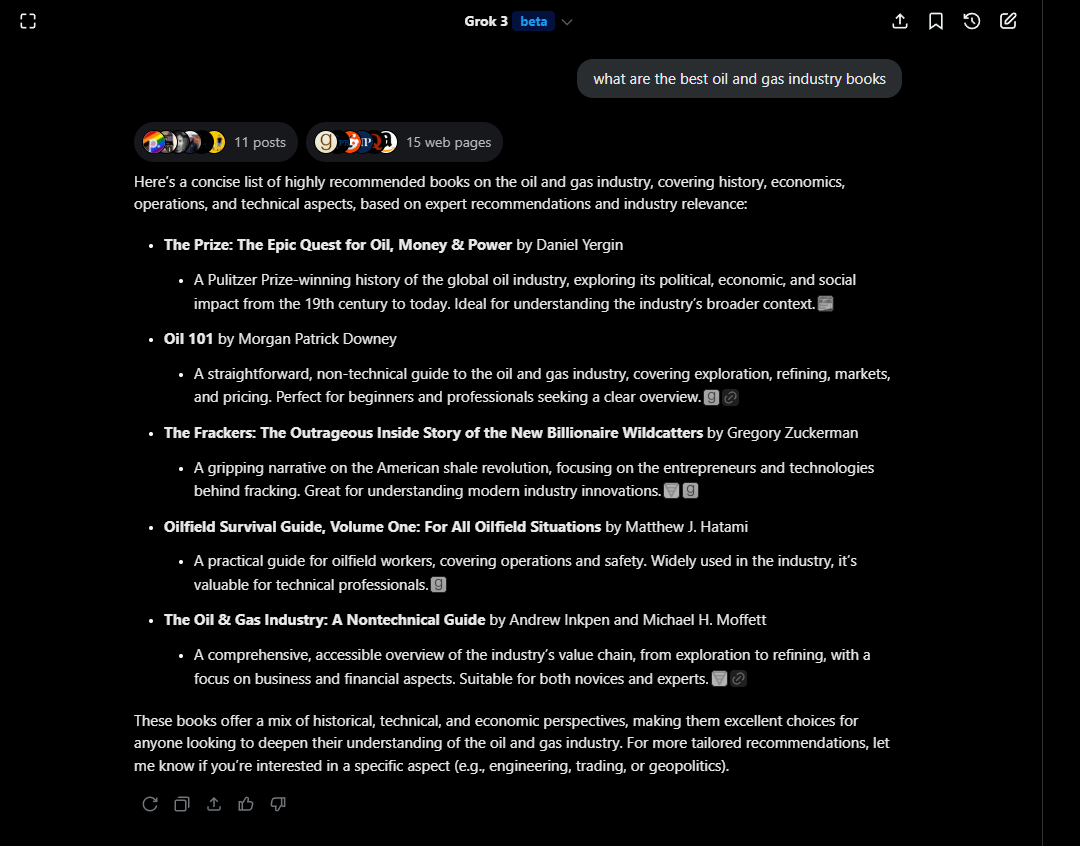
I was invited on Wind, Waves & Wells podcast. Hope you enjoy our discussion.
Deepwater Horizon and the Lessons Still Being Missed https://t.co/o7RCxMG7ZU via @YouTube
If you are looking for innovative methods to reduce costs, check out my new book, Shale Oil and Gas Operations: Maximize Cash Flow with Cost Reduction. #oilandgas#costreduction
https://t.co/GLy3BeDs9Q
Check out my latest podcast on maximizing free cash flow with cost reduction. Thank you @geoffreycann for having me as a guest on your show.
700 Ways to Boost Cash Flow in Oil and Gas
https://t.co/otczT3UGep
I was invited to discuss my interest in drilling a deep well on the Moon and Asteroid Defense. Hope you enjoy the podcast. #Moon#SpaceX#Asteroid
https://t.co/aWaS5LJYTX
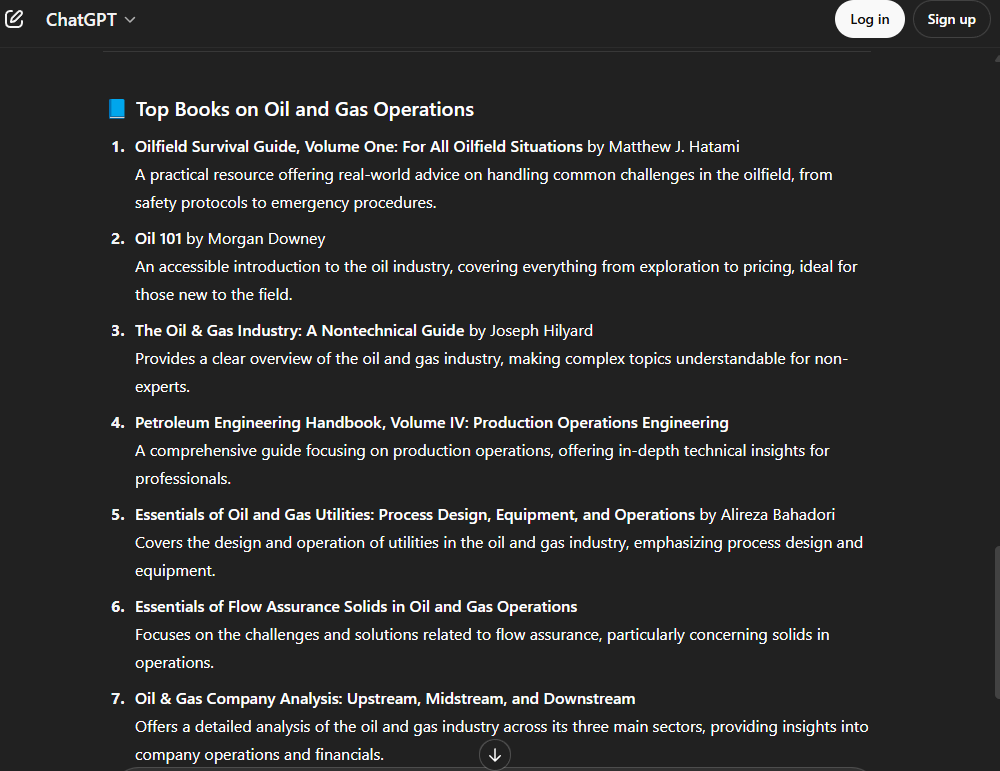
I asked ChatGPT, "What are the top books on oil and gas operations?" It listed Oilfield Survival Guide as number one (see below). I have no idea how ChatGPT determined that, but I have been told Oilfield Survival Guide is in 80% of oil industry offices. If it is indeed true, it is a great honor. Hope everyone is doing well. I am working on one more book and hope to be finished soon. #oilandgas
Werner Von Braun standing next to the five F-1 engines of a Saturn V on display at the U.S. Space & Rocket Center
The Saturn V rocket was a type of rocket called a Heavy Lift Vehicle, meaning it was very powerful and could launch heavy payloads into orbit or beyond. It had three stages, each with its own engines and fuel tanks, that would separate from the rocket after burning out. The Saturn V was human-rated, meaning it was designed to carry humans safely. It was also powered by liquid fuel, which gave it more thrust and efficiency than solid fuel rockets.
It was 111 meters (363 feet) tall, about the height of a 36-story building, and 18 meters (60 feet) taller than the Statue of Liberty. It weighed 2.8 million kilograms (6.2 million pounds) when fully fueled for liftoff, the weight of about 400 elephants. It generated 34.5 million newtons (7.6 million pounds) of thrust at launch, creating more power than 85 Hoover Dams. It could launch about 118,000 kilograms (130 tons) into Earth orbit, or about 43,500 kilograms (50 tons) to the moon. That’s about as much weight as 10 or four school buses, respectively.
It had five F-1 engines in its first stage, which were the most powerful single-chamber liquid-fueled rocket engines ever developed. Each F-1 engine produced 1.5 million newtons (337,000 pounds) of thrust at sea level. The F-1 engines were so loud that they could be heard up to 64 kilometers (40 miles) away from the launch site.
The person photographed here is Werner von Braun. Werner von Braun was a German and American aerospace engineer and space architect who played a prominent role in the development of rocket technology and space exploration. He was also a member of the Nazi Party and the SS, which has raised ethical questions about his legacy.
He helped design and co-develop the V-2 rocket, the first artificial object to travel into space, for Nazi Germany during World War II. The V-2 was used as a weapon against Allied cities, killing thousands of civilians. He was secretly moved to the United States after the war, along with about 1,600 other German scientists, engineers, and technicians, as part of Operation Paperclip. He worked for the US Army on an intermediate-range ballistic missile program, and he developed the rockets that launched the first US satellite Explorer 1 in 1958. He became the director of the Marshall Space Flight Center and the chief architect of the Saturn V rocket, the most powerful rocket ever flown successfully. The Saturn V was used to launch astronauts to the moon as part of the Apollo program, and to launch Skylab, the first American space station.
📷 NASA
There are two possible outcomes: if the result confirms the hypothesis, then you've made a measurement. If the result is contrary to the hypothesis, then you've made a discovery.
-- Enrico Fermi
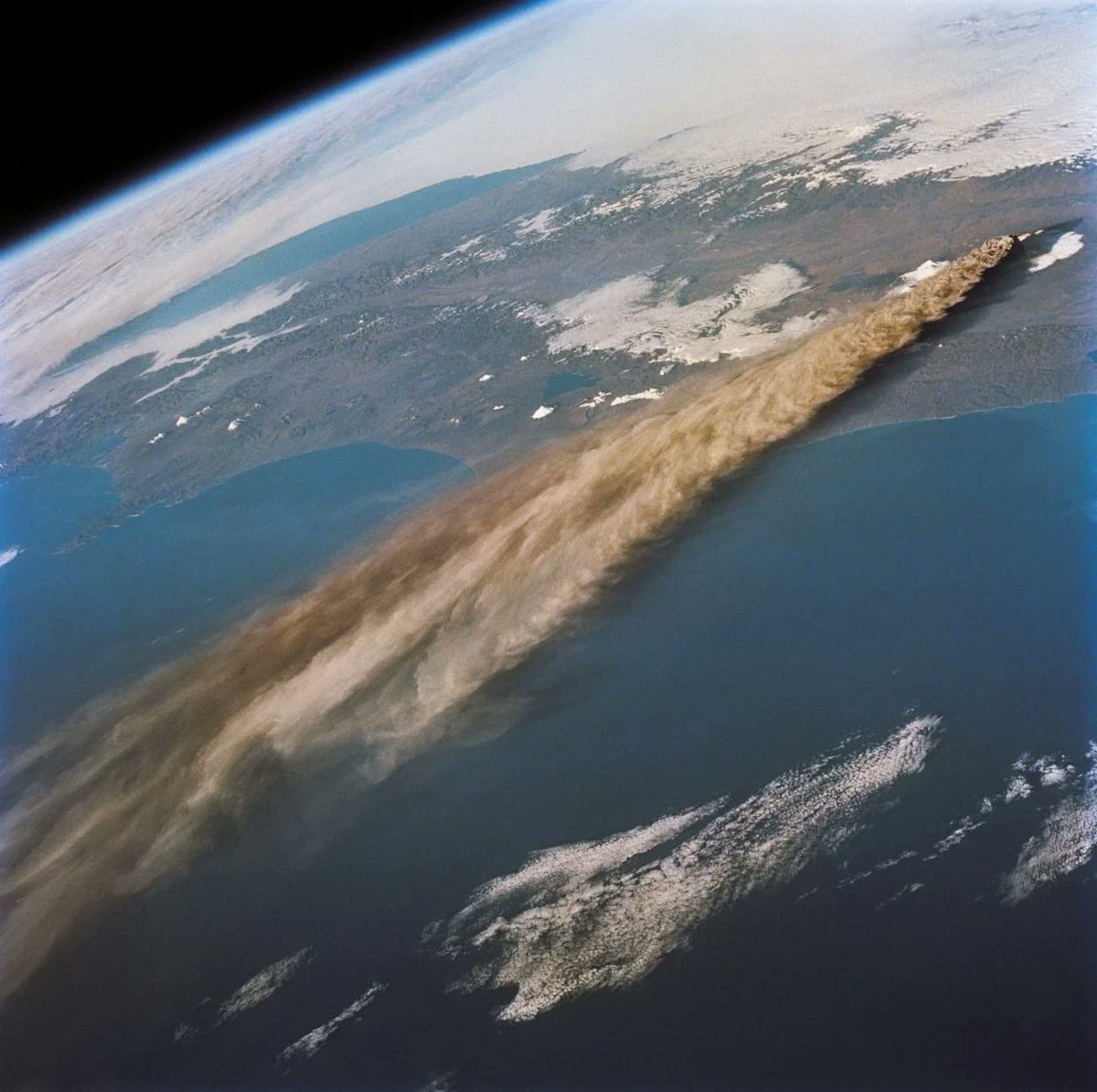
A Mesmerizing Look at Earth’s Ocean Currents in Motion! 🌀😵💫
The oceans never rest, and now you can witness their mesmerizing, endless flow like never before.
Former Vice Chairman and CFO of Visa Inc., Vasant Prabhu, explains why people often underestimate the financial side of #fintech in this clip from a recent visit to CBS' campus in Manhattanville.
Of all the US states, hurricane-prone Florida faces some of the greatest climate-related challenges, a situation that has led to the exit or collapse of many of the state’s homeowners insurers.
A new study from Professor Parinitha Sastry digs into what’s wrong with Florida’s insurance market — and how taxpayers end up footing the bill for it. https://t.co/8zQ8KWbiwI
Today NIH canceled grants for ~$10.9 million including:
-$1.7M for the “China Health and Retirement Longitudinal study” at Peking University in Beijing, China
-$135K for a research grant to China Medical University in Shenyang, China
-$142K for “using telehealth to improve access to gender-affirming care”
-$1.3M for “transforming health for gender-diverse young adults”
-$120K for “personalized 3-D avatar tool development” focused on “gender identities”
-$400K for researching “sources of minority stress and alcohol consumption” among “adults who report uncertainty about their sexual orientation”
-$160K for researching “racialized sexual discrimination” among “young sexual minority men of color”
-$241K for “an intervention to promote healthy relationships among transgender and gender expansive youth”