Just had a faculty meeting at INSEAD about the impact of AI on management education and how we should respond.
Every serious business school is having the AI conversation right now.
1/
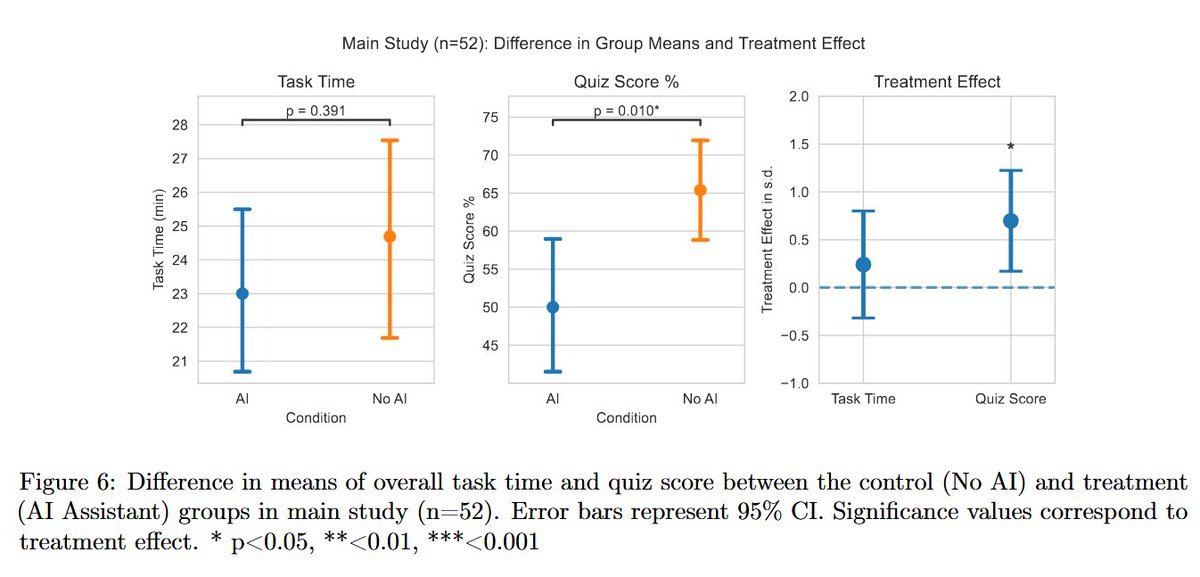
Anthropic (Claude) wollte herausfinden, wie KI-Nutzung die Kompetenzentwicklung beeinflusst.
In einem randomisierten Experiment lernten Probanden Progammieraufgaben entweder mit oder ohne KI.
Das Ergebnis: Die Gruppe ohne KI hatte nach dem Experiment höhere Fachkompetenz als die Gruppe mit KI.
Und: Die Gruppe mit KI war nicht mal signifikant schneller.
Die Studie ist ein gutes Beispiel für ein breiteres Problem mit KI: Auch in einem optimalen Setting, in dem man KI begleitend zum Lernen einsetzt, kommt es zur Auslagerung kognitiver Aktivität. Cognitive Offloading bedeutet rein mechanistisch, dass man selbst weniger denkt.
Das betrifft alle Domänen, nicht nur Stem. Die meisten Studis in sozialwissenschaftlichen Disziplinen sind heute ohne KI komplett aufgeschmissen. Mit KI kriegen sie es irgendwie hin - aber was ist dann noch der Sinn des Ganzen?
Das ist eines der grossen Risiken von KI. Alle stürzen sich in halsbrecherischem Tempo auf die ChatGPT, Claude und Co. Im Irrglauben, dass sie dadurch kompetenter und produktiver werden.
Die Studie:
https://t.co/NrAw0F4qeB
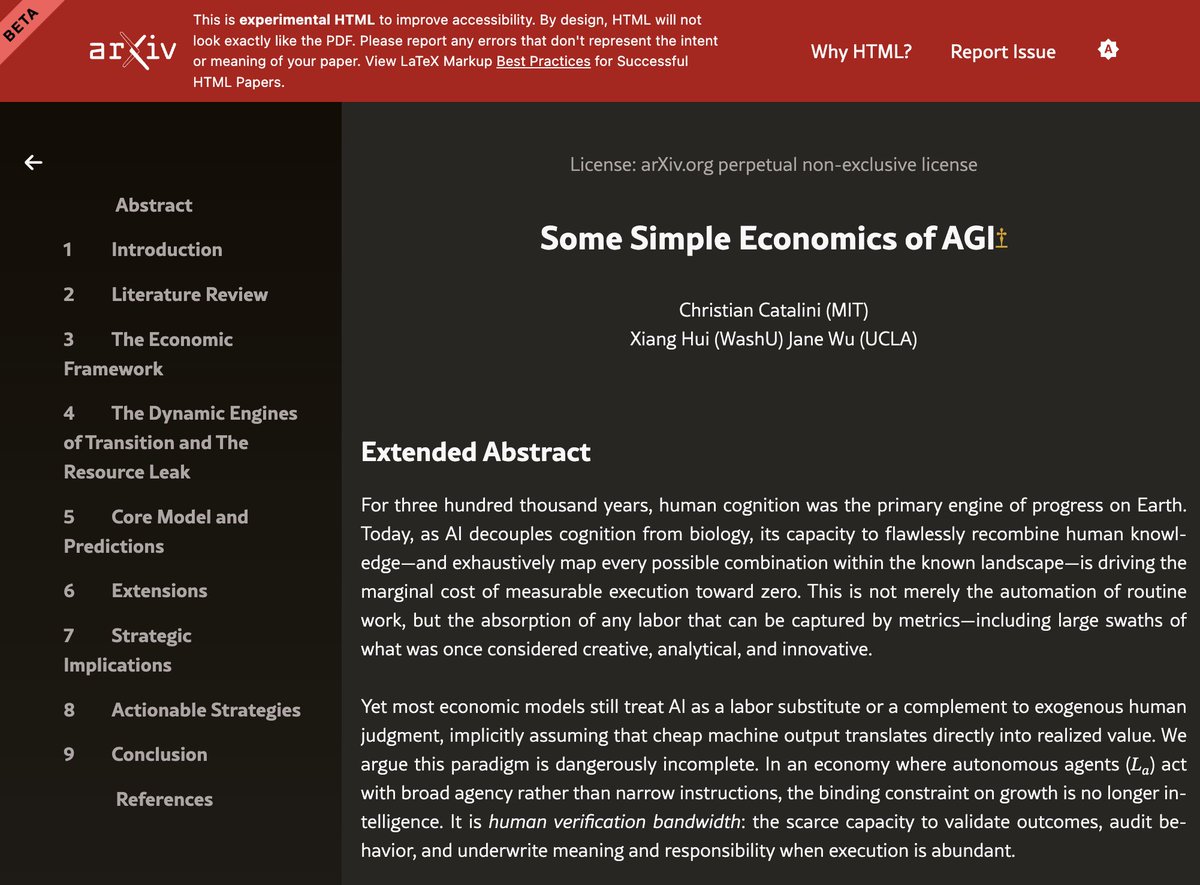
1/ Some Simple Economics of AGI—🔥🧵
Right now, there is a low-grade panic running through the economy. Everyone is asking the same anxious question: what exactly is AI going to automate, and what will be left for us?
It’s now clear that the @realDonaldTrump Administration computed reciprocal tariffs without using tariff data. This is to economics what creationism is to biology, astrology is to astronomy, or RFK thought is to vaccine science. The Trump tariff policy makes little sense EVEN if you believe in protectionist mercantilist economics.
🧵 Want to prevent generations of scientifically illiterate citizens from opposing evolutionary theories or rejecting the benefits of science (like vaccines)?
Teach more science in schools.
A thread 🧵👇
@QJEHarvard, @BenjaminArold
1/7
It's the geography, stupid!
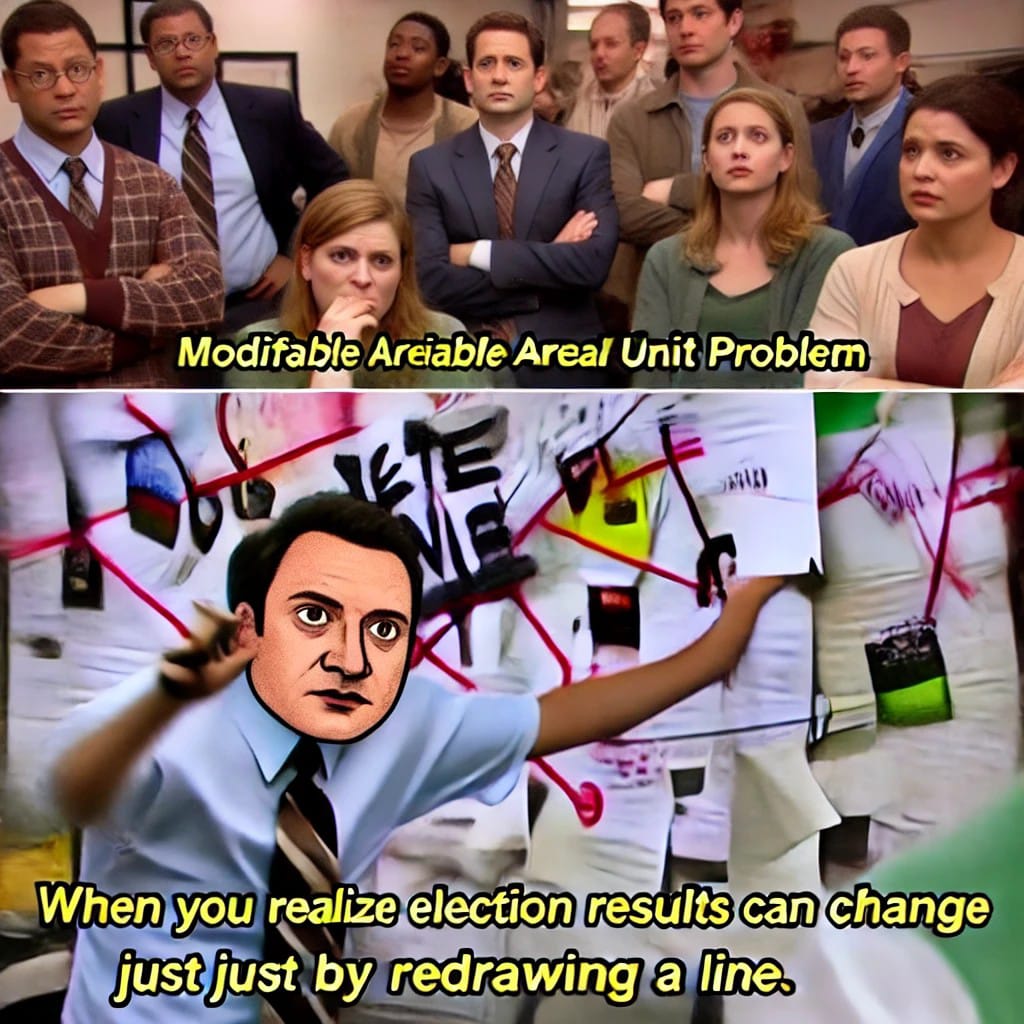
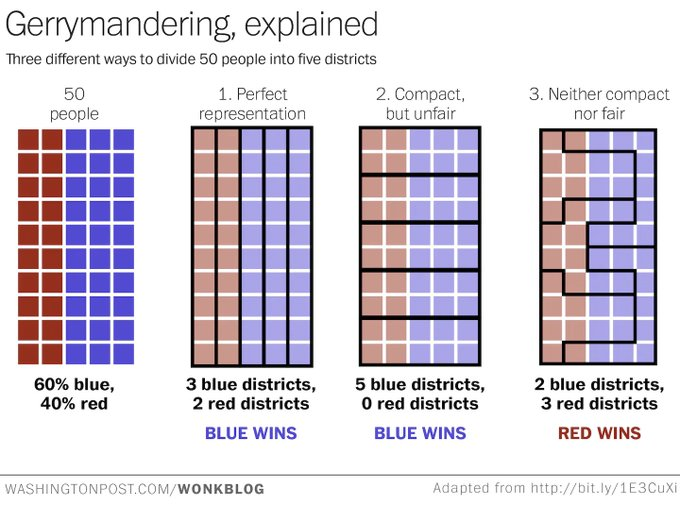
@yohaniddawela explains why every four years, everyone's talking about the geography of the US election system and #maup. #maup is the spatial analysis equivalent to the well known simpson paradoxon in statistics #USElection2024#dataliteracy
One important geospatial concept has a MASSIVE impact on election results.
It's called the Modifiable Areal Unit Problem.
Here’s what you need to know about it:
Die kleinen und mittelgroßen Unternehmen stecken in der Klemme: Ihr Umsatz sinkt und die Personalkosten steigen. Das zeigt der neue Datev-Mittelstandsindex, den die F.A.Z. von nun an regelmäßig veröffentlicht. https://t.co/RZDGpLjtp0 #Mittelstand#KMU@DATEV#Mittelstandsindex
Gute Wirtschaftspolitik braucht gerade in turbulenten Zeiten eine fundierte Grundlage. Der DATEV Mittelstandsindex setzt genau hier an und schafft Transparenz zur Lage im Mittelstand, dem Herzstück der dt Volkswirtschaft! Dranbleiben lohnt sich definitiv
Neu und jetzt jeden Monat bei uns: Der #Datev-Mittelstandsindex, erstmals wird der reichhaltige Datenschatz des Anbieters derart genutzt. Ein Muss für alle Konjunkturbeobachter: https://t.co/mUafVlnIGU @faznet@WelterPatrick
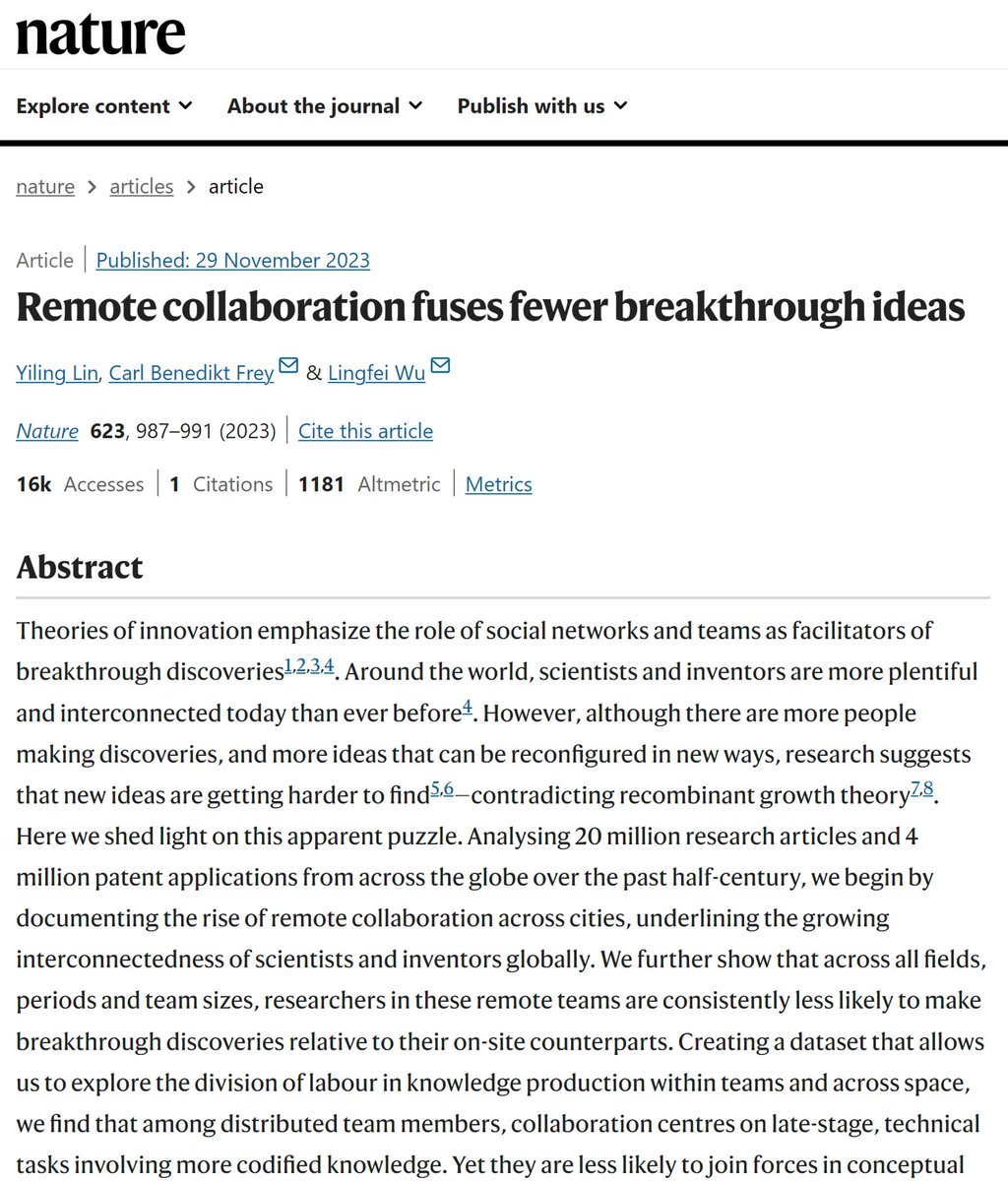
This is a great paper, but it is *massively* misunderstood.
It does not show that WFH reduces innovation. This paper and its follow-up actually suggests by 2023 that WFH increases innovation. To explain:
1) This paper is about *collocation* not *WFH*. They are completely different. If two people share the same office address - even if they are both hybrid or remote - they would be classified as collocated. For example, my co-author Steve Davis and I both work a hybrid schedule at Stanford, coming to the office maybe 2 days a week. We both have a Stanford office address on papers. So, for this paper we would count as being *collocated*. Indeed, almost all hybrid WFH teams would count as collocated.
2) Co-author teams are becoming more dispersed. The paper reports the average distance between team members offices has increased from 100km to 1,000km over the last 60 years. This reveals that tens of thousands of scientists are choosing to work in more global teams, presumably to access a wider network of experts. I co-author with researchers across five continents because it lets me work with great people. If teams of elite scientists, whose entire careers are focused on cutting-edge innovation, are becoming more dispersed it suggests it has major benefits.
3) The results do not hold after 2010. This is critical as Zoom and Dropbox cloud file sharing emerged after 2010. Indeed the follow-up paper by Carl Frey (one of the co-authors) and Giorgio President from Oxford shows innovation is *higher* for remote collaboration after 2010! https://t.co/8MeibM8JeO
So a fantastic paper - it deserves to be published in Nature. But to understand it you need to read beyond the title. You can't judge a book by its cover, nor a Nature paper by its 6 word title.
And please forward this to any mangers or CEOs claiming this implies WFH reduces innovation. It does not - indeed points (2) and (3) suggest exactly the reverse.
Es sieht so aus als wäre 2022 der letzte Zeitpunkt der Menschheitsgeschichte, in der wissenschaftliche Inhalte ohne die Hilfe von KI erstellt wurden. Wir können KI nur bis 2022 echt trainieren, ab 2023 ist vermutlich alles kontaminiert.
This is a thread about what was right and what was wrong in the recent Senate hearings on AI harms featuring @OpenAI CEO @sama, as well as @IBM's @_ChristinaMont and @GaryMarcus (one of the researchers in this field I respect most).
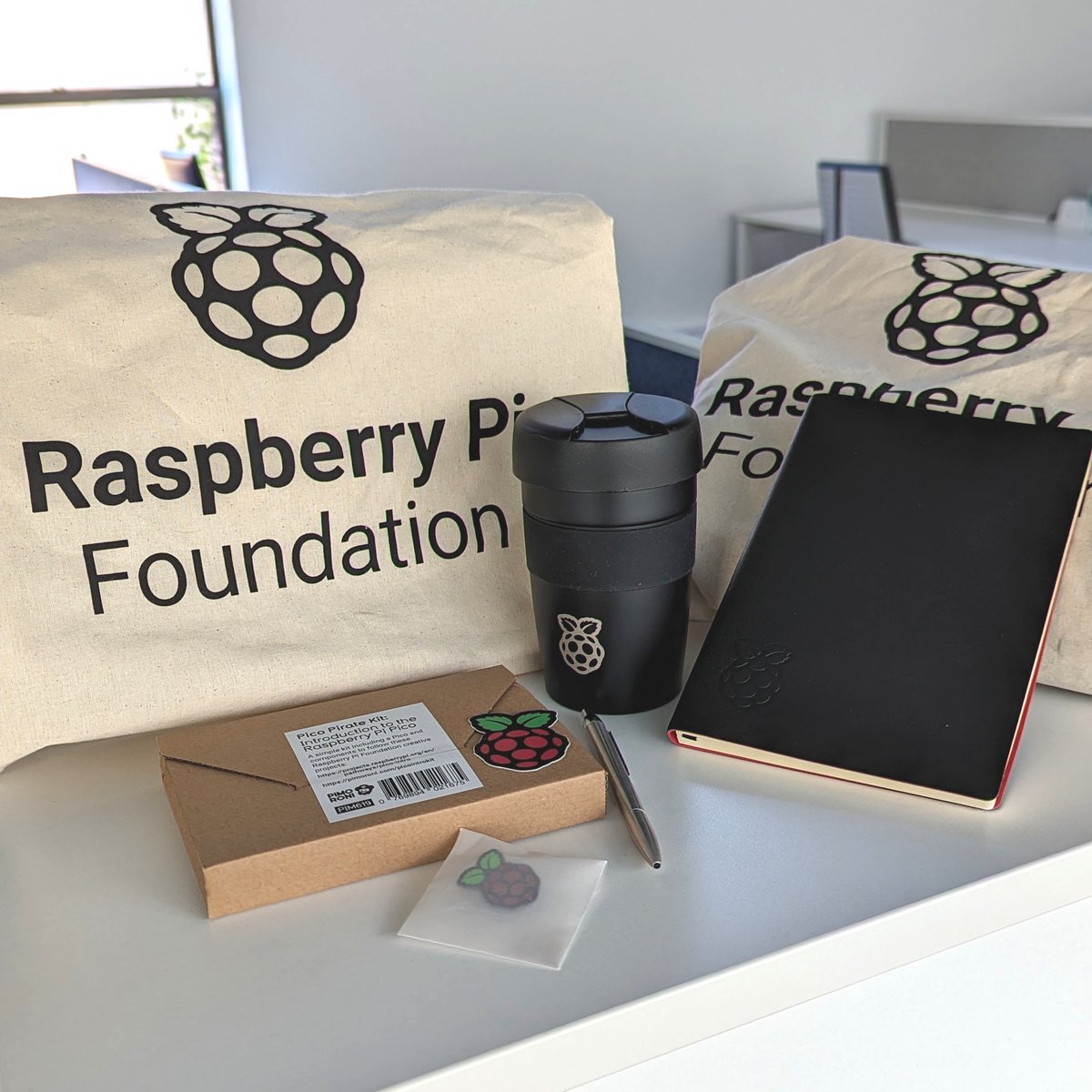
10K FOLLOWER GIVEAWAY 🎉🎈🎁
To celebrate 10K followers on Twitter, we're giving away 3x Raspberry Pi Foundation tote bags containing Raspberry Pi branded goodies 😍 Winners will be randomly selected on Friday, 19 May 2023.
To enter: Follow us, like & RT this tweet.
Good luck!
The Prisoner's Dilemma shows that cooperation in international politics (and other areas) is hard.
But it's not right, nor is it useful.
That's what Harrison Wagner taught us.
[THREAD]
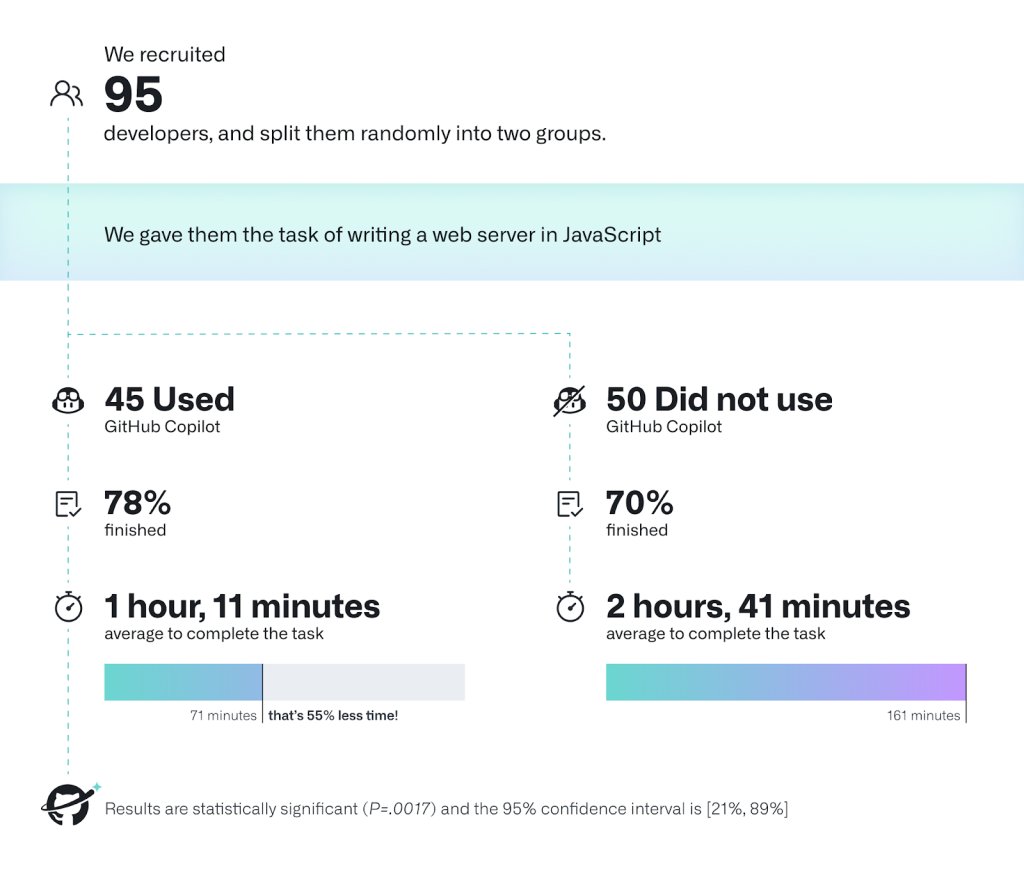
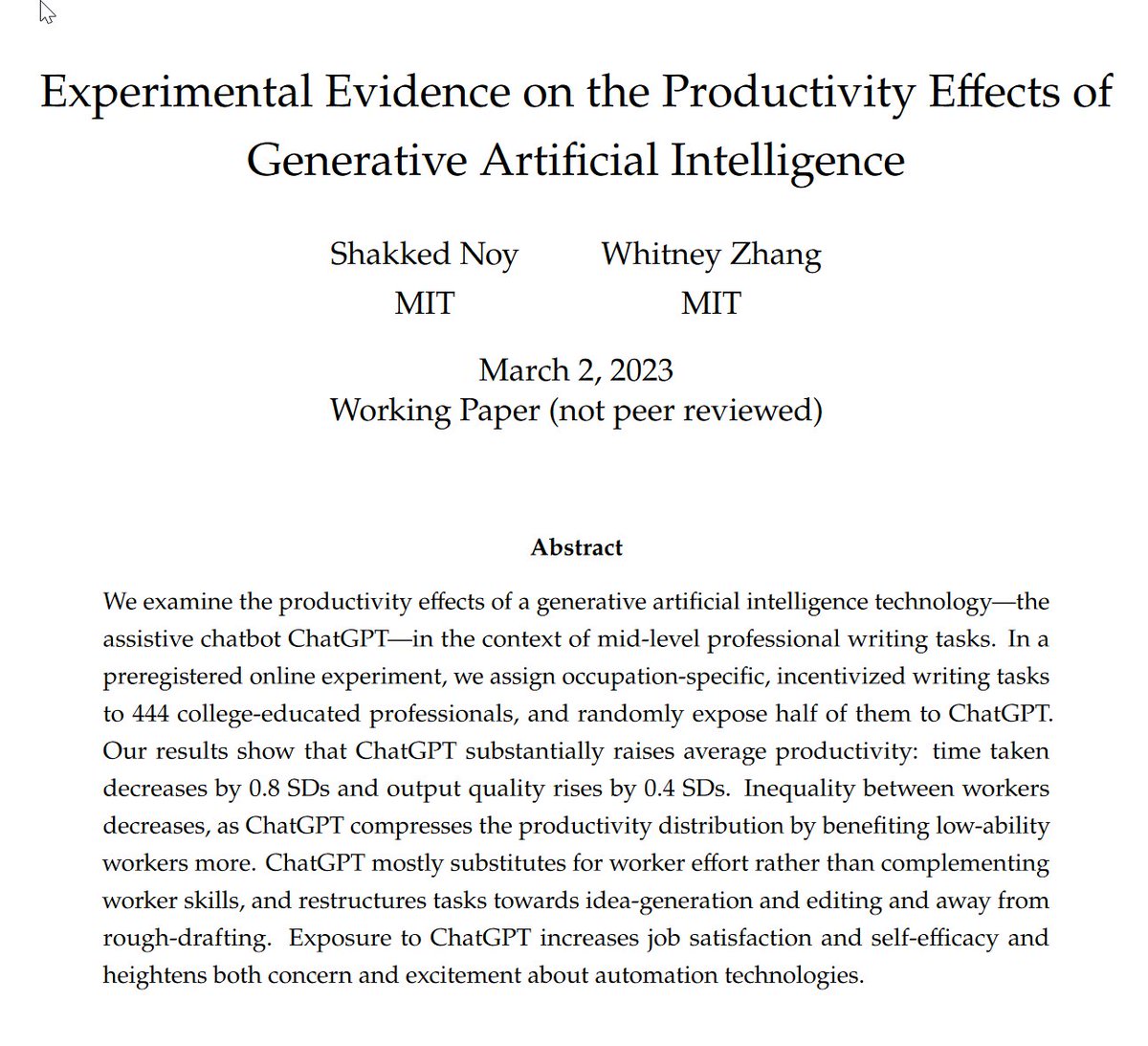
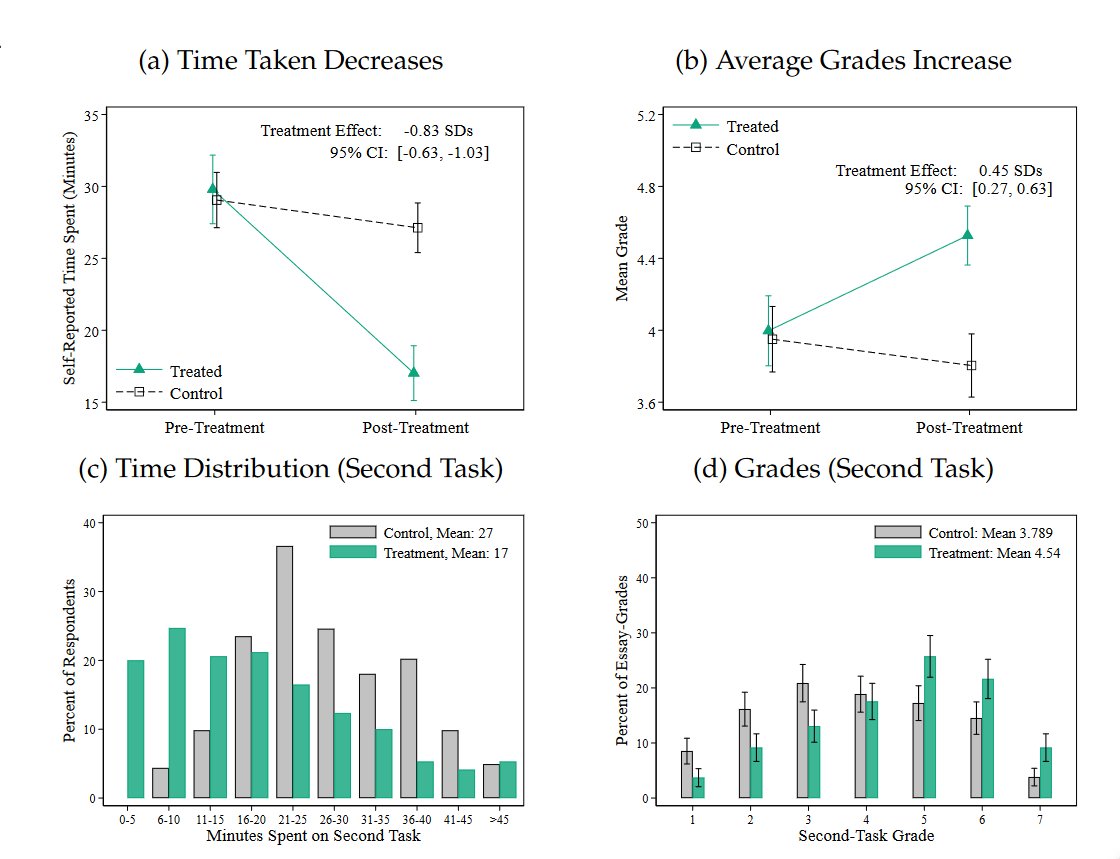
👀Two early papers find the effects of generative AI on knowledge work are completely unprecedented in modern history
Separate studies of both writers and programmers find 50% increases in productivity with AI, and higher performance and satisfaction. And this is just the start.









![ProfPaulPoast's tweet photo. The Prisoner's Dilemma shows that cooperation in international politics (and other areas) is hard.
But it's not right, nor is it useful.
That's what Harrison Wagner taught us.
[THREAD] https://t.co/h0gMyDXZ9w](https://pbs.twimg.com/media/FqYDz-SWAAExJrn.jpg)