🎀Announcing Ares & Van Ditmars #3 💃💃 In our latest @WEPsocial article, @macarena_ares & I use a life course approach to study political differences by social class.🗃️We observe respondents during youth and later employment trajectories, accounting for family origin. (1/5)
#OpenAccess from @EPSRjournal -
An urban–rural divide of political discontent in Europe? Conflicting results on satisfaction with democracy - https://t.co/KzUUSOtfbG
- @nathalie_vigna#FirstView
PPRNet-Serie: Wohlfahrtschauvinismus als elektoral erfolgreiche Strategie für linke Parteien? - @MatthiasEnggist
https://t.co/xTmIn1NmR8
PPRNet-Series: Why Welfare Chauvinism is not a Winning Strategy for the Left
https://t.co/Z5wdbzqCHe
The EU's regional funds are one of the biggest spending items of the EU and a key sticking point in the next budget negotiations.
In a new paper, @valentin_lang, @DanBischof and I use new data to see who benefits from them. And we show they need fundamental reforms. Here's why:
New in @SPSR_RSSP: Youth perspectives on welfare deservingness and welfare attitudes. Young people in Switzerland provide valuable and interesting insights. Surprising: EU unemployed are NOT seen as less deserving than Swiss unemployed!
Read: https://t.co/1QLmqUMc9D
🚨Pre-print alert: Is the urban-rural divide affectively polarised? 🏙️🏞️
In a new working paper, @DominikSchraff and I explore this question using comparative survey data from 9 European countries.
Link: https://t.co/IaE0UVAP7G
🧵 (1/7)
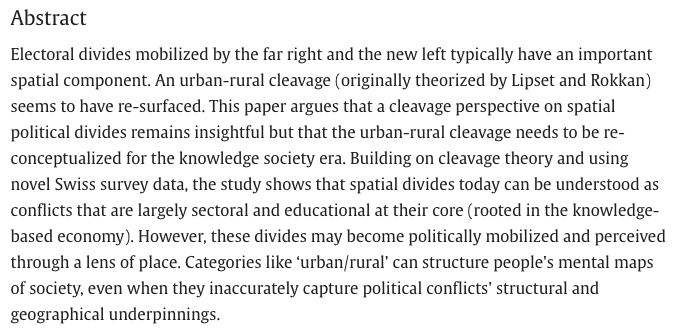
New article on place-based identities and cleavage formation in the knowledge society, out in @ElectoralStdies.
If you study spatial inequalities, rural resentment, and/or generally cleavage politics, this might be of interest!
https://t.co/9P7yxDNttp
New open access article with @SamirNegash1 in Journal of European social policy, where we look at people's preferences for a) including migrants in the welfare state and b) letting them in the country the first place https://t.co/xqYJofNwaR
🚨 Publication alert 🚨
My first dissertation paper has just been published in @jepp_journal 🎉🎉
In the paper I investigate the relationship between place-based resentment and political trust in local and national institutions.
Link: https://t.co/7sdgdJHlB4
🧵(1/9)
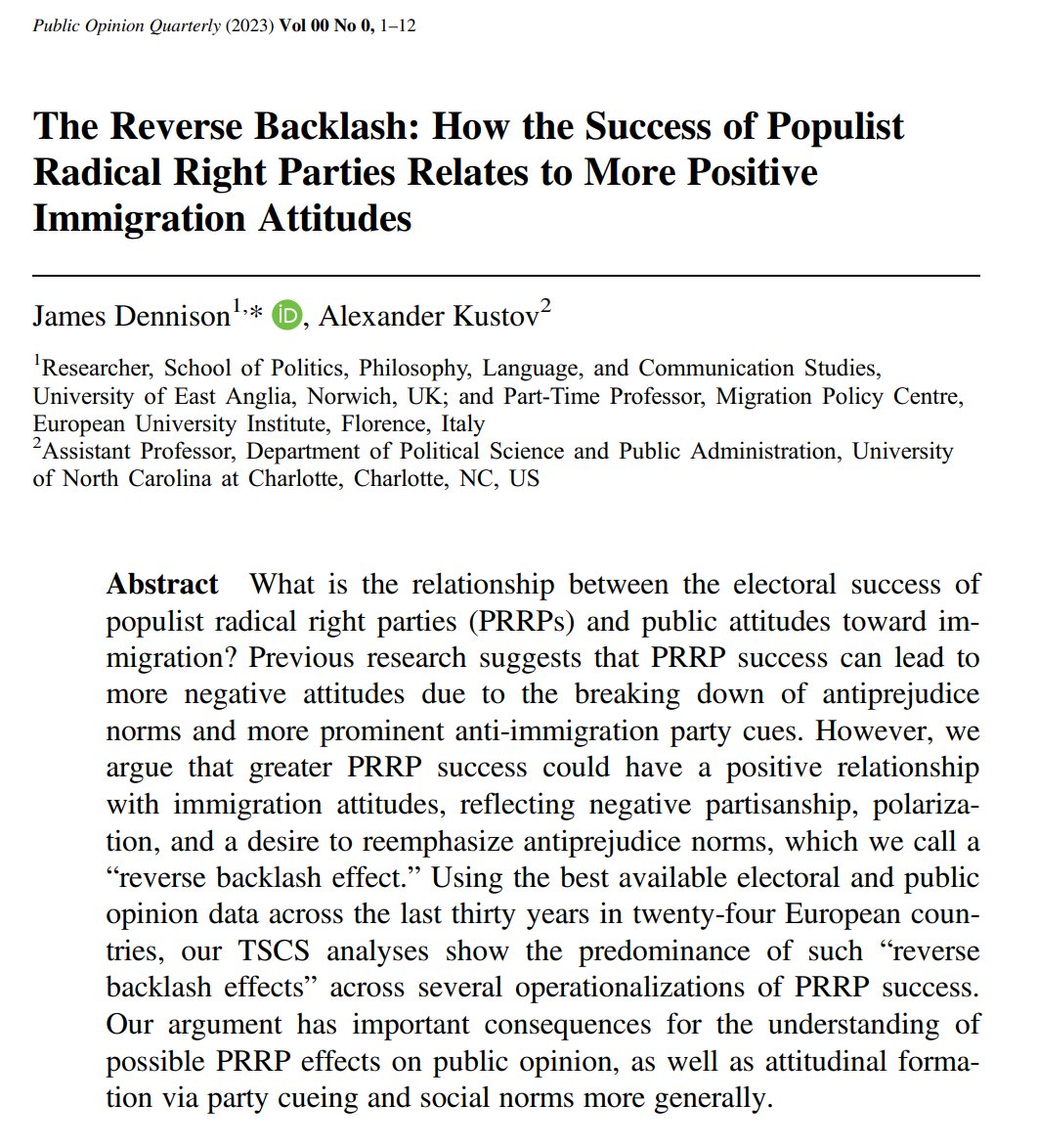
We've all heard about "immigration backlash." But what happens to immigration attitudes when populists win?
Reverse backlash! Our new study finds that public opinion is usually more pro-immigration *after* the electoral success of anti-immigration parties https://t.co/7KhiARC2Kx
We have a cover. New book "How the Radical Right Has Changed Capitalism and Welfare in Europe and the USA" forthcoming @OUPAcademic on 29th February 24.
Thanks so much to @DoroBohle, @SiljaHausermann & @jrhopkin for their advance praise.
@Julius_Ktxt I have coded (with the help of an RA) welfare chauvinism positions for 40 parties across 7 West European countries based on manifestos / MARPOR for my PhD. I am happy to share this data. The drawback is that I only have a snapshot at one time point (around 2018).
@ZackG_Politics@robfordmancs@lawrencemckay94@PME_Politics Of course, just controlling for these crude socio-demographic factors does still not rule out that this is due to composition. The goal of the paper is primarily description. Happy to send over the working paper in case you are interested.
@ZackG_Politics@robfordmancs@lawrencemckay94@PME_Politics It is indeed just a 5-point answer scale that is not combined with others. We recode to the 0-100 scale for comparability with other measures/countries. Controlling for age/gender/educ/ethnicity does change the emerging gap only slightly.