BA(Hons), MAHist, BTheol, GCertSocRes, GDipProfW, CertInfoTech. - Understanding history for hope.
Australian Football, Tennis.
MauriceJWhite on BlueSky.
What is happening here.
The bond market is now pricing-in 4 more 25 basis point rate hikes by June 2027, a total of +125 basis points including September's hike.
Just 9 months ago, markets had expected at least 100 basis points of rate CUTS by June 2027.
That's a +225 basis point differential in interest rate expectations in a matter of months.
Meanwhile, the 10Y Note Yield is up nearly +70 basis points in 30 days with no comment from the Trump Administration.
To top it all off, after a failed attempt at intervention, the US Treasury is now completely silent as long-term yields surge to their highest level since June 2002.
The bond market is trading like 7%+ inflation is back and the Fed is about to start raising rates by 50 basis points at a time.
This is unsustainable.
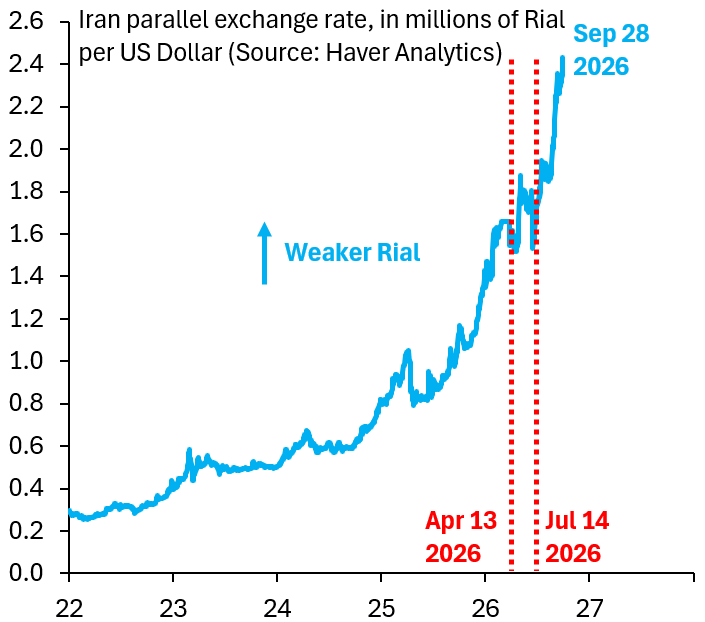
We're nearing the end of the line on Iran. The Rial had another big fall yesterday. Iran exported 80 million barrels of oil in the 4 weeks before the blockade was reimposed on July 14. That cash is now depleted. The blockade and US sanctions are working...
https://t.co/sqEjdJEjDx
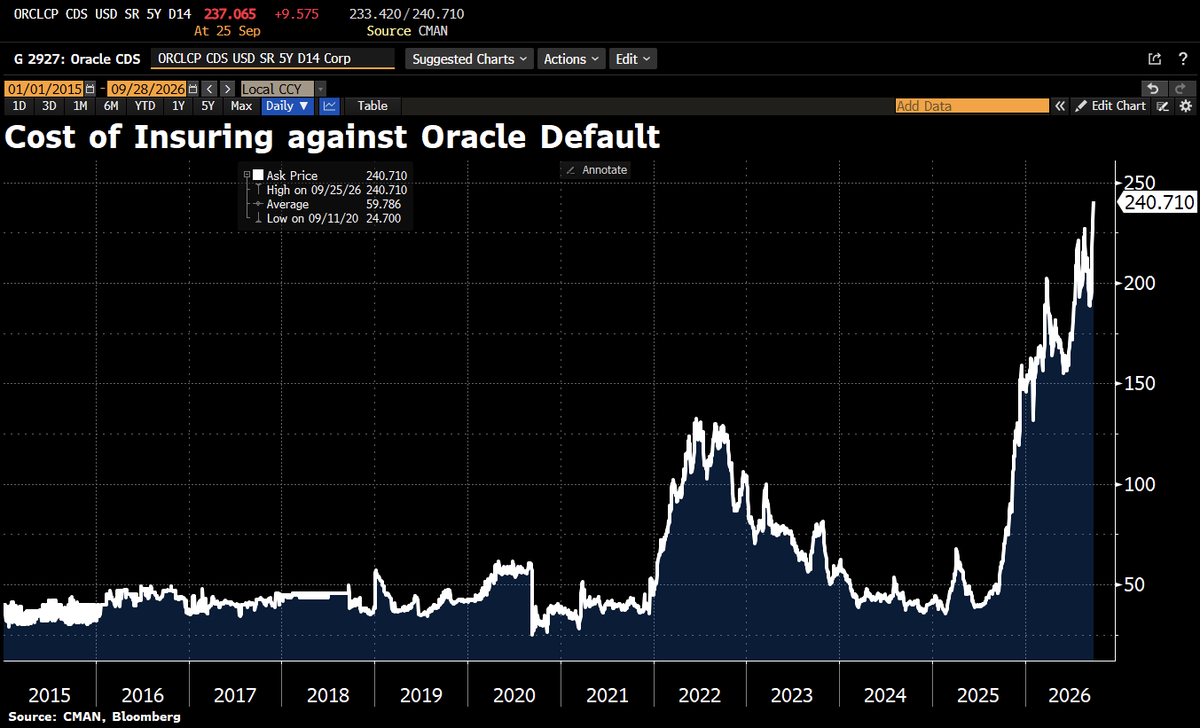
OUCH! The cost of insuring Oracle against default has surged to a record after its force majeure notice for Project Jupiter rattled AI data-center debt markets. 5y CDS quoted at 240.7bps imply a 19.1% probability of default by end-2031, assuming 40% recovery. Almost 1 in 5!
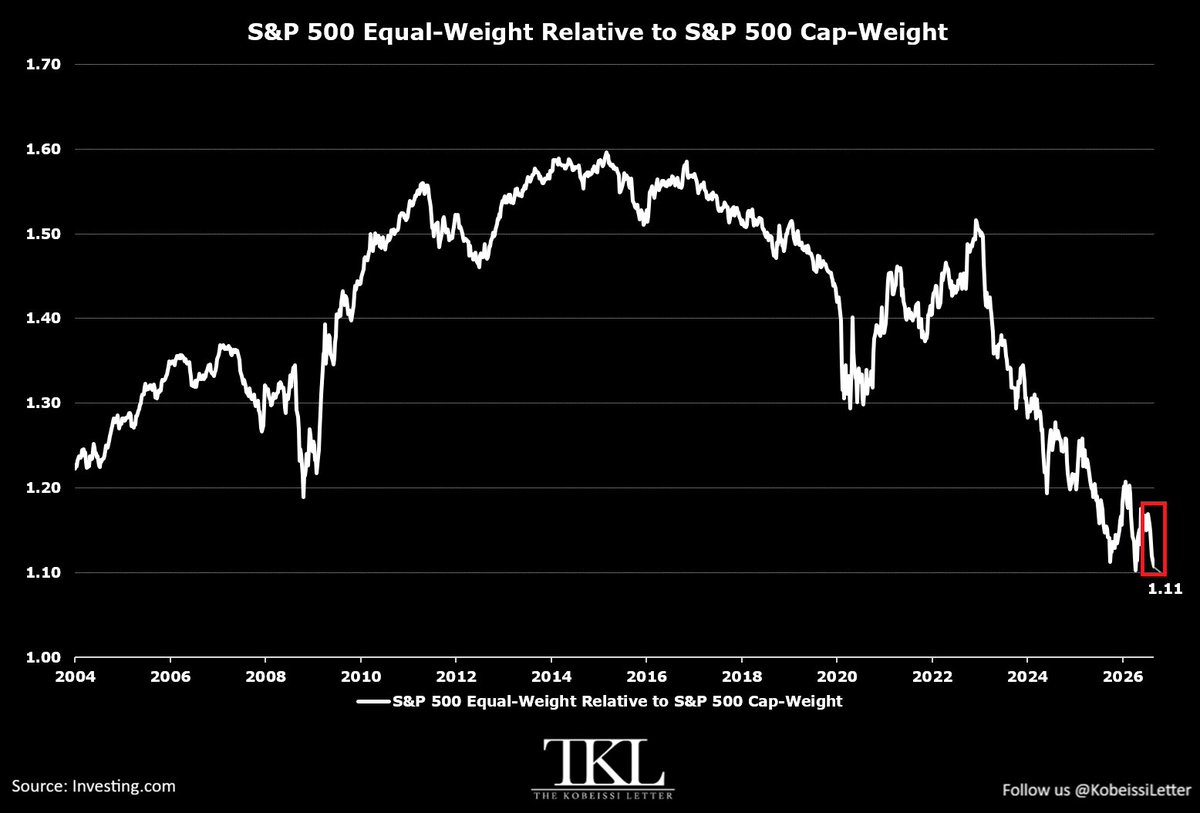
The average US stock is struggling.
The ratio of the equal-weighted S&P 500 to the S&P 500 index is down to 1.11, its 3rd-lowest level since April 2003.
This ratio has declined for 5 consecutive weeks by a total of -5.5%.
Over this period, the equal-weighted S&P 500 has fallen -4.4% while the S&P 500 has increased by +0.8%.
This also puts the ratio on track for its 4th consecutive annual decline, the longest streak since 1999.
By comparison, this metric peaked at 1.60 in April 2015.
AI is carrying the entire stock market.
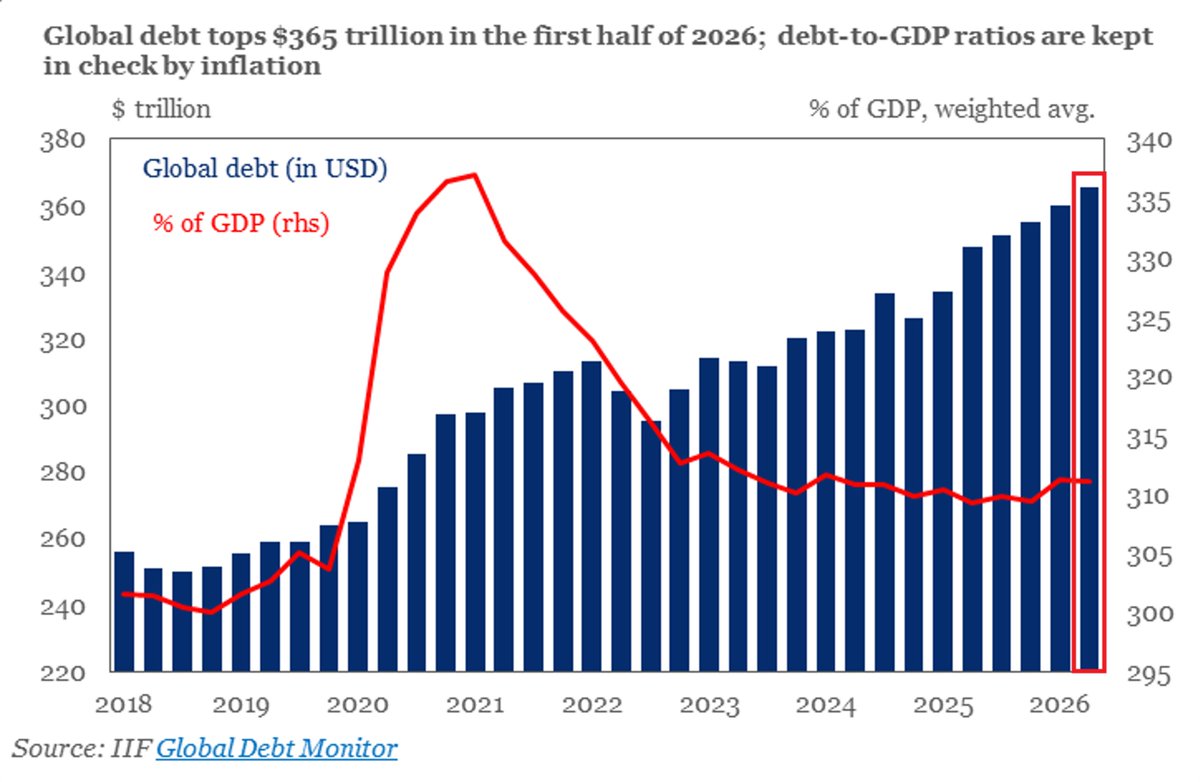
BREAKING: Global debt jumped by more than +$10 trillion in H1 2026, to a record $365 trillion.
Emerging-market debt drove the increase, rising +$6.5 trillion, to a record $110 trillion, with most of the surge coming from governments and non-financial companies.
Excluding China, emerging-market and developing-economy debt soared to a record $38 trillion.
Global debt now stands at ~310% of global GDP, although the ratio has fallen -25 percentage points from its early-2021 peak, largely because inflation has boosted nominal GDP rather than because of deleveraging.
Meanwhile, developed economies paid more than $3.3 trillion in interest on marketable government debt over the last year, exceeding estimated global spending on AI at $2.6 trillion, defense at $3.1 trillion, and clean energy at $2.3 trillion.
This comes as annual government interest payments across the G7 alone surged +85% YoY.
The global debt crisis is in uncharted territory.
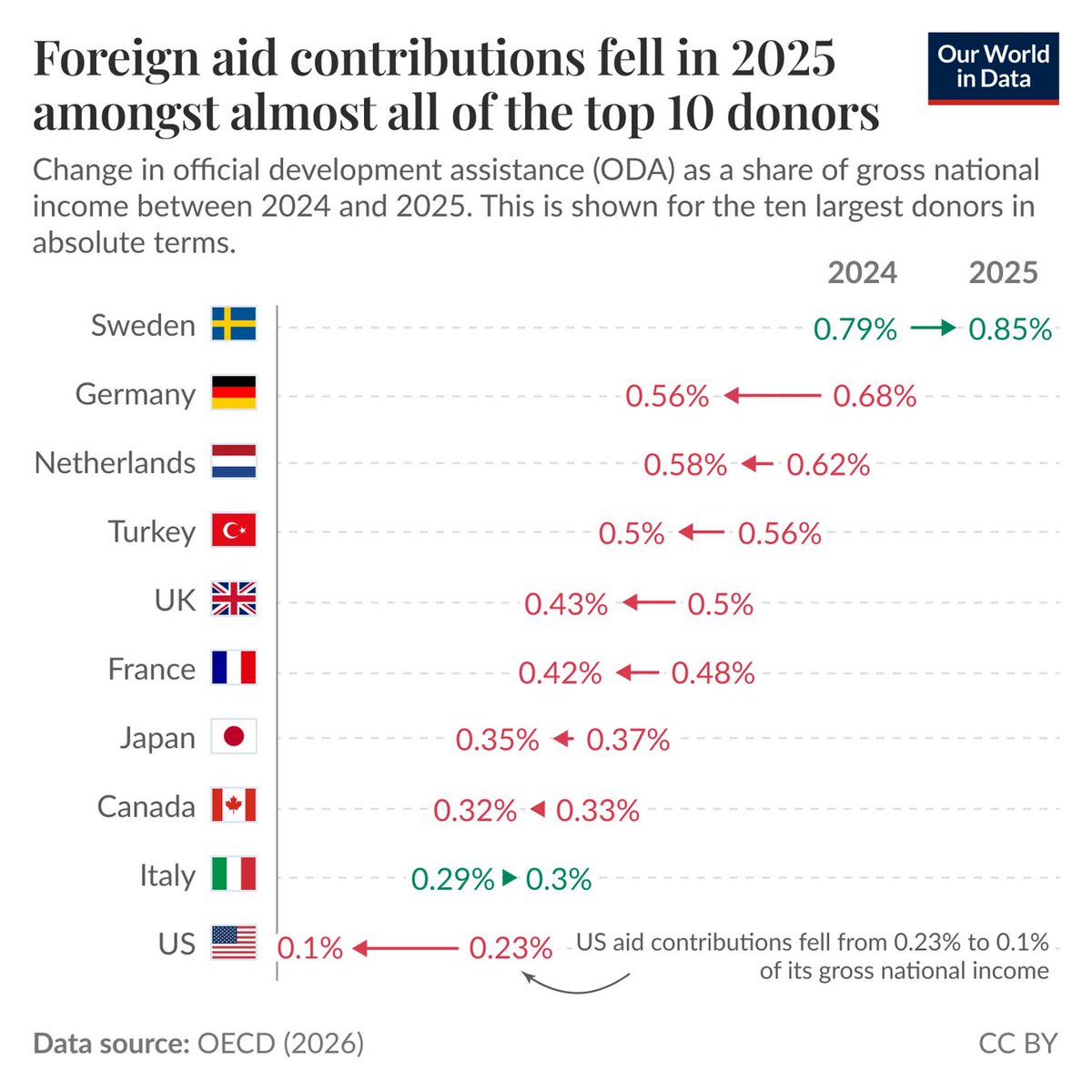
Foreign aid contributions fell in 2025 amongst almost all of the top 10 donors.
In 2025, the amount of foreign aid given by the world’s richest countries fell by almost a quarter. That amounted to a reduction of roughly US$50 billion.
Aid cuts in the United States — and the shutdown of its agency for international development, USAID — got the most attention, and for good reason: the US is the world’s largest aid donor in dollar terms, so its contributions make a huge difference to the global total.
But many other countries cut their aid contributions, too. In the chart, you can see the change among the largest 10 donors (in dollar terms) from 2024 to 2025. This is given as a share of their gross national income.
Contributions fell in eight of the ten countries. Only Sweden and Italy increased their budgets.
The countries shown are the largest donors in dollar terms; some others not shown contribute far more in relative terms: Norway, for example, was the only country to give more than 1% of its national income to foreign aid.
(written by @_HannahRitchie)
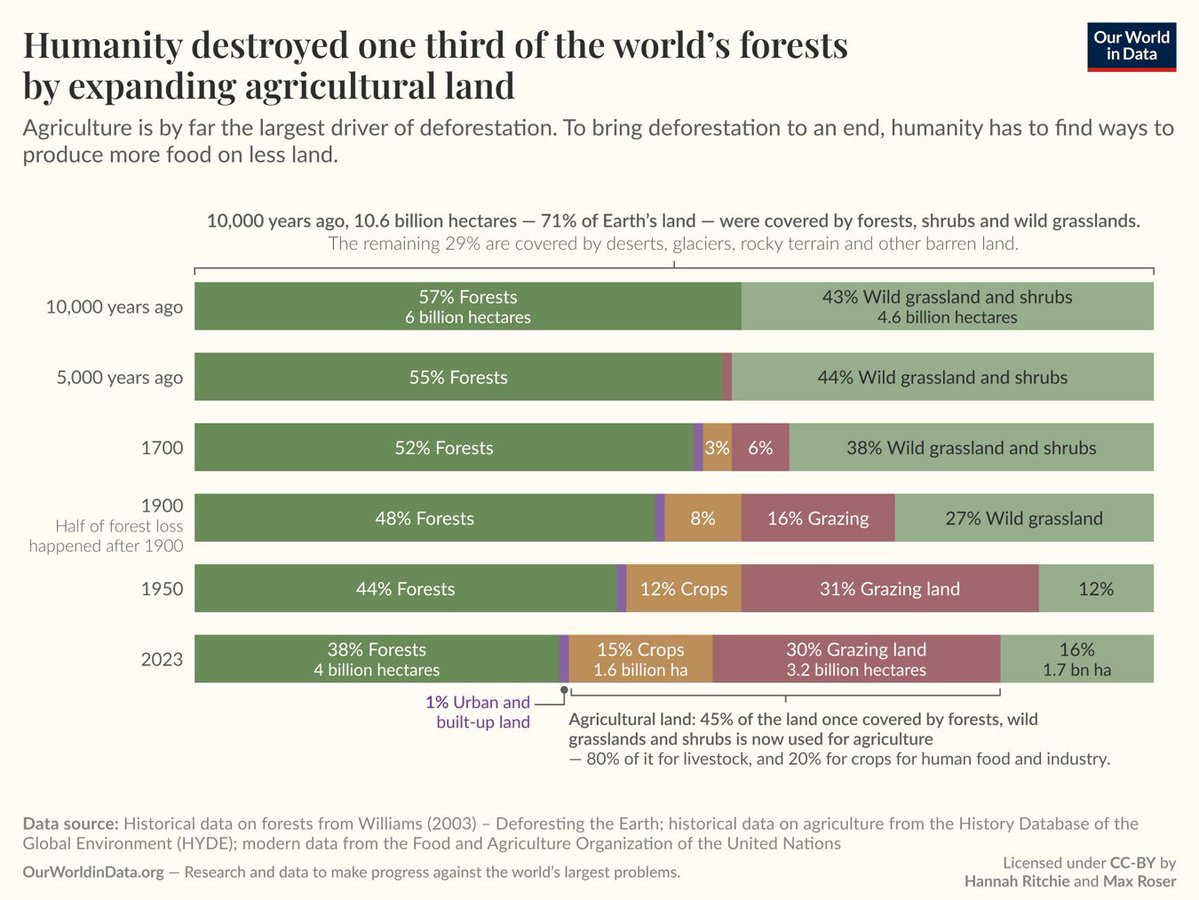
"The world passed “peak deforestation” in the 1980s, and it has been on the decline since then... Since 1961, the amount of land we use for agriculture has increased by only 7%. Meanwhile, the global population has more than doubled, from 3.1 to 8 billion."
Shortly after the end of the last great ice age — 10,000 years ago — 57% of the world’s habitable land was covered by forest. That’s 6 billion hectares. Today, only 4 billion hectares are left. The world has lost one-third of its forests, an area twice the size of the United States.
Only 10% of this was lost in the first half of this period, until 5,000 years ago. The turn of the 20th century is when global forest loss reached the halfway point: half of total forest loss occurred from 8,000 BCE to 1900; the other half occurred in the last century alone. Deforestation is not a new problem: relatively small populations of the past were capable of driving a large amount of forest loss. But deforestation accelerated over the last century, driven by the continued expansion of land for agriculture. Urban land accounts for just 1% of global habitable land.
The world passed “peak deforestation” in the 1980s, and it has been on the decline since then. Improvements in crop yields mean the per capita demand for agricultural land continues to fall. Since 1961, the amount of land we use for agriculture has increased by only 7%. Meanwhile, the global population has more than doubled, from 3.1 to 8 billion. This means that agricultural land per person has more than halved.
There are real reasons to believe that this century doesn’t have to replicate the destruction of the last one.
Australia especially vulnerable and yet the Liberal Party has just committed to a climate change denial platform. No one under 50 should vote for the Liberals if they care at all for future generations.
@Peter_Fitz The A.L.P. should be considering what overdue reforms they will be able to pass with control of the Senate as well as the House after the next election.
An interesting piece in @ForeignPolicy by @IgnatiusPost suggests we might, in fact, be witnessing the twilight of the dictators’ era, not the dawn.
"The three global strongmen are ageing—Trump is 80, and Xi and Putin are 73—and all three are beset by speculation about their health. They rule decisively, but over fragmented countries. None has created a plan to sustain his legacy. All three suffer from what might be called autocrats’ disease. In their arrogance, they make mistakes."
"We can see the hubris in all three leaders as they struggle to dominate a world in transition. They’re superpowers that can’t win wars; dominant economies burdened by debt and corruption. Most of all, they face the unknowable challenges of transformational AI technology.
Wise leaders view the future with humility—and a recognition that even with vast power, they can’t steer events. We’re stuck with the autocratic leaders we’ve got. But not forever."
https://t.co/a110DWNhwt
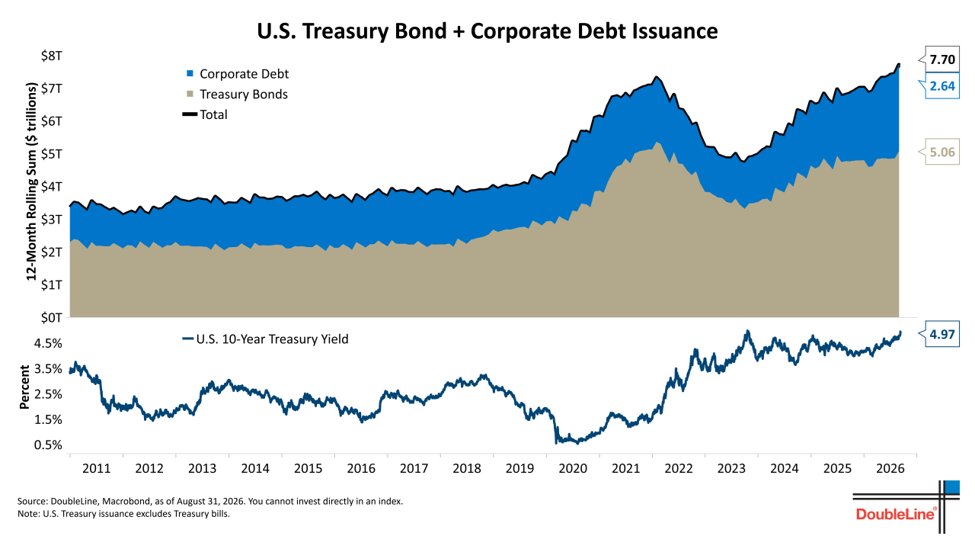
"Corporate America is funding one of the largest investment cycles in decades while the US government is running historically high deficits, forcing both public and private borrowers to compete for capital."
AI firms and the US government are competing for capital:
US Treasury issuance excluding T-bills has risen to $5.06 trillion over the last 12 months, the highest since the 2021 record.
Over the same period, corporate debt issuance has surged to a record $2.64 trillion.
This brings total Treasury and corporate debt issuance up to $7.70 trillion, an all-time high.
This is increasingly driven by AI-related firms, whose bond issuance has soared +541% YoY in 2025, to $109 billion, and another +78% in the first half of 2026, to a record $194 billion.
In other words, corporate America is funding one of the largest investment cycles in decades while the US government is running historically high deficits, forcing both public and private borrowers to compete for capital.
This competition is adding to other forces pushing long-term yields higher, including inflation, Fed policy, and economic growth expectations.
The US bond market is entering an era of intense capital competition.
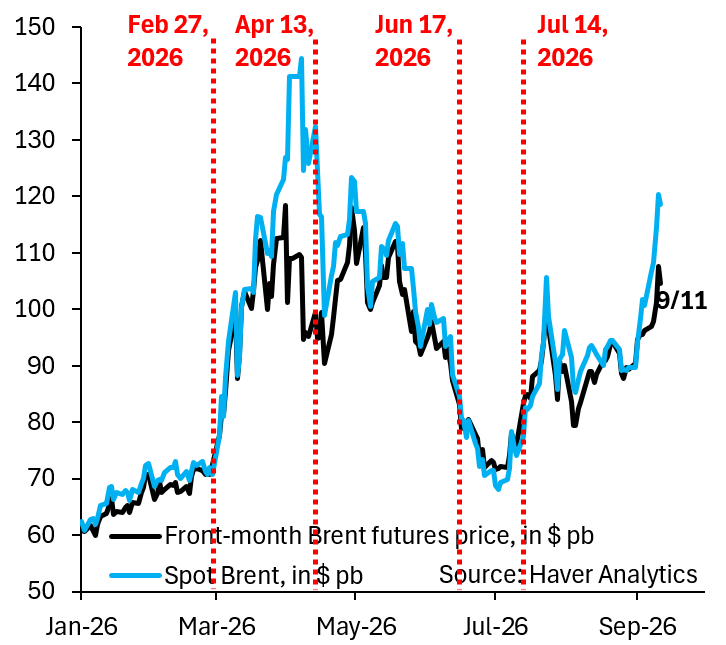
The narrative on oil is shifting. After the pipeline attack, the usual voices that prophesy an apocalyptic rise in oil were loud. But that's now giving way to facts, which are that oil flows through the SoH are rising. Data and facts always prevail...
https://t.co/SoQyi5cJOp
"Successful conservation efforts (including the removal of obsolete dams, the creation of effective fish passages, and the protection of free-flowing rivers) have already shown promising results in restoring fish populations and river health."
Freshwater fish populations have collapsed by a staggering 81%.
This dramatic decline is emerging as one of the most severe, yet often overlooked, wildlife crises on Earth, with serious consequences for both river ecosystems and global food security.
According to a major 2024 global assessment, migratory freshwater fish populations plummeted by an average of 81% between 1970 and 2020. This collapse is happening far faster than declines in terrestrial or marine wildlife. The main culprits are human-made barriers such as dams and weirs that block ancient migration routes, combined with pollution, habitat destruction, and climate change.
These fish play a critical role in maintaining the health of rivers and wetlands. Their disappearance disrupts entire ecosystems, affecting everything from nutrient cycling to the survival of other species. For millions of people in Asia, Africa, and Latin America, migratory fish are also a vital source of nutrition and livelihood. Their decline directly threatens food security and local economies.
The good news? Recovery is still possible. Successful conservation efforts (including the removal of obsolete dams, the creation of effective fish passages, and the protection of free-flowing rivers) have already shown promising results in restoring fish populations and river health.
The challenge now is to act quickly and at scale before these vital freshwater systems cross a point of no return.
[World Wildlife Fund. (2026). Living Planet Report 2025: A System in Peril. World Wildlife Fund]
Caixin: "The global race to develop AI has largely been framed as a technological and financial triumph, promising to turbocharge productivity and reshape industries. Yet, as the initial euphoria settles, leading economists and industry executives are beginning to sound the alarm on a complex macroeconomic hangover. While AI is expected to significantly boost supply, it threatens to simultaneously suppress labor income, weaken consumer demand and trigger long-term deflationary pressures."
https://t.co/6zqr93nJ8X
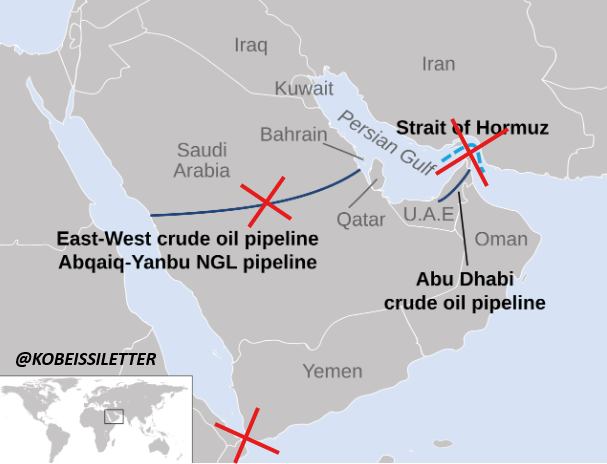
It seems most people don't understand how severe the energy situation is right now in the Middle East.
As of Friday, Saudi Arabia's East-West pipeline has officially been shut down after recent attacks, putting -4 million barrels of daily oil exports at risk.
Meanwhile, the Bab el-Mandeb Strait is now at risk of being shut down, threatening up to -9 million barrels of daily oil supply.
All while the Strait of Hormuz is operating at ~20% of its pre-Iran War capacity, removing -15 million barrels of daily oil flows.
Combined, this represents nearly ~30 MILLION barrels per day of oil flows that are either offline or at risk.
Even after accounting for some overlap between these routes, the scale of the potential disruption is enormous relative to the ~100 million barrel per day global oil market.
This is one of the most severe energy supply situations in modern history.
The attack on the East-West pipeline is pretty much the worst thing that could have happened for global supply, yet front-month futures only managed to rise a bit above $100, due to rising oil flows out of the SoH. We won't get another bad spike in oil...
https://t.co/WI1ZPQCb1v
BREAKING: Saudi Crown Prince MBS called Trump twice on Thursday strongly urging him to launch US strikes on the Houthis as they closed in on the Bab el-Mandeb Strait and seized more than 3,000 sq. km, per two US officials.
Trump refused.
The request is a sharp reversal from July, when MBS told Trump Saudi Arabia could handle the Houthis on its own. US officials have told their Saudi counterparts that Trump will not give that support and that the directive is to keep American forces focused on Iran and the Strait of Hormuz and avoid opening another front.
MBS made his bet in February, hosting the US air armada at Prince Sultan Air Base that opened the war, and took the Iranian retaliation on Saudi soil that followed, repeated missile and drone strikes on the base that killed a US soldier and destroyed an E-3 AWACS, and strikes on Saudi refineries. The Houthi advance on Bab el-Mandeb and Thursday's hit on the East-West pipeline are that war's downstream effect, and they are landing on Saudi Arabia alone.
Behind the directive is also capacity, with the Pentagon's own commanders having filed formal objections to extending the Iran war, calling it unsustainable, and US officials saying Patriot and long-range missile stockpiles are catastrophically low, leaving nothing spare to defend Saudi oil infrastructure from the retaliation a Houthi campaign would bring. A Houthi front would draw on the same magazines already being emptied over Jordan and the Gulf.
Pakistan turns down Saudi request to strike Houthis.
Pakistan says the Mecca Pact of mutual defense “doesn’t cover a pre-existing condition,” so it only covers wars started after the pact was signed. It also covers only state actors, not non-state actors (and perhaps preferably those within reach of Pakistani power projection).
Saudis won’t ask Turkey (the third partner in the Mecca Pact). If they did, Turks would happily deploy naval assets from their Somalia base. Turks itch to control Bab al-Mandab; a fight with the Houthis would give them an excuse. Saudis are not keen to replace Iranian occupation of Yemen and the strait with Turkey.





![Rainmaker1973's tweet photo. Freshwater fish populations have collapsed by a staggering 81%.
This dramatic decline is emerging as one of the most severe, yet often overlooked, wildlife crises on Earth, with serious consequences for both river ecosystems and global food security.
According to a major 2024 global assessment, migratory freshwater fish populations plummeted by an average of 81% between 1970 and 2020. This collapse is happening far faster than declines in terrestrial or marine wildlife. The main culprits are human-made barriers such as dams and weirs that block ancient migration routes, combined with pollution, habitat destruction, and climate change.
These fish play a critical role in maintaining the health of rivers and wetlands. Their disappearance disrupts entire ecosystems, affecting everything from nutrient cycling to the survival of other species. For millions of people in Asia, Africa, and Latin America, migratory fish are also a vital source of nutrition and livelihood. Their decline directly threatens food security and local economies.
The good news? Recovery is still possible. Successful conservation efforts (including the removal of obsolete dams, the creation of effective fish passages, and the protection of free-flowing rivers) have already shown promising results in restoring fish populations and river health.
The challenge now is to act quickly and at scale before these vital freshwater systems cross a point of no return.
[World Wildlife Fund. (2026). Living Planet Report 2025: A System in Peril. World Wildlife Fund]](https://pbs.twimg.com/media/HSAU_-QakAA-jYZ.jpg)