Today, we’re partnering with Nscale to deploy up to 100,000 GPUs on the NVIDIA Vera Rubin Platform
We're committing $3.5 billion initially, with plans to scale beyond $6 billion
Bringing a robot into every home demands compute at an unprecedented scale
Warm-heartedness. Even animals appreciate it. If you are motivated by loving kindness, it will be reflected in the happy expression on your face. Real beauty is inner beauty.
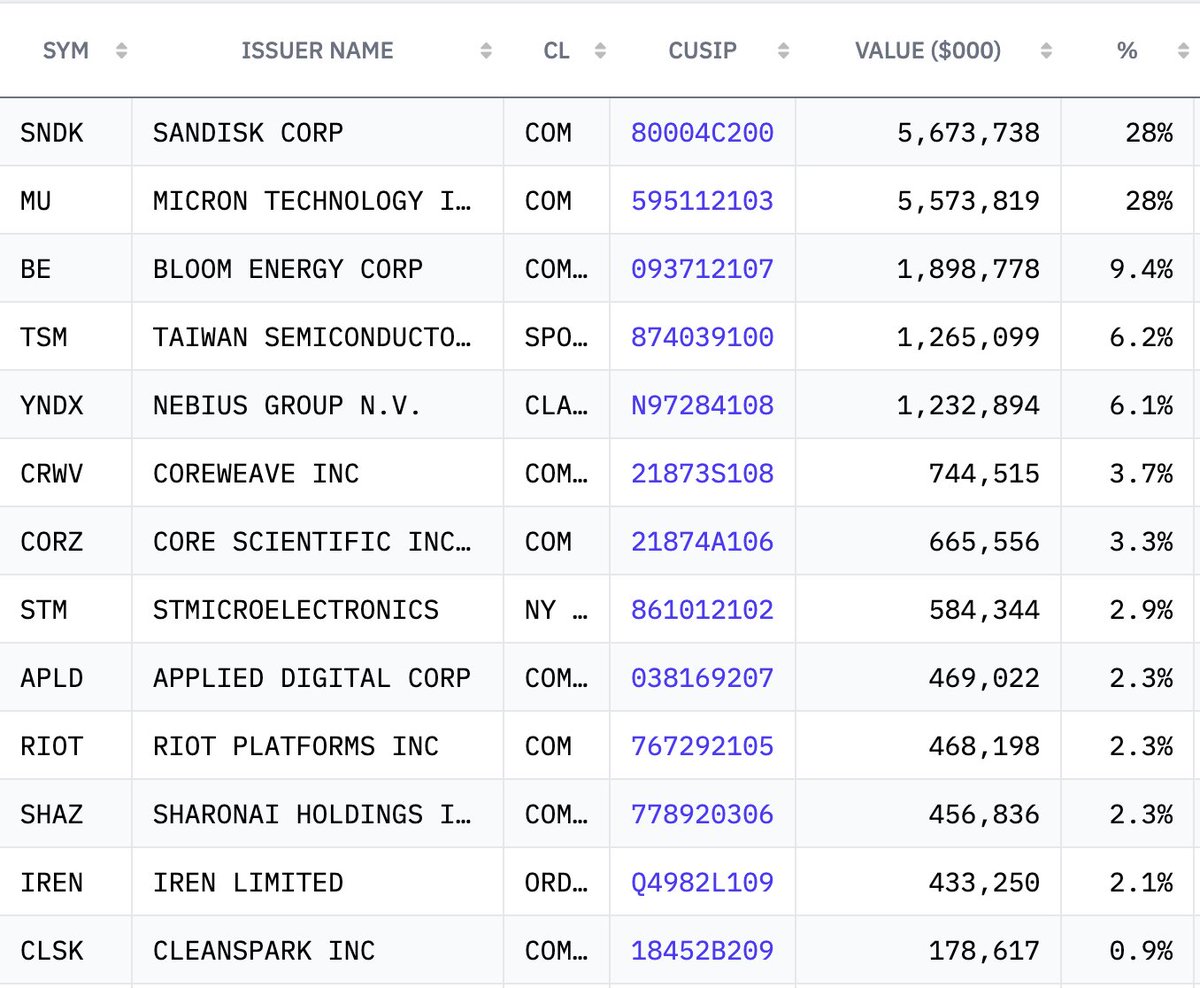
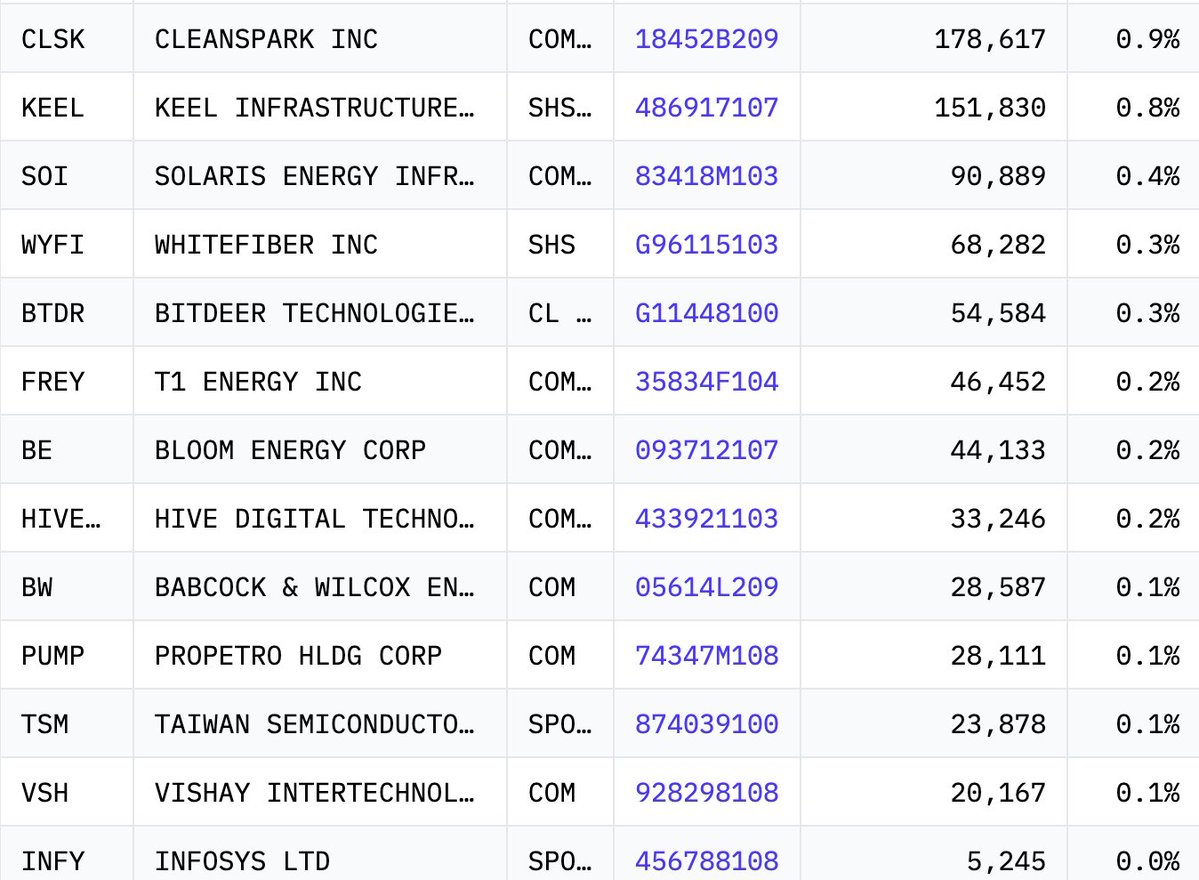
Just taking a look at Leopold's Situational Awareness Q2 13F latest holdings as of June 30th:
1. $SNDK - $5.674B
2. $MU - $5.574B
3. $BE - $1.899B
4. $TSM - $1.265B
5. $NBIS - $1.232B
6. $CRWV - $744.5M
7. $CORZ - $665.6M
8. $STM - $584.3M (new)
9. $APLD - $469.0M
10. $RIOT - $468.2M
11. $SHAZ - $456.8M
12. $IREN - $433.3M
Less material positions includeed $CLSK, $KEEL, sei-network:native, $WYFI, $BTDR, $TE, $HIVE, $VSH, and others.
Seems like Situational Awareness concentrated around memory (Sandisk, Micron), that have low forward multiples but high visibility into 2030.
As well as Anthropic/energy/power adjacent from colo/neoclouds + Bloom.
Some of the bottlenecks like the MLCC trade, he couldn't see play out (Taiyo Yuden, etc). due to July's liqudation. And some are new like $STM (eg. MCU price hikes).
With core winners of everything such as $TSM (but less high-beta).
This looked similar to my H2 2026/early 2027 portfolio with Nebius, Micron, TSM, colo players and others as core focus. (I've heavily concentrated on upstream networking/legacy memory currently, with a lot of name overlap).
But always cool to see what others are doing.
The person you marry is the person you fight with. The house you buy is the house you repair. The dream job you take is the job you stress over. Everything comes with an inherent sacrifice—whatever makes us feel good will also inevitably make us feel bad.
FYI to the AI bears: $NVDA projects $1.3T of hyperscaler spend for 2027.
Up from ~$800B in 2026, alongside ~70% revenue growth despite remaining capacity constrained… far above prior Street expectations of ~45%.
That capex flows across the AI supply chain… from memory and networking to foundries. Especially through the new bottlenecks/chokepoints that didn’t benefit from older generations.
We’re like 2 hours into the party where people started off drinking Sapporo draft beer.
Someone spiked Situational’s drinks and we had to pause the party for 30 min.
But now it’s back on with tequila shots on the table.
I think the real party is about to begin.
When I finished college, my ambition was not to build the world’s fastest chip company.
I wanted to become a professor of development economics.
I went to work in Pakistan.
The Northwest Frontier Province is about as far from Silicon Valley as you can get.
After I came back, I started a PhD program and finished my classes and qualification exams.
Then I got bored.
I thought I'd add an MBA and end up teaching at a business school.
My housemate Jim was joining a tiny startup.
They asked me to join, twice.
I said no. I had no interest in data networking.
I thought it was plumbing.
Eventually I caved and wrote their business plan.
Then I joined them. And it turned out to be an extraordinary team and a phenomenal industry.
We built chips and systems for switching and routing. We played a small role in changing the world.
We sold the company less than a year later for $280M, when that was a lot of money.
8 of those guys are still with me, more than 25 years later, at @cerebras today.
I call it the myth of LinkedIn - this idea that we all had our careers mapped from the time we left high school.
Mine wasn't a straight path.
It was a series of accidents where I fell into things I enjoyed.
Where I was curious, met people whom I liked, and learned from.
If you're 18 and someone asks you to pick a narrow lane - don't.
Go to university.
Learn how to think.
Be as broad as you can.
Follow your curiosity. Explore.
The journey will take you to amazing places.
This is Roland.
He is one of our performance engineers.
And a passionate pizza maker.
One Tuesday, he just set up shop in the @cerebras lunchroom.
Brought in a hand truck filled with dough and sauce.
Set up his pizza oven in the patio.
Now it’s a thing.
Great pizzas on Tuesday evenings.
Everyone stops by and grabs a slice.
For 4 months, he paid for the ingredients out of pocket.
He didn't even think to ask for it to be subsidized.
He just wanted to practice his pizza making.
Now we buy the ingredients.
He did what he loved and shared it.
And by doing that, he brought the team together.
That is the culture we want at Cerebras.
Where people get to be their whole selves.
We want the office to be more than a place to show up to work.
If you're passionate about something, share it with your colleagues.
Everyone benefits, everyone learns.
That’s the environment we want at @cerebras.
Neil Movva (@neilmovva) started his career at Nvidia, working on GPUs and kernels, and has an unusually deep understanding of inference, from software to chips to power.
We spend a lot of time on each of those layers, how they connect, and where the important tradeoffs are.
What makes this conversation special is how detailed it is (like a 401-level class), yet Neil makes it remarkably clear and easy to follow.
Today he runs Sail Research, a company building infrastructure for agents to make tokens as cheap as possible.
We discuss:
- Latency versus throughput
- Why there are no bad chips, only bad pricing
- The end of kernel engineering
- Buying chips and power no one else wants
- New chip architectures
- Nvidia lore + his contrarian view of the company
- Open source and the frontier labs
I learned a ton. Enjoy!
TIMESTAMPS
0:00 Intro
0:38 Building a “Token Factory”
4:21 The Future of Background Agents
13:09 Nvidia and the GPU Stack
23:27 Chips, Memory, and Transformers
36:14 The Future of AI Training Data
44:32 Chip Scarcity and Compute Arbitrage
52:44 Reinventing the AI Data Center
59:01 Power and the “Scavenger Strategy”
1:10:10 Open vs. Closed AI
“Those who died yesterday had plans for today. And those who died today had plans for tomorrow.
Do not take life for granted. In a blink of an eye, everything can change.
Forgive often and live with all of your heart. You may never know when you may not have the chance again.”
One year before Apple co-founder Steve Jobs died, he sent an email to himself and it read:
I grow little of the food I eat, and of the little I do grow, I did not breed or perfect the seeds.
I do not make any of my own clothing.
I speak a language did not invent or refine.
I did not discover the mathematics I use.
I am protected by freedoms and laws I did not conceive of or legislate, and do not enforce or adjudicate.
I am moved by music I did not create myself.
When I needed medical attention, I was helpless to help myself survive.
I did not invent the transistor, the microprocessor, object oriented programming, or most of the technology I work with.
I love and admire my species, living and dead, and am totally dependent on them for my life and well being.
—End
Be grateful for the people in your life and let them know that they matter.