‼️MORE WILDNESS IN PSYCHIATRY
Ketamine has long been thought to impact depression through glutamate signaling.
But it doesn’t
A new paper in @Nature shows that ADENOSINE is the causal neurotransmitter
And adenosine also underlies the antidepressant effects of ECT
🤯
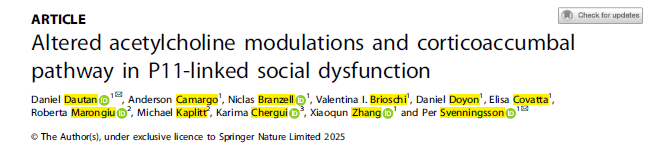
So happy to have it out, it was a very challenging manuscript but at the end it is worth it. We show for the first time the effect of depression-like phenotypes on social anxiety and social motivation.
Together we go farther.
Thanks to a partnership with @ASAP_Research and @MichaelJFoxOrg, the @AllenInstitute's ABC Atlas now includes #ParkinsonsDisease data from 3 million brain cells from 9 regions.
This is the first time Parkinson’s data has been included in the Atlas. It nearly doubles the amount of human brain data available and gives researchers a shared language and a powerful tool to explore how diseases like #Parkinsons and #Alzheimers affect the brain at the cellular level.
https://t.co/zEeP6L7srL
new preprint from our lab: Modular striatal dynamics and reciprocal inhibition orchestrate skilled action sequencing.
Using high-resolution kinematics tracking and neural recordings in mice performing a water-reaching task, we found spatially distributed modules of striatal projection neurons whose activity corresponded to the generation of each element in the sequence (aiming, reaching, and drinking). They are activated sequentially and exhibit reciprocal inhibition, ensuring a strict serial order. Optogenetic activation of the direct pathway of the orofacial module promoted licking while suppressing reaching. Reaching could suppress stimulation-evoked licking, revealing bidirectional inhibitory interactions. Our findings demonstrate that the modular organization in the striatum, coupled with reciprocal inhibition, sculpts the temporal progression of actions.https://t.co/ygOchDGvnQ
Happy to share this new paper from the lab in collaboration with George Augustine, characterizing synaptic connectivity between the claustrum and the anterior cingulate cortex. Congratulations to Roberto, Zach, and all co-authors! @RobertodelaTor
Postdoc positions available in my lab @karolinskainst - exciting science and fantastic environment. I take mentoring seriously - 7/7 postdocs that left my lab has faculty positions today. Existing datasets and funds to build new ones available. https://t.co/fGgDwbpC2j
Enhancing the Cre-loxP system: Two new genetic tools – roxCre and loxCre – can improve the performance of the Cre-loxP system for making genetic modifications in vivo.
https://t.co/tWWZ418o9v
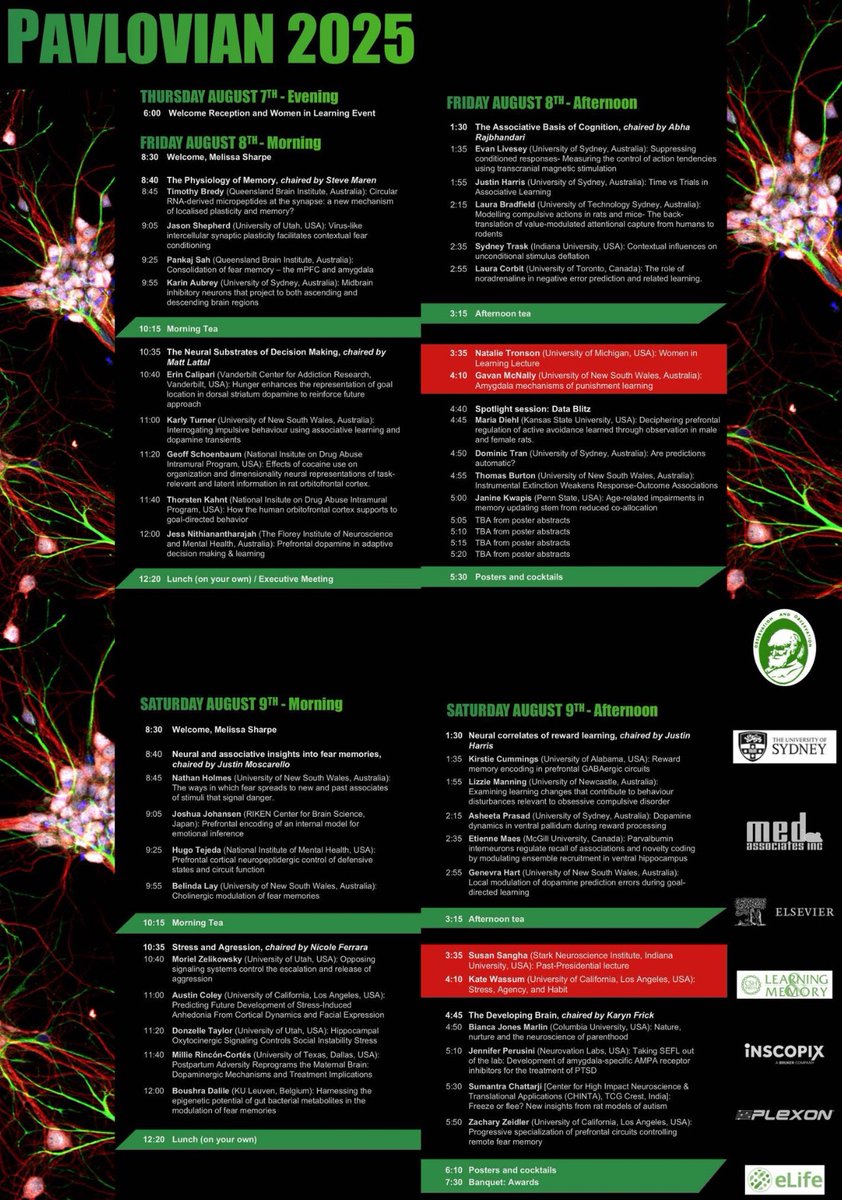
🚨LAST DAY to submit poster abstracts for the PAVLOVIAN 2025 annual meeting this FRIDAY 🚨
Check out our 🔥 program and submit abstracts in the link below, with 5 travel awards available for students and postdocs! 🧠
Our scientists with over 150 collaborators have released the largest functional map and wiring diagram of the brain to date – seven years in the making.
Today’s 1.6 petabyte release marks a historic day for neuroscience. This moonshot milestone will further efforts towards understanding the cortical mechanisms of intelligence. Congratulations to the teams who made this possible.
In @eLife: Molecular and spatial transcriptomic classification of midbrain dopamine neurons and their alterations in a LRRK2G2019S model of Parkinson’s disease https://t.co/8YUEYLfrlD
Do you want to know how basal ganglia synaptic plasticity contribute to movement symtoms in PD? Can you achieve a giga seal? Good, then Join us! Please share.
https://t.co/hTVDE4DpWS
It's clear that many do not understand what @NIH-funded research does to improve health. It's time to revive a study published 10 years ago that provides incredible information about this. link in the comment
Every single new drug approved by the FDA from 2010–2016 was built on NIH-funded research—that’s all 210 drugs. But what the public sees is just the tip of the iceberg.
Pharma takes credit for the final product, but beneath each drug developed, there are ~20 years of basic research, and 90% of the cost is from basic research funded by the NIH, which discovers drug targets, understands disease mechanisms, and creates life-saving treatments.
Figuring out how cancer evades the immune system, how addiction rewires the brain, and how heart disease develops is the role of the NIH, creating the foundation for the breakthrough drugs that come 20 years later, and the NIH does all that with only 0.8% of the US budget.
Without NIH, there would be no cancer immunotherapy, no anti-overdose medication, no anti-heart attack or stroke medication, no cutting-edge treatments.
If NIH funding is cut, the iceberg will melt. That means fewer cures, more suffering, and more lives lost.
The science beneath the surface keeps us afloat.
Invest in NIH. Invest in life
Have just returned from an amazing week in Sydney at the @ACAN_Course with 12 young, clever, enquiring minds and inspiring faculty (see if you can pick who's who in the photo 😄). Thanks to course Director Jay for invitation and all for a great week @AusNeuroSoc@ANS_Students
Save the date!
UK Neural Computation 2025 will be at Imperial College London
9 July: ECR day
10-11 July: main meeting
9 invited speakers, 4 talks from abstracts and many posters
Abstract & registration opening soon
Pls share!
https://t.co/20OtknExHK
I want to highlight *some* of my favorite studies on dendrites and spines from 2024 👀 - feeling very excited and inspired about the field 🔥 Happy new year y'all!
3D printing has had a major impact on neuroscience research in recent years. Our curated collection of designs is one of the most accessed posts on our website. Read about it in this week’s post on OpenBehavior:
https://t.co/ITJdqIAMs6
#neurotech#DIYneuroscience#3Dprinting
Thrilled to announce that our study is finally published in @CellReports! Huge thanks to our dedicated team, collaborators, reviewers, and the support from @Vetenskapsradet, @Wstiftelserna, and @StratNeuro. Proud moment! 🎉 https://t.co/ZNTROpTJCW