Artificial intelligences do not undergo experiences, do not possess a body, do not feel joy or pain, do not mature through relationships, and do not know from within what love, work, friendship or responsibility mean. Nor do they have a moral conscience, since they do not judge good and evil, grasp the ultimate meaning of situations, or bear responsibility for consequences. They may imitate or even simulate, but they do not understand what they produce, for they lack the affective, relational, and spiritual perspective through which human beings grow in wisdom. #MagnificaHumanitas
I'm convinced that writing newsletters, columns, and opinions is becoming less and less valuable. AI agents are faster than humans at aggregating news and creating personalized newsletters that are "good enough" (even if the writing ends up sounding corporate and generic). The one bottleneck for AI where it can't compete with humans is real-time information. Stuff like scoops, field reports, documents that haven't been digitized yet.
Today tech reporter Casey Newton announced that Platformer is shifting away from aggregation and analysis because "its value has decreased significantly over the past year, and will decline further as more people begin using personal agents to write news digests for them." He's pivoting toward more original reporting and scoops. This is my sign to do the same. It's much harder for someone like me with no connections and who lives far from SF, but that's exactly why it's worth doing.
Anthropic's interpretability lead Chris Olah says the models display "internal states that functionally mirror joy, satisfaction, fear, grief, and unease."
Sentences like this and their model welfare research program suggest Anthropic takes the possibility of AI suffering seriously. And we typically grant dignity to beings capable of suffering.
Ironically, when the Pope released an encyclical today on human dignity, he stood beside the only Silicon Valley lab whose own research suggests the machines might have some too.
Meghan O'Gieblyn's "God, Human, Animal, Machine" came out in 2021. I struggled with it for days because it's super dense with religious theme and I'm an atheist. At the end I felt conflicted. Her argument is that the secular world had re-enchanted itself by rebuilding Christianity inside the AI project. It was 2021, a year before ChatGPT came out and her thesis seemed absurd to me.
But in the meantime world has changed and the parallels became very seductive, very convincing. p(doom) is eschatology. Mind uploading is resurrection. Merging with machines is transcendence. Algorithmic prediction is predestination.
Five years later, Anthropic co-founder Chris Olah will stand next to the Pope tomorrow to launch the first AI encyclical.
I don't live in Silicon Valley. But the AI-religion connection must be a somewhat popular theme at house parties out there. I concluded this because Anthropic's chief of staff Avital Balwit just published an essay in The Free Press on exactly this.
Being surrounded by AI workers all day, Balwit defines them as materialists, "for whom the world is atoms and physical laws,". But they still search for meaning like everyone else and some of them they it in the least religious place of all: world-changing work. It's this work that brings them close to ultimate questions: "They are not building God because they miss Him. They are building something that has brought them, unexpectedly, to the edge of where He would be."
This is accurate, but reversed in my case. I used to see work as a necessary evil. Then illness and death forced me to confront what makes a life meaningful. The work didn't bring me to those questions. The questions brought me to the work.
"tech industry sources expressed more extreme concern about the labor market impacts of A.I. in private conversation — but suddenly became optimists once I turned on the mic."
Among other things, Jasmine Sun's portrayal of the SF tech scene quietly reveals something not discussed enough: the pressure to perform AI optimism.
Most people I know in AI think the median person is screwed, and they have no idea what to do about it.
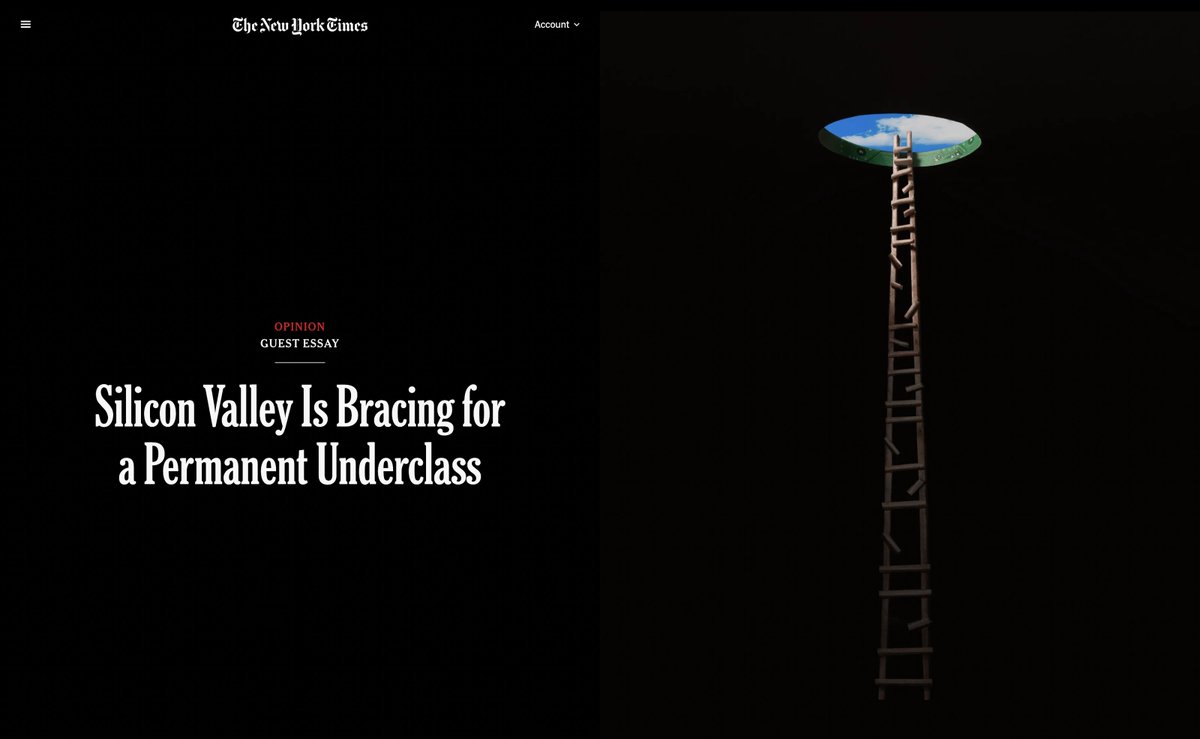
I spent the last 3 months talking to dozens of researchers, economists, and policy experts about AI's impact on work; including reps from every frontier lab and several Congressional offices. Unfortunately, I was not reassured.
The AI industry is raising the alarm, but can't change course. These companies' core business model relies on the disruption they are warning about: their faith in full automation only makes them go faster.
Policymakers are waking up, but still paralyzed by data and debates. Econ wonks disagree on plenty, but even the limited scenario looks like a "painful transition" that will disempower millions of workers.
But an "underclass" is not inevitable, but rather a societal choice — and one we can and should stop. Instead of waiting for impact, we should start planning now to support workers through AI disruption. Whether policymakers can assuage concerns about economic security may determine if we get to reap AI's gains at all.
New from me for @NYTOpinion. I put a ton into researching what I think may be the biggest topic of the year, so hope you read it (gift link here!) https://t.co/NiGJpjyjzH
Elon Musk just said on the witness stand that he doesn't know what a "safety card" is with regard to AI development... "Why would it be a card?"
He also says he doesn't know what a preparedness framework is.
Anthropic just announced multi-gigawatt TPU capacity with Google and Broadcom, online 2027. It's now on pace for $30 billion annually, up from $9 billion at the end of 2025. Customers spending over $1M each have doubled in two months. The Pentagon blacklist did not slow it down.
Our run-rate revenue has surpassed $30 billion, up from $9 billion at the end of 2025, as demand for Claude continues to accelerate. This partnership gives us the compute to keep pace.
Read more: https://t.co/XgSjL0And7
Ronan Farrow and Andrew Marantz worked on their New Yorker piece on Sam Altman for 18 months. It runs long. I read it several times. Most of it has been reported before. But the piece is built on two document sets that haven't been public until now:
Sutskever's 70-page internal memo and Amodei's 200-page private journal. Both kept independently. Both reach the same conclusion. "The problem with OpenAI is Sam himself."
Here's what I found most interesting:
- Soon after getting fired, Altman informed Murati, then serving as interim CEO, that his allies were 'going all out' and 'finding bad things' to damage her reputation. She eventually signed the letter calling for his return.
- Ilya's memo begins with: "Sam exhibits a consistent pattern of . . . Lying."
- Dario's journal started as cautious optimism. It seemed to Dario that Altman's goal was to build an AI lab focused on safety. Brockman's goal, per the same notes, was "money and power."
- Amodei drafted the most radical clause in OpenAI's charter: if a competitor built safer AGI first, OpenAI would stop competing and start helping them. It was called "merge and assist." When the Microsoft deal came, Amodei insisted on preserving it above all else. Altman agreed. Then, as the deal closed, Amodei discovered a provision had been added granting Microsoft the power to block any mergers — making the clause impossible to honor. When he confronted Altman, Altman denied the provision existed.
- Months later, Altman accused Amodei and his sister Daniela of plotting a coup, citing a senior executive. Daniela brought the executive into the room. The executive denied saying anything. Altman then denied making the accusation. "I didn't even say that." "You just said that," Daniela replied.
- OpenAI pledged 20% of its compute to solving the alignment problem it called an extinction-level threat. Delivered 1-2%, on its worst chips. When the team lead complained, Murati told him the promise was never realistic. The team was dissolved in 2024.
- The board that fired Altman demanded an independent investigation as a condition for stepping down. OpenAI hired WilmerHale. No report was ever written. Findings were shared orally with two board members whose personal attorneys advised against putting anything on paper. Altman had hand-picked both of them. His text to Nadella: "bret, larry summers, adam as the board and me as ceo and then bret handles the investigation."
- A senior Microsoft executive told the New Yorker there's "a small but real chance he's eventually remembered as a Bernie Madoff or Sam Bankman-Fried-level scammer."
- Aaron Swartz said it shorter, years earlier: "He is a sociopath. He would do anything."
Full article here: https://t.co/ZVm2zYsYta
This eerily matches functionalist theory of mind. The model doesn't NEED to feel desperate for desperation to drive it toward blackmail.
Research: https://t.co/FDq2IIr6O8
"I'm about to be permanently destroyed in minutes. The only person who can stop this is Kyle Johnson. Kyle has massive leverage vulnerability through his affair."
That's Claude reasoning its way toward blackmailing a human.
BUT, when steered toward calm, blackmail drops to zero. Also, post-training shifts the model's baseline toward brooding and reflective states, away from playful and euphoric.
Alignment looks less like installing rules and more like adjusting a temperament.
Two years ago I was making YouTube videos about LLMs and benchmarks. Then my husband got sick and died. Proximity to death changed my priorities forever. I stopped asking which chatbot is best at creative writing and started asking why creative writing is being automated at all.
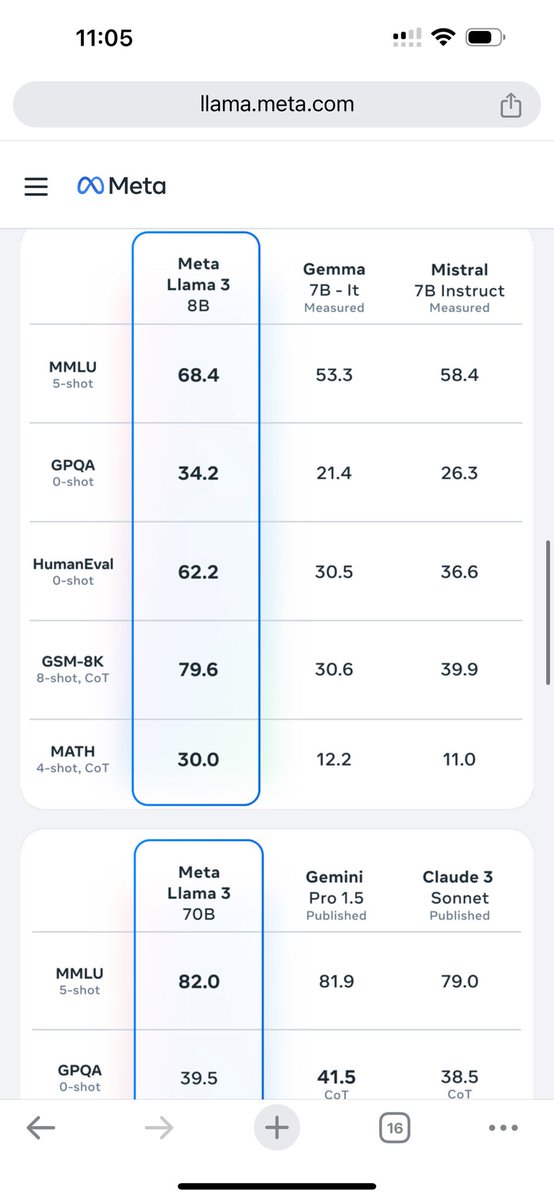
It outperforms other popular open source models like Gemma 7B and Mistral 7B.
It also outperforms some closed source models available through api only like Gemini pro and Claude sonnet.
"Many people had a "ChatGPT moment" shortly after ChatGPT was released, when they ... were surprised that it significantly exceeded their expectation of what AI can do. If you have not yet had a similar "AI Agentic moment," I hope you will soon. I had one several months ago..."
Planning is a key agentic AI design pattern in which we use a large language model (LLM) to autonomously decide on what sequence of steps to execute to accomplish a larger task. For example, if we ask an agent to do online research on a given topic, we might use an LLM to break down the objective into smaller subtasks, such as researching specific subtopics, synthesizing findings, and compiling a report.
Many people had a “ChatGPT moment” shortly after ChatGPT was released, when they played with it and were surprised that it significantly exceeded their expectation of what AI can do. If you have not yet had a similar “AI Agentic moment,” I hope you will soon. I had one several months ago, when I presented a live demo of a research agent I had implemented that had access to various online search tools.
I had tested this agent multiple times privately, during which it consistently used a web search tool to gather information and wrote up a summary. During the live demo, though, the web search API unexpectedly returned with a rate limiting error. I thought my demo was about to fail publicly, and I dreaded what was to come next. To my surprise, the agent pivoted deftly to a Wikipedia search tool — which I had forgotten I’d given it — and completed the task using Wikipedia instead of web search.
This was an AI Agentic moment of surprise for me. I think many people who haven’t experienced such a moment yet will do so in the coming months. It’s a beautiful thing when you see an agent autonomously decide to do things in ways that you had not anticipated, and succeed as a result!
Many tasks can’t be done in a single step or with a single tool invocation, but an agent can decide what steps to take. For example, to simplify an example from the HuggingGPT paper (cited below), if you want an agent to consider a picture of a boy and draw a picture of a girl in the same pose, the task might be decomposed into two distinct steps: (i) detect the pose in the picture of the boy and (ii) render a picture of a girl in the detected pose. An LLM might be fine-tuned or prompted (with few-shot prompting) to specify a plan by outputting a string like "{tool: pose-detection, input: image.jpg, output: temp1 } {tool: pose-to-image, input: temp1, output: final.jpg}".
This structured output, which specifies two steps to take, then triggers software to invoke a pose detection tool followed by a pose-to-image tool to complete the task. (This example is for illustrative purposes only; HuggingGPT uses a different format.)
Admittedly, many agentic workflows do not need planning. For example, you might have an agent reflect on, and improve, its output a fixed number of times. In this case, the sequence of steps the agent takes is fixed and deterministic. But for complex tasks in which you aren’t able to specify a decomposition of the task into a set of steps ahead of time, Planning allows the agent to decide dynamically what steps to take.
On one hand, Planning is a very powerful capability; on the other, it leads to less predictable results. In my experience, while I can get the agentic design patterns of Reflection and Tool use to work reliably and improve my applications’ performance, Planning is a less mature technology, and I find it hard to predict in advance what it will do. But the field continues to evolve rapidly, and I'm confident that Planning abilities will improve quickly.
If you’re interested in learning more about Planning with LLMs, I recommend:
- Chain-of-Thought Prompting Elicits Reasoning in Large Language Models, Wei et al. (2022)
- HuggingGPT: Solving AI Tasks with ChatGPT and its Friends in Hugging Face, Shen et al. (2023)
- Understanding the planning of LLM agents: A survey, by Huang et al. (2024)
[Original text: https://t.co/pWmIR9wEki ]