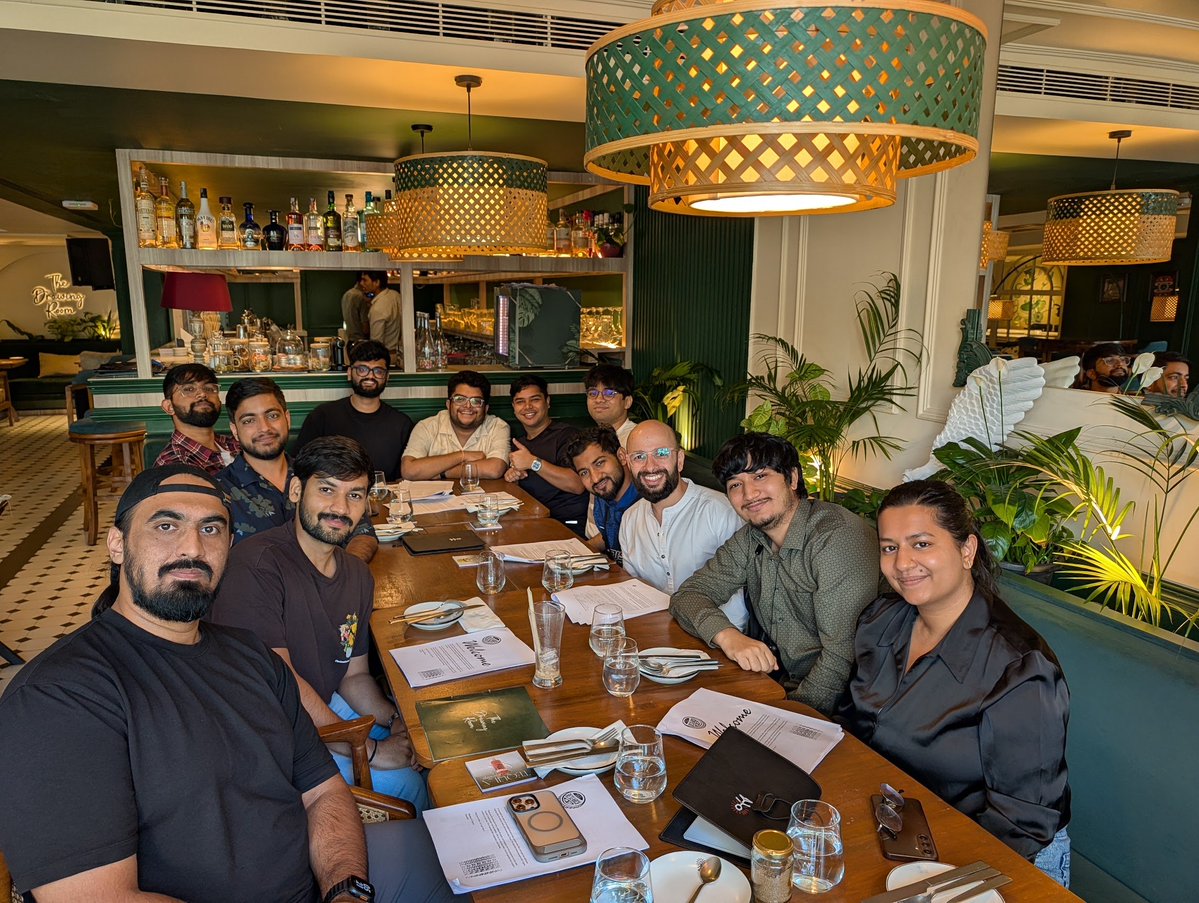
research papers + good people + good beer = saturday afternoon well spent.
this was research on tap, season 2 : self improving agentic systems
was a lot of fun doing this with @manthanguptaa
which one should we do next?
How does a model understand and explore a world it has never seen?
We introduce 🔭VISTA🔭, a visual harness that gives a VLM long-horizon vision for reasoning in an interactive world. With Claude Opus 5.0, it reaches 100% RHAE on @arcprize's ARC-AGI-3, perfectly solving all 25 public games.
Blog post: https://t.co/bYUWwi0KoQ 🧵
@liquidai Interesting timing — yesterday we benchmarked GPT-OSS 20B, Qwen 27B W4A16 and Muse-Glimmer 30B on a single L4 across latency, throughput, energy + quality.
Results: https://t.co/PpnNUu2P1q
Would love to contribute the L4 results to Pipette. What’s the path?
Is it possible to modify the behaviour of an LLM at inference time without fine-tuning it?
I tried this on Qwen3-8B.
Same frozen template. Same database. Same job.
Translate the internal representation one way → raw SQL.
Turn it the other direction → full Python/sqlite3/pandas pipeline.
No LoRA. No weight update.
Activation steering only .
The interesting question is not whether this is working.
It’s whether model behaviour can be a runtime parameter.
Tried something close to this yesterday on Qwen3-8B. Was able to switch SQL -> Python behaviour just by changing the internal representation, same prompt/model. Now I’m curious how stable these directions are once the model starts doing longer reasoning. Does ReFT see this changing across reasoning depth?
Is it possible to modify the behaviour of an LLM at inference time without fine-tuning it?
I tried this on Qwen3-8B.
Same frozen template. Same database. Same job.
Translate the internal representation one way → raw SQL.
Turn it the other direction → full Python/sqlite3/pandas pipeline.
No LoRA. No weight update.
Activation steering only .
The interesting question is not whether this is working.
It’s whether model behaviour can be a runtime parameter.
@CurtTigges I tried raw activation steering on Qwen3-8B yesterday and got a pretty clean SQL <-> Python switch with no prompt/model change. For something more complex like reasoning control, do you think raw directions still hold up or feature-level steering becomes necessary pretty quickly?
Is it possible to modify the behaviour of an LLM at inference time without fine-tuning it?
I tried this on Qwen3-8B.
Same frozen template. Same database. Same job.
Translate the internal representation one way → raw SQL.
Turn it the other direction → full Python/sqlite3/pandas pipeline.
No LoRA. No weight update.
Activation steering only .
The interesting question is not whether this is working.
It’s whether model behaviour can be a runtime parameter.
Tried this yesterday on Qwen3-8B. Same prompt, same model, but shifting the activation was enough to move between SQL and Python behaviour. What I’m thinking about now is whether we can steer the reasoning process itself — depth, verification, exploration etc — instead of just the final behaviour.
Is it possible to modify the behaviour of an LLM at inference time without fine-tuning it?
I tried this on Qwen3-8B.
Same frozen template. Same database. Same job.
Translate the internal representation one way → raw SQL.
Turn it the other direction → full Python/sqlite3/pandas pipeline.
No LoRA. No weight update.
Activation steering only .
The interesting question is not whether this is working.
It’s whether model behaviour can be a runtime parameter.
Been experimenting with this yesterday on Qwen3-8B. I could move SQL -> Python behaviour through the representation itself while keeping everything else frozen. Feels like the more interesting next step is dynamic RepE during reasoning instead of one fixed intervention. Have you explored that direction?
Is it possible to modify the behaviour of an LLM at inference time without fine-tuning it?
I tried this on Qwen3-8B.
Same frozen template. Same database. Same job.
Translate the internal representation one way → raw SQL.
Turn it the other direction → full Python/sqlite3/pandas pipeline.
No LoRA. No weight update.
Activation steering only .
The interesting question is not whether this is working.
It’s whether model behaviour can be a runtime parameter.
I’ve been playing with inference-time steering on Qwen3-8B. Started with something simple — SQL vs Python — but it made me wonder if reasoning itself can become an inference-time control surface: more verification, deeper search, shorter reasoning etc. Feels somewhere between RepE and post-training.