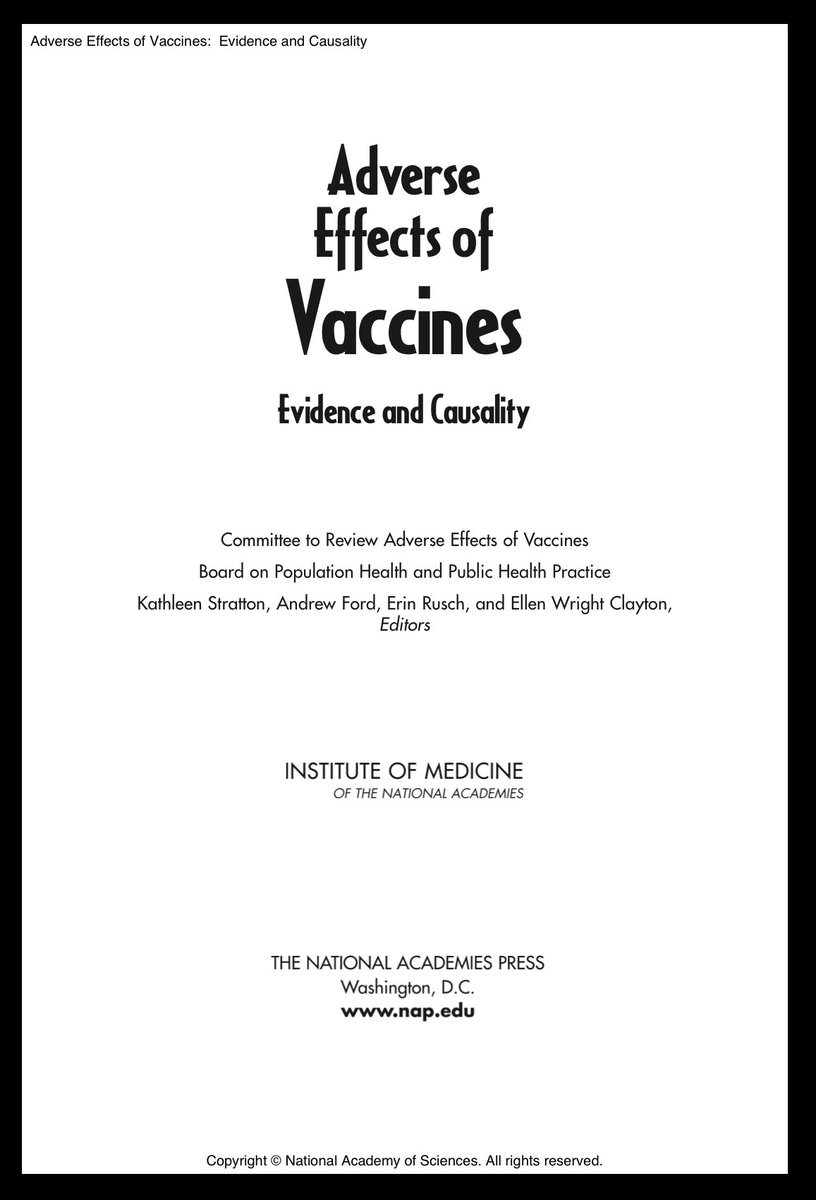
In 1996, a cable news anchor opened a segment by reading a magazine headline:
"The Lethal Dangers of the Billion Dollar Vaccine Business."
Then she mentioned her own baby son had just gotten the shot in question. What the magazine found was not something you'd hear on the news today. 🧵
In 1986, the EPA doubled the amount of fluoride allowed in drinking water, and its own scientists objected.
Their union warned it could cause crippling bone disease and backed a lawsuit against the agency. Then a Washington news crew caught what the EPA did next to keep them out of the courtroom. 🧵
@Livingmasterkey@Sir_Jaker@stopvaccinating Screened for what? Both cohorts compared to the background incidence should be sufficient to frame a statistical deviation.
But since you mentioned screening, I think they should screen parents who bring their kids in for sniffles and inject 72 vaxxes for Munchhausen’s by Proxy.
@Sir_Jaker@Livingmasterkey@stopvaccinating When I was a kid we had house call docs, no vaxxes. We were expected to survive the childhood diseases for which they now have vaxxes. A doc was only consulted in extreme cases. Measles, chicken pox, mumps weren’t reported. Now, they bring kids in for things we used to wait out.
MATHEMATICIANS FORGOT THEY WERE SCIENTISTS
On November 20, 2026, mathematician Levent Alpöge announced that he and Claude had apparently solved the Riemann Hypothesis, one of mathematics’ greatest unsolved problems. In fact, they claim to have solved the stronger Generalized Riemann Hypothesis as well.
The proof? Seventeen million lines of Lean code, a language for formally verifying mathematical proofs. An attempt to render it in ordinary mathematical prose ballooned past a quarter of a million pages.
Let’s assume the proof is correct and will be accepted.
One of the greatest mysteries in mathematics has been settled.
Except nobody really understands why it’s true.
The reaction has been extraordinary. Mathematicians are stunned, some exhilarated, others despairing. Some have even called it the mathpocalypse.
If AI can solve problems like Riemann, what’s left for mathematicians? Have they just watched their defining intellectual achievement become obsolete?
Perhaps the panic rests on a misunderstanding of what mathematicians are actually for.
And perhaps we’ve gotten the analogy between mathematics and science almost exactly backward.
THE WRONG ANALOGY
We usually think of mathematics as something like science, except with much higher standards of certainty.
Scientists propose hypotheses. Mathematicians propose conjectures.
Scientists gather evidence. Mathematicians seek proofs.
In science, sufficient evidence can establish a theory beyond reasonable doubt. In mathematics, a proof establishes a theorem beyond logical doubt.
The analogy seems obvious. Theorems correspond to scientific theories, and proofs to the evidence supporting them.
But I think we’ve matched up the wrong things.
Consider Kepler’s laws of planetary motion.
Drawing on Tycho Brahe’s enormous collection of astronomical observations, Kepler discovered three beautifully simple mathematical laws describing how planets move.
The observations established the regularities. But why should planets behave that way?
Kepler proposed his own explanation, involving a magnetic-like force emanating from the rotating Sun.
He was wrong.
It took Newton to provide a deeper explanation, deriving Kepler’s laws from principles that also explained falling apples, ocean tides, and much else.
The laws were right. Kepler’s explanation wasn’t. Newton’s explained more.
That’s science.
And this is the better analogy with mathematics.
Mathematical theorems are more like empirical laws than explanatory scientific theories.
An empirical law is a concise characterization of a regularity, backed by observations.
A mathematical theorem is a concise characterization of a regularity, backed by a rigorous proof.
Of course, a proof establishes logical necessity, whereas observations cannot. But the intellectual roles are similar.
The Riemann Hypothesis, then, wasn’t an explanatory hypothesis. It was a conjectured mathematical law.
The law has its proof.
But why is it true?
MATHEMATICS HAS UNEXPLAINED LAWS, TOO
Sometimes a proof is also an explanation.
Consider the theorem that the first n odd numbers add up to n². You can prove it algebraically. But arrange those odd numbers into successive L-shaped layers, each completing a larger square, and you can see why it’s true.
The same proof establishes the law and explains it. Mathematics has enjoyed this luxury for thousands of years, making the two jobs easy to conflate.
The distinction itself isn’t new. Aristotle recognized the difference between knowing that something is true and knowing why. Mathematicians have long admired illuminating proofs over those that merely demonstrate.
But appreciating that some proofs aren’t explanatory isn’t the same as recognizing that mathematical theorems occupy the same intellectual role as empirical laws.
Mathematics has always had unexplained laws. It just called them theorems.
And there’s another wrinkle that brings mathematics and science even closer...
🧵
@seanonolennon I think humans need to grow up. I have found many instances of AI censorship and it’s clear that any AI used by the public will either promote the state, or the corporations, or Hitler’s dream- both. And since this is happening, we can assume AI will be an imperialist project.
One member of RFK Jr.’s new autism committee just sounded the alarm.
“I’m very angry.”
“Vaccines have never been discussed by this committee.”
And she warned that staffers are blocking “decades of research” on vaccines and autism from being reviewed.
How?
Bookmark this.
Ginger Taylor just submitted a compendium of “250 papers and abstracts” on vaccines and autism to the committee.
“I disagree with the American Academy of Pediatrics’ conclusion that vaccines are not associated with autism.”
She revealed that committee members are being “robbed of their statutory duty” by “arbitrary” rules set by committee staffers.
“In 2007, I began compiling research papers, examined possible connections between vaccines and autism.”
“My bibliography now includes 250 citations.”
But staffers set a strict limitation on the research that could be submitted for consideration.
“The research our committee was able to submit … was limited to the past two years.”
“As a committee member, I strongly object to these restrictions.”
“A two-year publication … excludes decades of research that I believe deserve consideration.”
“Support staff are not appointed committee members.”
“I question the authority under which these restrictions were imposed.”
“I believe the committee should independently examine the research I’m submitting.”
“Including studies addressing immune system dysfunction.”
“Neuroinflammation.”
“Neurological development.”
“Mitochondrial dysfunction.”
“Oxidative stress.”
“I ask that all 250 submissions be accepted to the committee record and made available for consideration without arbitrary restrictions being placed on publication date.”
@ChildrensHD@CombatingAutism
This is a remarkable book, an example of the first draft of history in real time. If today the item looks out of stock, this is typical of Amazon when an item is this new. Give it a day or two. https://t.co/QkeVVxf8l0
There are many common coconut water brands I won’t drink anymore.
After years of making coconuts a dietary staple, I’ve found enormous differences in quality. Yet with coconut oil, paying more isn’t always necessary.
Here I share my preferred coconut water, two recipes I’ve made countless times, and when cheaper coconut oil is actually the better choice:
https://t.co/zpUeBnaMIz
@DrJMarine@IDSAInfo@AmerAcadPeds@ACPIMPhysicians Well, if they aren’t treating opportunistic mycoplasma or e coli infections and therefore allowing patients to die because they were previously infected with measles, as in two current malpractice cases, that might be be why Canada looks better. Fewer ideologues killing unvaxxed.
I just ran something I wrote through a "free" AI detector.
The writing was totally original by me. Nevertheless, two different online detectors said it was AI and offered to "rewrite" it for me, for a fee of course.
I then ran the same write-up through Grok, who said it was not AI.
Be careful with those "free AI detectors," as many of them are scams trying to take your dollars.