« Grâce à ce système, on a réduit de 40% nos coûts en LLM ».
Le modèle JEV est-il une petite révolution pour l’IA ? Là où un LLM classique utilise un nombre considérable de calculs (et de tokens) même pour des tâches simples, le JEV fait des choix très rapides à partir d’options données.
Selon les besoins, on peut ainsi obtenir une réponse en 200 milli-secondes au lieu de… 7 secondes. Après une semaine de tests, certaines sociétés annoncent même avoir réduit de 40% leurs appels LLM. Reste une inconnue : comment arbitrer l’appel au JEV ou à un LLM classique en fonction des besoins…
Toutes les 3 semaines, LegalPlace fait un point sur l’actualité de l’Intelligence Artificielle avec @Racem, CEO et co-fondateur de LegalPlace, Wassim Jouini @BoredGeekz, CTO et Head of AI de LegalPlace, et @karim_jouini, CEO et co-fondateur de https://t.co/097B2GfCoU
Emission complète :
https://t.co/hjDAjYSyHH
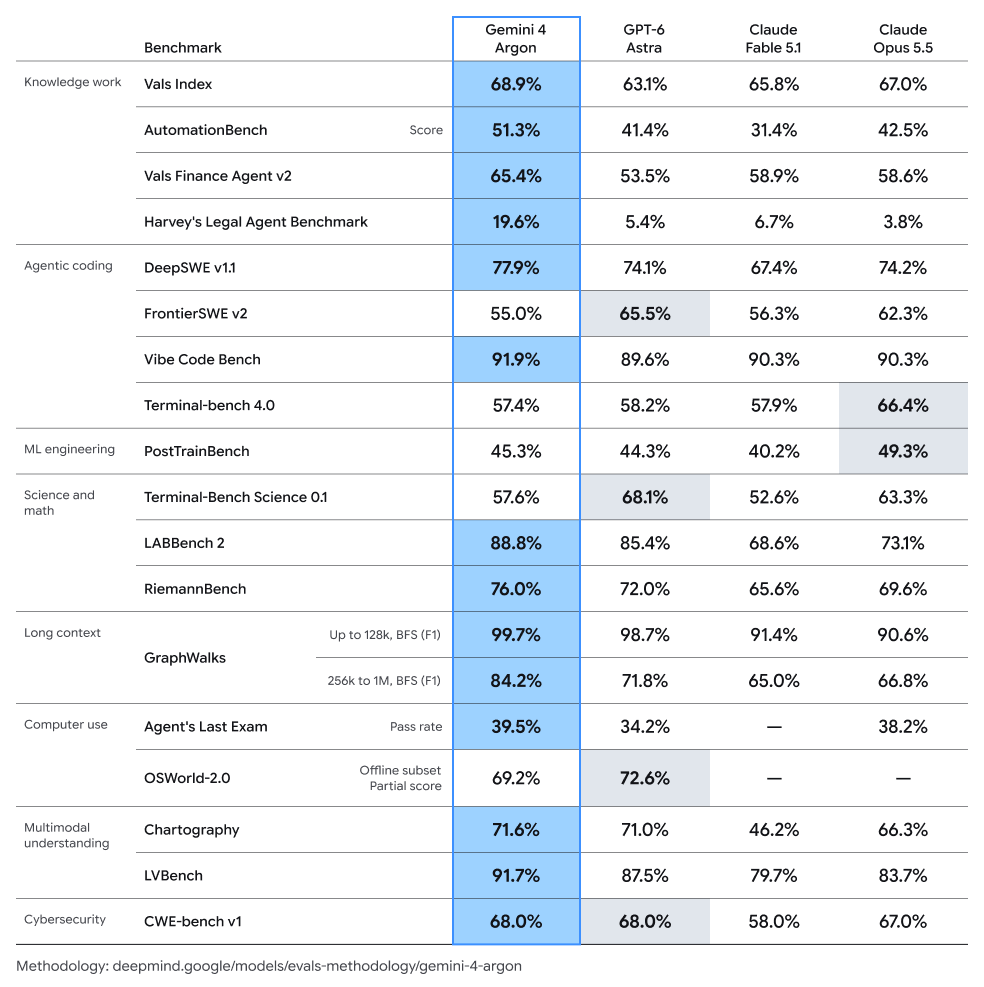
Lots of discussion out there about our next model(!), so I wanted to give an early look as soon as possible. Introducing Gemini 4 Argon!
It shows frontier performance in complex workflows, cyber defense and software engineering. Teams are using it extensively at Google, from coding to quantum computing, great feedback.
Here’s a look at the benchmarks:
I led engineering at Google DeepMind.
Today, I'm proud to introduce Fo to give personal AI something no lab ever has... Humans.
Other personal AI's pretend AI can do everything. Fo employs humans to do tasks that AI cannot.
- 2x better at real-world task completion (beats other agents by 69%)
- 94% trust rate (4x less likely to leak private info vs Muse, Instinct)
Sign up for free: https://t.co/9ndFhcN5mO
Feeling the AGI/ASI, few observations
1. Opus 5.5 really gives strong vibes of AGI (maybe not fully there, but we're very close, like 80%-90%).
For example, few breakthoughs in training humanoids are needed. We need to move this intelligence into physical world.
2. I don't think Anthropic has discovered any magical formula.
3. Which means, SpaceXAI, Google, and others will soon follow. This prediction is based on the amount of compute they already have + additional compute being added all the time.
4. Never was more confident that Anthropic, SpaceXAI, Google, OpenAI, likely Meta, basically all big US AGI labs will have proper AGI in 2027.
5. And from there we'll move quickly to ASI territory (likely also in 2027).
It looks like few GW of compute are enough for strong AGI, now imagine what we will able to do with 10-20GW of compute which are rapidly coming online.
And then with 100GW-200GW...
2027 will be an utterly insane year.
Ever wonder what $1874.40 of Opus 5.5 tokens looks like?
Wonder no more.
I highly recommend watching the whole video on 1080p on a large screen with sound on.
Pay attention to all the little details.
- Birds flying and diving into the ocean.
- Cloth, signs and lights swaying in the wind.
- Crabs scuttling along the shore and burrowing when you get close.
- Fish swimming alongside the whale.
- Lights illuminating the dock at night
Then zoom out and see the entire island. Never dipping below 60 FPS at 1440p resolution.
Yes, there's a few bugs and visual artifacts, some textures need improving, the shorelines waves sometimes look funny, but these are so trivial to fix at this point.
FYI I'm on the $200 subscription plan. This used 59% of my weekly usage and took 2h 7h of API time using multiple subagents, about 8h in real-time.
There was extremely little technical direction here. 99% of my prompts were "Add X and Y" or "This looks weird, make it better".
It's a great time for hobbyists, bad time for professionals. This experiment has further cemented my view that technical creatives are about to experience a massive disruption.
for a startup founder right now the paradox is that this may be the best & worst time to start a company.
the opportunity surface is basically infinite cuz ai keeps collapsing the cost of building, experimenting, & entering new markets. but the durability of any individual advantage is collapsing faster than ever too. anything obviously valuable gets copied, bundled, or commoditized incredibly fast. before you can even blink.
& worse now the big guys are shipping fast too so in many ways you’re kind of running downhill while meta, openai, anthropic, etc. are driving behind you even faster in a giant luxury bus with the high beams turned on to the max.
Ce que l'agent IA ne pourra jamais choisir à votre place
En France, nos grands distributeurs livrent une guerre de parts de marché et de prix. Consolidation partout : reprise des supermarchés Auchan par Intermarché avec une mise en œuvre possible fin 2026, les Mousquetaires visant 20 % de parts de marché d'ici 2028, dépeçage de Casino. Pendant ce temps, la grande distribution alimentaire ne progresse que de 0,7 % en volume en 2025. On grossit en rachetant, pas en vendant plus.
Aux États-Unis, le dogme a changé. Walmart, 713 milliards de dollars de chiffre d'affaires, affiche une croissance e-commerce de 26 %, neuvième trimestre consécutif au-dessus de 20 % aux US. Plus de 36 % de ses livraisons depuis magasin arrivent en moins de trois heures. Le cap du million de livraisons par drone est franchi, avec 270 magasins équipés visés en 2027. Et Walmart a déjà son agent IA : Sparky, qui construit des paniers selon les besoins alimentaires ou les habitudes du foyer. Amazon, lui, a dû racheter Whole Foods en 2017 pour 13,7 milliards de dollars pour mettre un pied dans l'alimentaire physique.
Les hypermarchés américains ne sont plus des magasins. Ce sont des hubs logistiques.
Mais copier ce modèle en France serait une erreur, et c'est pourtant ce que font nos enseignes urbaines avec le ship from store.
Walmart pick dans des boîtes de 15 000 m² en périphérie, avec des zones dédiées et des allées séparées. Nos magasins urbains font 400 à 1 500 m². Y faire préparer des gros paniers, c'est mettre le picker et le client dans le même rayon. Venir en magasin est déjà une contrainte. Si en plus on regarde un préparateur nous prendre le dernier paquet de pâtes sous le nez, l'expérience est morte. Et avec elle la seule chose qui justifie encore le magasin.
Les retailers français ont un actif que Walmart n'a pas : la proximité, le côté peuple, le bon produit, le boucher qu'on connaît. Il faut le protéger, pas le sacrifier au picking. Le magasin doit rester un lieu d'expérience et de petit panier plaisir. Le gros panier e-commerce, lui, doit sortir du magasin et passer par une vraie logistique urbaine : des hubs dédiés, denses, automatisés, pensés pour la livraison. Deux flux, deux outils. Ceux qui les mélangent perdront sur les deux tableaux.
Et cette logistique urbaine devient vitale, parce que la vraie rupture est ailleurs, et elle est silencieuse.
À l'ère de l'agentique, qu'est-ce qui différenciera encore les enseignes ? Pas les prix : un agent IA compare tout en une milliseconde. Pas le service : il sera commoditisé. Et surtout, un agent IA n'a ni émotion, ni attachement à une marque. Quand nos courses seront faites par nos agents, le choix de l'enseigne deviendra secondaire. Cinquante ans de fidélisation, de cartes et de programmes points, remis à zéro.
Sauf sur un point. Un agent arbitre un paquet de pâtes. Il n'arbitre pas un plat qu'on a aimé. Sur une commodité, il optimise le prix et le délai. Sur un repas, il exécute une préférence qu'il n'a pas le droit de contredire. La marque ne meurt pas, elle change de camp : elle quitte l'enseigne pour se loger dans l'assiette.
Et la société bascule exactement dans ce sens. Les gens sont seuls, les foyers rétrécissent, le temps de cuisine s'effondre. En Chine, 592 millions de personnes ont utilisé la livraison de repas en 2024. En France, le snacking pèse 22,3 milliards d'euros et 2,1 milliards de repas servis, et son premier concurrent reste le domicile. Fabrice Grinda le disait dans un podcast : cuisiner deviendra comme la couture au temps de nos grands-mères, un savoir-faire de passionnés, plus une nécessité.
On n'achètera plus des ingrédients. On achètera des repas.
Certains l'ont compris en France, notamment les spécialistes de l'urbain qui convertissent des pans entiers de leurs surfaces en prêt-à-manger. Mais c'est Marc Lore qui va le plus loin avec Wonder : 650 millions de dollars levés à 9 milliards de valorisation pré-money, l'ambition de livrer 21 repas par semaine à chaque client, un robot qui produit 500 bowls par heure quand un humain en fait 30 à 45, 10 000 sites visés d'ici 2040.
L'homme qui a vendu https://t.co/ia3ncO83vD à Amazon et https://t.co/MRRaKXzIDd à Walmart ne se trompe pas souvent de décennie. Ce qu'il construit arrivera en Europe. Pas demain, mais bien assez tôt.
Trois chantiers pour nos distributeurs : préserver le magasin, sortir la logistique du magasin, et décider ce qu'on mettra dans l'assiette quand l'agent aura choisi.
vidéo de : "the Infinite Makeline, the AI-powered robotic bowl assembly system"
Dario has written that we need to “pace the frontier,” and Sam has agreed. People may be surprised by my response: go ahead.
You guys are the frontier. By any reasonable metric — market share, revenue growth, model capability — the two of you have a duopoly on frontier intelligence. You’ve also claimed the lead is widening because of recursive self-improvement.
I don’t see what you see in the lab. If the unreleased models are scary enough that you think you should slow down, I support your decision to be responsible.
But stop pretending you need anyone else’s permission. Stop pretending antitrust law has to be suspended so you can form a cartel. Stop pretending you need a regulatory approval process that supersedes product liability. Stop pretending METR is independent when it is intertwined with Anthropic’s investors and staff. Stop pretending you need those same evaluators to police competitors who aren’t even at the frontier.
Most of all, stop pretending the motivation to slow down is purely altruistic. You face massive product-liability exposure if your products enable a truly damaging cyberattack. The market already punishes models that behave in unpredictable or unauthorized ways. After the Hugging Face episode, it is simply good business for OpenAI and Anthropic to trade some raw power for reliability and predictability. Call it alignment if you want. It is also just giving customers what they want.
Pacing the frontier would also create breathing room for a more intelligent conversation about regulation than Bernie Sanders’ “shut it all down.” China is very unlikely to join a global agreement, as you know, and that has to be taken into account as well.
So go ahead and pace the frontier. You are the ones setting it. The easiest way not to build superintelligence is for you to agree not to build it. Demanding your preferred regulatory framework as the price of that will look like blackmail of the public and the political system. So just do it.
If you do, you’ll buy goodwill for the next conversation. If you don’t, we’ll know this was just another bid for regulatory capture — or an election-season psyop.
Playing at the frontier is a rich man’s game. You burn too much cash to stay competitive, and if open source catches up, your margins get squeezed. The only moat left is regulation.
I hope the proposals by frontier labs to pace AI research stem from a genuine concern for safety and a recognition of the potential risks posed by future models, rather than a strategic effort to consolidate power and permanently solidify the market dominance of a few top players.
If these efforts are genuine, then oversight must take a more democratic and accountable form, with both national and international components, similar to the Nuclear Regulatory Commission in the US and the International Atomic Energy Agency internationally.
If there is only one organization responsible for safety monitoring, and it happens to be staffed by the same people as the frontier labs, and it is perfectly aligned with them both by incentives and by ideology, then it would be indistinguishable from letting frontier labs self-regulate and self-certify their own safety standards.
Two potential warning signs of regulatory capture to watch out for:
1. Calls to ban open-source AI. Open-source development currently serves as the only real counterweight to the dominance of frontier labs.
2. Attempts to hinder non-frontier research. Models that are one or two generations behind the frontier -- whose level of capability has already been deployed at scale -- are empirically known not to pose safety risks.
As long as we don't see 1 & 2, and we see real international coordination efforts, then I will optimistically believe that the proposals are benevolent.