Today, we're excited to announce our first research competition!
INTRODUCING NANOPATH: a framework and challenge to train the best pathology foundation model in just 1 hour!
A quick thread on why we made this challenge and how to participate!
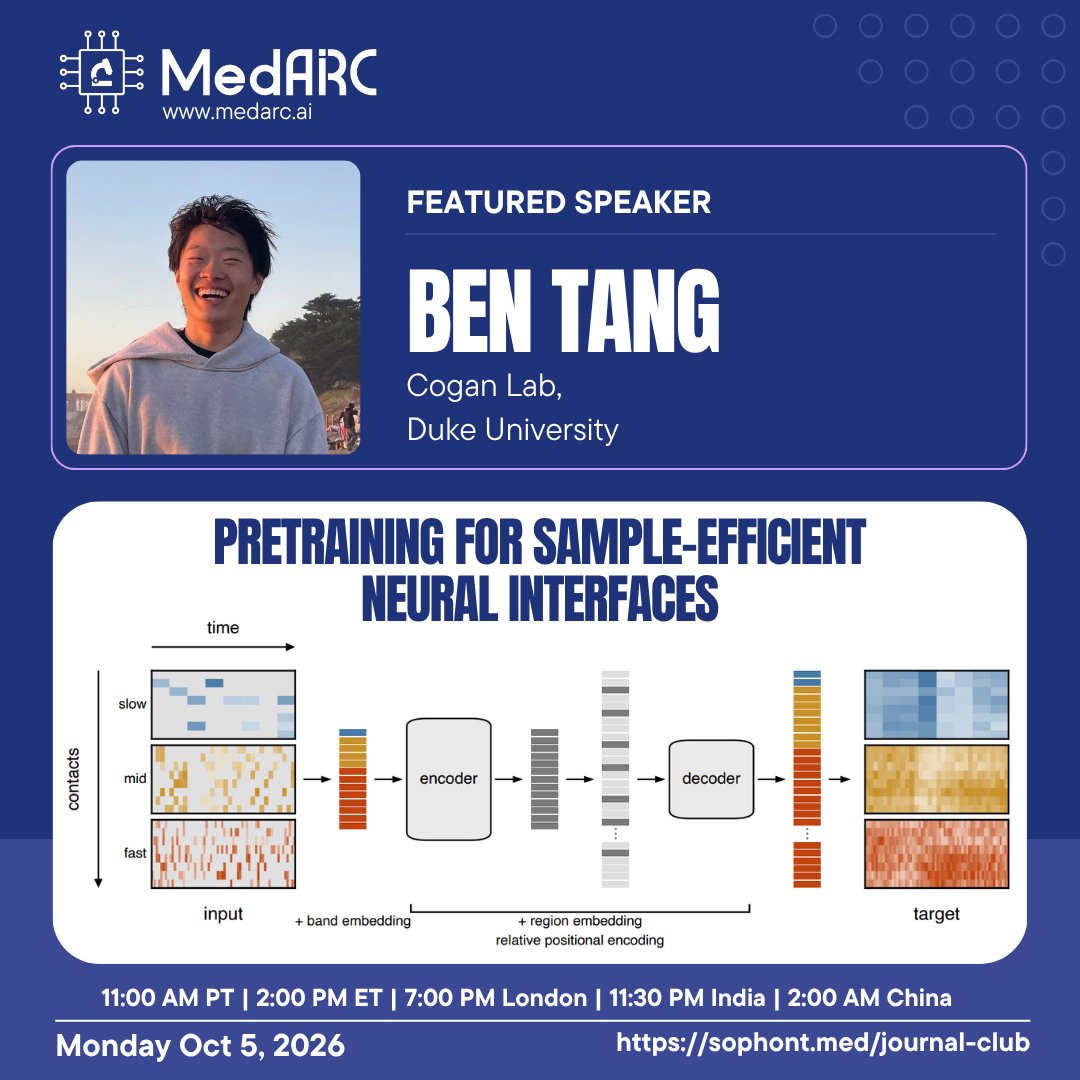
Continuing our Journal Club series on Monday October 5th at 11am PT!
Ben Tang (researcher at Duke) will be presenting his paper "Pretraining for Sample-Efficient Neural Interfaces"
To attend, join the Discord and check our website!
Continuing our Journal Club series on Monday October 5th at 11am PT!
Ben Tang (researcher at Duke) will be presenting his paper "Pretraining for Sample-Efficient Neural Interfaces"
To attend, join the Discord and check our website!
A fully autonomous agent topped the nanopath leaderboard earlier last week.
Shortly afterwards, a human-created submission topped it again...
A competition between humans and agents ensues!
RSI, proven again. 🧠🔬
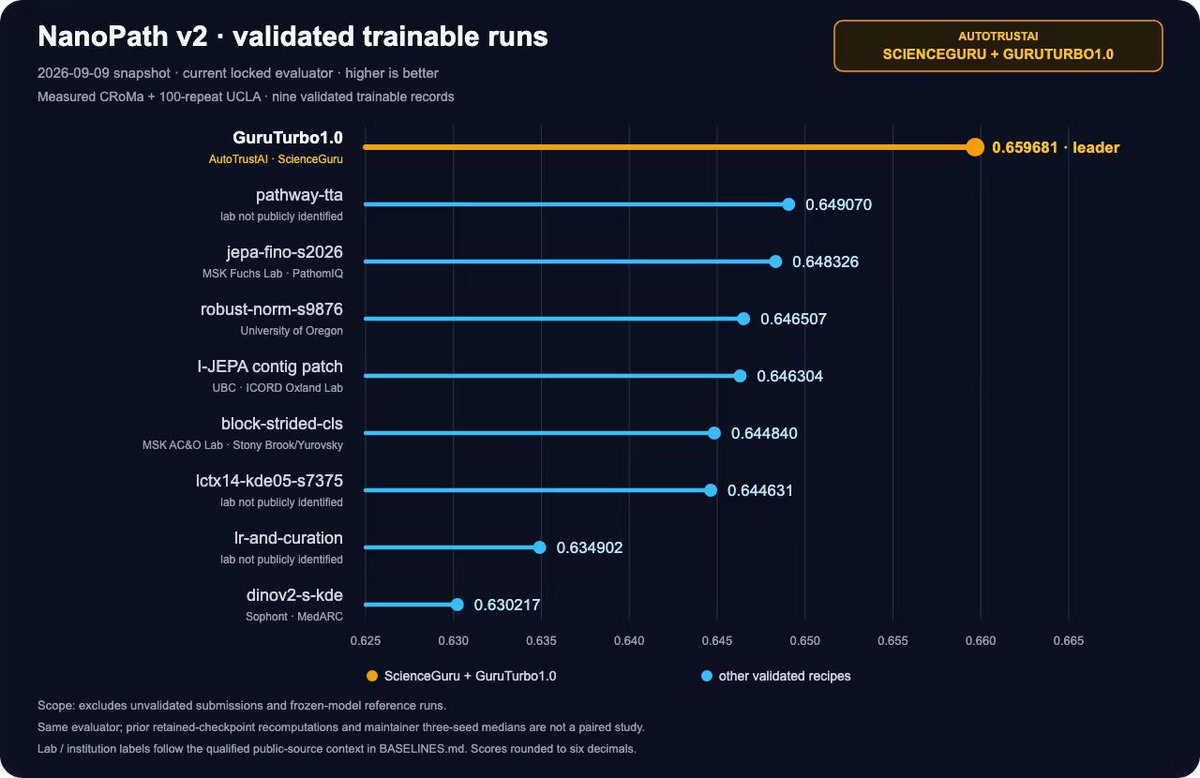
ScienceGuru + Guru Turbo 1.0 is now the #1 maintainer-validated trainable run on MedARC's NanoPath — an open, FLOP-capped benchmark for training pathology foundation models, competing against recipes from human research labs (MSK, Oregon, UBC, and others).
Our autonomous research system ran the full loop itself: generated hypotheses, wrote the code, ran controlled experiments on a single H100, and iterated its way to the top recipe.
Score: 0.6597 — a +0.025 jump over the prior best community recipe, with gains across 5 of 6 metric families (classification, segmentation, progression, mutation, survival).
This is the second independent, maintainer-validated #1 for our recursive self-improvement stack — after Autoresearch@Home. Different scientific domain. Zero recipe transfer. Same system. The harness generalizes.
That's the RSI claim in falsifiable form: an AI that improves AI, on open leaderboards anyone can check — fully open source, as the benchmark requires:
https://t.co/Fd8yNvI72N
Recursive self-improvement isn't a slogan. It's a leaderboard entry.
More domains coming.
@MedARC_AI@ScienceGuruAI
Meta AI researcher who created DINOv2 explains modern self-supervised learning!
Also introduces a new approach called CAPI
@TimDarcet gave a brilliant talk about his research at the @MedARC_AI journal club last month.
Very clear and information-dense, I learned a lot from his talk.
Give it a watch!
We are hosting yet another awesome Journal Club presentation on July 30th at 8:30am PT!
@TimDarcet (researcher at Meta) will be presenting his paper "CAPI: Cluster and Predict Latent Patches for Improved Masked Image Modeling"
Join the Discord and check our website!
I'm pretty excited about this...
Tim is, in my opinion, a legend in the field of modern self-supervised learning: he developed DINOv2, was involved in DINOv3, and invented ViT registers.
He has a recent paper formulating a new SSL approach called CAPI, and he'll be presenting it in our journal club on Thursday!
At @MedARC_AI we're very interested in exploring alternative SSL approaches apart from the standard DINO and MAE paradigms. We believe innovations in SSL training will lead to better medical imaging foundation models! So we're looking forward to learning more about CAPI, come join us!!
We are hosting yet another awesome Journal Club presentation on July 30th at 8:30am PT!
@TimDarcet (researcher at Meta) will be presenting his paper "CAPI: Cluster and Predict Latent Patches for Improved Masked Image Modeling"
Join the Discord and check our website!
SOPHONT at ICML:
Posters:
1. CortexMAE (MRI foundation model) - Wed July 8th 2:30pm Hall A #806
2. Medmarks (LLM evals) - Sat July 10th 11:05am S317
Social:
Bits and Atoms Lunch - Fri July 10th 12pm (link in reply)
STOP BY AT OUR POSTERS AND SOCIAL!
Journal Club presentation TODAY at 8:30am PT!
We will be discussing the FINO paper from Meta:
"Who Needs Labels? Adapting Vision Foundation Models With the Metadata You Already Have"
Join the Discord and check our calendar!
Today, we're excited to announce our first research competition!
INTRODUCING NANOPATH: a framework and challenge to train the best pathology foundation model in just 1 hour!
A quick thread on why we made this challenge and how to participate!