Learning from Interviews On the Go, a new blog post by @MedCultureLab's @sbgarrett shares ideas on how to implement best practice in qualitative research for interviews; assessing and refining your approach a few interviews into your study. https://t.co/AoNDAxDZ8Y
@MedCultureLab members @AlissaLily @dandohan@namrazon Alma Hernandez de Jesus @annachodos
@Rankin_Lab & colleagues new work: Primary Care Practitioner Perspectives on the Role of Primary Care in Dementia Diagnosis and Care https://t.co/OUPwC95Y5E
New work by @MedCultureLab members @sarahbgarrett and Stephen Zamarripa. Challenges and Opportunities for Clinician Implicit Bias Training: Insights from Perinatal Care Stakeholders | Health Equity #healthequity https://t.co/uyneocSzBM
@MedCultureLab member @danieldohan discusses how researchers invoke the idea of saturation, and some thoughts on how to give saturation its proper due. Saturated with Qualitative Data https://t.co/RVgkUTH2L7
@MedCultureLab member @JenJamesPhD has new work out: "We're not patients. We’re inmates”: Older Black women’s experience of aging, health and illness during and after incarceration https://t.co/ILQZKn2nex #incarceration#gerontology
New Perspective in @NEJM by @MedCultureLab
member @klharrisonPhD & colleagues. Toward Gerineuropalliative Care for Patients with Dementia #NEJM#palliativecare#dementia https://t.co/GN1L8fgrgl
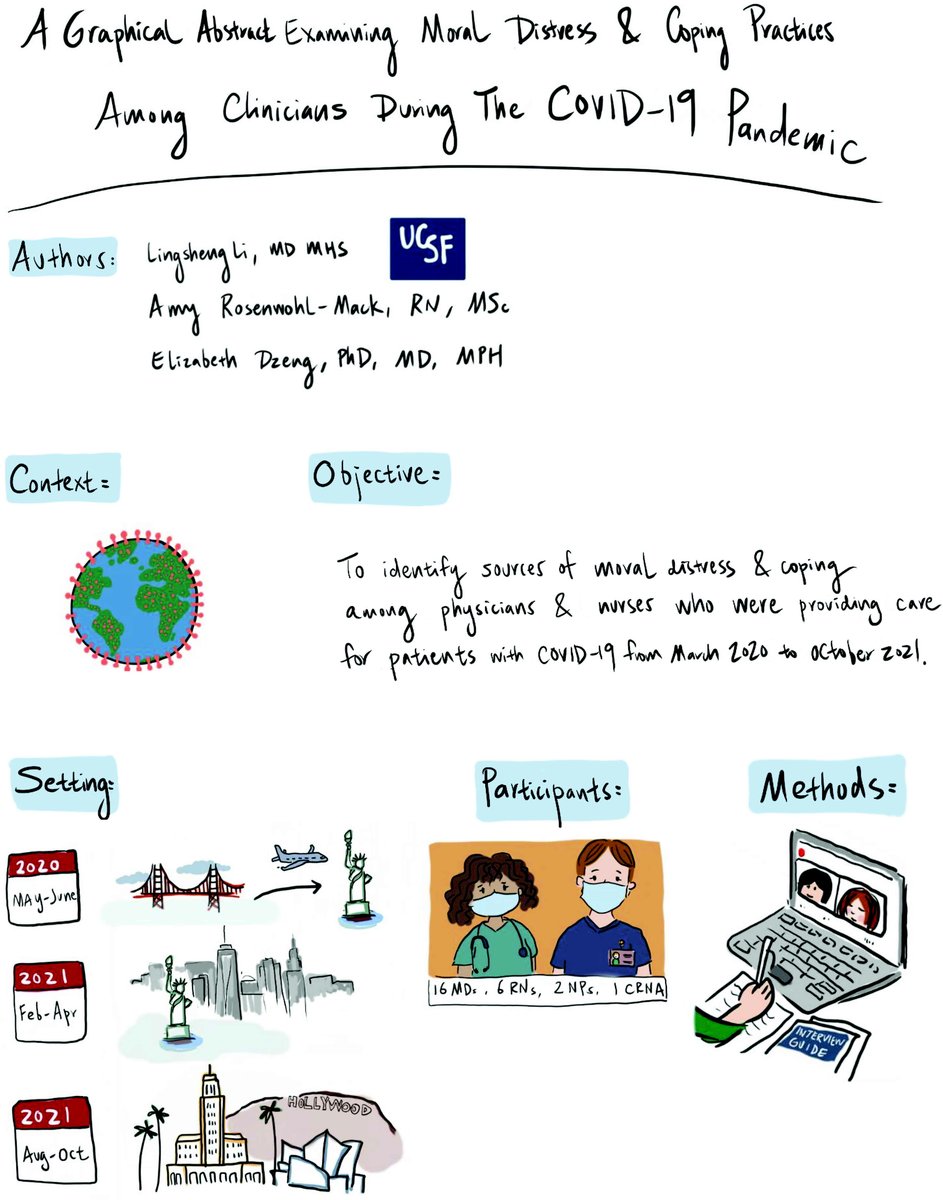
Great new graphic work on the emotional experiences of clinicians caring for Covid-19 patients by @MedCultureLab member @LizDzeng & colleagues in @AnnalsofIM#COVID19
New Graphic Medicine: “A Graphical Abstract Examining Moral Distress and Coping Practices Among Clinicians During the COVID-19 Pandemic” https://t.co/SBSjebYAk1 @lingshengli@LizDzeng
Transportation is a critical need for many patients. New work by @MedicalCultureLab member @namrazon & colleagues. Essential not Supplemental: Medicare Advantage Members’ Use of Non-Emergency Medical Transportation (NEMT) @JournalGIM https://t.co/habwrreZoU #MedicareAdvantage
New blog post on the @MedicalCulturesLab website - Observing, Accepting and Appreciating ADRD Caregiving #ADRD#dementia#caregivers
https://t.co/BFueSJ5js4
Hospital cultures should be considered in the development and implementation of hospital policies and interventions. A new study by @MedCultureLab member @lizdzeng et al. explores how hospital culture might influence intensity of end-of-life care. https://t.co/DePUJ7azOW
New work from @MedCultureLab member Alissa Bernstein Sideman (@AlissaLily) & colleagues. A stakeholder-engaged process to design and implement a dementia diagnosis Toolkit in primary care settings https://t.co/UAwJLcrUDt
@MedCultureLab member @sbgarrett's new blog post shares operational processes - mundane, nitty-gritty, everyday project details typically not described in community-based participatory research methods: Growing Skills in Community Research Collaborations https://t.co/SZQX4nZlQr
Learn how @MedCultureLab member @JenJamesPhD works to ensure everyone's voices are heard in her research on the intersection of race, gender and health in a new blog post, Engaging Key Voices in Work on Race, Gender and Health https://t.co/u5baV6KscM
New work by @MedCultureLab members @dandohan & Rebecca Sudore (@prepareforcare) in Urology! Patient-Identified Treatment Attributes among Older Men with Stress Urinary Incontinence: A Qualitative Look at What Matters to Patients Making Treatment Decisions https://t.co/hbRy4h2B9m
New work by @MedCultreLab members @klharrisonPhD @JenJamesPhD & colleagues. Hospice Quality, Race, and Disenrollment in Hospice Enrollees with Dementia https://t.co/MVRiEQTapV #hospice#DementiaCare
In the recent eps of Dementia Care on Air, Dr. @annachodos speaks w/ Dr. @EPortacolone about her work understanding the experiences of approx. 4.3M older adults in the U.S. who live alone & have cog. impairment or dementia https://t.co/iVqxrECjbP
Honored to launch our FIRST policy brief: 4.3 million older adults living alone with cognitive impairment in the US - 72% reported having trouble getting any help, only 20% reported being covered by Medicaid https://t.co/xxm97LsAlV
Striving to conduct qualitative research in an objective and unbiased fashion is a worthwhile ambition even if, ultimately, an impossible goal. Yet, it is important to do so thoughtfully. New blog post by @MedCultureLab's @dandohan! https://t.co/6cjF2iSBTs