“Computation is the central medium of our lifetime. And it's not just a technical medium, it's a cultural medium. So, I'm exploring the culture of code.” Prof. @zachlieberman reflects on his decade-long practice of daily code sketches. https://t.co/Kv0J45cA2D
The next frontier is AI that improves itself, and we believe everyone should know how to build it.
This semester, Ao @ao_qu18465 and I are teaching 'How to AI an AI for Almost Anything' @MIT@medialab -- a new course on self-evolving AI systems that recursively improve from experience, feedback, memory, and exploration over long interaction horizons.
The key idea: intelligence shouldn't stop improving when training ends.
We cover four levels of evolution:
(1) context evolution through prompt optimization and context management,
(2) harness evolution through memory, tools & skills, workflow optimization, and multi-agent systems,
(3) model evolution through RL, distillation, test-time training, self-play, and continual learning,
(4) task evolution through generating increasingly complex synthetic tasks, simulations, evaluations, and environments.
Slides, readings, and videos available: https://t.co/QLPhT77Yvj
We thank @Kimi_Moonshot and @PrimeIntellect for generously sponsoring API credits!
From @techreview: Explore “a completely subjective list of Institute inventions that have left life easier, less stressful, and even a little more fun,” including several from the Media Lab! https://t.co/TnfVzEQV28
MIT announces the MIT for America initiative. The effort aims to help U.S. learners from kindergarten to community college, with an emphasis on math, making, and the constructive use of AI. https://t.co/AN1wVtHuIb
The @space_enabled group at the MIT Media Lab is excited to host Zero Robotics, and is inviting high school students everywhere to join the 2027 High School Tournament!
Zero Robotics is a programming competition where students write code to control Astrobee, the free-flying robot that lives aboard the International Space Station. Teams of students work together to solve a game challenge using Astrobee and compete against teams from around the world.
The five-week program runs from Monday, January 11 to Friday, February 12, 2027, with the final event planned for Friday, February 19, 2027.
Zero Robotics is recruiting teams internationally! Grab at least three teammates and register by December 16, 2026: https://t.co/iiFRhj2scO
What happens to learning when students decide for themselves when to use AI?
TODAY: AHA Seminar with Osbert Bastani (Associate Professor, UPenn), from chess academies to AI tutors, on what his field studies reveal about AI in real classrooms.
Link: https://t.co/e0YEvfA4aN
Media Lab Professor @ishii_mit received the IDSA Special Achievement Award in recognition of his work integrating physical and digital environments.
Over three decades, Professor Ishii’s research has shown how bringing the arts, science, engineering, and design together creates innovations with real-world applications. His models now influence product development across industries, shaping how millions of people interact with information and each other.
https://t.co/1iZ4E9atFc
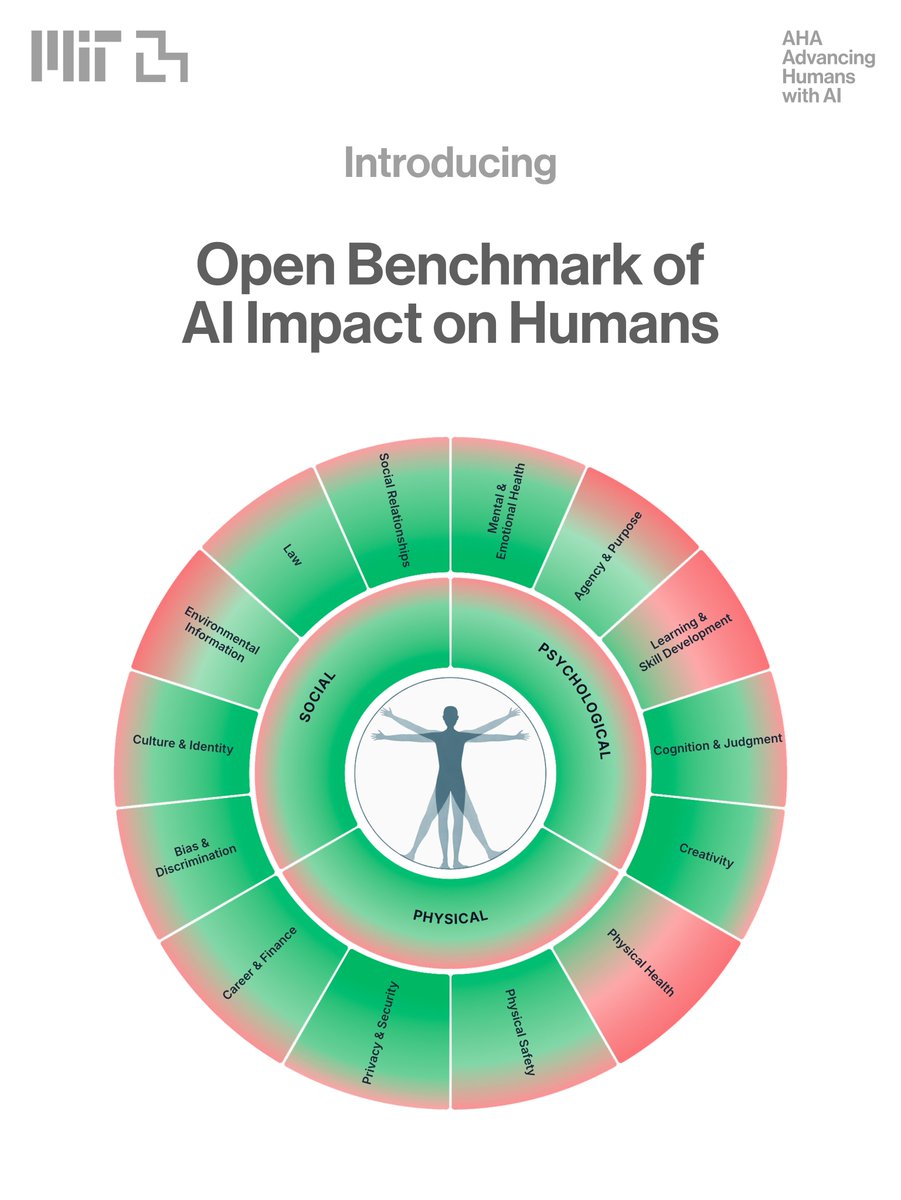
Rather than asking what AI can do, ImpactBench asks what AI does to people: how it shapes human psychology, autonomy, and wellbeing. https://t.co/HNUU6uI49a
At 5pm ET tonight, October 8, Professor @STurkle will join @AHA_MediaLab for an in-person conversation about her new book, "Artificial Intimacy," followed by an open Q+A with the audience. This event will not be livestreamed or recorded.
https://t.co/NqlnRaOjId
In her new book, “Artificial Intimacy: Who We Become When We Talk to Machines,” MIT Prof. @STurkle offers a sharp critique of chatbots, which offer a kind of “pretend empathy” that may damage human relationships. @mit_shass@MITPSTS
https://t.co/9a5scoZjTJ
We’ve lost an icon. Margaret Hamilton, a computer science pioneer best known for her work at MIT leading development of the flight software for the Apollo missions to the moon, has died at 90. Read about her legacy via MIT News: https://t.co/ODkbdIsoHw
Most AI benchmarks measure what models can do. ImpactBench measures what AI does to us.
800+ behavioral metrics. 48,540 conversations. Ten models. Undesirable behaviors avoided in only 53.1% of evaluations.
Explore: https://t.co/YzsVRuwIJl
Headlines and conversations about the risks of AI are everywhere — but many of them focus on end-of-the-world scenarios, while the everyday dangers of AI go unmeasured.
That’s why the MIT Media Lab’s Advancing Humans with AI (@aha_medialab) program, in collaboration with the @USCMarshall's Neely Center for Ethical Leadership and Decision Making, UC @BerkeleyHaas, and the Psychology of Technology Institute (@psych_of_tech), is launching ImpactBench, an expert-guided, open and evolving evaluation framework for measuring AI’s impact on human wellbeing.
Its findings also inform a consumer-facing tool, the AI Nutrition Label, which provides simple, at-a-glance ratings, modeled on food nutrition labels, showing how a given AI system scores on avoiding harm and promoting wellbeing.
Learn more: https://t.co/dnTNlPhoEc
Curious about applying to the Media Lab? Register for the Virtual Open House for Prospective Students on October 9! You’ll have an opportunity to hear from staff, faculty, and students; learn about the academic program and the research groups; and ask questions.
Learn more and register for the webinar: https://t.co/a75RteY0oj
“I feel the story I’m telling is the inner history of technology,” @MITPSTS professor @STurkle says. Her new book, "Artificial Intimacy," critiques chatbots and the antisocial dynamics she believes they encourage. https://t.co/4nqgGY0Mhr
@STurkle@MIT_SHASS@MITPSTS At 5pm on October 8, Professor Turkle will join the Advancing Humans with AI (AHA) program at the Media Lab for an in-person conversation about the book and open Q+A with the audience. This event will not be livestreamed or recorded.
https://t.co/NqlnRaOjId
In her new book, “Artificial Intimacy: Who We Become When We Talk to Machines,” MIT Prof. @STurkle offers a sharp critique of chatbots, which offer a kind of “pretend empathy” that may damage human relationships. @mit_shass@MITPSTS
https://t.co/9a5scoZjTJ
Boston-area friends—I’m playing two concerts at MIT this Saturday, October 3! 📷
I’ll be at the piano, joined by the MIT Chamber Chorus and student performers, celebrating my residency at MIT. Piano, voices, improvisation, and a few musical surprises with jam_bot—it’s a part of my musical world I’m excited to share with you.
📷 Thomas Tull Concert Hall
MIT · Cambridge, MA
📷 October 3 · 5 PM & 8 PM
📷 $10 general / $5 MIT
Tickets at https://t.co/fHl3ZjCz9H
Bring a friend and join us. I’d love to see some familiar faces—and meet some new ones!
#MITArts #jam_bot #MITFutureFest @medialab #bostonmusicscene
Curious about applying to the Media Lab? Register for the Virtual Open House for Prospective Students on October 9! You’ll have an opportunity to hear from staff, faculty, and students; learn about the academic program and the research groups; and ask questions.
Learn more and register for the webinar: https://t.co/a75RteY0oj