My personal take on Vietnam’s new draft SME law allowing crypto as bank collateral is this imho is a classic financial Trojan horse
The public goal is closing a $24B credit gap, which we need. The strategic goal is incentivizing $50B in “under the mattress” self-custodied crypto into regulated, domestic banking rails
Non-licensed CEX's and DEX's will have some trouble over the next year, but in order to incentivize people to use these new regulated local products you've got to provide a) better yields, b) the ability to on-ramp/ off-ramp monies locally & c) banking protections that self-custodied crypto doesn't provide.
Because banks require licensed custody for valuation & liquidation, users must migrate assets into local, compliant walled gardens like CAEX in order to easily deploy their crypto capital.
With a July 2027 rollout, Solana founders have a 12-month window to capture this capital migration
Founders should be thinking about
-Custody middleware. Adapt B2B payment rails like Bridge that allows Phantom/ Solflare wallet to seamlessly lock assets into a licensed local custodian (like CAEX) via bank APIs when an SME requests a loan
-Credit primitives like Kamino's lend model. Talk to your CEX b/c they're going to need things like deploying localized protocols that track LTV ratios and trigger automated, compliant off-ramp liquidations through domestic bank trading desks if collateral value drops.
-Stablecoin integration
Very exciting times in Vietnam!
Your doctor will never tell you about Nattokinase.
But it dissolves clots, lowers blood pressure and a new study showed it shrank arterial plaque by 36%.
No med or statin does that.
Here are all its health benefits (& how to use it properly):🧵
The LARGEST human ivermectin cancer study EVER conducted found 84% of cancer patients declared COMPLETE REMISSION, TUMOR SHRINKAGE, or HALTED TUMOR GROWTH.
Our study is now PEER-REVIEWED and PUBLISHED by the International Institute of Anticancer Research.
The tide is turning.
Elon Musk hasn't sold a Tesla share in years and lives off $1 billion in personal loans
His Tesla stock keeps appreciating
The loans charge him 2-3% interest
The IRS never sees a single dollar of capital gains tax
This is exactly how the wealthiest people in America accumulate wealth without paying taxes and it's available to anyone with $100K+ in assets
The strategy is called "borrow against appreciated assets" or sometimes "buy borrow die." It's the single most powerful tax-minimization strategy used by ultra-wealthy individuals in America
Mechanics:
When you SELL an asset that has appreciated, you owe capital gains tax. Federal long-term capital gains rates: 0%, 15%, or 20% depending on income. Plus state capital gains in most states (CA: 13.3%; NY: 8.82%). Plus net investment income tax of 3.8% for higher earners (IRC Section 1411)
For someone like Elon Musk selling $1B in Tesla stock, the total tax bill would be approximately:
Federal capital gains at 20%: $200M
Net investment income tax at 3.8%: $38M
Texas state tax: $0 (Texas has no state income tax, this is why Elon moved there)
Total tax bill on selling $1B: $238M
When you BORROW against appreciated assets, you owe ZERO tax. Loan proceeds are not income under IRC Section 61. They never appear on your tax return. They never trigger a tax event
For Elon to access $1B in cash for spending purposes, the math is:
Sell $1B in Tesla stock: $762M in net proceeds after tax
OR
Borrow $1B against $1B in Tesla collateral at 2-3% interest: $1B in net proceeds tax-free
Selling costs him $238M in taxes
Borrowing costs him $20-30M/year in interest (or roughly $200-300M over a decade if held that long)
But the borrowing strategy has additional benefits:
Tesla stock continues to appreciate. Over 10 years, $1B in Tesla stock has historically appreciated to multiples of that. Selling locks in the gain at today's value. Borrowing keeps the upside
The interest paid on the loan is potentially tax-deductible if structured as an investment loan (IRC Section 163(d)). Effective after-tax cost can be reduced to 1-2%
The loan never has to be repaid during his lifetime. He can refinance it indefinitely. When he dies, his heirs inherit the stock at a "stepped-up basis" (IRC Section 1014). The accumulated capital gains die with him. The heirs sell the stock at the stepped-up basis, pay off the loan, and keep the entire upside tax-free
The wealth transfers from Elon to his heirs entirely tax-free if structured correctly. Estate tax is a separate question but is largely avoidable through proper trust structures
The ultra-wealthy version of this strategy:
Borrow against appreciated stock
Use the loan proceeds for consumption (homes, cars, art, business operations)
Never sell the underlying stock
Refinance the loan at maturity to extract more cash if the underlying has appreciated
Pass everything to heirs at death with stepped-up basis
Heirs sell with $0 in accumulated capital gains tax owed
This strategy is sometimes called "buy, borrow, die" by tax planners. It's the foundation of how billionaire wealth perpetuates across generations without significant taxation
Available products for this strategy:
Pledged Asset Line (Schwab): borrow up to 50-70% of portfolio value at SOFR + 1-2%
Securities Backed Line of Credit (Morgan Stanley, Goldman): similar terms, $1M+ minimum
Custom Lending Solutions (private banking): for $10M+ portfolios, rates can drop to 1-2%
The accessibility tier:
If you have $100K+ in investment assets at Schwab/Fidelity/Vanguard, you can open a Pledged Asset Line. Typical terms: borrow up to 50% of your portfolio value at SOFR + 1.5-3% (current rates roughly 6-8% all-in). No fixed monthly principal payments. Interest only or pay nothing as long as the loan stays below the maintenance threshold
For someone with $200K in stocks/ETFs:
Borrow $100K at 6.5%
Use the $100K for any purpose (real estate down payment, business operations, etc.)
Annual interest cost: $6,500
Tax savings vs selling stocks: roughly $20,000-$30,000 in deferred capital gains
Net benefit: $13,500-$23,500/year in tax savings during the borrowing period
For someone with $1M in stocks/ETFs:
Borrow $500K at 6.5%
Use the $500K for real estate purchases, business equity, etc
Annual interest cost: $32,500
Tax savings vs selling stocks: roughly $100,000-$150,000 in deferred capital gains
Net benefit: $67,500-$117,500/year
Comparison to the alternative:
If you sell $500K in long-term appreciated stock to access cash:
Federal capital gains at 15%: $75,000 owed
State capital gains (varies): $20,000-$40,000 owed
Net cash to you: $385,000-$405,000
If you borrow $500K against the same stock:
Net cash to you: $500,000
Tax owed: $0
Annual interest cost: $32,500
Even paying $32,500/year in interest, you're $90K-$110K ahead in year 1 and the gap grows because your stock keeps appreciating while you hold it
The compounding effect over 20 years:
Person A sells $100K of Tesla stock at 15% capital gains, takes $85K. Spends it
Person B borrows $100K against $100K of Tesla stock, takes $100K, spends it. Stock keeps growing at historical rate (let's say 20%/yr conservatively)
20 years later:
Person A: stock is gone. Whatever they bought with $85K is whatever it is
Person B: still owns the original $100K in Tesla, now worth $3.8M. Refinanced the loan multiple times. Currently owes maybe $200K against $3.8M in collateral. Net wealth on this position: $3.6M
Same starting position. Different decision. $3.5M+ difference in 20 years
Important caveats:
The strategy works only when underlying asset is appreciating
Margin call risk if asset value drops below maintenance threshold
Interest costs accumulate over time and eventually reduce the net benefit if rates rise enough
Some borrowing limits apply (typically max 50-70% of portfolio value)
The strategy is most powerful for:
Concentrated stock holdings in publicly traded companies (especially employee stock from tech companies, founder stock, ESOP grants)
Large diversified portfolios held in taxable brokerage accounts
Real estate equity (similar strategy via cash-out refinances)
Business equity (some forms of borrowing available against ownership stakes)
The strategy is least useful for:
Small portfolios under $50K (interest costs eat any benefit)
Retirement accounts (can't borrow against IRAs/401(k)s; some 401(k)s allow loans but limited to $50K)
Assets without an established lending market (collectibles, private real estate that's hard to finance)
The reason this isn't standard financial advice:
Most financial advisors are compensated based on assets under management. They make more money when you keep assets invested. They don't necessarily make money when you optimize for cash extraction. The strategy is genuinely good for sophisticated clients but doesn't fit the standard advisor compensation model
Banks DO know about this strategy. They actively market it to wealthy clients. The Pledged Asset Line and securities-backed line of credit products are billion-dollar businesses at every major brokerage. They're just not marketed to ordinary retail clients because the minimums and complexity make them inappropriate for mass market
The threshold for accessing this strategy:
$100K+ in liquid investment assets = entry-level access via Schwab/Fidelity
$1M+ = full access to most products and competitive rates
$10M+ = access to private banking rates of 1-2%
$100M+ = Elon-level rates of essentially 0% real cost after tax deduction and stock appreciation
At each tier, the math becomes more favorable. The richest Americans access this strategy at rates that mean borrowing $1B is essentially free relative to their portfolio appreciation
Most middle-class Americans never use this strategy because:
They don't know it exists
They don't have $100K+ in taxable investment accounts
They follow standard advice that says "live within your means and don't borrow"
The wealthiest Americans use it constantly because:
They have the assets
They understand the math
They follow advice from advisors who are sophisticated about tax optimization
The gap between the two groups isn't talent. It's understanding that the tax code is written to reward holding assets indefinitely and penalize selling them. Selling = taxable event. Holding + borrowing = no taxable event. The system rewards never realizing gains
Elon never sells Tesla. He never pays capital gains tax. The IRS doesn't collect a dollar from his accumulated wealth. The strategy is legal. It's mathematically optimal. And it's been written into the tax code since before any of us were born
You don't need to be Elon to use this strategy. You need $100K and a Schwab account
(we get business owners up to 250k in 0% interest business funding, link in bio)
Google's CEO just revealed why 2026-2030 is the last opportunity for regular people to get rich.
Here’s exactly what he said…
& how you can capitalize:
🇺🇸 A Texas biotech company just hatched 26 live chicks from 3D-printed artificial eggs with no shells and no hens.
First time in history a complete bird embryo developed in a fully artificial system.
And that's just the warm-up.
Colossal Biosciences is using this same tech to bring back the South Island giant moa: a 12-foot-tall, 250 kg bird that went extinct 600 years ago.
No surrogate exists on Earth big enough to hatch one. So they built the technology to do it without one.
De-extinction just went from science fiction to a construction project.
Source: @WallStreetApes
🚨 BREAKING Scientists just gave 15 people a single IV drip.
No daily pills.
No monthly injections.
One time.
Done.
Their "bad" cholesterol dropped 50%.
Triglycerides dropped 55%.
And it may be PERMANENT.
This is CRISPR — and it just changed cardiology forever. 🧵
Alzheimer’s may be linked to gum bacteria, new research shows.
Scientists have repeatedly found Porphyromonas gingivalis—the chief bacterium that causes periodontitis—inside the brains of people who died with Alzheimer’s.
When researchers deliberately infected mice with this oral bacterium, the animals rapidly developed key Alzheimer’s pathology, including the buildup of amyloid-beta plaques.
Perhaps most alarming, the bacteria’s toxic enzymes have been detected in the brains of people showing early Alzheimer’s changes years before memory loss or other symptoms appear, suggesting the infection may quietly initiate damage long in advance.
These discoveries have sparked serious interest in new treatment approaches. An experimental drug called COR388 (from the company Cortexyme) has already succeeded in lowering both bacterial load and amyloid-beta levels in preclinical models. Although large human trials are still needed, the evidence is mounting that at least some cases of Alzheimer’s may have an infectious trigger rather than being purely degenerative.
[Dominy, S. S., et al. "Porphyromonas gingivalis in Alzheimer’s disease brains: Evidence for disease causation and treatment with small-molecule inhibitors", Science Advances, 5(1), eaau3333]
Big Pharma doesn't want you to know about Dr. Jason Fung.
While Type 2 Diabetes and insulin resistance take years off your lifespan...
He's proved you can reverse them naturally without meds.
Here are his top 7 protocols to reverse insulin resistance (bookmark this):🧵
A Russian biophysicist spent 30 years proving that shining red light on a cell could double its energy, and almost nobody believed her until a tech billionaire named Bryan Johnson made her work the most searched biohack on the internet.
Her name was Tiina Karu.
She worked in a Moscow lab through the 1980s and 1990s, and the discovery she defended for decades sat in journals nobody read while the rest of medicine ignored her.
The whole thing started by accident.
In 1967, a Hungarian doctor named Endre Mester was trying to use a new device called a laser to burn tumors out of mice. His laser was broken. It did not have enough power to burn anything. He used it anyway. The mice grew their hair back faster than the control group. Their wounds healed faster too. He had no idea why.
Tiina Karu picked up his work and asked the question that mattered. Why does this happen.
She ran experiments for 20 years. Different wavelengths. Different doses. Measuring what happens inside the cell when red light hits it. The answer she landed on was almost too specific to be true.
The thing in your body that responds to red light is one enzyme. Cytochrome c oxidase. It sits inside your mitochondria.
Mitochondria are the part of your cell that makes energy. They take oxygen and food and turn it into a molecule called ATP, which is the fuel your cells run on. Your body makes 40 to 70 kilograms of ATP every single day just to keep you alive. If your mitochondria slow down, you age faster, heal slower, lose hair, lose muscle, and get inflamed easier.
Cytochrome c oxidase does most of the work. It contains copper and iron atoms. Those atoms happen to absorb light at very specific colors. Red light at 630 to 670 nanometers. Near-infrared light at 810 to 850 nanometers.
Other colors do almost nothing. Blue does not work. Green does not work. The biology is locked to those two windows because that is what the metal inside the enzyme can physically catch.
When a red photon hits that enzyme, three things happen.
The enzyme runs faster. ATP production jumps 30 to 40% within minutes.
Nitric oxide gets released. Blood vessels widen. More oxygen and nutrients flow in.
A small stress signal goes off inside the cell that tells it to repair itself. The same signal it gets after exercise.
Red light is not adding anything to the cell. It is just unlocking work the cell was already trying to do.
For 30 years almost nobody outside her field cared. Red light therapy lived inside dental clinics for mouth ulcers and physical therapy offices for tendonitis. Medical schools did not teach it. The science sat in obscure journals.
Then the evidence started piling up.
A 2024 review of 18 trials confirmed red light speeds up wound healing.
Another 2024 review found it lowered inflammation markers by 38% over 4 weeks.
Athletes using red light before training had 45% less muscle soreness the next day.
Seven separate trials on hair loss showed visible regrowth in every single one.
A 2024 study found 15 minutes of red light before a meal cut blood sugar spikes by 27.7%.
In March 2026, Nature published a 4,000 word feature on red light therapy. The most respected scientific journal on Earth officially admitted there was real biology under the hype. That was the moment the field crossed from fringe to mainstream.
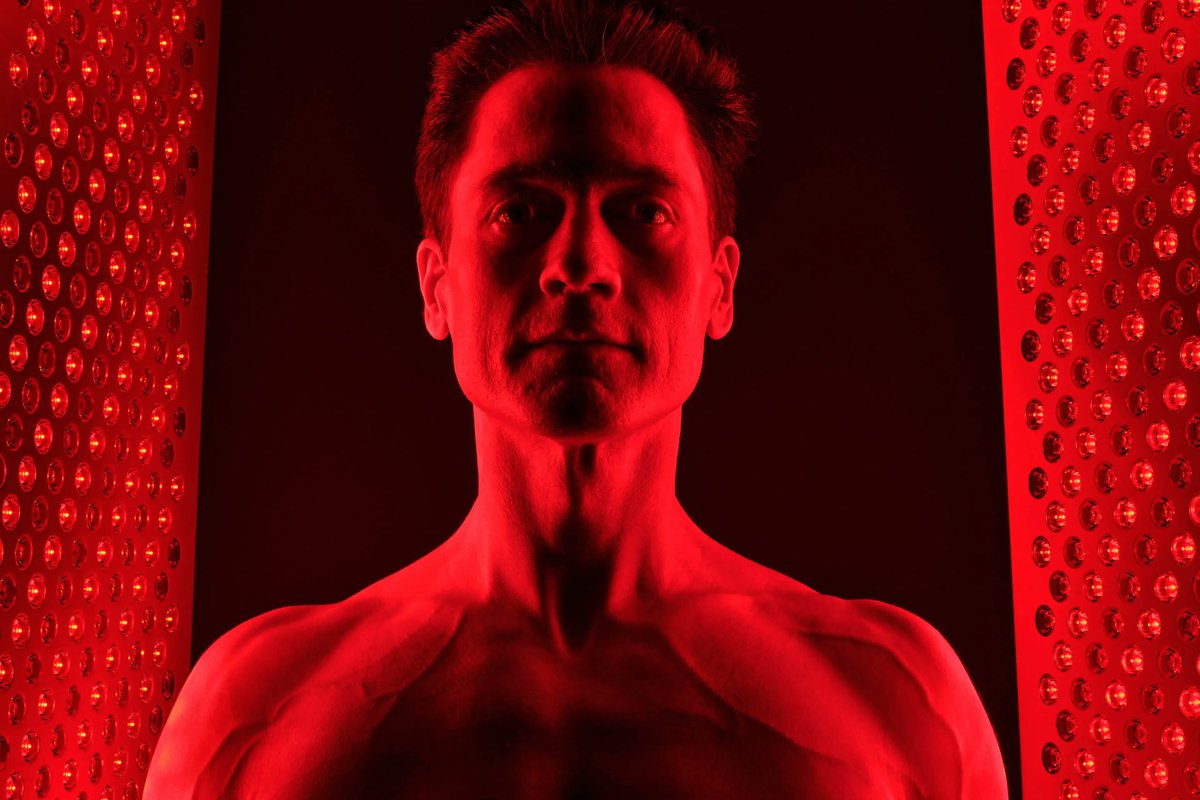
Bryan Johnson is the reason the average person now knows any of this exists. He uses a red light cap on his scalp for 6 minutes daily and a full-body panel three times a week. He posted his hair regrowth photos and his skin scans, and the algorithm did the rest. Red light masks went from biohacker forums to Sephora shelves in two years.
Tiina Karu died in 2019. She did not live to see Nature validate her. She did not live to see a billionaire turn the enzyme she identified into a billion dollar industry.
Every red light mask, panel, cap, and bed on the planet right now is just a way to deliver the photons she proved mattered.
The wavelengths were always there. The enzyme was always there. The biology was always real.
It just took a Hungarian doctor with a broken laser, a Russian scientist nobody listened to, and one tech billionaire willing to stand in front of a glowing panel for the world to finally pay attention.
I’m obsessed with red light therapy for a reason!!
After seeing how much it’s helped my inflammation and energy, I’m not even surprised Joe Rogan ditched his reading glasses.
This stuff works on a cellular level — it literally boosts your mitochondria and forces your cells to produce way more energy.
Eyes, brain, recovery, inflammation… red light is the real deal.
I’m telling you, people are sleeping on this!!


![Rainmaker1973's tweet photo. Alzheimer’s may be linked to gum bacteria, new research shows.
Scientists have repeatedly found Porphyromonas gingivalis—the chief bacterium that causes periodontitis—inside the brains of people who died with Alzheimer’s.
When researchers deliberately infected mice with this oral bacterium, the animals rapidly developed key Alzheimer’s pathology, including the buildup of amyloid-beta plaques.
Perhaps most alarming, the bacteria’s toxic enzymes have been detected in the brains of people showing early Alzheimer’s changes years before memory loss or other symptoms appear, suggesting the infection may quietly initiate damage long in advance.
These discoveries have sparked serious interest in new treatment approaches. An experimental drug called COR388 (from the company Cortexyme) has already succeeded in lowering both bacterial load and amyloid-beta levels in preclinical models. Although large human trials are still needed, the evidence is mounting that at least some cases of Alzheimer’s may have an infectious trigger rather than being purely degenerative.
[Dominy, S. S., et al. "Porphyromonas gingivalis in Alzheimer’s disease brains: Evidence for disease causation and treatment with small-molecule inhibitors", Science Advances, 5(1), eaau3333]](https://pbs.twimg.com/media/HIgP9ioX0AAZ1bb.png)