Proud to finally see our group's work out there! Among other things, the highest redshift SN Ia known at z=2.9! Plenty more where this came from.
https://t.co/uIxOPOvNC9
Big paper splash. New era in high-z transients begins. We use #JWST to find >40 SNe with redshifts 2<z<5...inc. spectra! 3 papers led by *early career researchers*. #AAS244 1/n
DeCoursey+ https://t.co/sQQvO4zDS9
Pierel+ https://t.co/dKejPcQ108
Siebert+ https://t.co/LZqfcu9OGF
On the topic of the DESI, and potential differences in supernovae, I thought it might be worth sharing our JWST Cycle 3 program and what we're doing, because it is highly relevant to all this!
https://t.co/rf3w1YJQL5
So it's a little weird seeing DESI people in the press articles talk about supernova differences. Now, should there be differences? In short, P+ and UNION have a high degree (though not total) of overlap in data, extremely different in analysis. DES-5yr has a completely independent high-z (and photometric) sample. There's nothing I've seen yet to think differences in supernovae are the story here, but we'll be digging in regardless as everything becomes public.
At the moment, JWST is the ONLY observatory that can find such supernovae. We'll be depending on all public data for which we can do difference imaging. Luckily, we've gotten pretty good at that.
🆕 The @RoyalAstroSoc has awarded the 2024 Group Achievement Award in Astronomy to the team responsible for designing and building Webb’s MIRI instrument! 🎉 Read more: https://t.co/DCatVEq17F or 🧵👇
In cool astro news - The PEARLS team discovered a gravitationally lensed supernova in #JWST observations of PLCK+G165. The target is SN H0pe, likely Type Ia SN at z~2, and triply imaged! See the AstroNote here: https://t.co/CAMjeFG9QU
@AstroJake I think it boils down to the fact that most of the last century of incidents were apparently covered up, and those involved did so with no congressional oversight. The difference is that now, we have credible reports out in the public, and these reports show a clear danger.
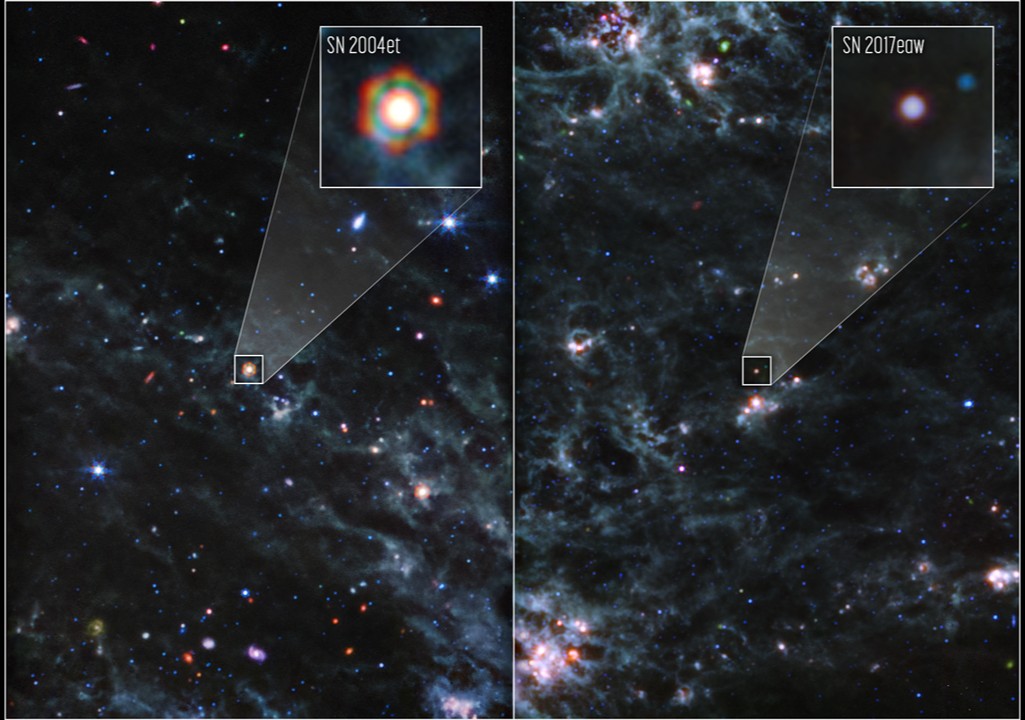
#NASAWebb researchers have made major strides in confirming the source of dust in the early universe with observations of two dying stars (supernovas!): https://t.co/p102juInon