What @ilblackdragon and NEAR team has built is a pragmatic solution which solves users’ problems “today” and such solutions win the users, technically perfect solutions win larpers (that too for a short time, you can never satisfy them for long)
This is craazy. I asked one of our PhD engineers to look into NEAR *Confidential* Intents wondering how they designed their system. Unredacted, word-for-word, this was his answer 😱😱😱
"Everything I found out about the privacy claims and confidential intents is so bad that it seems almost comical and I cannot believe what I am seeing. Apparently they run a completely separate instance of the protocol, which is called FAR (as an opposite to NEAR), and that has a permissioned operator set. The entire confidentiality claim seems to rest upon the fact that it is a permissioned chain and the nodes are trusted to keep things private, there doesn't seem to be any deep technology behind it and it also does not seem to be open source. The entities running the nodes are also not publicly known.
I almost feel weird writing this because it is so absurdly bad that it feels like ... I don't know ... a simulation? I know the usual level of overpromising in Web3 but this is so many levels beyond believable that it still feels unreal."
There's no such thing as a bigger disconnect at this point, than with $NEAR.
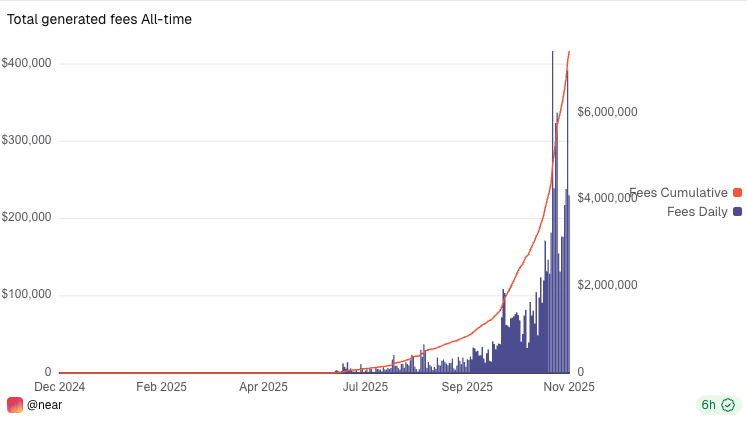
Intents going absolutely parabolic. Revenue shooting up.
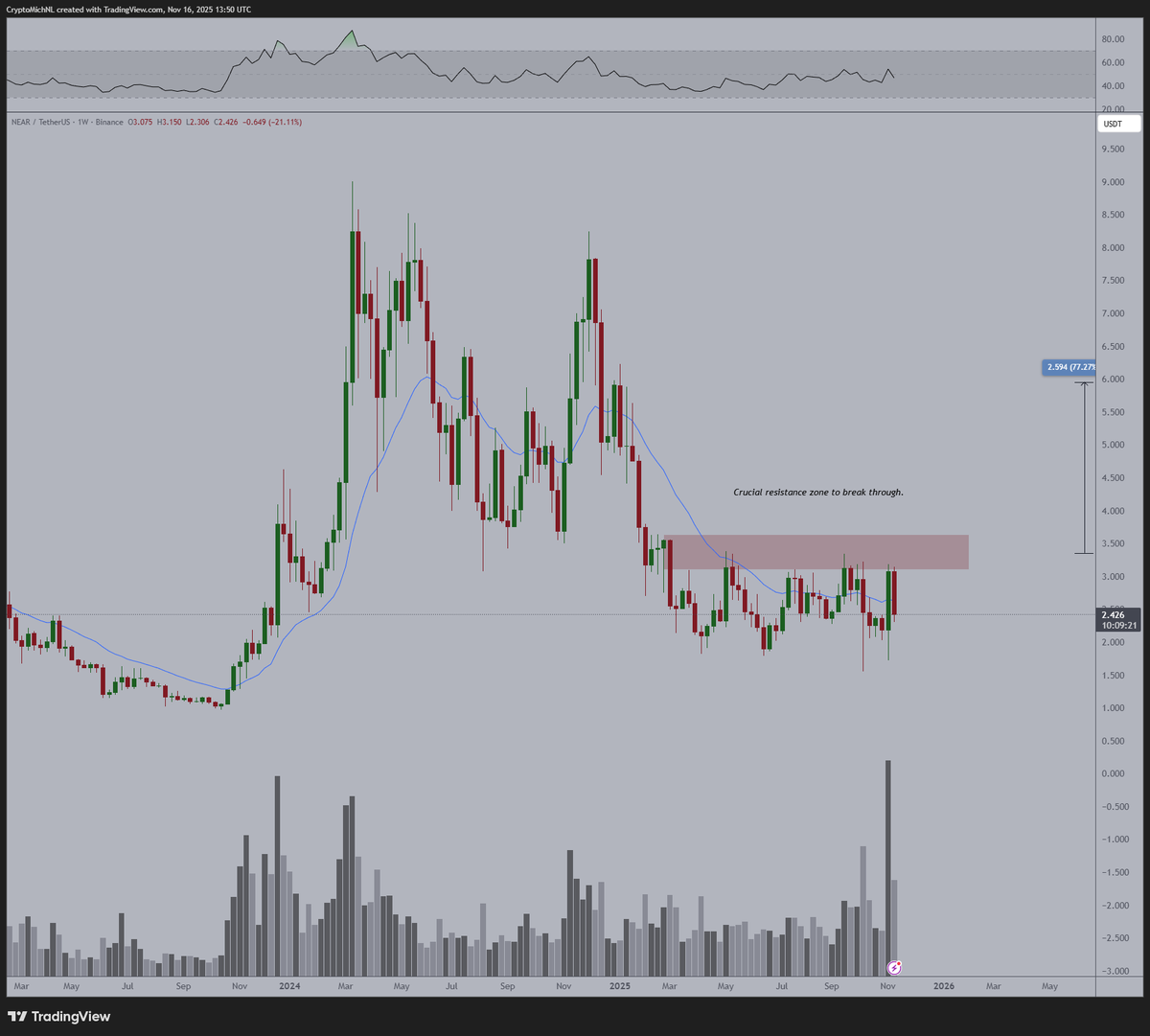
Price about to break, and then a market-wide correction.
Watch our episode with Illia about $NEAR here:
https://t.co/mBwILXY9UH
Now, I've mentioned this a few times before.
Before this dip occurred on $NEAR, it provided a massive opportunity to be accumulating this position.
Therefore, I would suggest to be looking at position-building into the entire AI vertical, as that is one of the key verticals in the coming period.
Aside from that, once $BTC has found a bottom, the assets that were moving the fastest prior to the correction are going to be the ones bounces back the fastest.
1/ The market is beginning to recognize the current state of @NEARProtocol, with public dashboards showing it as a top-tier L1 for fee generation (~$1.9M in the last 7 days).
This is a strong validation of network traction.
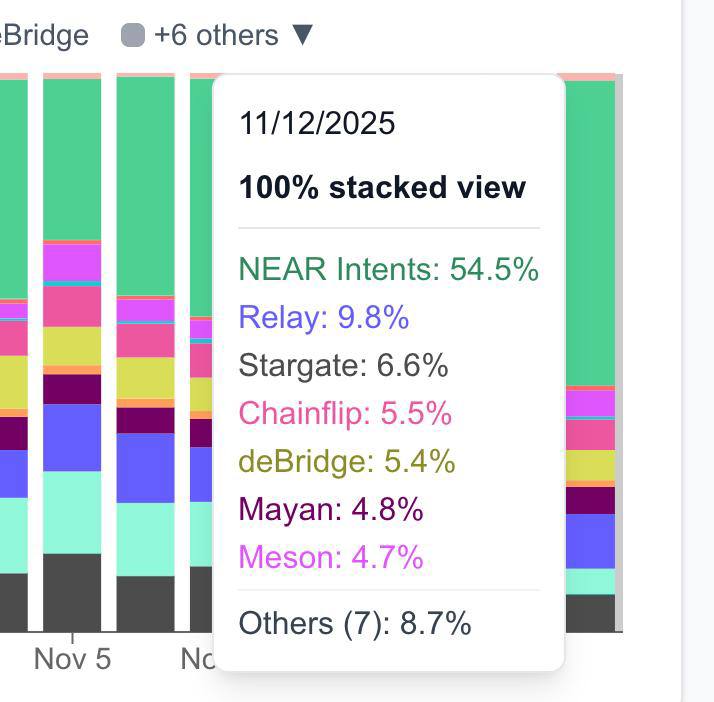
NEAR Intents = The Universal Liquidity Layer
0 to $1B in volume — 305 days
$1B to $2B in volume — 35 days
$2B to $3B in volume — 20 days
$3B to $4B in volume — 8 days
NEAR has successfully completed its halving upgrade on mainnet.
This upgrade reduces the maximum annual inflation rate of NEAR Protocol from 5% to 2.5%, ushering in an era of more sustainable tokenomics and strengthening incentive alignment across the NEAR ecosystem.
@KamBenbrik@NEARProtocol Your accusation is not based on facts. I would urge whoever still staking with chorus one to remove their stake. The fees are too high anyways.
Here is the results of the mentioned on-chain voting:
https://t.co/JIjD1VLuTO
It was incredible to see participation of 89 validators and 48.45% of total stake in the voting process, that required to issue a custom on-chain transaction from the pool owners account.
The overwhelming majority of 91.76% of stake-weighted validators voted YES for reducing the inflation. Some people argue that not-voting was implicit NO, but that's a bit flawed, since some validators (exchanges, institutions, staking providers) have to stay neutral and abstain. The problem is there were no ABSTAIN vote in the on-chain contract, so they couldn't have express their opinion this way.
The voting has ended without reaching the consensus threshold.
Currently, the protocol upgrade to 2.9.0 introduced the inflation reduction. Validators have to decide by either upgrading or not, which is a bit problematic, because there is no abstain option again.
As a NEAR stake holder who supports the inflation reduction, make sure to move your stake to a staking pool that voted FOR reducing inflation. If you are AGAINST the inflation reduction, move your stake to the pool that voted NO for reducing inflation.
The protocol upgrade voting is scheduled to start on October, 28 and will last for 3 weeks. So there is plenty of time to decide.
Halving would strengthen the NEAR tokenomics and incentivize the growth of NEAR's defi ecosystem. If you are a NEAR validator, please support the upgrade!
$NEAR is accumulating for the entire year of 2025.
That's nearly 9 months of accumulation.
Once it breaks through the resistance of $3.25-3.50 I assume it will be a strong breakout.