AI is moving into the physical world.
We're excited about a new wave of startups rebuilding the systems that power the real world, from education and healthcare to defense, finance, infrastructure, and work itself.
https://t.co/QCIz6DnQnN
🚨Vanguard (AUM= $10+ Trillion) is looking for a head of digital assets for first time.
Successful candidate will "develop the multi-year digital assets roadmap" for the $10+ Trillion asset manager.
h/t @matty_ice_BTC
this is just the most ridiculous AI application i've ever seen lol
a Peter Thiel-backed startup that makes AI collars for cows is now worth $2 billion
and the more I read about it the cooler it gets. here's how it works:
every cow wears a solar-powered collar that talks to a network of radio towers and an app on the farmer's phone
instead of building physical fences, the farmer draws the fence on a map in the app, and the collar keeps each cow inside that invisible line using GPS
when a cow drifts toward the edge, the collar plays a sound to steer her, and a gentle vibration tells her which way to go.
it's like how a car beeps as you back up toward a wall
the cows learn the cues in a few days
so now a rancher can move an entire herd to fresh grass by sliding the fence on a map, without driving out to open a single gate
and that same collar is reading each cow's body the whole time.
it takes five readings per second on every animal, so the AI can catch a cow that's sick, injured, ready to breed, or about to give birth before a person would ever notice walking the field
so it's basically like WHOOP for cows too lol
and they gave the AI behind it the perfect name: the Cowgorithm
it's been trained on more than 7 billion hours of real cow behavior, which is why Halter calls the data its real asset and moat.
they know what a normal cow looks like better than anyone, so they can flag the odd one out instantly
it's already on more than 1M cattle across New Zealand, Australia, and a bunch of US states.
California even used it on public land to graze cattle in patterns that clear dry brush and slow down wildfires
costs about $5 to $8 per cow per month
a job that used to mean barbed wire, gates, and driving the fields all day is now mostly 1 person on their phone
A new exciting release from @SentoraHQ . Thrilled to be launching this dedicated market with @ethena and @kamino@ethena scaling USDe on Solana is not just a “new asset comes to a new chain” story.
It is more interesting than that.
What is being assembled is a three-part credit stack:
@ethena brings the synthetic dollar.
@kamino provides the Solana-native lending infrastructure.
@SentoraHQ powers the risk management, curation, and institutional deployment layer.
The new @SentoraHQ USDG Earn vault on @kamino is a good example of this architecture in practice. The vault is focused on @ethena-related assets and deploys into a dedicated @ethena market on @kamino: USDG as the supplied liquidity asset, and yield-bearing USDe as collateral inside an isolated lending market. Users deposit USDG into the vault; borrowers access that liquidity against USDe collateral; @SentoraHQ configures the risk parameters that define how the market operates.
Simple on the surface. Quite dense underneath.
USDe is not a normal fiat-backed stablecoin. It is a synthetic dollar built from collateral, hedging, basis, funding, and market structure. This makes it powerful, because it can turn crypto-native balance sheets into dollar-like liquidity. It also means scaling it responsibly requires more than listing it everywhere and hoping the blended risk is fine.
The right primitive is dedicated, parameterized credit.
That is where the @SentoraHQ / @ethena / @kamino partnership becomes important. @kamino supplies the venue: lending markets, Earn vaults, risk isolation, analytics, and Solana-native execution. @ethena supplies the asset and the demand side of the ecosystem: USDe as collateral, distribution, and synthetic-dollar growth. @SentoraHQ sits between capital and protocol risk, with risk management powered by the @SentoraHQ platform: evaluating collateral liquidity, oracle coverage, market structure, LTVs, caps, and the conditions under which the vault should deploy capital.
This is the clean separation of concerns that DeFi has been slowly converging toward.
@ethena manufactures the synthetic dollar exposure.
@kamino makes that exposure usable inside high-throughput Solana credit markets.
@SentoraHQ decides how the risk is admitted, sized, monitored, and contained.
The key word is contained.
In older DeFi designs, risk often leaked everywhere. Assets were pooled together, markets shared assumptions, and a bad parameter in one corner could become everyone’s problem. Here, the USDe exposure is intentionally isolated inside a dedicated @ethena market. The vault is for users who want this specific @ethena-focused risk/reward profile. The market has its own collateral configuration and lending parameters. Risk lives where it is supposed to live.
That is what institutional-scale DeFi should look like: composable, but not careless.
For Solana, this matters because the chain already has the execution properties credit markets need: low-cost transactions, fast liquidations, efficient rebalancing, and usable UX. What it needs is more high-quality collateral, more stablecoin depth, and more professional risk curation. This partnership touches all three.
The headline is a USDG vault on @kamino.
The deeper story is that @ethena is becoming part of Solana’s credit layer, with @SentoraHQ providing the risk-managed vault infrastructure that makes the expansion legible to larger capital pools.
Less yield farm, more balance-sheet infrastructure. Much more to come.
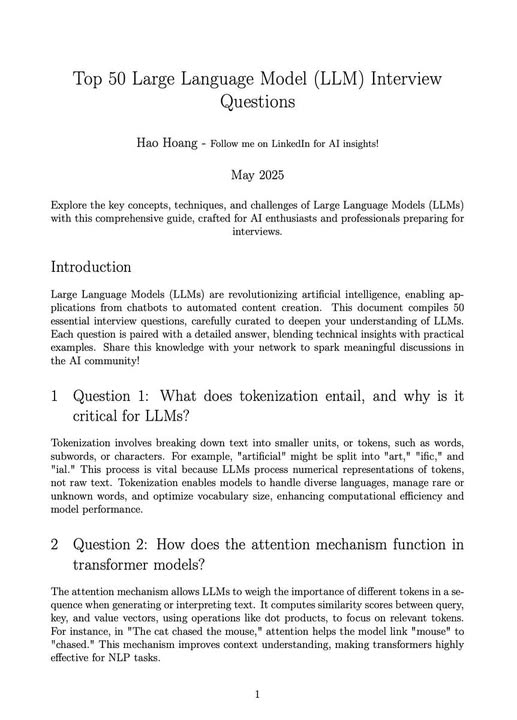
🚨 GOOGLE, META, OPENAI etc. BIG TECH are REJECTING JOB CANDIDATES BEFORE EVEN THEY FINISH TALKING.
50 LLM QUESTIONS. IF YOU CAN'T ANSWER THEM, THE INTERVIEW ENDS BEFORE IT STARTS.
The people passing these interviews are walking out with $200k+ offers.
Someone just LEAKED THE EXACT LLM INTERVIEW QUESTIONS these companies are asking right now.
And the gap between people who know these answers and people who do not is already costing careers.
Here is every category you need to know:
The Basics they always ask first:
↳ How does tokenization work and why does it matter
↳ How does attention actually work inside a transformer
↳ What is a context window and what breaks when it gets too big
↳ What are embeddings and how do they get initialized
↳ How does the model know word order without reading left to right
The fine-tuning questions that eliminate 80% of candidates:
↳ What is LoRA and why is it better than full fine-tuning
↳ What is QLoRA and when do you use it instead
↳ How do you fine-tune a model without making it forget everything it already knows
↳ What is model distillation and why do companies use it
↳ How do you handle vocabularies with millions of possible words
The generation questions most people guess on:
↳ Beam search vs greedy decoding, which one and when
↳ What temperature actually does to model output
↳ The difference between top-k and top-p sampling
↳ Why autoregressive models work differently from masked models
The advanced concepts that separate good from great:
↳ How RAG works and why it beats fine-tuning for factual accuracy
↳ Why Chain-of-Thought prompting makes models dramatically smarter
↳ What Mixture of Experts is and why every frontier model uses it now
↳ Zero-shot vs few-shot learning and when each one wins
The math questions that make people sweat:
↳ Why softmax is used inside attention and not something simpler
↳ What cross-entropy loss actually measures
↳ What KL divergence is and where it shows up in AI training
↳ Why vanishing gradients were destroying transformers and how they fixed it
If you are applying for any AI role in 2026 and you cannot answer at least 40 of these, you are not ready yet.
The full list of 50 questions is worth printing out and going through one by one.
Save this post. Your next interviewer has almost certainly pulled from this exact list.
@thechinacurrent Wow all these Americans who never stepped foot outside their own little country commenting on how China and Chinese people are like - fascinating the depth of pure ignorance among the American population
In 14 minutes, this Anthropic engineer who wrote "Building Effective Agents" will
teach you more about building them right than most developers figure out on their own
in months.
Bookmark this for the weekend. Then read the builder's guide below.
This 2-hour Stanford lecture breaks down how models like ChatGPT and Claude are actually built, clearer than what many people in top AI roles ever get exposed to.
Save this and set aside two hours today. It might end up being the most valuable thing you learn all week.