Metal has closed a $4.5m Seed round led by @a16z@speedrun and @ycombinator with participation from @pioneer_fund, @RebelFund_VC, @GaingelsVC, @indusvalleycap, @teamignitevc, @GoodwaterCap, @PhazeVentures and others.
This round accelerates our work toward a bigger goal: building the AI-native operating system for private capital markets — software that founders adopt while raising, and continue using across the entire capital formation process.
Alongside the announcement, we're publishing our thesis on where private capital markets are headed.
Read the full press release here: https://t.co/AuJaj2544m
Today we're announcing @metalraise $4.5M Seed Round, led by @a16z@speedrun / @ycombinator.
With participation from @pioneer_fund, Rebel Fund, @gaingelsvc, @indusvalleycap, @teamignitevc, @PhazeVentures and others.
In less than a year of launch, and with six consecutive quarters of 30-80% q/q growth, Metal is tracking for multi-million annual revenue run rate by the end of FY2026.
The core missing infrastructure in private markets has been an investor memory layer, an effort that we've been working on for three years. Today, for the first time, we are publishing our thesis on how private markets will evolve in the years ahead. See press release in comments below!
Boston startups: same money, fewer rounds.
@zhashx breaks down where the $8.3B went, who’s writing the checks, and why Series A got harder to reach.
Full Q4 report with @MetalRaise data 👇
Your startup’s traction might matter less than how quickly you move investors through your fundraising pipeline.
Gul Usman (@usmangul), founder and CEO of Metal (@MetalRaise), raised $120 million for Airlift before building an AI-powered fundraising platform backed by a16z and Y Combinator.
Chapters:
00:01 Introduction to Gul Usman and Metal
00:48 From Lahore to Mastercard, Marqeta, and DoorDash
03:31 The DoorDash experiment that broke Salesforce
08:52 Why career growth isn't linear
10:37 Building Airlift and Solving Pakistan's Transportation Problem
13:25 Why Airlift shut down after raising $120 million
16:05 The fundraising problem that inspired Metal
19:25 Y Combinator, experimentation, and finding product-market fit
22:47 Solving fundraising software's retention problem
26:01 How Metal matches founders with investors
30:03 Why sustainable growth beats short-term acceleration
32:48 Strategic urgency versus bias for action
35:29 Why most fundraising processes fail
40:02 Making investor updates more effective
42:12 Why warm introductions outperform cold emails
46:02 The strongest predictor of fundraising success
48:30 Closing thoughts and Metal's future
“The preparation goes into a round, which is where the magic happens.”
If investor pipeline velocity predicts fundraising success better than traction, should founders spend less time perfecting their pitch and more time generating investor momentum?
🎧 Watch, listen, and follow on your favorite platform: https://t.co/e2AxZPt5Nc
💬 Join the conversation on your favorite social network: https://t.co/ADxaZqXXue
📝 Read the full episode breakdown on our blog: https://t.co/dpm3ixtRPH
One of the most frustrating parts of fundraising is the lack of visibility into what happens after founders send their deck to an investor.
@MetalRaise just launched AI-native Data Rooms to help change that.
Founders can now securely share fundraising materials, track how investors engage with them, and use those signals to make smarter decisions about who to follow up with and where to focus their time.
But what's more interesting is how this fits into the bigger picture. Over the last few months, Metal has launched:
➢ Autopilot & Raise Agent: automating fundraising preparation and execution
➢ Mock Calls: helping founders prepare for investor conversations with AI simulations
➢ Investor Relations: managing investor relationships and updates after the round
➢ And now Data Rooms: bringing intelligence to the diligence process
Individually, each solves a real pain point. Together, they're building toward something much more ambitious: An AI-native operating system for capital formation.
One that helps founders prepare for a raise, find and engage the right investors, navigate diligence, and maintain those relationships long after the round closes.
Fundraising has historically been a fragmented, manual, relationship-driven process. Metal isn't trying to replace the human relationships at its core. It's building the infrastructure and intelligence around them so founders can spend more time on what actually matters.
Great to see @usmangul and the @MetalRaise team continue executing on this vision. Proud to have backed them at Indus Valley Capital alongside YC and a16z.
Check out the launch: https://t.co/JDznygCuXk
Your startup’s traction might matter less than how quickly you move investors through your fundraising pipeline.
@usmangul, founder and CEO of @MetalRaise, raised $120 million for Airlift before building an AI-powered fundraising platform backed by a16z, Y Combinator, and Team Ignite (the 3 most active early stage VCs as it turns out!).
On the Ignite Podcast with Brian Bell, they discuss:
- Why Metal’s fundraising data identifies process velocity, not traction, as the strongest predictor of success.
- Why only 7% to 20% of fundraising attempts succeed, depending on stage.
- How modeling restaurant revenue at DoorDash led merchants to offer 32% commissions.
- Why Airlift’s aggressive expansion became a liability when the funding market collapsed.
- How Metal ranks investors by company fit and uncovers hidden warm-introduction paths.
- Why founders should replace stalled investors quickly instead of waiting weeks for replies.
“The preparation goes into a round is where the magic happens.”
If investor pipeline velocity predicts fundraising success better than traction, should founders spend less time perfecting their pitch and more time generating investor momentum?
Start fundraising with https://t.co/I060IWgd24
🎧 Watch, listen, and follow on your favorite platform: https://t.co/zRx1nfivxN
💬 Join the conversation on your favorite social network: https://t.co/Em5RK72b5Z
📝 Read the full episode breakdown on our blog: https://t.co/BVeMU3b8Yv
Metal expands into Data Rooms.
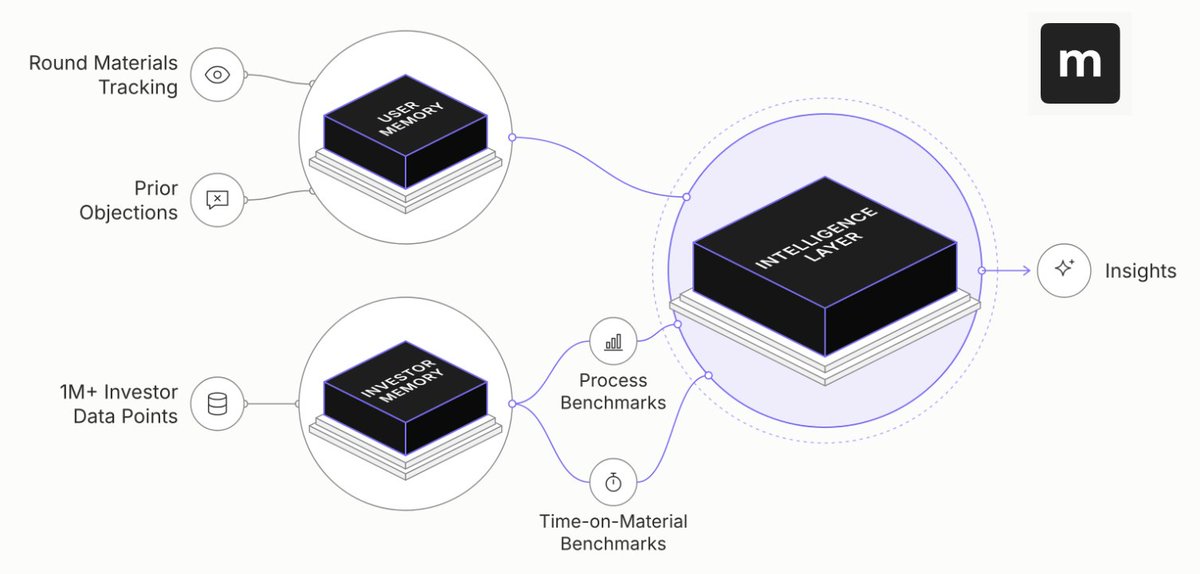
Today, as part of our consolidation strategy,@Metalraise is launching a new platform for Data Rooms and Round Materials.
Founders can now upload round materials to @Metalraise share secured links with investors for analytics on viewing data, and get sharp insights into ways to improve their materials. These insights are based on rich user context, as well as off-market proprietary data on how capital markets perceive a particular operating space or business model.
With each passing quarter, advancements in the capabilities of underlying models are opening up new opportunities. In the near future, the process for raising venture rounds will look quite dissimilar from how it works today.
At Metal, we aim to lead the upcoming transition to bring greater efficiency and precision to private markets.
What are the most common legal pitfalls that startups land into when raising a Series A?
On Nov 4, as part of @metalraise Behind the Raise series, we’re co-hosting a live session with VectorLegal to help founders prepare better.
Link to join below.
Most founders still write investor updates by hand, spending hours each month.
Then they chase the wrong investors for their follow-on.
@metalraise's AI Update Builder drafts the update. Follow-on Intelligence shows who’s most likely to re-invest.
Our team explains 👇
@Metalraise now lets founders rehearse an investor meeting before it happens.
Pick the investor you're about to meet, and our AI runs a live mock call based on how they think and the questions they typically ask. You get a scored analysis once the call ends.
Our team walks through it below 👇
Consumer raises take a median of 211 days to close, almost 2x as long as AI ( @Metalraise Data Desk).
Consumer Series A deals also fell 48% from Q1 2023 to Q1 2025 ( @cartainc)
On Wednesday, I'm sitting down with @nik_quinn (ex-GP
@lightspeedvp, now Founding Partner @Connectventures) to talk about the state of Consumer Series A rounds and how founders should be thinking of Consumer rounds.
In July 2025, I was invited to the a16z @Speedrun offices in Los Angeles (partly to introduce @Metalraise to their portfolio companies).
I ended up spending six months in LA, working from the @a16z offices.
During this time, many of my views evolved on startups, and this evolution was partly driven by a16z speedrun’s unique history and superpowers.
(1) Media for Startup: Before landing in LA, I was of the view that a uniquely powerful product is how you win the market. Through speedrun, I learned that there is an art and a science to launches, and that your demand gen team almost has to operate as a “media production” team.
(2) Storytelling: One of the most unique aspects of speedrun was the emphasis on storytelling. How you tell your story to the world has an outsized impact on various aspects of the business, particularly in the post-PMF world.
This week, a16z Speedrun opened applications for their next cohort (SR008), and I couldn’t recommend it more strongly to founders out there raising capital and building startups.
@m_costanzajr@usmangul@samshank We're glad, @m_costanzajr!
We've more events coming up if helpful --
We'll be hosting @Nik_Quinn on 20th October to dive deeper into Consumer Rounds.
Feel free to register here -- https://t.co/gmvBKEUImq
With Investor Relations, founders can go from managing their entire raise to managing their investors post-raise, all in one place, built on top of millions of datapoints on investors.