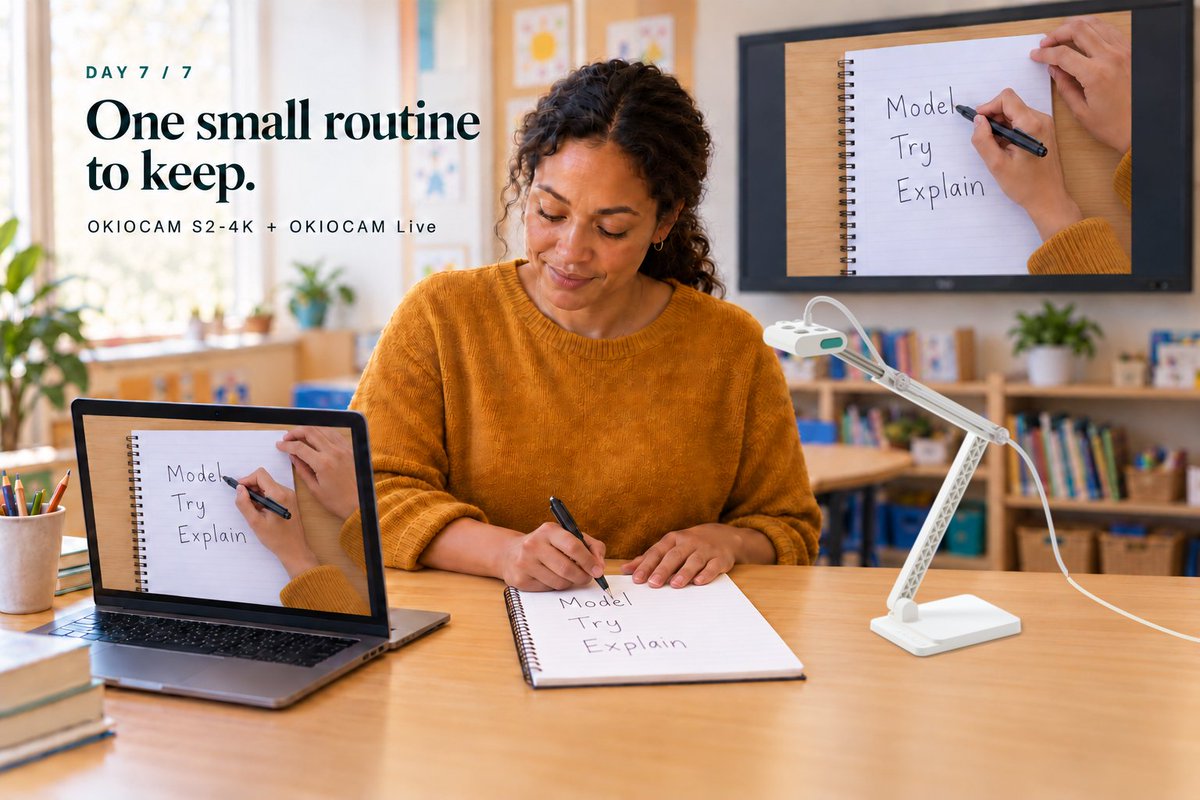
Day 7/7: One small routine to keep.
Model a step. Let students try. Ask them to explain.
OKIOCAM S2-4K + OKIOCAM Live helps you show the work, annotate a captured frame and save a snapshot for tomorrow.
US: https://t.co/VJw4eLBZ7x
@MsGeorges119@LakeHighlandsMS After each defense, partners could name one piece of evidence that changed or strengthened their thinking. It gives everyone a reason to listen closely.
@pinilla_thinks@CCE_Counselor A simple way to capture their thinking: have each child draw what they predict first, then add one detail they noticed afterward. The drawings make a lovely class discussion.
@FawkesDen@MrsCoutant@MrsKellyTo For a quick follow-up, let the kids sort pumpkin pictures by size, then count how many are in each group. They can explain how they decided where each one goes.
@amanda_spear4@Classroomscreen@MSTMAGNET@RISDmath For those multi-step problems, try having partners underline the question first, then circle the information they need for each step. It makes their plan easier to explain.
@Kel_Sanders Before mailing the cards, try a quick gallery walk and let each student share why they chose one detail. It gives everyone a chance to talk about their work.
@BHammill Before revealing the regression line, have partners compare their guesses and explain which points influenced them most. Then discuss why the fitted line differs.
@hpicciotto After students build a number, have partners sketch a different arrangement and write an equation for each. Comparing the drawings can make the operations easier to see.
@KarenCampe A nice follow-up is to have students pick one problem and explain a strategy they tried before looking at the solution. Their first attempts make good discussion starters.
@DrLewickiPhD A 10-by-10 grid makes this one click: shade four tenths one way and three tenths the other. The overlap shows why the answer is twelve hundredths.
@misshat2 Have teams sketch the fluid path and predict what will happen before testing. Then they can mark where their observations matched or surprised them.
@MelissaKumanski Have students fold a paper snowflake and draw the lines of symmetry before unfolding it. Then they can compare their predictions with the finished design.
Got packs to open or a project to build? Give chat a seat at your desk.
OKIOCAM S2-4K pairs an adjustable arm with a compact weighted base for your overhead setup.
Cards, crafts, close-ups. What would you stream first?
https://t.co/VJw4eLBZ7x
@jlmcdonald@huronschools Before a player covers 12, have them name two ways to make it, like 3 x 4 and 2 x 6. A quick array sketch gives their partner something to check, too.
@APondrom@TeamBrentfield@RISDmath@RISDTnLScience@_TeacherTaylor With the monster circuits, have partners sketch the path electricity will take before they connect the battery. When a light won't come on, they can use that same sketch to hunt for the gap.
@claudiaLzn@TISDRES Turn one monster sideways and ask, 'Did we change how many there are?' Then have kids write both multiplication facts beside it. The picture does a lot of the explaining.
@Areinholz1 I'd save one Halloween problem for Monday and have partners explain their first step before solving. A tiny bit of recall after all that excitement!
@WhiteCarolyna@yaleroadrunners@stacie_lilly Before the next challenge, have everyone jot down an estimate and one reason for it. Then compare estimates after solving. It gives the quieter kids something ready to share, too.