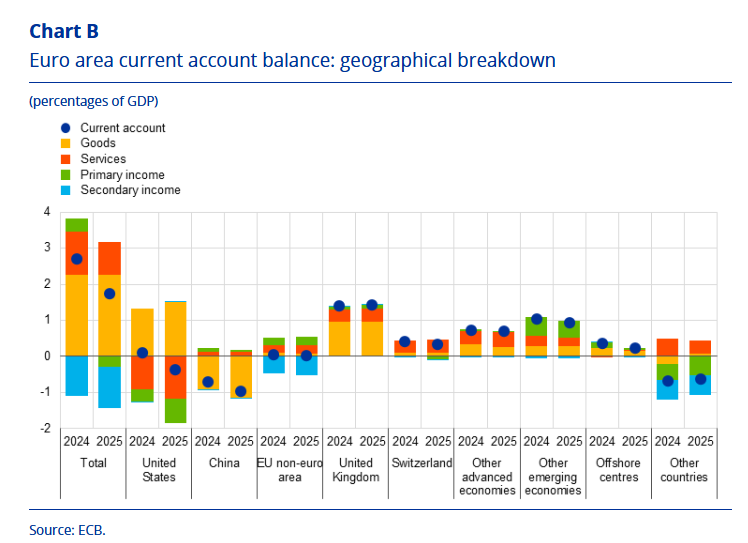
Interesting piece by the ECB, highlighting the fall in the euro area's current account surplus to 1.7% of euro area GDP in 2025 (way below China's surplus, even without adjusting for Ireland)
1/
As global imbalances are again in focus, the euro area current account surplus narrowed markedly in 2025. See our new box with @MichaelFidora@FPastoris and Lorenz Emter analysing the underlying drivers:
https://t.co/7yY0WXaK8w
#Trade between geopolitically aligned countries, or friend-shoring, has increased since 2018, while trade between rivals has decreased.
Costanza Bosone @unipv, Ernest Dautović @ecb, @MichaelFidora@ecb, @stamgiovanni@unitorvergata
https://t.co/SjBTbQfepL
Just published: #EconomicBulletin box analysing how euro area trade and financial linkages with Russia developed since Russia’s invasion of Ukraine. Joint work with @MichaelFidora@FPastoris Lorenz Emter
See our latest @ecb Working Paper on “Sudden stops and asset purchase programmes in the euro area” with @josefinafabiani, @RalphSetzer, Andreas Westphal and Nico Zorell.
Read how the euro area current account balance evolved during the pandemic in 2020 in our latest @ecb Economic Bulletin Box with @FPastoris and @Schmitz_BoP
The euro area current account surplus shrank slightly in 2020, to 2.2% of GDP. One of the largest coronavirus-related impacts was the sharp reduction in the services surplus due to travel restrictions during the pandemic. Read more https://t.co/RHo4Xs6F54 #EconomicBulletin