America was not “built by immigrants for immigrants.”
It was founded by colonial natives: Thomas Jefferson (Virginia-born) drafted the Declaration of Independence. James Madison (Virginia-born), the Father of the Constitution, and Gouverneur Morris (New York-born) shaped and finalized the Constitution.
They created a new nation rooted in British law, language, and Protestant culture.
They welcomed immigrants who came to assimilate into that existing American culture, not replace it.
Settlers built the house. Immigrants were welcome to join if they respected the house.
China looked at the lessons of 20th century great power conflict and drew the conclusion that military power alone doesn't determine outcomes, upstream industrial capacity does.
The Allies won because of overwhelming industrial might. Japan and Germany lost because they lacked critical industrial inputs. Starved of oil, they were forced into gambles that cost them the war…Japan attacking Pearl Harbor to seize the oil in the Dutch East Indies, Germany marching to the Caucasus to take the Baku oil fields. Input scarcity doesn't just weaken you. It steers your decisions. It pulls decisions away from the optimal plan and toward the necessary plan.
China learned this lesson and decided to be the one holding the chokepoints. By embedding itself so deeply into the upstream supply chains that feed American military production, a conflict would trigger Western industrial paralysis and neuter its ability to fight a long war.
But the chokehold only works if the West doesn't rectify its supply chain vulnerabilities before China is ready to move on Taiwan. So China's central strategic requirement was to delay Western recognition of the threat for as long as possible.
Thus, China's entire foreign policy posture becomes oriented around appearing non-threatening. And it works because it aligns with the economic incentives of Western elites who benefit from cheap inputs and profitable trade. The cost of denial is kept artificially low. Raising the alarm looks like paranoia or protectionism when cheap goods keep flowing and no shots are being fired.
The administration is now racing to unwind its supply chain vulnerability before the conflict window opens. But that takes years, and they face significant inertia, both domestically and among allies who remain naively blind to the risk.
China knows this. So their strategy is to keep the West sleepwalking. Which means they can’t show their hand. If China comes into direct military conflict with the US in order to defend a proxy, the West wakes up. The inertia collapses. The reshoring and remilitarization that China spent decades trying to prevent happens on an emergency timeline.
But the US finally realized it could use this against them.
Since China can’t show its hand until it's ready to move on Taiwan, the US realized that it can turn China's greatest strategic asset, the pacifist disguise, into a structural trap.
They cannot take overtly aggressive action without triggering the Western industrial mobilization their entire strategy depends on preventing.
So the US can eliminate their proxies and China can’t respond without destroying the disguise.
Maduro removed. Cuba strangled. Now Iran.
Beijing must decide if defending the proxy is worth waking the West up? And the answer keeps being no.
Until China’s window to move on Taiwan opens, the pacifist posture that enabled its chokeholds constrains their response to US actions.
Everything the US is doing right now is a race to be ready before that moment arrives. Clear the proxies. Arm the allies. Break the chokeholds. And build new ones of its own.
THE DONALD TRUMP FILES
What about Donald Trump? Isn't he in the Epstein files?
Well, we have now read 1.39 million DOJ documents in the Epstein case. Every one. We have built investigation dossiers on eight people: Bill Gates (2,265 documents), Woody Allen (2,613), Reid Hoffman (1,976), Bill Clinton (1,586), Larry Summers (739), Leon Black (667), Elon Musk (55), and Donald Trump.
For Donald Trump, across the entire corpus, we found 40 documents.
Not 40 damning documents. 40 documents total -- every sworn deposition, every FBI interview, every civil complaint, every flight log entry, every media reference of any kind linking Trump to Epstein in the largest document production in DOJ history.
As with Elon, the number is the story. And as with Elon, the documents themselves tell that story even better.
Every quote below is verbatim. Every citation is a DOJ document number you can verify. Click the links. This post comes from those links. There are just 40. You can read them yourself.
THE FRIENDSHIP
It must be made clear:
Trump and Epstein were friends. This must be stated plainly, because everything that follows only makes sense if you understand that.
They were Palm Beach neighbors in the 1990s. Both owned waterfront estates. Both moved in the same Manhattan social circles -- the dinner-party circuit that included Mort Zuckerman, Leon Black, Ronald Perelman, and a dozen other New York billionaires. In March 2003, Vanity Fair profiled Epstein as "The Talented Mr. Epstein" and named Trump as one of seven businessmen who dined at his 71st Street townhouse [187-11]. Juan Alessi, Epstein's house manager, named Trump among many prominent visitors to the Palm Beach property [055-12]. A 1993 photograph shows Trump and Marla Maples with Epstein and Maxwell at a New York party [EFTA00787056].
This was before Epstein's convictions.
In 2002, reached by phone for a New York Magazine profile, Trump gave the currently most weaponized quote in the entire archive:
"I've known Jeff for fifteen years. Terrific guy. He's a lot of fun to be with. It is even said that he likes beautiful women as much as I do, and many of them are on the younger side. No doubt about it -- Jeffrey enjoys his social life." [EFTA00013640]
That quote has been cited thousands of times. It was given on speakerphone, before any public allegations, before any investigation, before any reason to be cautious. "It is even said that" is hearsay framing -- Trump reporting what others say. "On the younger side" is ambiguous. But the quote exists, and it reflects a social warmth that post-Epstein scandal Trump would prefer to erase.
In 2003, Ghislaine Maxwell assembled a leather-bound album for Epstein's 50th birthday. Trump's contribution: a card with "several lines of typewritten text framed by the outline of a naked woman, which appears to be hand-drawn with a heavy marker," signed below the waist [senate_judiciary_to_bondi].
These are the facts, and the facts must be stated openly.
The friendship was real. But what happened next matters more.
THE FALLING OUT
Around 2004, that friendship ended.
Trump outbid Epstein at auction for the Maison de L'Amitie estate in Palm Beach. In Michael Wolff's 2017 recordings, Epstein himself confirmed the real estate dispute as the breaking point [wolff_tapes_transcript_exhibit].
But the real estate dispute was simply the excuse that Epstein made for something darker. Brad Edwards, the attorney who represented Epstein's victims, established under oath that Trump banned Epstein from Mar-a-Lago after Epstein sexually assaulted an underage girl at the club [773-04].
There is no documented contact between Trump and Epstein after the falling out in 2004. Not one email. Not one phone call. Not one schedule entry. Not one reference of any kind in 1.39 million documents.
After 2004, the relationship was over. Trump had drawn a hard line.
THE GIRL IN THE SPA
Virginia Roberts was sixteen years old, earning nine dollars an hour as a locker room attendant at Mar-a-Lago [1218-11]. In her memoir, she described the club in awestruck terms -- "sheer awe at the gold arches."
Ghislaine Maxwell approached her while she was reading a book about massage [EFTA01689026].
"I was working at Donald Trump's spa in Mar-a-Lago and I was prompted by Ghislaine to come to Jeffrey's mansion in Palm Beach that afternoon after work." [1090-16]
Roberts names many powerful men in her testimony. Clinton. Prince Andrew. Dershowitz. Wexner. She does not name Trump. He was the property owner. But Maxwell did the recruiting.
An FBI interview of a different victim's mother captures how this worked: she "heard that a prince and DONALD TRUMP visited EPSTEIN's house and this made [her] think that if they are there then how could EPSTEIN be a criminal" [EFTA00089603].
That is what Epstein did with famous names. He wore used them as bait. As camouflage. If Epstein was associated with so-and-so, then how could he be a predator? Trump, unlike others, immediately put a stop to that.
THE ACCUSATIONS
Three allegations against Trump exist in the corpus.
A Jane Doe civil lawsuit against Epstein's estate alleges that Epstein introduced her to Trump when she was fourteen, "allegedly elbowing Trump and saying, 'This is a good one, right?' Trump smiled and nodded in agreement" [1078-5].
At the Maxwell trial, a victim testified under oath that Epstein introduced her to Trump and took her to Mar-a-Lago when she was fourteen [120-cr-00330/745]. That testimony confirmed the social introduction. It contained no allegation of misconduct by Trump. Defense counsel used Trump's name to establish Epstein's social reach, not to implicate Trump.
In 2016, during the presidential campaign, a civil complaint alleged the rape of a thirteen-year-old at Epstein's 71st Street house in the summer of 1994 -- Katie Johnson v. Trump & Epstein [EFTA01386393]. It was filed pro se, dismissed for improper filing, refiled with an attorney, and dropped before trial. It was never proven, never tested under cross-examination, never corroborated by any other witness in the criminal investigation.
In August 2017, Epstein told Michael Wolff on tape: "I was Donald's closest friend for 10 years" [wolff_tapes_transcript_exhibit]. He claimed Trump liked to "f--- the wives of his best friends" and that Melania first slept with Trump on Epstein's plane. These recordings were released days before the 2024 election. They are unsworn claims by a convicted pedophile and serial liar to an author -- a man who told the same journalist his week included "woody allen, elon musk, frank gehri... bill gates" [EFTA02561193].
And that pedophile and liar had an axe to grind. A big one.
Those are the allegations. What follows is what happened when they were investigated.
THE INVESTIGATION
The FBI investigated Donald Trump in connection with the Epstein case.
The master case index lists him as a "positive case hit" with "salacious information": "Donald Trump (one identified victim claimed abuse by Trump but ultimately refused to cooperate)" [EFTA00161528]. One allegation. One victim who refused to cooperate. No prosecution.
The FBI's National Threat Operations Center received four separate complaints naming Trump [EFTA01660679]. A hearsay oral sex claim via a friend-of-friend chain. An anonymous party guest list. A claim about "big orgy parties" from a sixteen-year-old model. A Trump Golf Course allegation "deemed not credible." All anonymous. None corroborated.
The Senate Judiciary Committee -- bipartisan, Grassley and Durbin -- reported that FBI personnel were specifically instructed to "flag" any records in which President Trump was mentioned across all 1.39 million documents. The result: no incriminating "client list." No evidence of criminal conduct [senate_judiciary_to_bondi].
The Southern District of New York, which prosecuted the Epstein case, had Trump's phone records in their evidence. Their grand jury presentation includes a message slip showing Trump called Epstein on November 1, 2000 -- a routine call, no message content [EFTA00008599]. The same presentation, same pages, includes message slips reading "She has females for Mr. J.E." Prosecutors had Trump's innocuous call alongside explicit trafficking procurement. They found nothing to charge.
Attorney General William Barr, under oath before the House Oversight Committee:
"I was never informed of the evidence, and I'm skeptical there is any... if they had evidence, this would've been low-hanging fruit." [oversight_republican_staff_memo]
THE ATTORNEY WHO WOULD KNOW
Brad Edwards represented Epstein's victims for years. He investigated every lead. He subpoenaed records, deposed witnesses, and built the case that led to federal prosecution. He was the attorney most motivated to find evidence against anyone connected to Epstein.
In April 2010, Edwards filed a sworn affidavit:
"While research by other plaintiffs' attorneys and myself has uncovered other persons that were acquaintances of Mr. Epstein, specifically Donald Trump, Alan Dershowitz, Bill Clinton, Tommy Mottola, and David Copperfield, we have no information that any of those people (other than Mr. Dershowitz) have spoken to Mr. Epstein about Jane Doe or any of the other specific victims of Mr. Epstein's molestation." [560-03]
Edwards' attorney Jack Scarola: "There is no evidence the President was involved in Epstein's schemes" [773-04].
Edwards filed a notice to depose Trump in September 2009 [701]. As a witness. Not as a suspect. He sought Trump's testimony to help the victim's case.
And there is this: when Edwards was investigating Epstein, reaching out to the powerful men in Epstein's orbit for cooperation, Trump was the only person who picked up the phone and returned his call [50-2009-CA-040800/549].
The attorney who spent years investigating on behalf of Epstein's victims -- who had every reason to find evidence, every incentive to implicate the powerful -- swore under oath that his investigation found nothing linking Trump to the abuse.
When he called, Trump answered. Readily. Trump knew what Epstein was and wanted to talk about it.
WHAT THE DOCUMENTS DON'T SHOW
Pilot David Rodgers flew Epstein's planes for twenty-eight years. He sat for a seventeen-page FBI interview and reviewed his flight logs covering 1991 through 2007 [EFTA00159180]. Trump appears once: Flight 934, January 5, 1997. Passengers: Epstein, Maxwell, Donald Trump, Mark Epstein, and Didier, a chef. Route: Palm Beach to Newark.
No flight in the corpus shows Trump traveling to Little Saint James, to Zorro Ranch, or to any international destination on Epstein's aircraft.
Epstein's famous ninety-two-page personal contact book does not contain a "Donald Trump" entry [black-book-redacted]. It lists Robert and Blaine Trump, Ivana Trump, Ivanka Trump, and Trump Management Inc. -- the socialite channel, not Donald.
There are zero financial transactions between Trump and Epstein in any direction. No donations. No investments. No advisory fees. No foundation grants.
Even Epstein's own defense lawyers, in a motion to pare down a 169-person witness list, argued that Trump had "no connection at all" to the case [1338]. And Epstein himself, in a draft letter, grouped Trump among "friends and other innocent bystanders" whose names had been dragged in by "abusive discovery" [EFTA01128737].
THE COMPARISON
The Epstein documents reveal concentric circles of association. At the center: people who were financially entangled, who visited the island repeatedly, who maintained the relationship through and after Epstein's conviction.
Trump was not in any of these circles.
Woody Allen: 2,613 documents. Nine years of regular contact. Dinner companion. Epstein attended his film shoots.
Bill Gates: 2,265 documents. Multiple confirmed meetings. Donations routed through Epstein. Boris Nikolic named in Epstein's will.
Reid Hoffman: 1,976 documents. 36 documented gift exchanges. Slept at Epstein's 71st Street mansion.
Bill Clinton: 1,586 documents. 147 sexually explicit messages with Maxwell. Multiple confirmed island visits. Flights on Epstein's plane confirmed by his pilot ("ten or twenty times"). Active participation in the post-arrest denial campaign.
Larry Summers: 739 documents. Regular dinner companion. Island visits with family. Harvard Program for Evolutionary Dynamics funded through Epstein.
Leon Black: 667 documents. $158 million paid to Epstein across a decades-long financial relationship.
Elon Musk: 55 documents. Zero financial transactions. Twenty-two months of sporadic, taciturn emails with Epstein chasing Musk, but leaving Epstein little to grab onto.
Donald Trump: 40 documents. Zero financial transactions. Zero island visits. One commuter flight. A friendship that ended in 2004, eleven years before the first federal prosecution, after Trump drew the line and Epstein was banned from Mar-a-Lago for his behavior. The only person in Epstein's orbit who returned the victim's attorney's call.
Trump's entire file is 1.8% the size of Gates's.
WHAT REMAINS
These documents show a man who was part of an early social world he did not yet completely understand, who called a predator "terrific" before anyone knew what that predator was, who sent a crude birthday card before there was any reason not to, whose property was used as a hunting ground without his knowledge or permission -- and who, when the investigation came, banned the predator from his club, picked up the phone for the victim's attorney, and was cleared by every investigative body that looked.
40 documents. Every quote verbatim. Every citation verifiable.
Full compendium (40 docs): https://t.co/Wd7ecwZdfs
AI-optimized compendium (upload to any LLM and ask it anything): https://t.co/UmlvDJrE7T
The Massie-Khanna law does not provide for DOJ adding "context" to any file or release of files.
It has 2 primary components -- 1) the documents that must be released, 2) information that may be redacted.
The documents to be released include "all
unclassified records, documents, communications, and investigative materials in the possession of the Department of Justice, including the Federal Bureau of Investigation and United States Attorneys’ Offices"
There is no reference to "context" to be added to any such record before it was released.
The names of the individuals in the line-up cards created for some ID purpose are part of an common "investigatory material."
The statute does not allow for redaction of those names nor does the statute provide that explanations for how investigatory materials were gathered or used should be required.
How many thousands more DOJ attorneys does Massie think should have been employed to save idiots like him from himself?
Massie's mistake in falsely claiming the four gentleman were pedophiles is a product of the legislation Massie wrote and championed.
Massie should resign.
🚨 ELON MUSK JUST PUT A DEADLINE ON EARTH - "30 MONTHS LEFT. MARK MY WORDS”
On a podcast, Elon Musk doesn’t speculate, he timestamps the future. He says AI cannot scale on Earth the way it can in space. Period.
Solar power in orbit is ~5× more effective and radically cheaper without batteries. Once launch costs fall, Earth based data centers become legacy infrastructure overnight. Cooling limits. Land limits. Borders. Regulation. None of it matters anymore.
Then he says it out loud: "30 to 36 months. Mark my words."
After that, the cheapest, fastest, most dominant place to run AI is orbit - not nations, not continents, not Earth.
This isn’t a prediction.
It’s a countdown.
Is Elon solving a problem governments are too slow to even recognize?
The “So What” or “Why Calling It an Insurgency Actually Matters.”
In the first post I laid out the uncomfortable parallels: the Minneapolis Signal networks are not random protest coordination. They show structure, redundancy, OPSEC awareness, SALUTE-style reporting, dispatch roles, mobile intercepts, shared databases, and escalation protocols. This mirrors the early urban cells we tracked and eventually dismantled in Anbar and Helmand. The infrastructure exists. The cadre is adapting quickly. The violence has already turned lethal. The real question is not whether this qualifies as an insurgency. The real question is what changes when we finally name it one. Here is why the label matters and why refusing to use it (exactly as happened in 2003-2006 Iraq) hands the advantage to the other side.
1) Unity of Effort: From Siloed Bubbles to Cohesive Campaign
Right now, federal agencies operate in separate lanes. ICE and CBP concentrate on deportations and fugitive operations. Local police departments focus on public order. DOJ prosecutes through standard channels. Intelligence elements collect what they can without crossing domestic lines. Each group optimizes for its own narrow mission while the networked opposition exploits every seam between them.
We saw the same pattern in early Iraq. Units stayed inside their FOB bubbles with different chains of command, different rules of engagement, different priorities. Army elements hunted IED facilitators, Marines cleared Fallujah, intelligence agencies chased high-value targets, and civilian agencies worked reconstruction in isolation. Insurgents moved freely through the gaps and regenerated after every tactical defeat.
Once we acknowledged the insurgency (roughly 2006-2007 with the Surge and FM 3-24), the picture changed. We built unity of effort: joint task forces, fused intelligence cells, combined operations centers, and a shared understanding that this was no longer a collection of law enforcement actions plus military side projects. It became a synchronized campaign with security, governance, information, and economic lines of operation working together. Chains of command aligned. Resources flowed toward the decisive effort. Agencies that once competed now reinforced one another.
Apply the same logic here. Calling it an insurgency creates the doctrinal and legal foundation to stand up interagency fusion cells (DHS, DOJ, FBI, plus vetted local liaison where realistic), dedicate HUMINT and SIGINT assets against the actual networks instead of just street-level obstructors, and task-organize beyond agency silos. ICE and CBP by themselves cannot dismantle a distributed 1,000-member-per-zone command-and-control apparatus backed by local enablers. They need the full architecture of a counterinsurgency campaign where every element pulls in the same direction.
2) Authorities, Funding, and Task Organization Finally Align
Without the insurgency label you remain locked in Title 8 / Title 18 law-enforcement mode: warrants, probable cause, case-by-case prosecutions. Insurgents thrive in that environment. They stay below the threshold, absorb the arrest of foot soldiers, and regenerate. Prosecutions get dropped or delayed when local prosecutors and judges are sympathetic or compromised. We watched exactly that cycle in Iraq: insurgents detained locally, released by captured courts, back on the street within days.
Recognizing an insurgency opens different tools: broader surveillance authorities (FISA, Title III with national-security nexus), dedicated funding lines instead of scraping from existing agency budgets, special courts, or procedures if necessary to bypass local capture, and task-organized units that blend federal, state, and (where feasible) vetted local personnel.
In Anbar we eventually had to bypass corrupt local structures and route detainees through Baghdad’s special courts to prevent immediate release. The long delay in calling it an insurgency meant we paid in blood for years before those mechanisms existed. The same dynamic applies here. ICE and CBP are outmatched against embedded networks that enjoy local government cover. A counterinsurgency posture lets you build the structure to target the leadership and support apparatus, not merely the visible chasers.
3) The Historical Lesson: Delay Equals Enemy Consolidation
Iraq 2003-2006 is the warning we cannot ignore. Ground commanders (Special Forces, intelligence, line units) flagged an emerging insurgency by mid-2003. Senior political leadership banned the word and insisted it was only “dead-enders,” “criminals,” or “foreign fighters.” Narrative control overrode reality. The result was three years of escalation, multiple deaths, hardened enemy structures, and eroded popular support. By the time we admitted the truth and surged (Petraeus, Odierno, FM 3-24), the enemy was far stronger, sectarian civil war had erupted, and recovery cost far more in lives and treasure.
We cannot afford that timeline on our own soil. These networks are already hardening. They learn from every disrupted ICE raid, refine their OPSEC, expand recruitment, and spread to other cities. Every day we pretend this remains “activism” or “civil disobedience,” they train, grow, and strengthen narrative dominance (“community defense” versus “federal overreach”). This is not about seeking escalation. It is about facing reality so the correct tools can be applied before the movement enters a more dangerous phase. History teaches one clear lesson: name the threat accurately, align the national effort, resource it properly, or watch it metastasize.
As a former Special Forces Warrant Officer with multiple rotations running counterinsurgency ops—both hunting insurgents and trying to separate them from sympathetic populations—I’ve seen organized resistance up close. From Anbar to Helmand, the pattern is familiar: spotters, cutouts, dead drops (or modern equivalents), disciplined comms, role specialization, and a willingness to absorb casualties while bleeding the stronger force slowly.
What’s unfolding in Minneapolis right now isn’t “protest.” It’s low-level insurgency infrastructure, built by people who’ve clearly studied the playbook.
Signal groups at 1,000-member cap per zone. Dedicated roles: mobile chasers, plate checkers logging vehicle data into shared databases, 24/7 dispatch nodes vectoring assets, SALUTE-style reporting (Size, Activity, Location, Unit, Time, Equipment) on suspected federal vehicles. Daily chat rotations and timed deletions to frustrate forensic recovery. Vetting processes for new joiners. Mutual aid from sympathetic locals (teachers providing cover, possible PD tip-offs on license plate lookups). Home-base coordination points. Rapid escalation from observation to physical obstruction—or worse.
This isn’t spontaneous outrage. This is C2 (command and control) with redundancy, OPSEC hygiene, and task organization that would make a SF team sergeant nod in recognition. Replace “ICE agents” with “occupying coalition forces” and the structure maps almost 1:1 to early-stage urban cells we hunted in the mid-2000s.
The most sobering part? It’s domestic. Funded, trained (somewhere), and directed by people who live in the same country they’re trying to paralyze law enforcement in. When your own citizens build and operate this level of parallel intelligence and rapid-response network against federal officers—complete with doxxing, vehicle pursuits, and harassment that’s already turned lethal—you’re no longer dealing with civil disobedience. You’re facing a distributed resistance that’s learned the lessons of successful insurgencies: stay below the kinetic threshold most of the time, force over-reaction when possible, maintain popular support through narrative, and never present a single center of gravity.
I spent years training partner forces to dismantle exactly this kind of apparatus. Now pieces of it are standing up in American cities, enabled by elements of local government and civil society. That should keep every thinking American awake at night.
Not because I want escalation. But because history shows these things don’t de-escalate on their own once the infrastructure exists and the cadre believe they’re winning the information war.
We either recognize what we’re actually looking at—or we pretend it’s still just “activism” until the structures harden and spread.
Your call, America. But from where I sit, this isn’t January 2026 politics anymore.
It’s phase one of something we’ve spent decades trying to keep off our own soil.
I believe Greenland has massive strategic benefits for the United States.
I do not support taking it by force.
America is not a bully.
Ideally, we purchase it—similar to our purchases of Alaska or the Louisiana Purchase.
Acquiring Greenland is a many decades old conversation.
Today, President Trump announced the U.S. is leaving 66 anti-American, useless, or wasteful international organizations. Review of additional international organizations remains ongoing.
These withdrawals keep a key promise President Trump made to Americans - we will stop subsidizing globalist bureaucrats who act against our interests. The Trump Administration will always put America and Americans first.
More: https://t.co/VnKtITGOfS
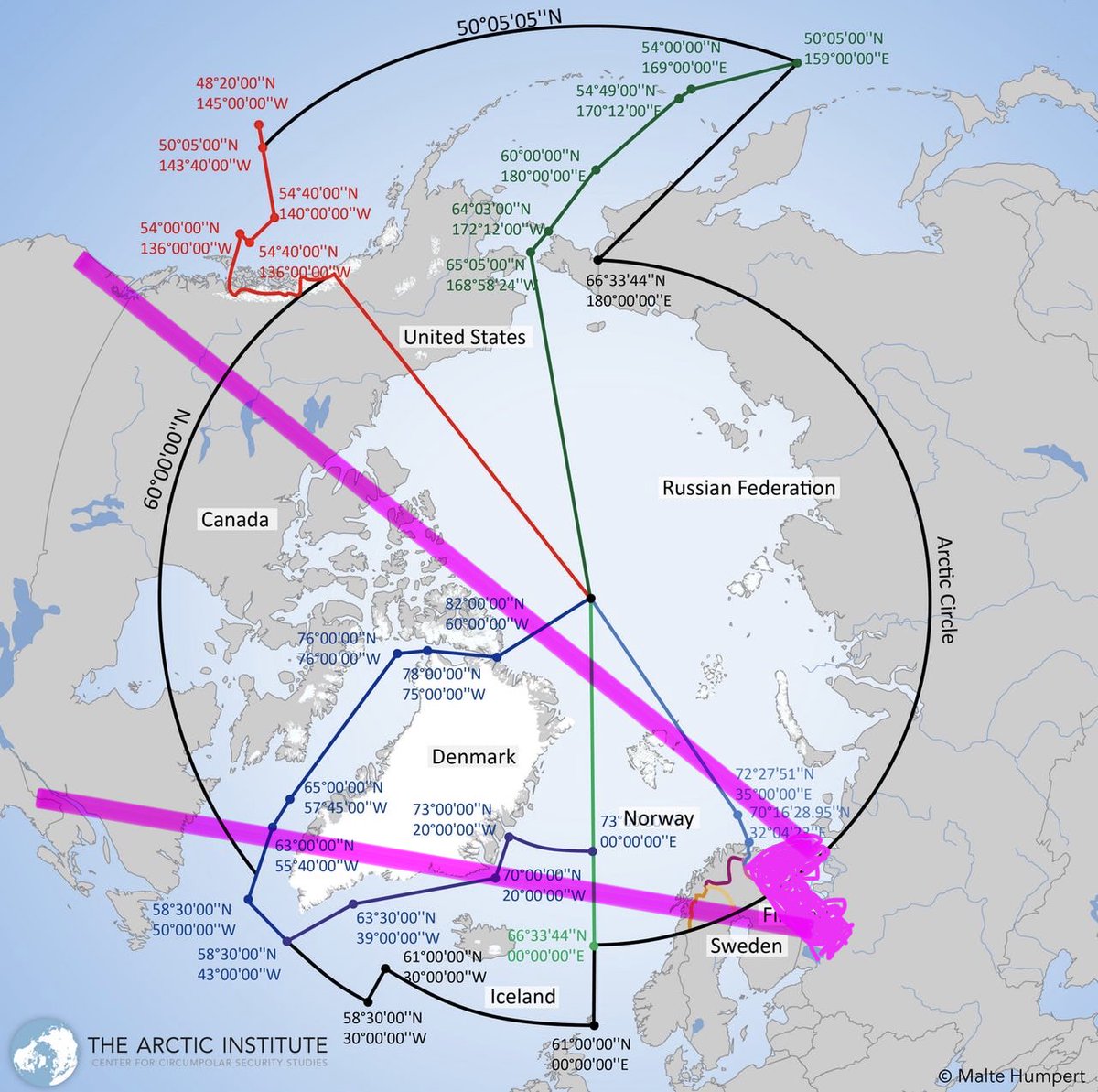
Greenland - As viewed from a proper map
Why Greenland? Well because Moscow bases almost all of their strategic military assets on the Kola Peninsula next to Finland. This is where the Russian ICBM silos, submarine bases, and their strategic bombers are.
If you look at the flight path (ballistic or powered) from Kola to anywhere on the lower 48, then everything goes over Greenland.
Greenland is the theatre where any strategic exchange between Washington and Moscow is contested.
If you want to intercept a ballistic missile, the best point to do so is at the apogee, at the top of the flight path. The shortest route for an interceptor to get to an apogee is from directly below the apogee.
That’s where Greenland is.
So, without stating what should happen here, this is **why** the Trump administration says they **need** Greenland for national security.
The other thing that is happening is that the Northern Passage through the Arctic is opening up, and soon there will be Chinese cargo ships sailing through the Arctic to Rotterdam. It’s faster than the Suez and the ships aren’t limited to Suezmax size so China and EU trade is going to accelerate a lot.
This means Chinese submarines will also be venturing under the Arctic into the Northern Atlantic, IF THEY AREN’T ALREADY DOING SO.
Hence, the North East coast of Greenland serves not 1 but 2 critical strategic security objectives of US national security.
If this wasn’t clear to you, please understand that the Mercator global map projection is for children and journalists only. It is not a useful guide to where any countries or territories actually are in the real world that we live in.
No self respecting adult should be using Mercator for their worldview. Anyone saying “there must be some other secret reason for Trump being interested in Greenland” is a certified ignoramus.
It’s striking how armchair experts rush to conclusions after looking at only a tiny slice of the data. A bit more context would significantly improve their “analysis.”
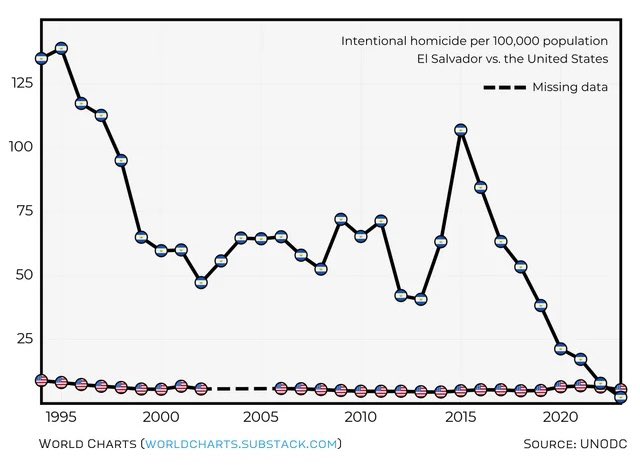
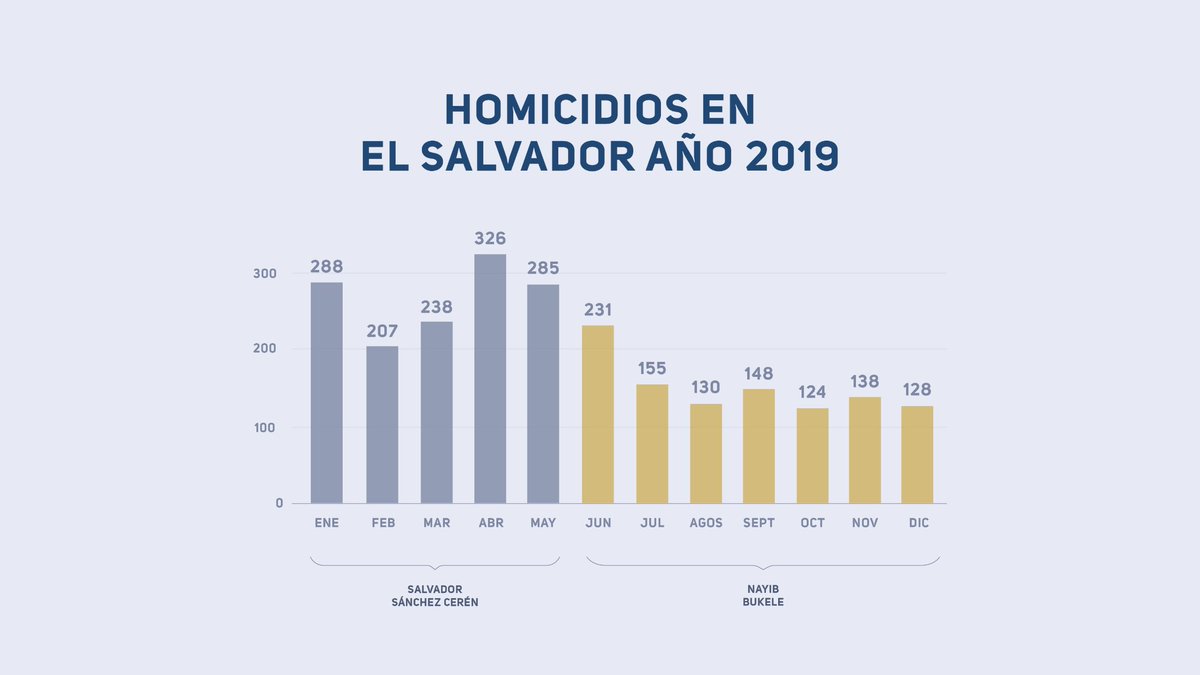
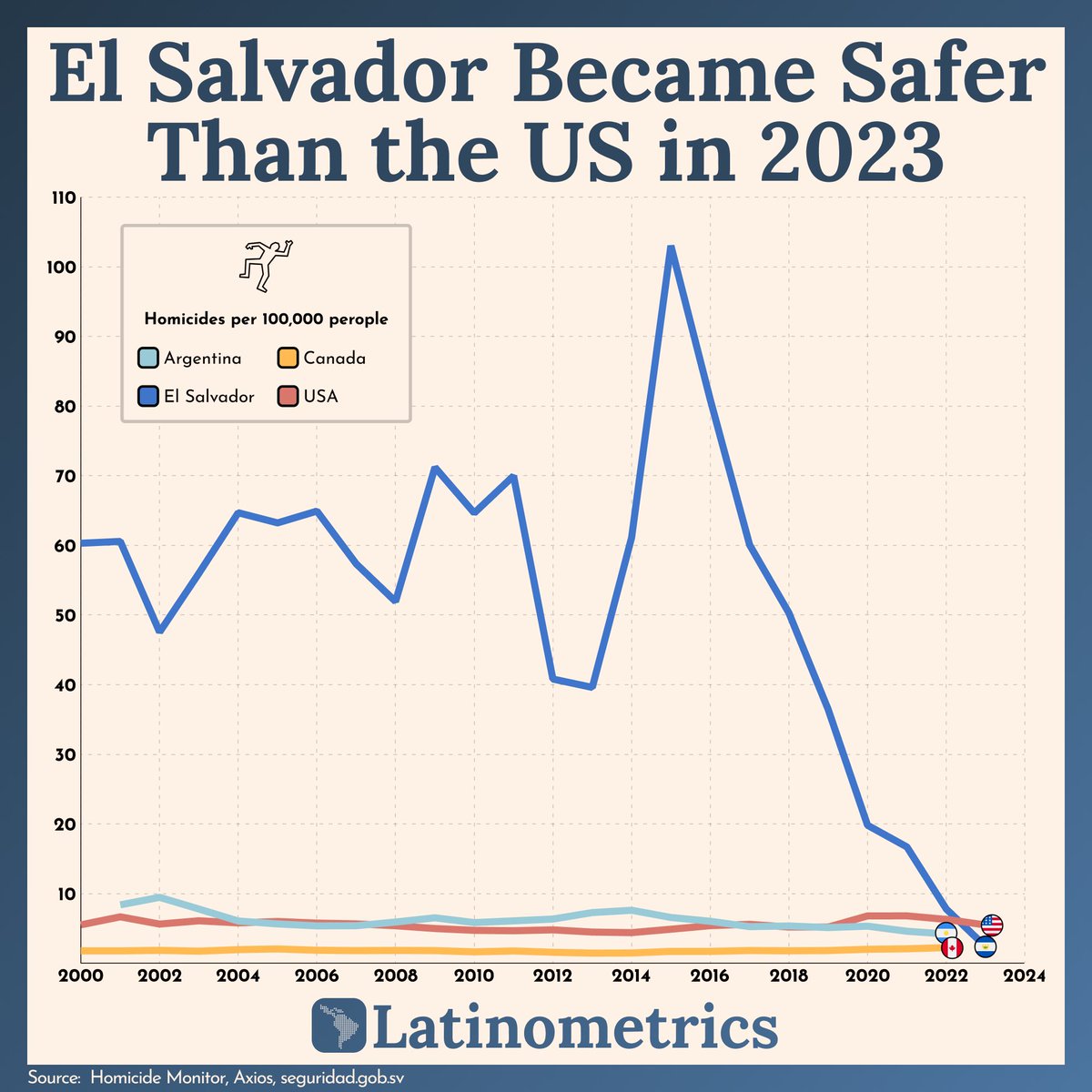
El Salvador has historically had an extraordinarily high murder rate. This began during the civil war in the 1980s and never truly ended afterward, with extreme spikes in the mid 1990s and again in 2015–2016. However, the mean, and even the least violent years, remained consistently comparable to that of an active war zone (graph 1).
The last year that was unaffected by our government’s anti-gang crackdown was 2018. In 2019, our administration took office, and the Territorial Control Plan was launched on June 20, 2019. That is why a sharp and sustained decline in murders becomes visible starting in July 2019 (graph 2).
The murder rate continued to fall throughout 2020 and 2021 (graph 3). However, it was not until the full-scale offensive against the gangs and the State of Exception in 2022 that crime dropped to levels consistent with a safe country (graph 3).
By 2023, El Salvador had become safer than the United States (graph 3), and by 2024, safer than Canada. In 2025, the murder rate fell by an additional 30%, now lower than many European countries.
Importantly, not only is the murder rate now extremely low, but its composition has also changed. Approximately 90% of cases now stem from domestic violence or fights between friends involving alcohol. These are the most difficult types of crimes to prevent (you cannot place a police officer in every home).
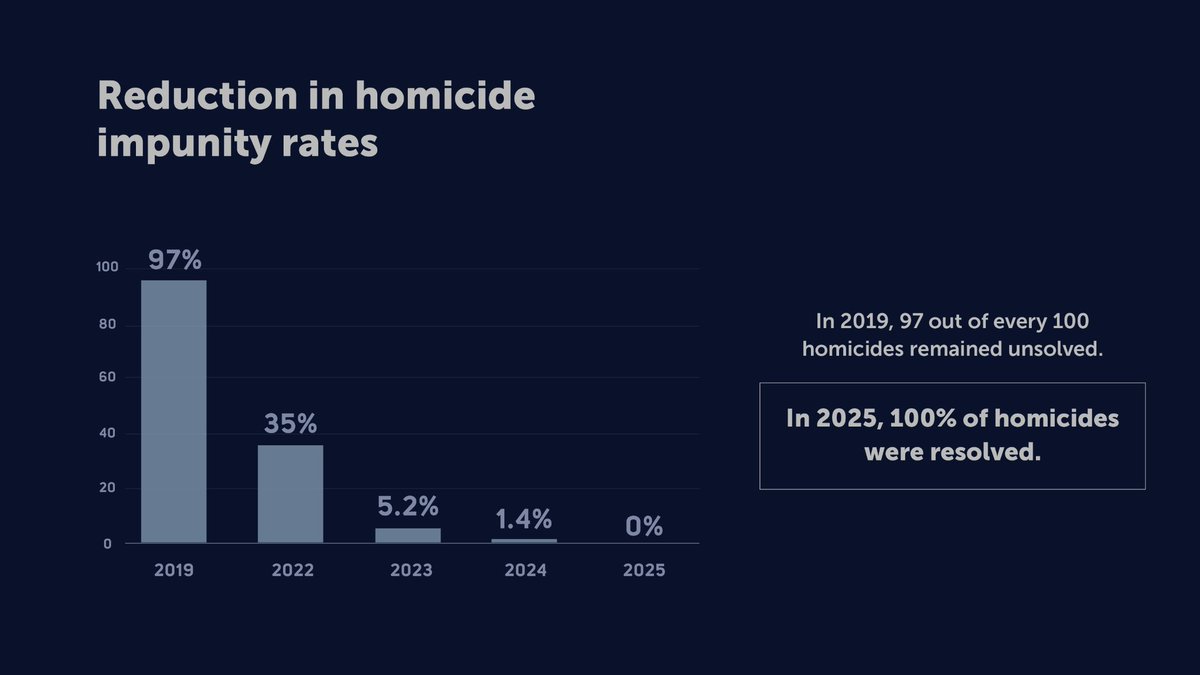
And even then, the country now achieves a total resolution and conviction rate (graph 4), which will drive the numbers even lower.
This is why there are no longer unsafe areas anywhere in the country. It is also why crimes like extortion, which once affected roughly 80% of Salvadorans, have nearly disappeared. The few remaining cases are largely limited to scams or the possession of intimate information or images.
In other words, we went from the Murder Capital of the World to the safest country in the Western Hemisphere, and we are on our way to becoming the safest country in the world.




![kevinnbass's tweet photo. THE DONALD TRUMP FILES
What about Donald Trump? Isn't he in the Epstein files?
Well, we have now read 1.39 million DOJ documents in the Epstein case. Every one. We have built investigation dossiers on eight people: Bill Gates (2,265 documents), Woody Allen (2,613), Reid Hoffman (1,976), Bill Clinton (1,586), Larry Summers (739), Leon Black (667), Elon Musk (55), and Donald Trump.
For Donald Trump, across the entire corpus, we found 40 documents.
Not 40 damning documents. 40 documents total -- every sworn deposition, every FBI interview, every civil complaint, every flight log entry, every media reference of any kind linking Trump to Epstein in the largest document production in DOJ history.
As with Elon, the number is the story. And as with Elon, the documents themselves tell that story even better.
Every quote below is verbatim. Every citation is a DOJ document number you can verify. Click the links. This post comes from those links. There are just 40. You can read them yourself.
THE FRIENDSHIP
It must be made clear:
Trump and Epstein were friends. This must be stated plainly, because everything that follows only makes sense if you understand that.
They were Palm Beach neighbors in the 1990s. Both owned waterfront estates. Both moved in the same Manhattan social circles -- the dinner-party circuit that included Mort Zuckerman, Leon Black, Ronald Perelman, and a dozen other New York billionaires. In March 2003, Vanity Fair profiled Epstein as "The Talented Mr. Epstein" and named Trump as one of seven businessmen who dined at his 71st Street townhouse [187-11]. Juan Alessi, Epstein's house manager, named Trump among many prominent visitors to the Palm Beach property [055-12]. A 1993 photograph shows Trump and Marla Maples with Epstein and Maxwell at a New York party [EFTA00787056].
This was before Epstein's convictions.
In 2002, reached by phone for a New York Magazine profile, Trump gave the currently most weaponized quote in the entire archive:
"I've known Jeff for fifteen years. Terrific guy. He's a lot of fun to be with. It is even said that he likes beautiful women as much as I do, and many of them are on the younger side. No doubt about it -- Jeffrey enjoys his social life." [EFTA00013640]
That quote has been cited thousands of times. It was given on speakerphone, before any public allegations, before any investigation, before any reason to be cautious. "It is even said that" is hearsay framing -- Trump reporting what others say. "On the younger side" is ambiguous. But the quote exists, and it reflects a social warmth that post-Epstein scandal Trump would prefer to erase.
In 2003, Ghislaine Maxwell assembled a leather-bound album for Epstein's 50th birthday. Trump's contribution: a card with "several lines of typewritten text framed by the outline of a naked woman, which appears to be hand-drawn with a heavy marker," signed below the waist [senate_judiciary_to_bondi].
These are the facts, and the facts must be stated openly.
The friendship was real. But what happened next matters more.
THE FALLING OUT
Around 2004, that friendship ended.
Trump outbid Epstein at auction for the Maison de L'Amitie estate in Palm Beach. In Michael Wolff's 2017 recordings, Epstein himself confirmed the real estate dispute as the breaking point [wolff_tapes_transcript_exhibit].
But the real estate dispute was simply the excuse that Epstein made for something darker. Brad Edwards, the attorney who represented Epstein's victims, established under oath that Trump banned Epstein from Mar-a-Lago after Epstein sexually assaulted an underage girl at the club [773-04].
There is no documented contact between Trump and Epstein after the falling out in 2004. Not one email. Not one phone call. Not one schedule entry. Not one reference of any kind in 1.39 million documents.
After 2004, the relationship was over. Trump had drawn a hard line.
THE GIRL IN THE SPA
Virginia Roberts was sixteen years old, earning nine dollars an hour as a locker room attendant at Mar-a-Lago [1218-11]. In her memoir, she described the club in awestruck terms -- "sheer awe at the gold arches."
Ghislaine Maxwell approached her while she was reading a book about massage [EFTA01689026].
"I was working at Donald Trump's spa in Mar-a-Lago and I was prompted by Ghislaine to come to Jeffrey's mansion in Palm Beach that afternoon after work." [1090-16]
Roberts names many powerful men in her testimony. Clinton. Prince Andrew. Dershowitz. Wexner. She does not name Trump. He was the property owner. But Maxwell did the recruiting.
An FBI interview of a different victim's mother captures how this worked: she "heard that a prince and DONALD TRUMP visited EPSTEIN's house and this made [her] think that if they are there then how could EPSTEIN be a criminal" [EFTA00089603].
That is what Epstein did with famous names. He wore used them as bait. As camouflage. If Epstein was associated with so-and-so, then how could he be a predator? Trump, unlike others, immediately put a stop to that.
THE ACCUSATIONS
Three allegations against Trump exist in the corpus.
A Jane Doe civil lawsuit against Epstein's estate alleges that Epstein introduced her to Trump when she was fourteen, "allegedly elbowing Trump and saying, 'This is a good one, right?' Trump smiled and nodded in agreement" [1078-5].
At the Maxwell trial, a victim testified under oath that Epstein introduced her to Trump and took her to Mar-a-Lago when she was fourteen [120-cr-00330/745]. That testimony confirmed the social introduction. It contained no allegation of misconduct by Trump. Defense counsel used Trump's name to establish Epstein's social reach, not to implicate Trump.
In 2016, during the presidential campaign, a civil complaint alleged the rape of a thirteen-year-old at Epstein's 71st Street house in the summer of 1994 -- Katie Johnson v. Trump & Epstein [EFTA01386393]. It was filed pro se, dismissed for improper filing, refiled with an attorney, and dropped before trial. It was never proven, never tested under cross-examination, never corroborated by any other witness in the criminal investigation.
In August 2017, Epstein told Michael Wolff on tape: "I was Donald's closest friend for 10 years" [wolff_tapes_transcript_exhibit]. He claimed Trump liked to "f--- the wives of his best friends" and that Melania first slept with Trump on Epstein's plane. These recordings were released days before the 2024 election. They are unsworn claims by a convicted pedophile and serial liar to an author -- a man who told the same journalist his week included "woody allen, elon musk, frank gehri... bill gates" [EFTA02561193].
And that pedophile and liar had an axe to grind. A big one.
Those are the allegations. What follows is what happened when they were investigated.
THE INVESTIGATION
The FBI investigated Donald Trump in connection with the Epstein case.
The master case index lists him as a "positive case hit" with "salacious information": "Donald Trump (one identified victim claimed abuse by Trump but ultimately refused to cooperate)" [EFTA00161528]. One allegation. One victim who refused to cooperate. No prosecution.
The FBI's National Threat Operations Center received four separate complaints naming Trump [EFTA01660679]. A hearsay oral sex claim via a friend-of-friend chain. An anonymous party guest list. A claim about "big orgy parties" from a sixteen-year-old model. A Trump Golf Course allegation "deemed not credible." All anonymous. None corroborated.
The Senate Judiciary Committee -- bipartisan, Grassley and Durbin -- reported that FBI personnel were specifically instructed to "flag" any records in which President Trump was mentioned across all 1.39 million documents. The result: no incriminating "client list." No evidence of criminal conduct [senate_judiciary_to_bondi].
The Southern District of New York, which prosecuted the Epstein case, had Trump's phone records in their evidence. Their grand jury presentation includes a message slip showing Trump called Epstein on November 1, 2000 -- a routine call, no message content [EFTA00008599]. The same presentation, same pages, includes message slips reading "She has females for Mr. J.E." Prosecutors had Trump's innocuous call alongside explicit trafficking procurement. They found nothing to charge.
Attorney General William Barr, under oath before the House Oversight Committee:
"I was never informed of the evidence, and I'm skeptical there is any... if they had evidence, this would've been low-hanging fruit." [oversight_republican_staff_memo]
THE ATTORNEY WHO WOULD KNOW
Brad Edwards represented Epstein's victims for years. He investigated every lead. He subpoenaed records, deposed witnesses, and built the case that led to federal prosecution. He was the attorney most motivated to find evidence against anyone connected to Epstein.
In April 2010, Edwards filed a sworn affidavit:
"While research by other plaintiffs' attorneys and myself has uncovered other persons that were acquaintances of Mr. Epstein, specifically Donald Trump, Alan Dershowitz, Bill Clinton, Tommy Mottola, and David Copperfield, we have no information that any of those people (other than Mr. Dershowitz) have spoken to Mr. Epstein about Jane Doe or any of the other specific victims of Mr. Epstein's molestation." [560-03]
Edwards' attorney Jack Scarola: "There is no evidence the President was involved in Epstein's schemes" [773-04].
Edwards filed a notice to depose Trump in September 2009 [701]. As a witness. Not as a suspect. He sought Trump's testimony to help the victim's case.
And there is this: when Edwards was investigating Epstein, reaching out to the powerful men in Epstein's orbit for cooperation, Trump was the only person who picked up the phone and returned his call [50-2009-CA-040800/549].
The attorney who spent years investigating on behalf of Epstein's victims -- who had every reason to find evidence, every incentive to implicate the powerful -- swore under oath that his investigation found nothing linking Trump to the abuse.
When he called, Trump answered. Readily. Trump knew what Epstein was and wanted to talk about it.
WHAT THE DOCUMENTS DON'T SHOW
Pilot David Rodgers flew Epstein's planes for twenty-eight years. He sat for a seventeen-page FBI interview and reviewed his flight logs covering 1991 through 2007 [EFTA00159180]. Trump appears once: Flight 934, January 5, 1997. Passengers: Epstein, Maxwell, Donald Trump, Mark Epstein, and Didier, a chef. Route: Palm Beach to Newark.
No flight in the corpus shows Trump traveling to Little Saint James, to Zorro Ranch, or to any international destination on Epstein's aircraft.
Epstein's famous ninety-two-page personal contact book does not contain a "Donald Trump" entry [black-book-redacted]. It lists Robert and Blaine Trump, Ivana Trump, Ivanka Trump, and Trump Management Inc. -- the socialite channel, not Donald.
There are zero financial transactions between Trump and Epstein in any direction. No donations. No investments. No advisory fees. No foundation grants.
Even Epstein's own defense lawyers, in a motion to pare down a 169-person witness list, argued that Trump had "no connection at all" to the case [1338]. And Epstein himself, in a draft letter, grouped Trump among "friends and other innocent bystanders" whose names had been dragged in by "abusive discovery" [EFTA01128737].
THE COMPARISON
The Epstein documents reveal concentric circles of association. At the center: people who were financially entangled, who visited the island repeatedly, who maintained the relationship through and after Epstein's conviction.
Trump was not in any of these circles.
Woody Allen: 2,613 documents. Nine years of regular contact. Dinner companion. Epstein attended his film shoots.
Bill Gates: 2,265 documents. Multiple confirmed meetings. Donations routed through Epstein. Boris Nikolic named in Epstein's will.
Reid Hoffman: 1,976 documents. 36 documented gift exchanges. Slept at Epstein's 71st Street mansion.
Bill Clinton: 1,586 documents. 147 sexually explicit messages with Maxwell. Multiple confirmed island visits. Flights on Epstein's plane confirmed by his pilot ("ten or twenty times"). Active participation in the post-arrest denial campaign.
Larry Summers: 739 documents. Regular dinner companion. Island visits with family. Harvard Program for Evolutionary Dynamics funded through Epstein.
Leon Black: 667 documents. $158 million paid to Epstein across a decades-long financial relationship.
Elon Musk: 55 documents. Zero financial transactions. Twenty-two months of sporadic, taciturn emails with Epstein chasing Musk, but leaving Epstein little to grab onto.
Donald Trump: 40 documents. Zero financial transactions. Zero island visits. One commuter flight. A friendship that ended in 2004, eleven years before the first federal prosecution, after Trump drew the line and Epstein was banned from Mar-a-Lago for his behavior. The only person in Epstein's orbit who returned the victim's attorney's call.
Trump's entire file is 1.8% the size of Gates's.
WHAT REMAINS
These documents show a man who was part of an early social world he did not yet completely understand, who called a predator "terrific" before anyone knew what that predator was, who sent a crude birthday card before there was any reason not to, whose property was used as a hunting ground without his knowledge or permission -- and who, when the investigation came, banned the predator from his club, picked up the phone for the victim's attorney, and was cleared by every investigative body that looked.
40 documents. Every quote verbatim. Every citation verifiable.
Full compendium (40 docs): https://t.co/Wd7ecwZdfs
AI-optimized compendium (upload to any LLM and ask it anything): https://t.co/UmlvDJrE7T](https://pbs.twimg.com/media/HCsvZH2bAAAHiFq.jpg)