I am having a drink this evening with a friend in a Chiswick pub. Two policemen have just come into the pub and asked me to step outside. I have stepped outside and they have threatened me because I tweeted about a councillor banning seating outside pubs in Chiswick. They admit on video (watch it!) that I did not break the law at all. They came to threaten me. To warn me off tweeting about councillors and the council. This is modern Britain. This is the police state. Please, please, please watch this video. It does involve me using very bad language, but this has got to be seen. Police coming out to threaten someone who hasn’t committed a crime. I’m fuming.
J'en peux plus des mecs de plus de 20 ans qui croient encore au Père Noël.
Alors je vais t'expliquer, comme à un gosse, à quel point c'est attardé de croire au socialisme.
T'es dans une classe de 30 élèves. Un élève bosse comme un fou et a 18 de moyenne. Un autre fait rien et a 4. Le prof décide que c'est injuste et donne à tout le monde la moyenne de la classe : 11.
Celui qui avait 18 arrête de bosser. Pourquoi se fatiguer si ça change rien ? Celui qui avait 4 continue de rien faire. Pourquoi bosser si on te donne 11 gratuitement ?
L'année suivante la moyenne de la classe est à 7. Puis 5. Puis 3.
Le prof ne comprend pas. Il pense que le problème c'est que les élèves ne sont pas assez solidaires. Alors il met en place des punitions pour ceux qui ne font pas assez d'efforts. Il surveille tout le monde. Il décide qui étudie quoi. Il interdit de changer de classe.
C'est exactement ce qui s'est passé. À chaque fois. Dans chaque pays. Sans exception.
URSS, Chine, Cuba, Venezuela, Corée du Nord, Cambodge, Éthiopie, Allemagne de l'Est. 40 tentatives. Même résultat. À chaque fois.
Le socialisme punit ceux qui produisent et récompense ceux qui ne produisent pas. Tout le monde finit par ne plus produire. Et quand plus personne ne produit, le gouvernement utilise la force pour obliger les gens à travailler.
C'est pas un accident. C'est le design.
Le Père Noël, au moins, t'arrêtes d'y croire vers 8 ans.
Labour risks being forced to seek emergency help from the International Monetary Fund (IMF) as Britain lurches toward a debt crisis, leading economists are now warning.
Former IMF chief economist Ken Rogoff says, in a new interview, that there is “more than 50:50 chance” of a major UK debt crisis before the end of this decade.
He is joined by Sir Charlie Bean, a former senior official at both the Bank of England and the Office for Budget Responsibility, who says the need for an IMF bail-out is now a “material risk” for the British economy.
I not only firmly agree with Ken Rogoff and Sir Charlie Bean – but have been repeatedly issuing the very same warnings for a very long time.
Because the grave risk of a major fiscal meltdown has been apparent for at least the last two years – to anyone who combines serious knowledge of UK economics and politics and global debt markets with an open mind.
The UK's public finances were already fragile when Labour took office back in July 2024.
But this government's misguided, ideologically-driven statist policies have made a bad situation much worse, seriously increasing the danger of a deep fiscal crisis - which would cause a disastrous state funding shortfall and a very nasty inflation spike.
That would result in Downing Street being forced to follow the orders of unelected technocrats flown in from Washington and elsewhere.
It would be a very major national humiliation combined with a deep economic slump and an even more intense cost-of-living crisis – in which low-income households, as ever, would suffer the most.
Yet those of us that have shown the brains and courage to point out these inconvenient truths over recent months and years have long been dismissed and derided for our trouble - not only by ignorant politicians and approval-seeking journalists but also the overwhelming majority of "leading economists".
Ahead of the general election in mid-2024, with Labour on course to win, the conventional wisdom among the great sages of broadsheet journalism and the economics establishment was that "the adults would soon be back in charge" ... Labour would "get lucky with the economy" ... and "Britain would now enjoy an extended period of political and fiscal stability".
I thought that was total nonsense – not least as I was well aware Labour's plans irresponsibly to increase borrowing and spending would be met with deep scepticism by the global pensions funds, insurance companies and other institutional investors that lend governments serious money.
My weekly @Telegraph "Economic Agenda" column of 23rd June 2024, a fortnight ahead of the general election, was a total outlier. I recounted the disaster of 1976 – when Britain was forced to go "cap in hand" to the IMF for a bailout – and warned that "The Ghosts of the 1970s" would haunt Labour's (so-called) economic resurrection".
Six months later, after the October 2024 "Hallowen" budget in which Chancellor Rachel Reeves did indeed sharply hike borrowing and spending, I assessed the market reaction then doubled-down – warning more assertively in my column of 12th January 2025 that "The UK risks a return to 1976 unless Reeves changes course".
And then again on 20th July 2025, as Labour's policies raised the costs of doing business, translating into price pressures which pushed up government borrowing costs even more, I again cautioned that "Inflation risks are taking Britain to the debt-crisis cliff edge".
"It’s now screamingly obvious that Labour’s crude Keynesianism – “pump priming” the economy by upping state borrowing and spending – isn’t working," I wrote in that column last July.
"Worse than that, this Government’s actions are pushing Britain towards a budgetary crisis every bit as serious as that in 1976 – when the UK was forced to go “cap in hand” to the IMF for a bail-out".
It's been a lonely task issuing these warnings. I've been hounded in public debates, slagged off by senior civil servants and often dismissed by "leading economists" as "alarmist".
So what do these same "leading economists" now say to Rogoff (Harvard Professor, Former IMF Chief Economist) and Bean (LSE Professor and Former Deputy Governor of the Bank of England)?
The "economics establishment" – with very few honourable exceptions, the brilliant @jagjit_chadha among them – has been and remains extremely reluctant to point out the deeply unsustainable nature of this government's addiction to ever more borrowing.
The systemic fiscal dangers of evermore "tax and spend" – and the prospect of a serious spike in gilt yields and related fiscal meltdown – are now so real and present as to be completely undeniable.
Yet the UK government is about to shift even further to the left, pushing up borrowing and spending even more under a new leader, in a bid to appease the massed ranks of economic illiterates among Labour's Parliamentary party and activist base – making those dangers even more acute.
Yet, still, the silence among "public intellectual" economists is deafening.
I'm glad the likes of Ken Rogoff and Charlie Bean are now issuing clear warnings. So where is the rest of the "economics establishment" - those who purport to understand fiscal management and financial markets, and often funded by taxpayers' money?
Britain is now clearly in the crosshairs of a very serious danger. The government's creditors are increasingly fickle and based overseas – with no regulatory or cultural obligations to lend money to the UK government.
Those holding UK gilts are increasingly "speculative" rather than "strategic" long-term investors – looking for quick returns, financing their government bond purchases with "leverage" (money borrowed from elsewhere), which will quickly be withdrawn when senitment decisively shifts, causing a plunge in gilt prices and a sharp additional surge in government borrowing costs, setting up a vicious circle.
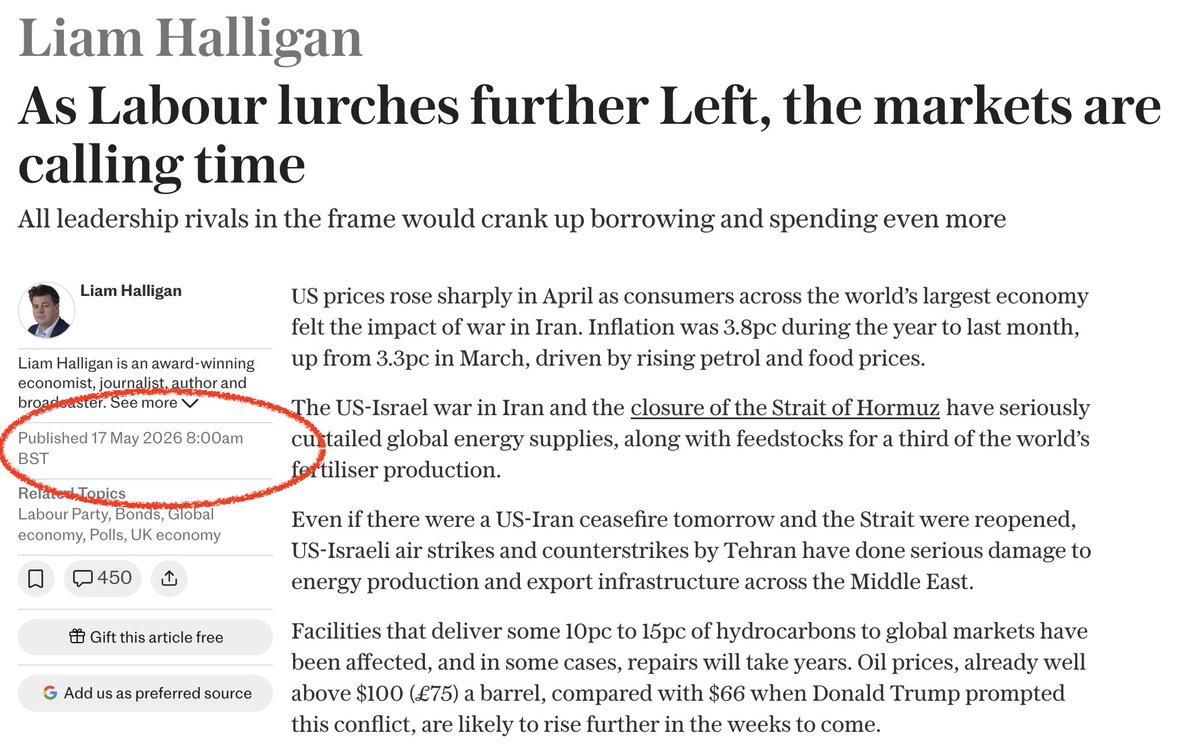
The UK government is very heavily indebted – and the global investors we rely on to bankroll a huge slice of our state spending are alarmed that of the £132bn the government borrowed last year, no less than £110bn was spent on debt interest – as I wrote in a column on 17th May 2026, "As Labour lurches further left, the markets are calling time".
Global investors are alarmed the UK has consistently had the highest inflation in the G7 (which pushes up borrowing costs) and has easily the highest share of index-linked debt (which magnifies the burden of inflation on the state's balance sheet).
And they are deeply, deeply alarmed that when Labour came to power in mid-2024, the Office for Budget Responsibility was forecasting additional state borrowing of £323bn by 2029, the scheduled end of this Parliament.
But Labour’s runaway spending and growth-crushing tax rises mean that the same five-year borrowing forecast is now £583bn – 80pc higher. And still, the trade unions, MPs and Labour activists who will choose Starmer’s successor now want even more.
It is not too late to pull the UK back from the fiscal brink, to avoid the extremely painful and deep, lingering damage of being forced to go to the IMF and perhaps other multi-lateral creditors for a bailout.
It is not too late to avoid the inflation surge, the currency crash, the shocking blow to consumer and business confidence alongside the sky-high interest rates that will seriously whack our economy – or the perhaps even deeper damage of yet more of the British electorate losing faith in the ability of our establishment to manage the country in a manner that avoids imposing serious hardship on so many hard-working people simply trying to make their way.
But our political and media class needs to start acknowledging the economic and financial truth – that the UK government is borrowing and spending too much, taxation is now so high that it's hammering growth and employment, and that trying to finally get the economy moving by "moving further left", borrowing and spending even more, will result in a fiscal collapse.
Smart, experienced, high-profile economists need to start speaking out – as Rogoff and Bean just have – raising the alarm in a bid to force the broader establishment to face reality. Before it's too late.
If you've read this far, you clearly think this analysis is worthwhile and important. So please like and share.
And for more, read my "Economic Agenda" column in The Sunday Telegraph each week – and subscribe to "When The Facts Change: Economics and Politics in a fast-moving world, with Liam Halligan"
THE DOSSIER #3: Torsten Bell MP – The Parachute Hypocrite
Torsten Bell,
September 1982. PPE from Oxford. Fabian Society speaker. Child Poverty Action Group trustee. Academy of Social Sciences Fellow. The network wrote your script before you learned to speak.
Your mother wrote policy papers about families. Your father taught at Swansea University then worked for Save the Children. Your twin brother is a civil servant. The Bell family has never had a real job. Never met a payroll. Never created wealth. Only consumed it. Only managed it. Only lectured those who make it.
You spent nine years at the Resolution Foundation writing about poverty. Nine years building your brand as the man who cared about the poor. Then you entered Parliament and immediately voted to keep the two-child benefit cap. You discovered principles are expensive when you are collecting a ministerial salary.
You claim "I'm no career politician" on your website. The lie is clinical. Treasury civil servant. Special Adviser to Darling during the crash you helped create. Policy Director for Miliband. Chief Executive of a think tank. Then MP. Then minister in six months. You have never had a job outside the Westminster bubble. You are the bubble.
You parachuted into Swansea West with no Welsh blood, no local roots, no connection to the place you now represent. The constituency was a convenience. A seat to be occupied. A stepping stone to your rapid promotion. The locals called you a carpetbagger. The national party crushed their democracy and imposed you anyway.
Six months to minister. The fastest rise in the new intake. Not because you are talented. Because you are obedient. Because you spent nine years at a think tank learning how to serve power while writing about challenging it. Because Starmer needed a reliable PPE graduate to vote as instructed.
You wrote a book called Great Britain? How We Get Our Future Back. You are the future. Another chinless wonder from the Oxford policy factory who discovered that thinking about poverty pays better than solving it. Another insider playing outsider because it tests well in focus groups.
Swansea West deserves better than a tourist. Britain deserves better than a professional opinion-haver who votes to keep children poor while collecting two salaries.
Your seat is safe. Permanent exile awaits. Congratulations. You are The Dossier. Your betrayal of Britain is now complete.
This past week, on a test bed in Britain, a Rolls-Royce jet engine ran at full take-off power on pure hydrogen, putting out water vapour instead of carbon.
Nobody on Earth had managed it before. It is the sort of thing that ought to stop the country in its tracks, and it will be forgotten by the weekend.
Leave aside the recent paroxysms of renewed net-zero insanity from Derelict Ed and the pervasive atmosphere of offended envy that greets much homegrown achievement nowadays in Britain. This engineering is a wonder, and it's British to the bone.
We gave the world the jet engine in the first place - Frank Whittle, a Coventry man and an RAF officer, patented it in 1930 while the Air Ministry assured him it was a curiosity. Rolls-Royce is today one of perhaps three firms anywhere that can build a large aero engine at the outer edge of the possible, and it has just done what most of the industry swore was twenty years away.
As usual, you marvel at how little the people who govern us had to do with it. The engineers in Derby are world-class; the stewardship above them is third-rate. They pulled off a global first while paying the most expensive industrial electricity in the developed world to keep the power on over the bench - a weight no German, American or Gulf rival has to carry. We produce frontier brilliance on the shop floor and fritter it away at the despatch box, and we have done for two generations.
That is the maddening shape of modern Britain: brilliance from below, sub- (or, indeed, ultra-) mediocrity from above. The people here who actually make things are still among the best in the world; the state that is meant to back them treats a firm like Rolls-Royce as a photocall today and a takeover target tomorrow, and prices its energy as though it would prefer the next plant were built in Texas.
Progress starts from the other end. Give these people what every rival government gives its champions and we beg ours to do without: the cheap, abundant power their competitors already enjoy, a supply chain built around them, and a state that guards a national asset rather than auctioning it. The hard part of a British revival - the talent, the nerve, the engineering - is already done, and was done again this week, by people who deserve a far better country than the one currently sitting above them.
We just taught an engine to breathe fire and exhale water. The least we owe the men and women who managed it is a government and a state as brilliant as they are.
@AvonandsomerRob I have fitted 16 of these around our house. Apart from some handle clearance problems on two of the blinds they have been brilliant. Am just about to order more. The oldest set we have is about 18 mo old.
Wednesday WM gave a full page to former Labour SM Jenny Rathbone.
Yesterday Drakeford got a couple of pages.
Today Skates gets THREE pages to feel sorry for himself.
FFS!
Here's four words explaining why Labour got hammered: Lying, incompetent, Woke wankers.
For his vomit-inducing persecution of innocent British troops, Hermer should join Starmer in being kicked out of the most unpatriotic government in our island's history
https://t.co/y6kQ3SoSEN
Starmer and Hermer Built the Machine Together. Now They Run the Country.
In 2007, two barristers worked without pay on a case that would change the legal landscape for every British soldier who had served in Iraq. Keir Starmer and Richard Hermer appeared as interveners in Al-Skeini v Secretary of State for Defence, representing eleven human rights organisations including Amnesty International and Liberty. Their argument was that the European Convention on Human Rights should apply to British forces operating overseas. They lost in the Court of Appeal. They appealed to the House of Lords. They lost again. But the legal principle they had argued for eventually prevailed at the European Court of Human Rights, and what followed was the Iraq Historic Allegations Team, sixty million pounds of public money, seven years of investigations, and not a single prosecution. The soldiers it pursued were, in almost every case, found to have acted properly.
Starmer believed in it enough to do it for free. Johnny Mercer, who spent years dismantling the consequences, put it plainly. Starmer had insisted on doing it for free. That is not the behaviour of a barrister following the cab rank rule. That is ideological conviction.
Hermer's conviction, it subsequently emerged, was not without financial reward once the machinery was running. Documents obtained by the Daily Telegraph show that having helped establish the legal architecture pro bono in 2007, Hermer then used that same architecture to pursue Iraqi claims against British soldiers at £450 an hour, fifty percent higher than the only other KC involved in the group action. He set his success fee at the maximum level permitted, one hundred percent of his normal rate. The MoD's own lawyers challenged his fees as excessive and said he was too junior to command that rate. He is thought to have earned around six figures from the broader group action. The claims he was pursuing were eventually ruled to be deliberate lies. The soldiers were fully exonerated.
Sergeant Richie Catterall had been cleared of wrongdoing by the British Army in 2003 for a fatal shooting in Basra. The Army found he had acted in self-defence. The legal precedent Starmer and Hermer established triggered two further investigations spanning thirteen years. A 2016 inquiry again concluded he had acted in self-defence and found a false document had been created to shift blame onto the military. Catterall was finally exonerated. He told the Telegraph he was gutted that Starmer had helped bring the case against him and that the Prime Minister owed him an apology.
Starmer is now Prime Minister. Hermer is now Attorney General, appointed by Starmer personally, elevated to the House of Lords specifically for the role, chosen over Emily Thornberry who had held the shadow brief. The former head of the Army, General Sir Peter Wall, has said Hermer's role in the Al-Sweady claims was tantamount to treason. A former commanding officer of 22 SAS said Hermer must step down. The Bar Standards Board has been asked to investigate. Nigel Farage has reported Hermer to the House of Lords standards commissioner.
The Troubles Bill that is now subjecting Northern Ireland veterans to the same lawfare is not an accident of policy. The process that drove Fred, a special forces veteran, to attempt suicide after his medical records were handed to terrorists' families was not an oversight. The machine that cost sixty million pounds and produced no prosecutions was not a mistake. Starmer and Hermer built it together, one working for free out of conviction, the other later working for maximum fees out of the same conviction, and now both occupy the positions from which they can ensure the machine keeps running.
D is a former Port Talbot steelworker, almost forty years at the Works (and a former Labour man through and through), and offers his thoughts on Stephen Kinnock, Labour in Wales and the local elections next month.
Excellent thread, this. Something I’ve spent a lot of time thinking about…
The British state is run by people who have never been fired, never missed a number, never had a client scream at them, never stayed up until 3am working on a deal, or repricing a book because Tokyo opened badly.
They have never experienced CONSEQUENCE. Ever.
THAT is the single most important fact in British public life.
The pipeline is so uniform and mediocre it scarcely needs describing:
- School
- PPE or adjacent
- Civil Service fast stream or a Think Tank research role
- Spell as local councillor to appear “grounded,”
- Then a safe seat and a red box before 40
At no point has the market ever called them a moron.
At no point has a P&L told them their idea was shit.
The feedback loop that every private sector professional takes for granted simply does not exist in their world.
This matters because policy is NOT an essay. It IS a trade. Every regulation has a cost, every tax has a behavioural response, every intervention has second and third order consequences.
In markets, if you misread convexity you get carried out. In government, you get reshuffled to a different department.
The incentive structure could not be more perfectly designed to retain the incompetent and repel the capable.
Anyone with genuine commercial talent is earning multiples of a ministerial salary by their early thirties. So the applicant pool self selects for people for whom the title is the reward because they could never command that status where performance is measured.
The think tank ecosystem makes it worse.
IPPR, the Resolution Foundation, JRF and the rest function as ideological finishing schools and revolving doors. They produce people fluent in the language of policy who have never implemented anything. They can model a distributional impact assessment in their sleep but could not run a corner shop at profit.
This is NOT intelligence. It is pattern matching within a closed system that never tests its own assumptions because everyone in it shares the same priors.
The civil service compounds it further. The fast stream rewards generalism, rotating you through departments every 18 to 24 months to develop “breadth,” which in practice means you never develop depth.
A Treasury official who helped design a tax policy in 2019 is working on transport by the time it starts distorting behaviour in 2022. Nobody owns the outcome.
The private sector has one thing the state fundamentally lacks: a kill switch.
Bad companies go bust.
Bad traders get sacked.
The state just absorbs failure, reclassifies it as “lessons learned,” and promotes the people responsible.
The compound effect of thirty years of this is a permanent class institutionally incapable of delivering growth or even understanding why the private sector they depend on for revenue keeps shrinking under their stewardship. This is what we have, right now.
You cannot fix this with better people inside the same system. The system selects against competence, insulates against feedback, and rewards survival over performance.
Every parliament is just a fresh rotation of the same profile through the same machine expressing the same surprise when nothing improves.
We need parallel institutions to be built by the guy or gal staying up til 3am repricing the book. The risk taker. The entrepreneur.
Then we gradually phase the existing sclerotic failed structures out.
That’s how we win.
Make Britain Great Again 🇬🇧 💪
Folks Me & Rhodri are going on the piss in Swansea & for a nice Curry; He was Charged with 8 Offences originally found guilty on 5 today on appeal 4 charges were overturned & dismissed so just 1 charge of force was found (dubious) & still SACKED! Policing is absolutely Fucked👇🤷♂️🤬
I sit in Parliament listening to these ministers, and it’s all just so depressing - the vast majority of them have never run a business, and it SHOWS. You would not believe how bad it is.
They think ‘work’ means turning up to an office between 9 and 5, answering a few emails, and going home at the end of the day. Nice lunch break, few coffees away from the desk, probably a smoking break or several. It doesn’t - not for the millions of men and women who actually create the wealth that funds the state.
Running a small business isn’t a job. It’s a way of life. It is life. It’s 24/7/365. It’s relentless. You are the accountant, HR department, compliance officer, cleaner, marketer, and customer service team - all in one. There’s no sick pay, no safety net, and no taxpayer-funded pension waiting for you.
Holiday? Good luck. If you do manage to get away, it’s checking the phone all day, every day. Wife/husband obviously getting pissed off. We’ve all been there...
It’s all on you. Every invoice chased, every tax deadline met, every bit of red tape navigated is on you. And if you make one mistake, one error, one small slip-up, the state comes after you - in a relentlessly efficient manner that is never afforded to us when we ask questions of it.
Most MPs have no idea what that feels like. They just don’t. We’re going to see more of this in the budget I’m sure. More hurt. More pain. More tax. They don’t get it.
They don’t understand that when a small business owner gets hit with another tax, it’s not absorbed by a ‘budget’ - it’s taken straight out of their family’s pocket.
There is no ‘deficit’ in the business world - that’s called going bust.
And they certainly don’t understand what real risk looks like. Politicians can vote through a policy on Monday and forget it by Tuesday - a small business owner lives with the consequences of that policy for years, decades. The MP monthly salary is safe. It always has been. In the public sector before, and in the public sector after - if not that, some charity/NGO funded entirely by the public sector.
GET A REAL JOB.
If MPs actually spent a week running a small firm - paying suppliers, tackling VAT, navigating health and safety law, sorting out HR issues, chasing clients for payment, trying to expand while staying compliant with everything from GDPR to local planning regulations - they’d legislate very differently. I can promise you that.
They’d realise that most of Britain’s problems could be solved by the state doing less, not more.
Cutting tax. Simplifying regulation. Slashing back the HRification of the country. Trusting people who actually produce things to get on with it.
Instead, we have a political class that talks endlessly about ‘growth’ while brutally punishing the only people capable of delivering it - especially going after the family businesses/farms, which is a particularly spiteful policy decision.
Small business owners are people who work harder than almost anyone in Parliament could imagine - and who are treated worse for it.
Britain’s small businesses don’t succeed because of politicians, they survive in spite of them.
@UKLabour Not the UK, but a small deranged part of the UK Labour Party. Go fuck yourselves, and when you think you have fucked yourselves completely, turn around and start again. You are monsters, and come the next general election, your home will be oblivion.
@CeriTho25683386 Hi Ceri. Not sure if this project is ongoing. Just discovered the post today. When I was about six my father took me to the crash site. The ground was quite boggy as I recall. The two engines block were visible, but not much other wreckage … just small scraps of aluminium. Mike