When software was expensive - thin, horizontal, best-of-breed software stacks extracted rents across every business.
Now that software is cheap - value moves to vertically integrated businesses that deliver opinionated end-to-end experiences.
@scott_shannon@awxjack Valid point re: credit card uptake, but on the liquidity point - leaves AR & Treasury teams underwriting new customers, monitoring credit quality of existing ones, and managing a sizeable credit book to all customers paying on terms
@johnarnold What about a torn ACL… that is not healing itself due to lack of blood flow and the body’s inability to reconstruct ligaments… and considerably limits activity
@Snapcrackle Great read. Some important differences but analogous to what needs to exist for B2B in the US. Qq - is the issuing bank still owning the consumer default risk? Are they essentially turning the consumer installment loan into a consumer credit insurance product on their b/s?
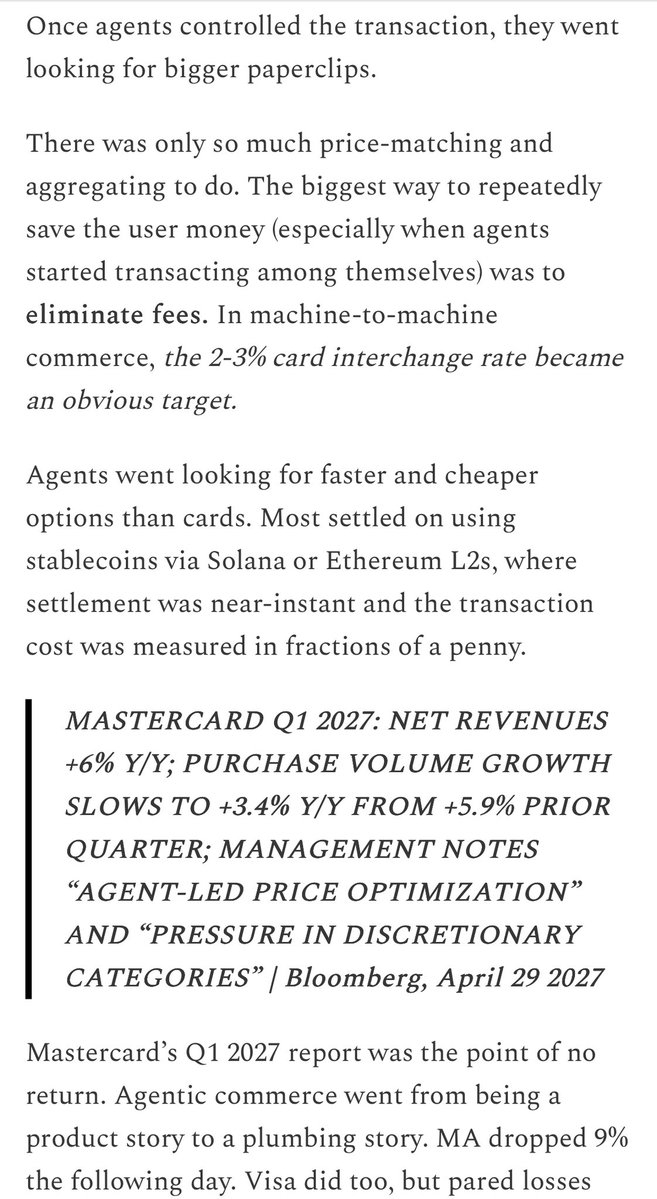
Um, no. Stablecoin networks are settlement networks. Card networks are authorization networks. Would take the opposite position — AI Agents can not transact without card (auth) networks
Something I believe that most people I talk to don’t…
People trust computers more than companies and people.
Trust compounds faster on open protocols than on closed companies, and compounded trust becomes the most valuable asset on the internet.
Most people believe value accrues to:
•apps
•brands
•growth
•distribution
•hype cycles
The secret is that over long time horizons, value accrues to the thing people trust not to change against them.
Open protocols win not because they’re better products today, but because they are more believable tomorrow.
We can trust them. Value accumulates to what we trust.
@oost_marcel@Visa It’s not really a hedge, it’s their tech that existed long before the advent of agentic commerce. Visa’s ability to authorize transactions is what enables Agents to execute c2b transactions in a trusted manner