How would you represent and design new TCR sequences?
Proud to share the latest AI/ML publication from the team, introducing an interpretable variational autoencoder, TCR-VALID, trained on approximately 100 million TCR sequences.
https://t.co/S3O5brpzaM
This morning we are introducing COGE — the Commission on Government Efficiency. This Commission will find ways for our city to work smarter, faster, and more effectively for working people. New Yorkers deserve a city government as careful with their money as they are.
Pretty sure I manifested the Commission on Government Efficiency six months ago 😄.
But seriously, excited to see @NYCMayor and NYC pushing on government efficiency and accountability with COGE.
Hey @ZohranKMamdani , congrats on the win 🎉
How about setting up a DOGE-like effort to eliminate financial waste and make NYC affordable for all of us?
Hey @ZohranKMamdani , congrats on the win 🎉
How about setting up a DOGE-like effort to eliminate financial waste and make NYC affordable for all of us?
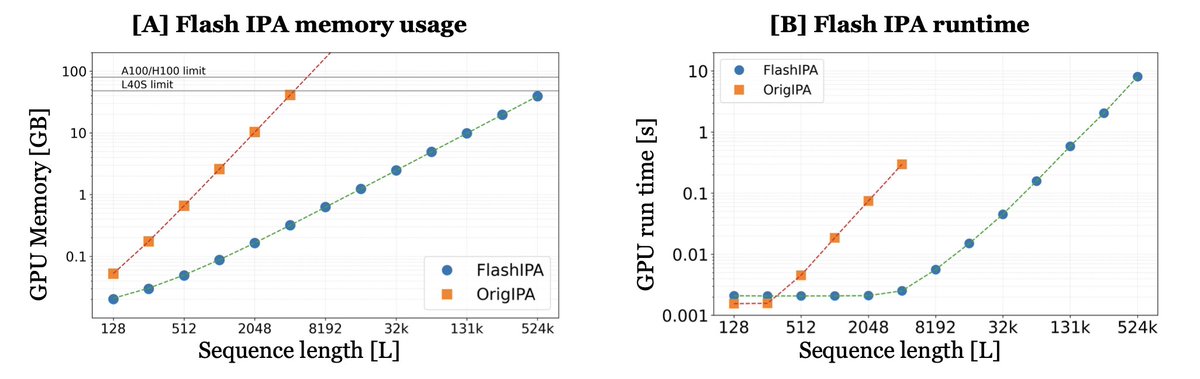
Announcing the release of Flash Invariant Point Attention.
A lightening-fast and memory-efficient attention mechanism, enforcing SE(3)-invariance for molecular structure prediction. Opens the door to modeling large biomolecules previously unattainable due to hardware limits.
Flash Invariant Point Attention
1.FlashIPA introduces a linear-scaling reformulation of Invariant Point Attention (IPA), a core algorithm in protein and RNA structure modeling. It achieves SE(3)-invariant geometry-aware attention with dramatically reduced memory and runtime, enabling training on sequences with thousands of residues.
2.IPA has been widely used in structural biology models like AlphaFold2, ESMFold, and FoldFlow, but its O(L²) scaling in sequence length severely limits training on long biomolecules. FlashIPA overcomes this with a factorized attention mechanism that leverages FlashAttention for efficient GPU usage.
3.FlashIPA maintains the geometric inductive bias of IPA by encoding pairwise spatial information via low-rank factorized representations, avoiding materializing full pairwise tensors. This preserves structural accuracy while dramatically reducing I/O costs.
4.In benchmark tests, FlashIPA matches or outperforms original IPA on validation tasks, while requiring significantly less GPU memory. It reduces memory usage by over 90% at length 512 and enables batch sizes up to 39× larger compared to IPA on the same hardware.
5.Integrating FlashIPA into models like FoldFlow and RNA-FrameFlow showed faster convergence, better scaling, and extended generation capacity. For proteins, sc-RMSD scores improved when trained with FlashIPA, especially when trained on full-length data without truncation.
6.For RNA generation, FlashIPA enabled training and inference on sequences over 4000 nucleotides—impossible with standard IPA. Models trained on a single GPU with FlashIPA performed comparably to IPA trained on 4 GPUs, demonstrating cost efficiency.
7.FlashIPA runs up to 30× faster than IPA for long RNA sequences and scales linearly in both memory and runtime. This opens the door to modeling large protein complexes or long RNAs previously out of reach due to hardware limitations.
8.Despite using approximate factorized representations, FlashIPA retains SE(3) invariance and maintains modeling fidelity. Loss curves and self-consistency scores validate its effectiveness in both protein and RNA generative tasks.
9.FlashIPA is designed for easy drop-in replacement, with an interface similar to existing IPA modules. It is compatible with standard biomolecular modeling pipelines and paves the way for efficient, scalable geometric deep learning.
10.Future improvements may include extending FlashIPA to support arbitrary head dimensions and exploring fully linear attention mechanisms. This would push biomolecular modeling even further toward large-scale and real-time applications.
💻Code: https://t.co/Gkc46XEXLE
📜Paper: https://t.co/mpQzfgwlUs
#GeometricDeepLearning #ProteinFolding #RNA3D #FlashAttention #InvariantPointAttention #AlphaFold #ComputationalBiology #FlashIPA
⭐5 Takeaways from Flagship’s AI x Discovery Summit⭐
At Flagship’s AI Summit, visionaries, industry leaders, and academics converged to discuss how AI is reshaping healthcare, sustainability and beyond. Many speakers shared tangible examples where AI is creating measurable value, faster than expected. Here are five takeaways from the day.
1. AI isn’t artificial — it’s alien. Alien as in “other,” not outer space.👽
The intelligence born from machines is fundamentally different from both human cognition and nature. By merging these three distinct forms of intelligence, a new form of intelligence is emerging called polyintelligence: a synergy poised to resolve today’s mounting uncertainty and tackle complex challenges.
2. Mundane AI is delivering tangible wins.🏆
From automating documentation to streamlining basic workflows, some of the quietest applications of AI are having the fastest real-world impact. These “mundane” uses are already showing evidence of lowering administrative burdens and relieving employee burnout for companies that have adopted them.
3. AI is changing how we work — and think.🧠
From AI copilots that assist decision-making to autonomous agents that collaborate, AI is reshaping teams and workflows. But its impact goes deeper: even when AI isn’t the answer, asking how it might help can spark new ways of thinking. To integrate AI successfully, organizations must encourage adoption and build trust — so people feel empowered, not replaced.
4. Discovery in science is accelerating.🔬
AI can model complex systems governed by known scientific laws and mathematical equations from physics, chemistry, and even biology with increasing speed and accuracy. In areas like drug discovery and materials science, this means AI is setting a new pace for progress.
5. Technological innovation isn’t enough.👾
Public investment, cross-sector collaboration, and robust pipelines of skilled talent ensure AI’s impact is broad and beneficial. As AI systems grow more powerful, diverse perspectives and coordinated efforts become even more critical.
We were honored to be joined by some of our brightest minds, challenging us to prepare for the kinds of unanticipated leaps only AI can make — “moves” even these top human experts wouldn’t think to try. As AI continues to evolve, we are excited to see how it will reenvision existing technologies, uncover novel solutions, and redefine the impossible.
“The Billion Cells Project will help clarify our understanding of the fundamental biology underpinning human health + disease while supercharging efforts at the intersection of AI & biology.” - @JCoolScience
Learn more about the project https://t.co/YaP800otuT
Shout out to all the awe-inspiring immigrant scientists, many of which have faced exceptional hardship:
- haven’t seen family in years
- lived with heightened visa/immigration anxiety
- conduct scientific research in a foreign language
You’re amazing!
This award is very hard to respond to. I have received many hundred congratulatory notes, from former students, post-docs, Princeton University juniors and seniors, funding agencies and foundations, authors, signature collectors, amateurs, elementary school neural network followers, and on and on. An astonishing fraction of them has found their way into useful and interesting Neural Network careers by a casual interaction in class, at a meeting, hearing what I had to say about their ideas, learning from thinking about how I worked with a class, or from being my teaching assistants... There are some whom I remember well, and others for whom my reaction is “are they certain that our interaction sparked a single usable thought?” Yet they go on and comment “you changed my life” and follow on to explain that they heard me lecture when they were 15, and have been a member of the Neural Network brigade of the research army ever afterward.
I cannot make detailed comments to most of my letter writers. In sum I can only say that I tremendously enjoyed the interactions that the Neural Network community provided me with; that the mutual interactions have given me much pleasure over the years; that the community interested both in brain and in artificial brain has proved a good way for science to develop even if institutions have not always been sympathetic. Often these institutions found the enthusiasm infectious, after a period of doubt. In short, we often have won--. No, perhaps all we know is that we have not yet lost. I still believe that finding mind lodged in biological matter is the most profound question that physics can pose. And that the breadth of physics is a good base from which to begin.
@yun_s_song@yimmieg@ematsen Nice work. Interesting contrast to the statistical analyses of TCR allelic inclusion which implies that they are not necessarily dysfunctional. https://t.co/r5pAByf6EJ
Excited to announce PROPERMAB: an integrative framework for in silico prediction of antibody developability using machine learning.
Preprint: https://t.co/Cex3GNMa5E
Instead of relying on computationally intensive 3D protein structure predictions and molecular dynamics simulations, we've demonstrated that relevant structure-derived features can be accurately predicted directly from sequence data using lightweight machine learning models.