Check our global Meta-Analysis on Seed Microbiota that just came out in @NewPhyt 🎉
We identified the core and flexible seed microbiota across 50 plant species 🦠
We built an open database of 3190 seed samples 🌿 from 28 countries 🌎 with 5 marker genes 🧬
https://t.co/uUYyO392Lv
My last tweet here
Now @microbialmarie.bsky.social
Check the starter pack, I created to follow Plant-Bacteria interactions 🌾🦠 researchers to get you started: https://t.co/z8pe8YUZno
Great to see a global meta analysis of this. It’s so obvious from our data at the regional scale between conversions of native grassland to Ag. Hopefully people start understanding the ramifications.
https://t.co/b031bQMHWT
Look at the new cover of mSystems! Beautiful seeds and their microbiomes! In this study, we found stable transmission of particular bacterial taxa across plant generations via the seed, despite parent plant exposure to stress
@MicrobialMarie
https://t.co/KOZxp8u2hi
Out in @NatureComms with @Lou_tsia @andreasarichter and many others.
https://t.co/5GmBLv27GN
This is really amazing if you are into drought, soil microbes and fungi.
The methods used will be part of my ERC_project, #postdoc position deadline December 5th. More details below ⏬️
📢 Check our new preprint on the Unexplored Yeast Diversity in Seed Microbiota 🌾🦠
We used a combination of fungal culturomics, microscopy and metabarcoding on 8 plant species
@IRHS_Angers@Emersys_IRHS@SUCSEED_Project@INRAE_PdL
https://t.co/iOcrafocOX
Comparative Analysis of Two Neighboring Conducive and Suppressive Soils Toward Plant Parasitism Caused by Phelipanche ramosa on Brassica napus | Phytobiomes Journal https://t.co/2kONViBZMY
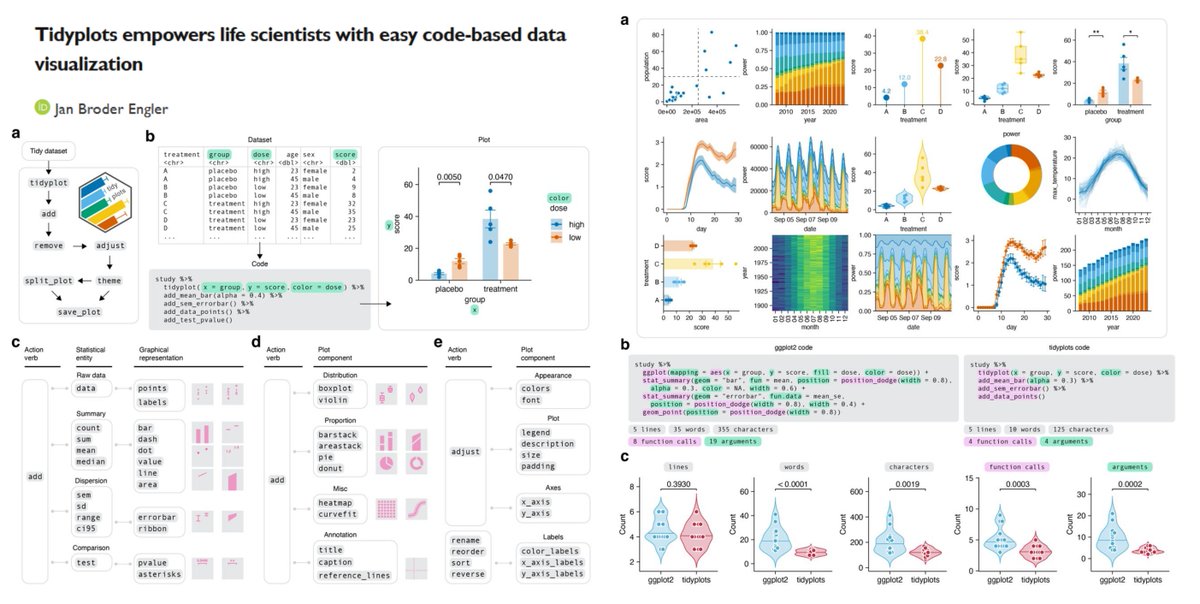
tidyplots
Time to say goodbye to ggplot2?🫡
"a significant reduction of code complexity" vs ggplot2
https://t.co/6wKFnRrjMn
@JanBroderEngler bioRxiv 2024
https://t.co/rqvyMsj5JK
It’s out! Discover how plant domestication shapes endophytic bacterial communities in Cannabis seeds and its potential for microbiome-assisted crop improvement and sustainable production. 🌱🔬 https://t.co/2WKFInw7aH @TomiSci1@GBerg_ubt@jmachadofreitas@IsabellaKogl@tugraz
📢New preprint on the recovery of plant beneficial Helotiales from plant roots
https://t.co/2ZRalMAqZv
Long story short:
👉Medium = not so important
👉BUT need to screen A LOOOOT of colonies 🧐
~ 2K to get ~600 isolates of interest (300 Helo)🧫‼️
Work by Pauline! @ecomicrolyon
Excited to share our paper in @TrendsMicrobiol
This piece is not about microbes but about very critical aspects of academia:
“From advisors to mentors: fostering supportive mentorship in academia”
https://t.co/ETUpLi5xZR
#mentoring#phdlife#AcademicChatter
The @EcogenLab is searching for 3! PostDocs to join us in the PATHOCOM ERCSyg project in Toulouse, investigating the impact of host and microbial genetics on plant pathogen-pathogen interactions. The links to apply are below. Deadline 29th of Nov!!
I've just explored the brand-new tidyplots package in R, and it’s impressive how effortlessly it enables you to create beautiful, publication-ready plots. Designed with scientific papers in mind, tidyplots lets you build, adjust, and refine plot components gradually, all with a consistent and intuitive syntax that takes the complexity out of visualization.
✔️ Simple Syntax: Tidyplots offers user-friendly functions for creating polished visuals with minimal coding, saving you time and effort.
✔️ Consistent Style: Achieve a cohesive look across all visuals, eliminating the need for repetitive adjustments.
✔️ Flexible Customization: Easily customize colors, labels, and themes to align with your project’s goals, resulting in professional and engaging data displays.
✔️ Enhanced Data Storytelling: Built for clarity, tidyplots helps you convey insights effectively, making your data stand out.
The example visualizations shown here were created by the package author, Jan Broder Engler, and are featured on the tidyplots website: https://t.co/fgIWzxFVZI
#rstats #dataviz #tidyverse
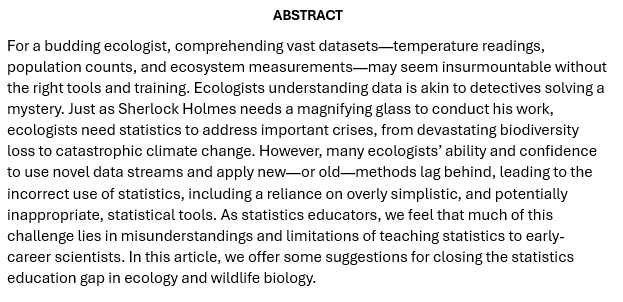
Here are some thoughts on teaching #statistics to non-statistical students, specifically those in #applied#ecology degrees. Thanks to @willpkay and @TiagoALOMarques for an enjoyable (and not last) collaboration.
request pdf here 👉https://t.co/7oDAM68DJG
Our latest work was just published in @ISMEComms
“Biological and experimental factors that define the effectiveness of microbial inoculation on plant traits: a meta-analysis”
Link ⏩ https://t.co/GJqgA7qNdB
#MicrobialEcology#PlantMicrobe
The Nagoya Protocol and its implications for microbiology | this article states currently it is creating considerable hurdles in research. Despite all good intentions-unless deficiencies are addressed, it can severely constrain international collaboration https://t.co/HOQZzMmYtG
Preprint alert!🦠
We introduce a new global microbial trend that parallels established ecological concepts in animals/plants. Closely related taxa share more similar communities- this can be traced back for billions of years in all phyla and environments.
https://t.co/PTUMU9PHtg
Excited to share our Tansley Insight in @NewPhytol! From Synthetic Communities to Synthetic Ecosystems: Exploring Causalities in Plant-Microbe-Environment Interactions! 🌱https://t.co/VvztXmsn7P. Huge thanks to everyone @hacquard_st@HerpellJohannes, @mpipz_cologne
Thread👇