$RKLB: It doesn't happen too often, but when RSI touches 30, this is a screaming buy.
We're there now.
I, for one, view these cheaper prices as a gift.
At $150 I thought the valuation was too high.
Here? A frickin' steal given their recent acquisitions and growth.
And let's not forget Neutron is coming. The sentiment is so poor right now it's like people have forgotten about this.
When RSI and MACD and the squeal of retail coalesce, it tells me I need to buy more RKLB.
It's a recipe that has yet to fail, even in the initial post-SPAC era when it chopped sideways in the single digits with some pops here and there for years.
Could we still see $60 here? Absolutely.
Wouldn't change my thesis and only makes buying more attractive.
High beta has reset after the SpaceX IPO and more Iran war escalations. These too shall pass as the expression goes.
For now, I'm prepared to stay the course.
GLTA and NFA...
People have short memories.
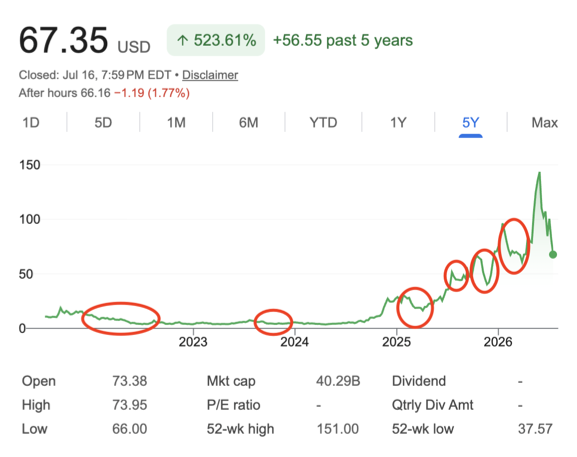
Last November, $RKLB fell ~50%, from around $73 to $37. X was full of posts saying it was over. "It'll never make new ATHs." "Starship will kill the launch market." "Neutron is delayed and will be irrelevant."
About 60 days later, $RKLB was back at all-time highs.
If the stock price is bothering you more than the business itself, you're probably living on borrowed conviction from other people.
An investor should never live on borrowed conviction.
Why panic now that the stock is already down 50%, when the business continues to improve?
Space Systems, which generates ~70% of revenue, is still growing 40-50% YoY. Neutron is closer than it's ever been. A single successful Neutron launch is expected to generate approximately eight times the revenue of an Electron launch.
The Iridium acquisition is a major strategic shift. Around 70-80% of the long-term space economy is expected to come from space services, not launch. $RKLB has officially entered that game.
The space industry itself is still in its infancy. Every time I read about where this industry is headed, I get more excited about its long-term potential.
Does seeing your portfolio get cut in half hurt? Of course it does. I'm not enjoying it either. But that's how growth investing works. Volatility is the admission fee.
If the market is getting to you emotionally, step away from the screen for a while. Spend time with family and friends. These are numbers on a screen. They go up. They go down.
What matters over time is whether the business keeps executing.
Go look at 10-20 year charts of Tesla, Amazon, Microsoft, or Meta. They've all had multiple 50%+ drawdowns. Looking back today, those crashes barely register because the businesses kept compounding.
The hardest companies to own are the ones trying to create entirely new markets. That's also why not everyone gets wealthy investing. It takes research, patience, and conviction to hold through the periods when almost everyone else has given up.
AI and space are still in the early innings. They'll likely go through multiple booms, busts, and bubbles before they mature.
Mature industries rarely produce life-changing returns because their future is already largely priced in. The biggest asymmetric returns usually come from disruptive technologies before they're widely understood.
Commercial aviation created enormous wealth in its early decades. Today, it's a mature industry. Very few people buy airline stocks expecting extraordinary returns.
Space is different.
Reusable rockets are still new. Direct-to-cell satellite connectivity is new. That's just one application. There will likely be hundreds, maybe thousands, of space-based applications that haven't even been imagined yet.
As for today, a pullback after such an aggressive sector-wide run was never surprising. Markets don't move in straight lines. They surge, they cool off, they consolidate, and then eventually they find their next direction.
Following is the 5-year chart of $RKLB, and red circles show a 40-50% drop in stock prices. Imagine if investors had sold there?