🚀 Just shipped BotStop — the first motion-based anti-AI CAPTCHA.
Watch the digits literally carve themselves out of TV static and bounce like a DVD logo.
Bots see only noise. Humans read instantly.
Test it yourself, pause the demo and the code vanishes!
Live demo 👇
@cursor_ai Found a terrible destructive behaviour in Composer 2.5, rejecting the deletion of a file often invokes the model to manually delete the content within it rather than retain the file as is.
Personally I think any prison sentence that is going to result in the prisoners death is a waste of everyone else's resources, a bullet costs less than a dollar.
Then again, prison as a punishment is functionally useless all the same. Strip them of privacy and enforce socially beneficial work operations for those that are to be returned to society, and a bullet for those that are too destructive to be considered irredeemable.
False convictions likewise should propagate like punishment back up the chain of enforcement. Execute an innocent man and the entire lineage of enforcers from judges, lawyers, and police should be scrutinised to find the point of failure and the resultant effect of their actions should be levied upon them.
The same should be the case for lack of enforcement that results in ongoing societal harm, identify the point where enforcement failed and criminalise the offending actors who allow persistently destructive people to return to society.
@VraserX Sometimes the fact that it can't do things is important. The push to action is detrimental to the push to comprehension. These models aren't going to get smarter, just more functional. And the reason for the pivot is due to their creators own intellectual limitations.
@UnforcedAG@EnlightenStS@howie_hua Unlearn it, because it's fundamentally wrong. This is what happens when you let a mathematician smuggle in a rounding error.
I used to be a developer 15 years ago, I can no longer write syntax, the neurons carrying those skills died a long time ago, I however didn't lose my ability to read or interpret code, or my systems and process knowledge.
AI is functionally assisting me to produce an infinite amount of code that I wouldn't otherwise. It's let me reclaim the the ability to develop solutions that I wouldn't be able to without it.
I've also managed to draft the outlines of a book I'd been putting off from source material that if I were to try do myself would have taken me easily 100x the amount of time.
I think that the real 100x'ers are people with significant domain knowledge or skill that has since expired that AI lets return to or exceed their lost abilities by building on the fundamentals they still possess, and those who have significant vision for things they want to accomplish.
If you're working on a singular product as a currently adequate developer, no AI probably isn't enhancing your output that much. There's also a lot to be said about the ability to work longer and more productively with the assistance of cognitive offloading.
I used to be a developer 15 years ago, I can no longer write syntax, the neurons carrying those skills died a long time ago, I however didn't lose my ability to read or interpret code, or my systems and process knowledge.
AI is functionally assisting me to produce an infinite amount of code that I wouldn't otherwise. It's let me reclaim the the ability to develop solutions that I wouldn't be able to without it.
I've also managed to draft the outlines of a book I'd been putting off from source material that if I were to try do myself would have taken me easily 100x the amount of time.
I think that the real 100x'ers are people with significant domain knowledge or skill that has since expired that AI lets return to or exceed their lost abilities by building on the fundamentals they still possess, and those who have significant vision for things they want to accomplish.
If you're working on a singular product as a currently adequate developer, no AI probably isn't enhancing your output that much. There's also a lot to be said about the ability to work longer and more productively with the assistance of cognitive offloading.
Ever have those days when everything makes you want to burn the whole place to the ground? It's been a long while since I've had one, but today is one of those days.
@openai Don't know what you did to 5.5 to make it so utterly useless at file creation and editing, but having it fail to produce some basic fucking LaTeX edits has become a futile process where it fails to use it's own environment, containers and tools.
⚠The Ebola Situation⚠️
Recent news regarding the Ebola situation caught my attention and so I took it upon myself to run some preliminary forecasting in an attempt to predict the outcome of the current DRC outbreak.
The current model assessment is that the Ebola outbreak has moved beyond a clean containment scenario. The control systems that normally break Ebola transmission — contact tracing, trusted isolation, safe burial, protected body handling, and reliable community cooperation — are no longer functioning as the dominant force in the outbreak. Under the current calculation, the outbreak is therefore expected to continue spreading until the social and logistical conditions that support transmission begin to break down under pressure.
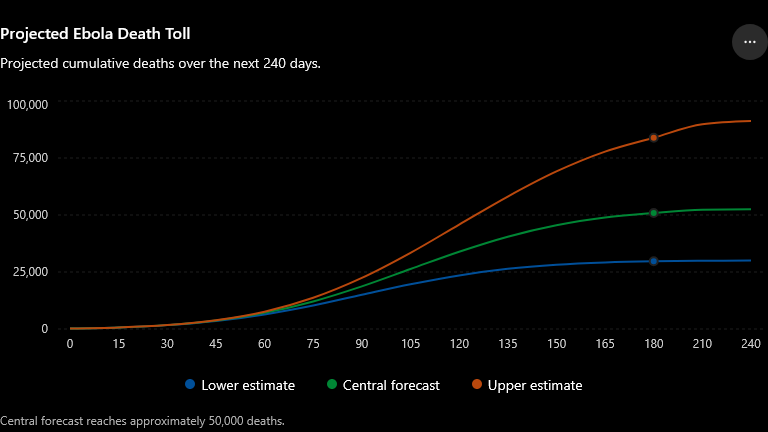
The central forecast is approximately 50,000 total deaths, with a modelled range of 30,000 to 90,000. This estimate comes from the current propagation rate of 0.065 per day, an existing death count of 264, and a projected collapse point around 105 days from the current state. Earlier collapse would produce a much lower total; later collapse would push the outbreak toward the upper end of the range.
The reason the forecast is severe is that Ebola is no longer being stopped mainly by response activity. When contact tracing fails, hidden transmission chains remain active. When isolation is not trusted, sick people remain embedded in household and community networks. When safe burial fails, deaths become further transmission events. When aid workers cannot safely manage bodies or maintain local trust, outside assistance stops functioning as containment and becomes part of the surrounding disorder.
The most likely outcome is therefore not a clean suppression of the outbreak, but a dirty decline caused by environmental breakdown. The virus is expected to slow only after fear, death, disrupted movement, damaged care networks, and exhausted contact chains reduce its ability to keep finding new transmission pathways. In plain terms: the outbreak is likely to burn through the conditions that allow it to spread before it begins to fall.
The current conclusion is that the outbreak is on the high-death path. Unless the failed control systems are rapidly rebuilt into trusted local operations, the model’s best estimate remains approximately 50,000 deaths, with the outbreak turning downward around 105 days from the current state.
The calculation begins with three values:
Existing deaths at calculation start: 264
Estimated growth rate: 0.065 per day
Estimated current daily deaths: 17 per day
The growth rate gives the approximate doubling time:
Doubling time = ln(2) / 0.065
Doubling time = 10.7 days
Daily deaths are then modeled with a rise-and-fall curve:
J(t) = 17 × exp(0.065t − 0.065t² / 2T)
where J(t) is daily deaths, t is days from the current state, and T is the turning point. The turning point is the day when daily deaths stop accelerating and begin declining.
The cumulative death toll is calculated as:
Total deaths = 264 + sum of daily deaths over the projection period
The three tested turning points are 90 days, 105 days, and 120 days.
The forecast is highly sensitive to the turning point. Moving the turning point from day 90 to day 120 increases the peak from about 320 deaths per day to about 850 deaths per day.
The key analytical result is that delay has a non-linear effect. The longer the outbreak continues before the curve turns, the larger the final death toll becomes.