Happy to see our Manufacturing Risk-free Government Debt out in JFE!
We develop a Modigliani-Miller counterpart for govt finance: to manufacture risk-free debt, govt must shift risk onto taxpayers; to insure taxpayers, its debt must carry more risk. Three is no free lunch.
Glad to see this come out in the JPE now. Seems relevant. Joint work with an amazing team: @SVNieuwerburgh , @ProfJiang, Mindy Xiaolan and Z. Chen.
Stijn and I ended up in the same vol. as our adviser T. Sargent who first got us thinking about fiscal issues some 25 years ago!.
https://t.co/aONf28vktt
The value of federal government debt in the U.S. exceeds its fiscal capacity, the expected present discounted value of future primary surpluses. Resolving this puzzle requires violations of transversality, a likely major fiscal correction, or mispricing https://t.co/oZLzCgc5AY
I was recently part of a panel on AI at the AFA, together with @TaniaBabina@andrea_eisfeldt Steve Kaplan, Toby Moskowitz, and Lauren Cohen.
I am around at the 45 minute mark:
https://t.co/NTxR2nLlVc
In the past three years, the largest ten cities lost about 2 million residents, says Columbia Business School professor @SVNieuwerburgh. https://t.co/v7XEgy0OEV
1/Tomorrow marks the end of WW-I on the 11th hour of the 11th day of the 11th month. As a bond investor, using WW-I as a template for Covid, you would have been on target.
Real cumulative returns on all Treasurys plotted below (years on the horizontal axis). **paper coming soon
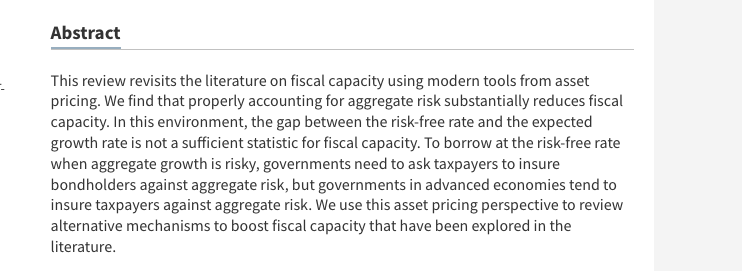
1/The gap between the risk-free rate r and the growth rate g is not a sufficient statistic for fiscal capacity in the real world 👇
https://t.co/ixH3AX5w6y
joint work with @ProfJiang , @MindyXiaolan and @SVNieuwerburgh
📣The secular decline in rates may not have boosted U.S. fiscal capacity as much as you think, but it definitely has exposed the U.S. Treasury to more interest rate risk. 🧵
based on #BPEA piece https://t.co/sSlzg0q9PM
@SVNieuwerburgh@ProfJiang@MindyXiaolan
Interested in international macroeconomics and finance? The website below has all the materials from the Stanford Initiative, a two-day workshop that aims to get PhD students started in research in the field. 1/n
https://t.co/YhRcTKqdaM
A new working paper by @ErnestLiuEcon, @ProfSongMa, and @laura_veldkamp documents characteristics of data markets, explores the potential market power of data monopolists, and explores how consumers fare under different data pricing models. https://t.co/a3xyS98fQV
Last week at #MarkusAcademy we had @StanfordGSB Prof. Chad Jones @ChadJonesEcon to discuss his new paper on A.I.: “The A.I. Dilemma: Growth versus Existential Risk.” A thread with the highlights 👇👇1/5
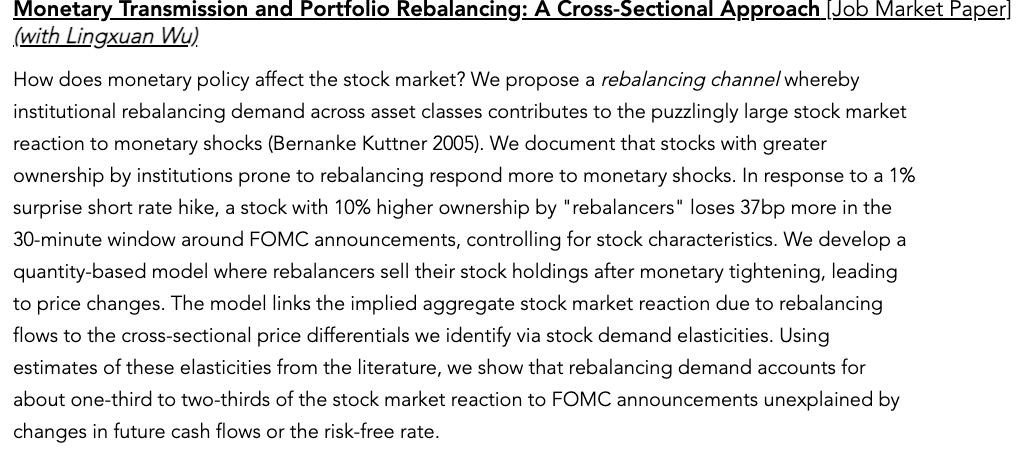
Stanford GSB's @_Xu_Lu 's creative JMP explores implications of inelastic investor demand for monetary policy transmission.
Mechanism: investors who operate under a rebalancing mandate.
When the Fed increases rates and bond prices 📉, re-balancers sell stocks. stocks 📉
1️⃣In 2015, when fiscal-driven inflation was not a popular idea, I was intrigued by fiscal theory of price level and its empirical challenge.
I argued real exchange rate responds to fiscal news, which became my thesis https://t.co/Z0V5s9cXdu and influenced my subsequent works
https://t.co/IobazfF49P
@fang_leon
Many thanks to @nberpubs for featuring our work on inflation hedging properties of major asset classes. We show that separating energy from core inflation is crucial. Yesterday's market reaction to the surprise CPI print is case in point.
1/n